Marrakech

Marrakech from the rooftop bar and terrace of El Fenn hotel
with the minaret of the Kutubiyya Mosque in the distance

David and I were lucky enough to have the chance to attend five nights in Marrakech celebrating the wedding of American friends’ daughter to a Moroccan-American man. As this was a private event, I won’t write or share photos of that except to say our hosts went to extraordinary lengths to ensure their guests had a fabulous time. (And we did!) Instead, I’ll keep this post to a relatively short travelogue, sharing some photos and a few places we really enjoyed. It wasn’t my first time in Marrakech, but it had been some years and there were new places to discover (and a cautionary tale to share).

Around the medina of Marrakech

We stayed in lovely Riad XO with the family of the bride. (A “riad” is a traditional villa surrounding one or more courtyards.) Riad XO is newly remodeled by its French owner and boasts many rooms of varying sizes, multiple courtyards and terraces on several levels. The owner is charming and speaks excellent English in addition to his native French. The location in the medina, or old town, is excellent, just a few minute’s walk to the Ben Youssef Medersa (madrasa), Ben Youssef Mosque, Marrakech Museum, the 12th century Almoravid Koubba dome, and many souks (shops) and restaurants.

Between lots of fun wedding events over our five-nights in Marrakech (a hammam spa morning, camel ride, shopping for traditional wedding attire, dinners, a cocktail party, henna-ing of hands, simple socializing at the riad…), we enjoyed visiting the Jardin Majorelle and exploring the medina. At the suggestion of Riad XO’s owner, we lunched one day at the rooftop Terrasse des Épices restaurant. It was enjoyable, but clearly aimed at tourists willing to splurge as the prices are very high in comparison to other restaurants in the area. Waiters sported big straw hats with the restaurants name to protect from the sun and identical hats were left at the tables for diners. Although Terrasse des Épices occupies a large rooftop space, it didn’t really have the great view we expected since it is surrounded immediately below by barren plots of land and the backs of ramshackle structures. I had the impression from Riad XO’s owner that the Terrasse des Épices overlooked Le Jardin Secret, a restored palace and gardens. It doesn’t, but it is a short walk between the two.

Yves Saint Laurent et Pierre Bergé’s Jardin Majorelle and Berber museum

We actually enjoyed more the tiny rooftop terrace of Les Almoravides restaurant which overlooks the plaza in front of the Ben Youssef Mosque and the Almoravid Koubba. (Google Maps gives the address as J2J6+MX4, Marrakesh 40000, Morocco, although you can just search Google Maps by “Les almoravides”.) The views are great as is the food and the prices are hard to beat. Service is friendly and English and French are spoken. We liked a coffee and pastry break so much that we went back another day for a delicious lunch. The tangines were excellent with “Berber style” offering lots of veggies in addition to (or without) meat (chicken, lamb or beer). In worse weather Les Almoravides also offer charming indoor dining areas on its multiple floors and takeaway from its street-front counter. It’s a casual little place and stairs to the upper floors actually take you past a corner of the compact kitchen. [Note: Several flights of narrow stairs are required to get to the rooftop.]

Looking over the medina of Marrakech: The light tan dome immediately ahead in the thumbnail above is the Almoravid Koubba; immediately to the left is the Ben Youssef Mosque; and, at the far end of the plaza is the Marrakech Museum.

With our on-our-own time limited, we had to choose between visiting the Ben Youssef Medersa and the Marrakech Museum. We opted for the former and enjoyed our unstructured ramble through the restored Islamic school with its many dormitory rooms and decorated corridors around a central courtyard.

Ben Youssef Medersa

Throughout the medina we saw signs of the 2023 earthquake. Collapsed buildings, rubble and cracked and braced towers were common. The medina can be sensory overload: colors, beauty, squalor, history, odors and sounds and a bustling humanity. We enjoyed diving in and we enjoyed finding oases of peace to get a break from it all: Lunching with friends from the wedding at Zeitoun Café before haggling for wedding clothes in the souks, a special dinner with our hosts in the oh-so-different French Quarter at Grand Café de la Poste which felt like something out of the old movie Casablanca. And, of course, there was always the delightful refuge of Riad XO.

View of the Kutubiyya Mosque from Zeitoun Café

That cautionary tale: As we were heading back to Riad XO one afternoon through the maze of of souk-lined streets that make up the medina, one of the shopkeepers who called out to us said we were lucky to be in town for a Berber leather auction and that it was just a couple turns away. I’d seen Moroccan leather tanning in Taroudant and thought it would be fun to see again with David. Another man passing by said he worked there and was heading that way and we could follow him. As this second man strode swiftly through an increasingly long walk, I realized something was off. When I ducked into a courtyard with the stone pits I recognized as inactive leather tanning vats, a local called out to me to ignore that as is was closed, pointing at the man ahead of us who had reached his destination. We followed him down a crumbling alley, squeezing past a laden donkey cart, to come out in an odiferous courtyard of sorts filled with leather-tanning vats. The stench was horrible and our “guide” introduced us to a gap-toothed man who handed us wilted bunches of mint he called “Berber bouquets” for us to hold under our noses to combat the smell. As this man sought to lead us further into a maze of vats, I’d had enough. No way was I getting farther from the main road. I put a hand to my head and another to my stomach, claimed illness, and turned to walk quickly out of this place with David. The gap-toothed man called after us, but we ignored him until we were back on the main road. There, we stopped and he demanded ten dollars for the “tour” and gesturing at a painted sign in Arabic over the alley entrance. David argued with him, telling him we never wanted a tour and we didn’t have dollars, while I upped my feigned illness routine and began to walk off. David finally handed over about $1.70 worth of dirham and turned to follow me as the man complained this wasn’t “fair.” It was a scam from the start with the first shopkeeper and the guy who claimed to work at the leather auction and I should have cut it short sooner. Oh well. We got off with no real damage, a view of leather tanning, and a good reminder to remain vigilent.

We shouldn’t have followed the guy in the “Pink” jacket…
but we did see leather tanning (and cats! :)).

Other wedding guests had brushes with similar scams. One of our group thought a man was helping him get back to the riad, but was led out of his way then confronted by a group of men and asked for $50 when he got near the riad. Our friend pointed out the security cameras above the riad and offered $10 or nothing which the men accepted, calling him “no gentleman.” The name calling would be funny save for the clear intimidation. The bridegroom confirmed that these volunteer guides who lead tourists astray is a common scam in the medina. There is a lot of poverty there brushing up to tourists who seem fabulously wealthy by comparison. I never carried a purse or wore jewelry in the medina save for clearly inexpensive costume pieces and strongly advise the same.

Our time in Marrakech flew by. With our five nights over and the bridal couple happily married in a lovely ceremony, we headed back to the ultra-modern Marrakech Menara Airport for the 3+ hour Royal Air Maroc flight back to Paris. We only had a few nights there before we were off again to visit family in Texas… and experience a total solar eclipse!

Practical info:

Lots of restaurants and souks (shops) take credit cards, but not all do. Multiple ATM’s at the airport did not work for us despite trying multiple cards. We got the local currency (dirham) from a money exchange booth en route to our first stop, the Jardin Majorelle. There are a few ATM’s in the medina, but we were told by the bridegroom that the exchange rate was about the same between live money exchanges (which are much more common) and ATM’s (which don’t always work, as we discovered). We only needed to change money that one time.

As a popular tourist destination, western dress is very common in Marrakech and head coverings for women tourists are totally unnecessary. It is a more modest culture, though, and short shorts and skirts and revealing clothing could be misinterpreted. Wanting to be respectful, I opted for skirts and pants that covered my knees and tops that covered my shoulders.

Stone Town and the Park Hyatt Zanzibar

I booked our last two nights in Zanzibar at the Park Hyatt Zanzibar, a beautiful and historic former mansion set on the water and in the middle of Stone Town (also known as “Mji Mkongwe” which means “old town” in Swahili). Stone Town is the old part of Zanzibar City, the main city of Zanzibar, which sits on the west coast of the island facing the direction of mainland Tanzania.

The architecture and layout of Stone Town reflects the island’s historic ties to Oman as well as a complex fusion of the many cultures that have influenced it over the centuries. Stone Town was the seat of the Sultans of Oman and Zanzibar. Zanzibar became a part of the holdings of the Sultan of Oman in 1698. Around 1840, a later sultan moved his capital from Muscat to Stone Town. In 1856, a struggle over succession divided territories into the Sultanate of Oman and Muscat and a separate Sultanate of Zanzibar which existed until 1964 when the sultan was overthrown in the Zanzibar Revolution.

Throughout its early history, Zanzibar was influenced by the slave trade and the spice trade. Europeans from the United Kingdom and Germany, in particular, as well as Arabs and East Africans from the mainland and South Asian traders left their mark on the island. These influences can be found in the island’s food and language as well as architecture.

As our Zanzitaxi driver navigated the winding streets of Stone Town, we admired the buildings and made note of places to visit. The Freddie Mercury Museum and his adjacent former home (now a hotel) caught our eye and we made sure to walk the three minutes back from the Park Hyatt to check it out.

The Park Hyatt Zanzibar itself is a building to explore and enjoy. It’s lovely but un-air-conditioned lobby reminded me of the Raffles Hotel in Singapore. This old part of the hotel is beautiful and still houses some of the hotel’s best suites (all air-conditioned unlike the common areas), but we were staying in the newer adjoining air-conditioned building.

Older portions of the Park Hyatt Zanzibar

The new building apparently caused some concern, pre-construction, that it would risk Stone Town’s status as a UNESCO Heritage Site. Happily, the architecture blends wonderfully with its surroundings and any controversy seems to have disappeared. My Hyatt points put us in a large street-facing king room. The room was large and stylish, but when I mentioned a relatively minor issue with the room to Reception and asked for it to be dealt with, we were quickly moved to a waterfront room with balcony. Later, the manager sought us out in the dining room to apologize and to make sure we were happy. We were!

Our upgraded waterfront king room with balcony in the Park Hyatt Zanzibar
[Our original city-view room actually had a larger seating area, but the balcony
and waterfront view made the new room truly special.]

Staying at the Park Hyatt Zanzibar allowed us to experience Stone Town in a unique and immersive way. Located in the heart of Stone Town, we were an easy walk away from major sights, a short walk to: the Old Fort (free, but not a lot to see), Forodhani Gardens, the House of Wonders (closed and under repair after a major collapse in December 2020), the Freddie Mercury house and museum, and more.

Around Stone Town (from top left, row by row): Forodhani Gardens, Old Fort walls and passage into old town, “Painters’ Coridoor,” old town street with Freddie Mercury House and Museum to the left, the Old Dispensary, Cape Town Fish Market

We enjoyed a brief, lazy time in and near the Park Hyatt and I don’t claim to be an authority on Stone Town. I did my research, but had no real must-sees there. Boat rides out to Prison Island did not appeal. We’d seen tortoises in the Galápagos, prison ruins didn’t intrigue me, and I really didn’t want to find myself stuck on a small touristy island in the heat and at the mercy of someone else (and marine conditions) to get back to the main island and away from omnipresent beach vendors. With our time in Stone Town limited, I preferred to take advantage of the Park Hyatt, explore the old town surrounding the hotel, and relax. Given the high heat and humidity, we limited our walks around Stone Town in both time and time of day, saw all we cared to, and enjoyed ourselves.

But just exploring the Park Hyatt Zanzibar offered a glimpse of old and new Stone Town. Aside from the lovely building and its courtyards (including one with an artist working on the latest in a collection of canvases near a towering 200-year-old Muyuni mango tree), the Park Hyatt Zanzibar sits on a strip of beach frequented by locals and overlooking clusters of tour boats and the passing of ferries between Zanzibar and mainland Tanzania. We found people- and boat-watching from the hotel terrace and balconies or its pretty little zero-horizon pool endlessly entertaining.

Practical info:

I deliberately chose to end our stay in Zanzibar in Stone Town so that we would be near the airport. I read too many stories of random traffic problems causing hours-long delays when people drove to the airport from other parts of the island. I can’t verify that and we had no issues the day we drove from Nungwi to Stone Town, but I was happy not to have that worry nagging in the back of my mind.

We used Hyatt credit card annual free night certificates plus a point top-up to book a king bed room at the Park Hyatt Zanzibar. This included an impressive breakfast buffet that featured sparkling wine on our last morning (due perhaps to a temporary move that morning due to renovations from the usual dining area).

A short walk from the Park Hyatt, we enjoyed a casual sunset dinner one night at 6° South Zanzibar Grill & Wine Bar.

Nungwi, Zanzibar: resort time on a prime beach

Lone Masai on Nungwi Beach

Nungwi Beach on the northern coast of Zanzibar ranks among the prettiest on the island and is home to many popular resorts, hotels and restaurants. I definitely wanted to spend some of our time in Zanzibar there. Scanning our available hotel points and certificates and local resorts I was happy to find very reasonable award availability at Marriott’s Nungwi Beach Resort by Turaco. Reviews sounded good, the location was great, so I quickly locked in four nights.

Although roads are generally good in Zanzibar, the last half mile or so through the town of Nungwi approaching the resort is a narrow dirt road. Our SUV slowed to a crawl as our Zanzibar driver, Ally, dodged impressive potholes and wove among small shops. We stopped in front of tall gates, checking in with a security guard before proceeding to a large open-air lobby.

Reception provided us with two welcome drinks apiece, a tasty something in a glass and fresh coconuts with straws. There was no way to finish both (and we’d just come from Jambo Spice Farm where we’d eaten plenty and drunk our fill of coconut water) before the bellman was ready to escort us to our room. My award points got us a third floor standard king room with a balcony overlooking the pool and a view of the beach and ocean to our right. The room was spacious and housekeeping had covered not just the bed with hibiscus flowers and leaves, but also the bathroom counter and a low shelving unit under the flat screen tv (a charming process repeated all but one of our four days).

Our standard king room

We loved the room and soon decided the location was ideal as well. Although we faced the pool with its swim-up bar and party music, the pool and bar closed at 7pm, leaving our room blessedly quiet and with a nice view over the lush resort grounds and the ocean. On the other hand, rooms facing the beach are close to dining and entertainment and subject to noise much later than we’d be happy with.

The beach set-up is interesting. Without the natural rise atop which our Uroa hotel sat, this Marriott resort relied on a high retaining wall to protect it from the big tides of Zanzibar. (Get a glimpse of it in the video below.) This set-up meant we spent our beach time in loungers on the sandy “beach” on the resort side of the wall so that when sitting we saw just the heads of passers-by below on the public beach. The wall also provides a security barrier and there was always a guard walking the top of the wall. He wasn’t armed, but he would occasionally intervene to tell vendors peering over the wall to move on which they did without argument.

To get to the warm ocean water, we descended stone steps to the lower beach. A group of young Masai men waited there most hours of the day, offering tours, promoting shops, posing for photos and just visiting. Despite reviews I read complaining about these “beach boys,” we found them to be friendly and not overly persistent. We couldn’t blame them at all for trying to earn a living, especially with the slow rainy season soon approaching. They took “no” for an answer–sometimes after a few attempts at altering their pitch–then were often happy to visit, asking us where we were from, where we’d been in Zanzibar and elsewhere in Africa and what we thought of their homeland. They entertained themselves and us with jumping contests and an occasional song. Accepting tips from passers by, but not asking for anything that I saw. A few local women also offered massages or tours, but again, they accepted a “no” and moved on.

Masai on Nungwi Beach and the retaining wall of the Marriott resort

The big tides I’d been expecting didn’t materialize until our third day in Nungwi. That day the tide was so far out that many boats were left high and dry. Groups of locals harvested the pale green seaweed exposed by the receding water. We were told the seaweed is dried, powdered and used as a seasoning. We walked far out among the tidal pools finding many small crabs and fish and beautiful African red knob sea stars. I love this kind of tidal pool ecosystem and had been looking forward to it. It reminded me of the wonderful tidal pools in Nusa Dua, Bali… but minus the deadly sea critters. [Note: As with most beaches in Zanzibar, water shoes are a good idea. Spiny sea urchins are common, although they weren’t as plentiful in Nungwi as the were in Uroa.]

African red knob sea star in Nungwi shallows
Looking back at Nungwi Beach Resort by Turaco with the tide going out

I couldn’t pass up the chance to see more of the local sea life and arranged a day of scuba diving before we arrived in Nungwi with Dive Point Zanzibar which was recommended by the resort and charged identical prices to every other Zanzibar dive outfit I researched. Dive Point Zanzibar has a small office on the premises of Nungwi Beach Resort by Turaco, but their equipment is at another location nearby in Nungwi. They also have a main office in Matemwe, closer to popular diving and snorkeling off Mnemba Island. Dive Point Zanzibar offered dives at either Mnemba Island (known for larger fish and diving with dolphins, but reported to have mostly dead coral) and off Tumbatu Island (known for its colorful coral and tropical fish). I was inclined to Tumbatu from the start, but learning that it was nearly an hour drive to Matemwe (and an extra $30pp for that drive) to dive Mnemba cemented my thoughts. Being among a flock of boats chasing dolphins in Lovina, Bali, made me leery of seemingly similar descriptions of the diving and snorkeling crowds off Mnemba. And I love a good coral reef!

A driver with a van arrived promptly to pick us up from the lobby of our Marriott resort for the 5-minute ride to the Dive Point Zanzibar Nungwi office. After selecting fins and donning shortie wetsuits, our dive master led us on foot to the beach where our dive boat (a wooden motorized dhow) awaited us. We were joined by two other couples, a young Norwegian couple and a middle-aged Russian couple. We had our dive master to ourselves, though, as the others were either learning to dive or just snorkeling. [Note: Kudos to Dive Point Zanzibar for really nice equipment. New wetsuits (front zipping, too; not the all-too-common boarding shorties with the back zips not meant for divers wearing tanks) and BCD’s, quality masks and well-maintained regs were a pleasure to use.]

It was a 45+-minute ride to the first dive site off of Tumbatu island. Waters in the area can be rough during some periods, but we had the benefit of smooth seas and a gentle breeze. The dive was fairly shallow, around 40 feet. Almost immediately upon descending, we came across two octopuses in full view before darting to hide beneath a coral stand. The rest of the dive treated us to pretty coral and swarms of smaller tropical fish as well as some colorful nudibranches and another octopus, nothing remarkably different from a lot of other dives but enjoyable as diving always is. Visibility was only average, with a lot of bio material suspended in the water. After a snack break provided by Dive Point Zanzibar, we moved to our second dive off the little island just north of Tumbatu. This island is called Mwana Wa Mwana, which means “son of son” (or as our dive master translated it “baby of baby”). Our dive master explained that Tumbatu is known as the child of Zanzibar and this little island is the baby of that bigger island baby. The second dive was similar to the first and ended with enormous schools of colorful fish circling large stands of coral. The diving wasn’t exceptional, but it was good and a great way to spend the day.

Fishing ladies on Nungwi Beach near where we boarded our diving dhow

Prior to booking our trip to Zanzibar, I did a little research–as I always do before our trips–on safety which includes both potential health and crime issues. I’d read that crime, including violent crime, could be a problem in Zanzibar as in much of Africa. It was one of the reasons I opted for drivers rather than renting a car. Although the roads were good, I was particularly happy with this choice after we twice had drivers stopped by police requesting a bribe. Our drivers told us this was normal saying with a laugh that “This is Africa!”, but it could have been intimidating if we’d been on our own and dealing with language issues. I read particular warnings about crime along the beaches stretching from Nungwi to Kendwa stating that there had been violent muggings there. Warnings said not to walk the beach at night. Despite this, we saw quite a few tourists walking along the beach to the many restaurants and hotels near Nungwi Beach Resort by Turaco. We walked along the beach a fair ways ourselves during the day and I don’t think I’d have too many concerns about it in the early evening when lots of people are out. That said, we ended up being lazy and eating at our hotel as we’d done in Uroa. The food was good and the beachfront location of the Fisherman’s Grill restaurant was beautiful and especially spectacular at sunset. We learned to come early to grab one of those waterfront tables. Our room included a large buffet breakfast (even though when I booked with Marriott points the site said breakfast wasn’t included) and we opted to just pay à la carte for lunches and dinners. We just don’t eat or drink enough to justify the all-inclusive price and we found our total bill for lunches and dinners to be reasonably priced.

Sunset view from Fisherman’s Grill with one of the nightly soccer games that spring up along Zanzibar beaches as the sun and temperature drop.

The only issue we had during our stay at Marriott’s Nungwi Beach Resort by Turaco was an air conditioner that dripped water onto the floor between our entry area and the bedroom. Maintenance took a day to get it fixed, but it wasn’t a big deal. Nevertheless, the receptionist when we checked out apologized profusely and offered to buy us drinks to make up for it. We’d just had drinks and a light lunch at the bar and our Zanzitaxi ride was arriving so I half-jokingly suggested she could comp the drinks we’d just had. She jumped on the idea and comped us not only the drinks, but also our lunch then took off a discount from one of our earlier meals. More than generous. We left the Nungwi Beach Resort by Marriott extremely happy customers!

A Zanzibar Spice Farm en route from Uroa to Nungwi

After four nights at a boutique hotel on Uroa Beach on the east coast of Zanzibar, it was time to move to a resort hotel on Zanzibar’s popular north coast. The drive looked to be over an hour, but that still left us with some time to kill between check-out in Uroa and check-in in Nungwi. I knew I wanted to visit a Zanzibar spice farm and lots of spice farm tours are offered out of Stone Town, but with only two nights planned in Stone Town, I didn’t want to spend our one full day there on a tour. This moving day between two hotels seemed like the perfect opportunity to fit in a spice farm tour and lunch en route. When I asked Zanzitaxi to add the stop to our transfer, they suggested Jambo Spice Farm and we made plans. (“Jambo jambo!” is a familiar greeting in Swahili meaning hello.)

Most spice farms in Zanzibar are north of Stone Town which sits on the west coast of the main island of Zanzibar. This meant a detour from the most direct route between Uroa and Nungwi, but that was no big deal. F-Zeen Boutique Hotel offered us a late check-out (11am instead of 10am) so we arrived at Jambo Spice Farm right around noon.

Our guide introduced himself as “Mohammed or Mr. Schneider.” When I asked him which he preferred, he said “Mr. Schneider.” He introduced his young assistant as “Mr. Capuccino.” Well, OK. Swahili names can be tricky for foreigners so I guess this was their solution and we went with it. Mr. Schneider turned out to be very knowledgeable having focused on Chemistry, Physics and Biology at university. His English was very functional, but he said he was even more fluent in German, a language he loved and a country to which he had once traveled.

Jambo “Spice Farm,” apparently like the other spice farms offering tours in Zanzibar, is really more of a place to view lots of spices in an easily walkable, relatively compact area. I knew this going in and wasn’t surprised that we weren’t walking through cultivated fields or orchards. I didn’t realize, however, how the tour area was located in the middle of a village residential area and it was fun to see groups of uniformed school children cutting through the “spice farm” paths, apparently walking home for lunch.

Lots of the spices on display are not native to Zanzibar, but are grown there. Spices are one of the three main industries in Zanzibar along with raffia and tourism. Mr. Schneider recited the culinary and medicinal uses of the plants as young Mr. Capuccino cut pods or roots, peeled bark and the like. We strolled beneath trees, seeking shade in the heat, from spice plant to spice plant. We saw and tasted cardamom, vanilla, cinnamon, nutmeg (with its red ribbons of mace) and more. We tasted parts of the plants we hadn’t before, sometimes surprised by the unexpected flavors or smells. For example, the root of the cinnamon tree smells like Vicks VapoRub(!) and is used similarly. The tour was interesting and fun.

Mr. Capuccino wove palm and flower adornments for us as we walked: a bracelet, a necklace, a ring, two crowns. A vendor offered soaps and perfumes from a small table, but we declined. A man climbed a palm tree singing as we drank coconut water from a freshly cut coconut and ate slabs of gelatinous fresh coconut meat. Lunch was generous and cooked in front of us: rice, chicken, plantains, delicious local stewed greens. We were offered samples of something like 7 or 8 different fresh fruits: pineapple, papaya, passion fruit, orange, watermelon, guava, canteloupe… Finally, Mr. Schneider led us to a very basic outdoor “spice shop” where we bought packets of spices at reasonable prices. I’d read some complaints about tipping, but we went prepared with small bills and, honestly, the tips were nothing to us and meant a lot to the people we tipped. We tipped Mr. Schneider and gave small tips to Mr. Capuccino, the guy who climbed the palm tree, and the fruit man. Everyone seemed happy.

The whole visit to Jambo Spice Farm including lunch took about an hour and a half. Ally, the friendly owner of Zanzitaxi and our driver for the day waited nearby while we toured with a blessedly air-conditioned van. Jambo Spice Farm was a fun stop and the perfect way to break up and draw out our transfer from Uroa to Nungwi. Note: It was hot even in the shade so dress accordingly. Also, while we saw no mosquitoes, I understand they can be an issue after the rainy season, so insect repellent may be essential depending on the season, especially considering the potential malaria risk.

Uroa, Zanzibar

View from our porch at F-Zeen Boutique Hotel in Uroa, Zanzibar

After some weeks of gray and cold Paris, I was ready for sunshine and warmth. Unfortunately, the Mediterranean is still too cold for me this time of year so I started looking further afield. I eyed Cape Verde (Cap Vert) but found flights less-than-convient. A couple of stunning photos of Zanzibar beaches caught my eye, further research piqued my easily-piqued curiosity, and when I discovered I could book us reasonably-priced award flights in Qatar Airways business class with an overnight layover in Doha, I was all in.

Zanzibar is the name for both a multi-island “state” of Tanzania and a name for the main island of that state. Stone Town, Zanzibar, is about an hour ferry ride to Dar es Salaam on the mainland of Tanzania. Although Tanzania is primarily Christian, Zanzibar is Muslim and was the former home of the Sultans of Oman and Zanzibar. The Omani influence on architecture can be seen throughout historic Stone Town. Zanzibar is known for spices and was a former hub of the slave trade. Its Swahili culture reflects the influences of Africa, Europe and the Middle East. Swahili is the main language, but at least some English is widely spoken.

After reading that driving across Zanzibar is subject to the vagaries of weather and traffic, I decided to break up a 10-night stay into 4 nights on the east coast (beautiful beaches and smaller hotels), 4 nights on the north coast (more beautiful beaches and bigger resorts) and 2 nights in Stone Town (historic and closest to the airport).

A quick search through our available points and free-night certificates yielded happy results: in addition to flying on miles and using a free night certificate at the Intercontinental West Bay in Doha, we could book a well-rated Marriott resort in northern Nungwi with points and two nights at the premier and historic Park Hyatt Zanzibar with certificates and points. This left us with only the 4 nights on the east coast to pay for in cash. This trip was clearly meant to happen!

I settled on the F-Zeen Boutique Hotel (formerly Tamarind Beach Hotel) in Uroa for our first four nights on the east coast of the main island of Zanzibar. F-Zeen consists of a number of oceanfront traditional-style, thatched-roofed, air-conditioned cottages (both one-story duplexes and two story quads) and a number of un-air-conditioned (but still pretty) cottages further back from the water behind a swimming pool. Air-conditioning is essential for us and I chose one of their best waterfront cottages.

Our Zanzitaxi driver was waiting as promised at the airport near Stone Town. When he started driving south instead of straight east towards Uroa (per Google Maps on my phone), he explained that the usual route was blocked due to the funeral procession of a former president of Tanzania who’d been a native of Zanzibar. Fortunately, the detour took us along nice roads and we arrived at F-Zeen Boutique Hotel after about an hour.

Side view from our porch of F-Zeen pool, grounds, and beach

We were greeted by a friendly hostess, a welcome drink, and two sleeping cats on the small sofas in an outdoor area that serves as a small lobby. We were led to the cottage the farthest to our left along the oceanfront. Although pretty enough, I wasn’t thrilled with the location just beside a neighboring small bar where dogs barked and music played. Happily, our hostess found us a short time later on the beach, to offer us a choice between two other rooms and we quickly settled on an upstairs unit (Room 22) with big windows on two sides and a large porch facing the beach a few steps away. The bedroom was lovely and spacious, only lacking much in the way of storage space. Mosquito netting could close off the sleeping area from the front door and a small vanity area and bathroom although we saw no mosquitoes while there.* The bathroom was basic with a curved rebar creating a shower curtain. We lost power a few times, but never for more than ten minutes. It is Africa and Zanzibar is a poor island, so this wasn’t unexpected and not a problem.

Our four nights at F-Zeen passed quickly although we spent most of our time lounging on the beach, swimming in the wonderfully warm water of the ocean and the pool, and walking along the beach. I’d chosen Uroa Beach after reading that it was more laid back than Nungwi and that we wouldn’t be plagued by beach peddlers. This turned out to be accurate, although occasional Masai passed by offering sandals for sale and a few women offered massages. They did not press when we declined and left us in peace. More often, we saw locals going about their business, women passing with bundles of sticks on their heads, children playing, men wade fishing with seine nets.

We brought masks and snorkels, but there wasn’t much to see near the shore and the water is very shallow. Fine sand makes the beach a pleasure despite scattered seaweed, but there are spiny urchins further out and we were glad we brought water shoes. Zanzibar is known for big tides and the water recedes a fair amount for periods of the day. F-Zeen Boutique Hotel sits atop a sandy rise that forms a natural barrier to the sea although the water never came all the way to this slope while we were there. It made for a nicer beach than some of the hotels we walked to that either sat much further back from the ocean, narrow strips of beach or had rocky barriers between them and the water.

Our room included breakfast which was served buffet-style in an open-air dining room. We absolutely loved the selection of fresh tropical fruits, and I became a passion fruit junkie. We planned to try some of the little independent and hotel restaurants we saw on our beach walks, but ended up taking all our meals at F-Zeen. The food was good local fare if not gourmet and it was just too easy to walk the short distance to the dining room. Friendly and cheerful staff sealed the deal.

We wanted to visit Jozani Forest before we moved to our second hotel on the north shore, much farther away from the forest. F-Zeen was happy to arrange a driver and guide. The drive was just under an hour and well worth our time. We loved wandering under the trees as Zanzibar red colobos monkeys (only native to Zanzibar) and blue (Sykes’) monkeys moved in the trees above us, groomed babies, fed on ripe guava that littered the forest floor, and generally went about their lives totally unconcerned about the humans among them.

https://youtube.com/shorts/1SFb2JZk-GI?feature=share

All-in-all, we really enjoyed our laid-back start to Zanzibar at Uroa Beach and F-Zeen Boutique Hotel.

______________

*Although we saw no mosquitoes, Zanzibar is still a known malaria zone so we got prescriptions pre-travel and were taking anti-malarial medicine before, during and for a week after our trip. We probably saw no mosquitoes because we were in Zanzibar just before the main rainy season (which usually begins late March). However, many people mentioned how bad the mosquitoes can get after the rainy season and anyone planning to travel there should educate themselves and take appropriate precautions.

South Africa finale: A gorgeous hotel in a former Constantia vineyard

Although the room we stayed in listed online at over $700/night, our stay at The Cellars-Hohenort was completely free thanks to Hyatt credit card “annual” certificates which David had accumulated over the pandemic as Hyatt and other hotel chains extended the validity of such certificates during the worldwide shut-down. (We used my three certificates for our stay at The Marine Hermanus.) The Cellars-Hohenort is part of the Liz McGrath collection of three 5-star hotels which, along with The Marine Hermanus, had just come under the Hyatt umbrella. We couldn’t have been happier with this use of the certificates!

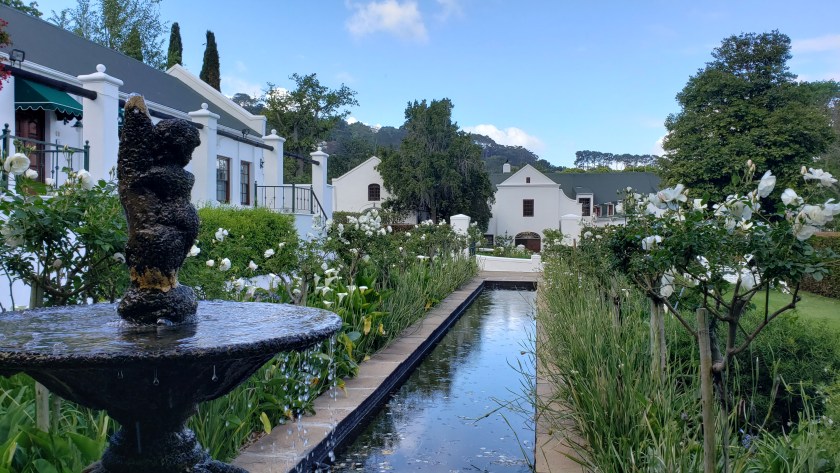
Magnificent camphor trees and other idyllic spots on the grounds of The Cellars-Hohenort

The Cellars-Hohenort is housed in several gleaming white, traditional-style buildings of a former winery. The hotel sits on grounds that could rival any botanical garden with flower beds, fountains, ponds, a small vineyard and a stand of immense 272-year old Camphor trees (planted in 1760). We loved exploring the grounds and ate every breakfast enjoying the view of Table Mountain.

View from our indoor breakfast table. The weather was so nice
we moved outside for our last two mornings

Due to our Hyatt status, the Cellars-Hohenort comped us our “continental breakfast,” an ample spread that went beyond the usual. This is a perk they probably weren’t obliged to offer during a free stay and really added to the value of our certificates. We ate dinner twice in their excellent restaurant, too. We charged to the room then paid at check-out with a Hyatt credit card so that we earned 9x the points for those expenses. (The bonus points did not automatically show on my statement, probably because of the affiliate-status of the Liz MacGrath hotels, but a call to Hyatt had those extra points quickly added to my account.)

More of The Cellars-Hohenort

The Cellars-Hohenort could not be more conveniently located for wine tasting in the Constantia region. We made stops at Klein Constantia, Eagles’ Nest and Constantia Glen, the furthest from our hotel being a 12-minute drive away. The wines were all good and we really loved the views from the pretty terrace dining area at Constantia Glen. Eagle’s Nest was particularly family-friendly with children playing around picnic tables scattered around a back lawn.

We spent our last full day wandering the spectacular Kirstenbosch National Botanical Garden, a mere 6-minute drive from The Cellars-Hohenort. The Kirstenbosch website justly boasts “Kirstenbosch National Botanical Garden is acclaimed as one of the great botanic gardens of the world. Few gardens can match the sheer grandeur of the setting of Kirstenbosch, against the eastern slopes of Cape Town’s Table Mountain.” I could do a post just on the garden, but enough for now. Suffice it to say, we loved it, it’s more than worth the trip, and the on-site restaurant moyo Kirstenbosch is delightful, too, especially if you can snag a table outside on a gorgeous day.

Kirstenbosch National Botanical Garden, founded in 1913

Although we felt far from the bustle of Cape Town proper, it’s only an easy <25-minute drive from The Cellars-Hohenort to the Cape Town airport. We did leave a little earlier than necessary to avoid rush hour, though, on the advice of the hotel.

An Afrikaner ostrich farm

Skeiding ostriches were as curious about us as we were about them.

I’m behind on blogging having been distracted by the holidays and then the heartbreaking last weeks with my beloved, nearly 18-year old dog, so am finishing up the end of our South Africa trip while on a transAtlantic cruise from Florida back to Europe. I’ll keep it brief, but I hated to let two favorite South African stays (and a pair of awesome Qatar Airways Qsuites flights home) go unreported.

Looking for something different after our time driving South Africa’s Garden Route, I was intrigued to find Skeiding Guest Farm, billed as a working ostrich farm. How fun!) Turning inland from the Garden Route, the drive to Skeiding took us through dramatic mountain passes into the Little Karoo, a rugged high plains area. We stopped for lunch at a funky little roadside café and gift shop called Bella de Karoo and descended back through the mountains to the ostrich farm at the end of some miles of unpaved road. (Bella de Karoo apparently has guest rooms elsewhere, but we didn’t check those out.)

The main house at Skeiding Guest Farm where meals are served.

Skeiding Guest Farm is run by a married couple, Neels and Anné-Lize, who both trace their ancestry back to the earliest Afrikaner settlers. Skeiding is a working farm on 1200 hectares (appx. 2965 acres). We were met at the main house by Neels who checked us in and showed us to our charming cottage with its big covered patio overlooking a sweeping vista. After settling on a dinner time, David and I headed out to hike the farm (a working ranch as well as a farm), accompanied by Clara, the friendly doberman.

Skeiding farm (clockwise from top): views of the Langeberg Mountains, a curious ostrich, view from the living room of our cottage, and hiking with Clara the doberman

On this first ramble, we saw lots of sheep, but no ostriches. We also marveled at the local birds, particularly the brilliant yellow and red weaver birds who flitted back and forth among their woven nests that dangle like straw Christmas ornaments from so many African trees.

Brilliantly colored weaver birds

We found the farm’s flock of ostriches on a later hike, laughing as the big-eyed creatures at first ran from us, then approached, looking for treats. Neels told us he’d greatly reduced the flock as selling meat became a money-losing business due to international restrictions following an outbreak of bird disease in Africa. He now mostly keeps the ostriches for guests and to sell their eggs to race horse breeders who use them for feed to enhance the horses’ coats and general health.

Neels at the braai and an excellent dinner

Food at Skeiding Guest Farm deserves a special mention as it was abundant and outstanding. Anné-Lize is the main cook while Neels is in charge of the indoor braai (barbecue). We opted for ostrich steaks, of course, which Neels barbecued to perfection in front of us. The rest of the meal, accompanied by local wine, was equally delicious. The next morning revealed an extensive spread of a dozen cheeses(!), picture-perfect fruit plates, and cooked-to-order scrambled ostrich eggs. More food that we needed, but we enjoyed every bit of it!

A breakfast feast

South Africa: The Garden Route

The Indian Ocean at The Heads, Knysna, South Africa

The famed Garden Route along the southern coast of the Western Cape of South Africa stretches from Mossel Bay to Storms River. I’d planned our first two nights officially on the Garden Route at an AirBnB apartment in Mossel Bay. The drive from Hermanus was just under 3 ½ hours along an inland stretch of the N2 highway. It wasn’t the gorgeous coastline we’d enjoyed en route from Cape Town to Hermanus via the Cape Peninsula, but it had had its own rugged vastness with mountains looming beyond plains off to our left. We loved a lunch stop at Ou Meul Bakkery in Riviersonderend where kudu venison meat pies and sweet pastries were delicious and cheap.

Our AirBnB apartment in Mossel Bay was on an upper floor of an oceanfront complex with a wall of glass overlooking the water from the enclosed balcony where we ate breakfast. Our hostess had said whales and dolphins could be sighted from the window, but we didn’t see any, which was a bit of a let-down after non-stop whales in Hermanus. We took long strolls along the wide, nearly deserted beach both days we stayed in Mossel Bay. It seems there’s not a lot to do in the town in the off-season.

View from our Mossel Bay AirBnB apartment

A casual waterfront restaurant (Delfino’s) recommended by our hostess served uninspired food in a nothing-special atmosphere. It wasn’t horrible, but not a stellar start. A sea of small campers and tents parked next to the restaurant parking lot; I guessed them to be the local version of the “snow birds” that frequent my home state of Texas in the winter. We found a better dinner option on our own at pretty Café Gannet the second night, and really enjoyed it. I just wish we’d found it sooner and worked in time to try the picturesque make-your-own-gin micro distillery on their premises. Still, we were left looking for much to do in the cool spring weather. We watched waves crashing near a zip line that dropped to the shore from a peak where a lighthouse overlooked the waterfront, but no one braved dipping through the icy spray. We tried Big Joe’s, a local franchise meat pie shop whose gravy-filled meat pies couldn’t hold a candle to the meat-packed kudu venison pies at Ou Meul. We wandered a bit on the local main street. Hmm. After all the build-up for the Garden Route, our first stop wasn’t stacking up to charming Hermanus nor the spectacular views around the Cape Peninsula. We were looking forward to moving into the heart of the Garden Route. Hopefully, we’d see what all the fuss was about.

The beach is wide and beautiful at Mossel Bay, but this pic is a reminder that security is always an issue in South Africa. We enjoyed the freedom of driving ourselves and exploring, but we remained extra vigilant and barbed wire, warnings of “armed response,” guards, etc. are the norm.

I’d booked a guest house in Knysna (“nize-nuh”), but the drive was less than 1 ½ hours, so we decided to drive on past another 50 min, to the Bloukrans Bridge before coming back to check in. This would put us near to the far east side of the Garden Route so we’d see most of it before we settled in at centrally-located Knysna. The drive did give us some lovely views of the coast, as promised. Was it prettier than the Cape Peninsula? Not really.

The Bloukrans Bridge boasts the “highest commercial bungee jumping site in the world,” and it’s pretty spectacular, whatever its current ranking. Neither David or I had any interest in jumping, but it was fun to see. (If you are interested in jumping, learn more here.) We enjoyed lunch at a picnic table overlooking the bridge, feeling a little bad about the empty main building and vendors with wares set out for no one but us (and we weren’t interested). Tourism was clearly taking a big hit due to the pandemic. One other couple arrived while we were there, also Americans, but that was it. Entrance to the Tsitsikamma viewing area is free; we were just stopped at an entrance booth where we gave our names for some unknown reason. No one stopped us on the way out and the booth seemed deserted.

Bloukrans Bridge

After navigating a steep road and a dicey uphill turn-in through a quick-closing electric gate, we found our Knysna guest house to be all we’d hoped for. Perched on a slope overlooking the Knysna “Lagoon” (an estuary) and The Heads (headlands opening onto the Indian Ocean), the house was beautiful and clean, our hostess welcoming and very chatty. We loved our room with two walls of windows and a nice balcony offering that gorgeous view.

Our Knysna guest house balcony with view of the Lagoon and The Heads

We soon learned that the estuary fills and drains each day and it was fascinating to watch shallow islands emerge and retreat. Birds flocked to the islands to feed. We rented a canoe one day and paddled out to one of the islands. The Steenbok Nature Reserve on Leisure Island provided more (free) bird watching and a nice walk along the water with lots of local dog owners. A short drive to The Heads offered spectacular views from the East Head overlooks, some jutting over the cliff edges facing the Indian Ocean. East Head Café is a real treat with outdoor seating overlooking the pass between The Heads. We enjoyed local craft beer at Red Bridge Brewing Co. and toasted our last night in Knysna with champagne and local oysters waterside at Drydock.

Summing up the Garden Route for us: We enjoyed our four nights on the Garden Route, but in hindsight, we would have skipped Mossel Bay altogether and gone straight to Knysna. (We’d spend those two nights in the Stellenbosch wine region instead.) If you’re looking for beach time and the weather is warm, I’m sure Mossel Bay is fun, especially for families with kids, but we’ve got lots of warm beaches at home and we weren’t in South Africa for that, even if we’d been there in summer. Also, I’d debated between Knysna and Plettenberg Bay, and am glad I chose Knysna. It’s bigger (appx. 70,000 pop. vs. PB’s 19,000) and just had more to offer us.

Tip: I found canoe and kayak rentals in a tourist brochure and debated booking via the website listed there, but decided to just drive to the physical site first. (Located at Kalaideskoop on Thesen Island, across from the Gastropub, despite the brochure putting it at restaurant Sirocco) The price was substantially less on-site than what I saw in the tourist brochure at a purported “discount”. This may have been partially due to the depressed tourism due to Covid-19, but just FYI.

Up next: An Afrikaner ostrich farm!

Hermanus, South Africa: coastal charm, whales and wine

Hermanus, South Africa

Six free-annual-night Hyatt certificates first put Hermanus, South Africa, on my radar screen. David and I each had accumulated lots of hotel certificates over the pandemic and we each had three Hyatt nights that we needed to use. We get one certificate/year with certain credit cards and, although they usually expire within a year, Hyatt had extended the expiration due to the pandemic. This created a great opportunity to use those certificates for an extended stay. We often use these certificates for a 2-night stay, using each of our 1-night certificates, then calling the hotel to make sure we can stay in the same room, rather than checking out and then in again as the booking switches from one of our names to the other. So, we could have lumped our nights together for a 6-night free stay somewhere, but that really didn’t suit our plans on this trip.

With travel so restricted due to the pandemic, a lot of the usual best-use locations (like Asia) were closed to us. When the idea of a trip to Africa started to come together, I searched Kenya and South Africa for interesting-looking Hyatts. As luck would have it, Hyatt had just added three new Small Luxury Hotels (SLH) to its lineup in South Africa and two of them fell under the eligibility requirements for our certificates. (The certificates are good for hotels in Hyatt Categories 1-4. The idea is to use the certificate for the poshest Category 4 available in order to maximize the value of the certificate.) I decided to use my three certificates at The Marine Hermanus. What a great find that turned out to be!

We arrived just after dark at The Marine after our day exploring the Cape Peninsula. After a quick stop at the guard post, we were let into the gated parking lot and shown to the registration desk. The welcome was very friendly and, after confirming we were hungry, we were promised a table would be waiting in the dining room as soon as we settled into our room. I had reserved a standard king room and it was charming. On the side of the building facing away from the town of Hermanus, we had a very oblique view of the water, I think. It was dark and morning would tell. Or so I thought. After a quick wash-up, I went to put our valuables into the safe and discovered it to be old and not functioning. Oh well, I wasn’t overly concerned, but did want to lock things up so mentioned it to the man at Reception on our way to dinner. Midway through an excellent meal, he arrived, apologizing again and saying he was moving us to a suite and would escort us there with our luggage as soon as we were finished with dinner. Well, that called for a toast!

The Marine Hermanus

The suite turned out to be enormous, easily three times the size of our original, comfortably-sized room. Our new digs had a king-sized bed, sofa and coffee table, small dining table and two chairs, a minifridge stocked with free beer, soft drinks and snacks under the tv, a vanity, and enough open space for a rousing game of ping-pong. The bathroom sported a huge shower, a massive tub, a toilet, and three(!) sinks. To top it all off, we had one of the few balconies in the vintage hotel, and the biggest one at that. Our balcony sat atop the covered entrance to the hotel so, straight ahead, we looked down the street towards downtown Hermanus. The bay was just to the left, but since our balcony was so big we had a table and chairs and lots of room. Once the sun was up (and rain showers cleared), we could sit outside and watch whales any time of the day! [An internet search showed this suite was running about $560/night at the time, making this stay an excellent use of my Hyatt certificates.]

It’s always fun to survey your new surroundings after arriving in the dark. Morning revealed to us a picture-perfect waterside town with a paved walk meandering along the cliffs. The weather proved to be fickle, changing quickly from sunny with scattered clouds to squalls that moved through quickly. We nevertheless set out for a walk along the cliffs to the main town pier. We spied our first whales in no time and had fun watching them until the weather drove us to shelter. We explored semi-sheltered booths of local items for sale then moved on to indoor shops as rain came down in earnest. Our first day in Hermanus continued like that with us moving in and out-of-doors as the weather dictated. Fortunately, the town is small and The Marine was in easy walking distance. Our spacious suite wasn’t a shabby retreat either!

Whale breaching just off shore by The Marine

In addition to a view of the bay and of the town, we had a view of the modestly-sized parking in front of The Marine. We were impressed to see men washing every car in the lot… and repeating the wash after every frequent shower. Unemployment is high in South Africa and perhaps as a result there seem to be many such service jobs, making us feel very pampered, if a bit uncomfortably so.

Over the three nights we spent in Hermanus, we explored the cliff walk for long stretches in both directions. The cliffs along the town front invariably offered excellent whale watching, with several whales to be seen at almost any time, some very near the land. We saw mother whales with calves, whales breaching, spyhopping and fin waving. It was magical! Wandering past the main town pier we found lots of “dassies” (large brown-furred rodents also known as rock hyraxes) grazing among whimsical sculptures. Rounding a curve in the coastline, the water became less sheltered with big waves breaking on huge rock slabs. Wildflowers and birds, including a pheasant-like Cape Francolin mama with chicks, wandered the wildflower-laden greenery that decorated the upper portion of the rugged coast.

The rugged coast of Hermanus

In addition to two excellent meals at The Marine, we had seafood with a view of the water at Lemonicious and wood-fired pizza at Embers Wood Fired Oven which also offers a surprisingly good selection of Belgian beers, thanks to input from a Belgian couple who retired from their own restaurant in Hermanus a couple of years back. They were in Embers the night we ate there, visiting with the owner, and we were delighted to find they were Antwerpers by origin with a daughter still in school there. On a sunny weekend afternoon, we ate a tasty lunch outside at Pear Tree Bistro with a view of the bay while a talented local musician played with the aid of an amplifier set up beside his van.

The Hemel-en-Aarde Valley (“Heaven and Earth”), a popular and scenic wine region, is located a short drive from Hermanus and we drove one day to a wine tasting at Ataraxia, a pretty winery with a tasting room designed to look like a chapel. We were surprised to find our choice of wineries really limited on a weekend. For some bizarre reason, many of the wineries were either closed entirely on the weekend or only open from 9 or 10am to noon. Who wants wine for breakfast?! It seemed really crazy since it would seem their main source of steady businessduring the on-and-off travel bans due to Covid-19 would be daytrippers from Cape Town, most of whom would be presumably working during the week and free on weekends. In fact, we shared a table at Ataraxia with a group of women doing a girls’ weekend away from husbands and kids. (These ladies were tons of fun and apparently had no problem with breakfast-time drinking.) They told us they thought the weird winery hours were due to the pandemic. I’m not sure how that makes sense, but there you have it.

Ataraxia Winery in the Hemel-en-Aarde Valley

All in all, we loved Hermanus. It’s not a big-event place, but a charming town to pass some days whale-and-wave watching and enjoying the local food and wine. I can’t say enough good things about The Marine or its parent group, The Liz McGrath Collection. We had to call them twice, once to ask to move our reservation at The Marine up a day and another time to advise them of a late arrival. Both times, the phone line was answered immediately by someone eager and able to help. Would that all customer service lines were like that!

South Africa, the Beginning: Cape Town and Cape Peninsula

A final view of Mt. Kilimajaro as we leave Kenya, the Zambezi River just above Victoria Falls
on a refueling stop in Zambia… and Cape Town, South Africa, here we come!

After our Kenya safari, it was time for 15 days/14 nights in South Africa. I wanted to spend the entire time in the Western Cape, exploring Cape Town, driving the famous Garden Route at leisure and doing a little wine tasting. We also wanted to make use of Hyatt anniversary night certificates that had been piling up during the pandemic but that would be expiring before too long. With Hyatt and Small Luxury Hotels having recently added the 3-hotel Liz McGrath boutique hotel chain in South Africa to its lineup, we had a great opportunity to get max value from those certificates.

I booked some hotels well before we left the States: I booked our first few nights in the Hyatt Regency Cape Town. I chose this hotel primarily because it was a very nice and convenient hotel at a ridiculously cheap price (especially with a buy-2-get-1-free member promo Hyatt was offering) and because I was braced for travel uncertainty from Kenya and didn’t really care if we missed a night or two at this hotel. (Uncertainty arose both from Covid issues and Kenya Airways’ reputation for canceling flights.) Then, I booked 3 nights using my Hyatt certificates at The Marine in Hermanus, a gorgeous Liz McGrath hotel on the cliffs of a picturesque coastal town known for great whale watching. Next, I booked our last 3 nights in South Africa at the Cellars-Hohenort (another Liz McGrath hotel) with David’s Hyatt certificates. The Cellars-Hohenort is a former winery located on spectacular grounds in the Constantia wine region and suburb of Cape Town, an easy drive to the airport for our departure flight home.

With these 9 nights booked, we were left with 5 free nights that I decided to leave open until we got to South Africa and could get the lay of the land. I rented a car for the 12 days after our first 3 nights in Cape Town so we were free to roam. I originally had in mind spending all 5 of our unbooked nights on the Garden Route, maybe breaking them up as 2 nights/2 nights/1 night, in some combination thereof. This turned out to be a fine choice as tourism was still way down due to the pandemic and room availability was not an issue.

We ended up staying 2 nights in Mossel Bay at a 2-bedroom/2-bath AirBnB apartment on the beach, 2 nights at a guest house in Knyzna with a balcony overlooking the “lagoon”and “The Heads” (an estuary and headlands opening to the Indian Ocean), and 1 night at a 4000-acre Afrikaaner ostrich farm inland. We really enjoyed our time in South Africa. With hindsight, the only thing I’d change is to skip staying in Mossel Bay and spend those 2 nights in the Stellenboch wine region. I’ll explain why in a later post since I’m going to break up our time in South Africa into several posts.

Cape Town the first time:

We landed at Cape Town Airport early afternoon, bought cheap MTN SIM cards at the airport, and hopped a taxi to the Hyatt Regency Cape Town. (We don’t usually buy SIM cards anymore since switching to T-Mobile, but decided that we wanted to get the best possible coverage because we’d had connectivity issues in Kenya and we planned to be driving long distances on our own in a country with a bit of a history of crime and violence.) I’d made no plans, anticipating a slow first day in Cape Town as we’d been up since 4:30am. So we enjoyed a little downtime before indulging in 2-for-1 local wine and happy hour small plates at nearby Iron Steak Bar. Our friendly young waiter reinforced hotel staff’s recommendation that we not walk around the area after dark, so we headed back to the hotel to later grab an uninspiring dinner and call it an early night.

The Hyatt Regency Cape Town is a very nice hotel with some drawbacks worth noting. First off, it’s located on the edge of the Bo-Kaap District, a neighborhood of colorful Malay-style buildings that makes every list of places-to-visit-in-Cape-Town I’ve seen. The area is definitely distinctive and lends itself to photos, but (on repeated advice) I never stepped out the door with a purse and staff warned us against displaying anything of value or walking after dark. To be fair, I don’t mean to imply that Bo-Kaap is a special case regarding security, our hotel’s warnings applied to strolls in the non-Bo-Kaap direction as well. For that matter, we were warned about walking after dark pretty much everywhere in Cape Town we went save for the V & A Waterfront.

Colorful Malay-style houses in the Bo-Kaap neighborhood

I’d hoped (and kind of expected) the locals would tell me the warnings about crime I’d read before arriving were overblown, but they did the opposite. Without fail, everyone we talked to in Cape Town advised us against walking even a couple of blocks and suggested we take Uber everywhere, which we did. We did walk around some during the day and we saw more than a few questionable characters, but we had only minimal hassles from panhandlers. Still, it wasn’t a great feeling to be so on guard and we missed the miles-long city rambles we love in Europe. Another issue we discovered in Cape Town was the unreliable electricity. Without warning, the power went off one morning and, after waiting thirty minutes for it to come back on, David called the front desk. “It’s load-shedding. Do you know what that is?” No we didn’t, but we do now. Apparently, South Africa has suffered an energy crisis with periodic rolling blackouts since 2007. There’s a handy app called EksomSePush that warns of impending blackouts, but how’s a foreign visitor to know if not told? The Hyatt Regency didn’t bother to tell us when we checked in or to post a notice anywhere of impending 2-hour blackouts. (Blackouts can run up to 8 hours at a stretch depending on the level deemed necessary.) At the Hyatt Regency, power goes off in all the rooms, only staying on via generator in the common areas. Thankfully, I didn’t have soaking wet hair when the power went off, but I can imagine some pretty inconvenient situations. We learned to ask when the next outage was and eventually, I discovered and downloaded that nifty app. More specifically to the Hyatt Regency, its restaurant is rather institutional and does not have a liquor license. It was a good thing we’d already had wine the first night, and with so much on offer in Cape Town, we never considered eating there again.

The Victoria & Alfred (“V & A”) Waterfront is a upscale leisure center of Cape Town. We hopped an Uber there our first full day and enjoyed exploring the shops, food stalls, bars and views of Table Mountain beyond the cluster of docked boats. Tour boats leave from here to Robben Island where Nelson Mandela was imprisoned for 27 years and the Zeitz Museum of Contemporary African Art is housed in an intriguing old silo. We liked the V & A so much, we returned for a second a visit to enjoy an outdoor waterside lunch at the Victoria & Alfred Hotel and a second visit to the African Trading Port. I could spend hours in this huge, multi-story store which offers everything from cheap souvenirs by the bushel to really spectacular (and spectacularly-priced) one-of-a-kind African works of art, ceremonial clothing, religious items, colonial-era goods and big game trophies. There’s a definite museum-quality to many of the items in the jam-packed rooms. [Note: South Africa is taking the pandemic seriously. Masks are required even on the open sidewalks and we saw police at the Waterfront reminding people to put on their masks or pull them up over their nose.]

The V & A Waterfront in Cape Town

A surprise favorite in Cape Town was the old fort known as the Castle of Good Hope. The fort houses so much more than we expected and we ended up spending hours exploring not just the old fortification, but the multiple museums explaining the history of Cape Town with maps and art showing the location of the original waterfront (now moved), reconstructed rooms from the 17- and 1800’s, and memorabilia and photos from pre-Apartheid multi-ethnic neighborhoods Bo-Kaap and District 6 where residents were forcibly evicted and sent to “township” slums. I’d listened to an excellent audiobook on the history of South Africa (“A Rainbow in the Night”) in preparation for this trip and the Castle offered so many images that served as perfect illustrations to the book.

The Castle of Good Hope, a fortress dating back to 1666
and the oldest colonial building in South Africa, houses multiple museums and displays

We really found the city itself to be more of a bar-and-eatery destination, albeit in a spectacular natural location. The ethnic diversity of the city does make the eating and drinking varied and interesting. We enjoyed wine tasting and small plates at Openwine a half block from the Hyatt Regency. Ostrich steaks for dinner at Kloof Street House were delicious and the eclectic Victorian atmosphere date-night-worthy. I’d heard so much about Cape Town and its beautiful setting that I was a little surprised at how few things felt like true must-sees to me. (Of course, this is just my humble opinion. With age and a lot of travel under my belt, I find I’m less inclined to feel pressure to visit a place just because it’s on someone else’s list if I’m just not feeling motivated for whatever reason.) All those lists end up including the Cape Peninsula and daytrips to wine country as part of Cape Town. Tabling the Table Mountain cable car despite the short drive from our hotel and giving Robben Island a pass due to unpredictable weather, we were ready to get out of the city and start our road trip. First up was the Cape Peninsula. I was excited!

The Cape Peninsula: Beautiful beaches, the end of the world, and penguins!

After doing a little research, I’d booked a Budget rental car at a downtown location a 10-minute walk from our hotel. We had the car for 12 days and we’d drop it off at the Cape Town Airport when it was time to fly out. Budget shares the downtown location with Avis and the same people staff the shared counter in a parking garage under a commercial building. Shortly after 10am, we drove our brand new 4-door Toyota Corolla back to the hotel to pick up our luggage and we were off.

We wanted to drive to the Cape of Good Hope at the very tip on the Cape Peninsula. There’s so much to see en route including swanky Camps Bay Beach and Chapman’s Peak Drive, often cited as one of the most beautiful coastal drives in the world. Honestly, all of the driving on the peninsula is pretty spectacular, but the stretch known as Chapman’s Peak Drive clings to some particularly steep mountain walls overlooking the water. This stretch is a toll road and offers plenty of pull-offs to admire the view. This doesn’t particularly discourage local vendors, and we saw several of those set up at the overlooks offering beaded statuettes and other souvenirs.

Starting off on the Cape Peninsula: Camps Bay Beach, Hout Bay,
Chapman’s Peak Drive, and Noordhoek Beach

From Chapman’s Peak we drove past the vast stretch of Nordhoek Beach then turned inland and crossed the peninsula to stop for lunch in Simon’s Town on the east coast. From there, we headed straight for the tip of the peninsula and Cape Point National Park, officially the Cape of Good Hope section of Table Mountain National Park. This meant we passed up one of the things I most wanted to see, the penguin colony at Boulders Beach, but we’d visit the penguins on the return trip north.

The main park road branches with the Cape of Good Hope to the right (west) as you head south. We opted to go there first just because the name was so familiar from childhood history and geography lessons. Clouds scudded by in the stiff breeze, seeming to change the weather from minute to minute. We passed ostriches grazing before parking to clamber over the rocks at the point. When we returned to our car, I found a large mama baboon waiting on my side. Signs warn about baboons everywhere we’ve been in Africa. (We were even told to keep our sliding glass doors in Kenya locked because they would open them and come in.) So when I saw that baboon waiting, I told David I’d get in on his side and climb over (right-side driver car). Just as I settle in, David says the baboon is charging a woman who had her hatchback open. The baboon jumped past her into the car. A family member helped her finally chase it out, but it made off with stolen loot:

Beware the baboons!

At the farthest reaches of the park is the Flying Dutchman Funicular which carries visitors to the new Cape of Good Hope Lighthouse. As with so much on this October trip in the time of Covid-19, we found few cars in the large parking lot and no wait to ride up. The view of this rugged spot where ships have braved the merging of two oceans for centuries really feels like the end of the world.

Cape Point

We timed our arrival at Boulders Beach near to its 6:30pm closing time. (Park hours in South Africa are seasonal, so check before you go.) After leaving the car in a nearly empty lot, we walked across a long and meandering boardwalk to the main entrance to the beach and penguin colony. First alerted by the smell, we found nesting penguins in the sheltering undergrowth all along the boardwalk. After paying the entry fee, the walk widened as it faced the open water and led to a viewing platform on the beach where many dozens of penguins milled about in the sand or swam in the surf. Wonderful! Only a few other people and a family we’d met back at the funicular joined us and we lingered until they left and we had the spot to ourselves. Baby penguins flapped and called for parental attention. A rainbow arched into the ocean. It was magical.

Boulders Penguin Colony

Having shut down Boulders Beach, we headed northward along the eastern coast of the Cape Peninsula then along the southern coast of the mainland towards our next destination, the whale-watching town of Hermanus. As one of our very favorite stays in South Africa, Hermanus and historic clifftop hotel The Marine deserve their own post, so that will be up next.

error: Content is protected !!