Seaside Puglia: Bari, Italy, via Monopoli and Polignano a Mare

Lama Monachile at Polignano a Mare

With our time in our charming trullo in Alberobello at an end, it was time to drive to Bari for a final night before catching a flight back to Paris. We planned to make the most of the day, setting out in the morning to make some highlight stops along the coast en route. I was especially looking forward to Polignano a Mare whose picturesque beach at Lama Monachile features in many enticing photos of Puglia. I’d also read great things about Monopoli, just south of Polignano a Mare, so decided to stop there first.

It’s an easy 30-minute drive from Alberobello to Monopoli, some of it through beautiful olive groves. We stopped to admire a stand of old olive trees bordered by a bank of purple flowers too pretty to pass up.

Olive trees and flowers en route from Alberobello to Monopoli

Reaching Monopoli, we easily found free street parking, harborside, on Via Cala Fontanella near a footpath to Largo Fontanella. (These streets and the Largo Fontanella park are searchable on Google Maps.) As with other daytrips in Puglia, the joy is in just wandering and admiring the beauty of achingly picturesque towns. In Monopoli, this included small, boat-filled harbors as well as paved plazas and pretty narrow streets.

Monopoli

A short 15-minute drive up the coast we arrived at our next stop, Polignano a Mare. We found plenty of open spaces in a public parking lot (free on the day we arrived) and were soon off to explore again. A short walk away brought us to Lama Monachile, a gorgeous small bay and the most photographed spot in Puglia. [Lead photo] We first viewed the iconic beach and bay from atop a Roman era bridge than spans a narrow gorge leading to the bay. Descending to the beach, we found it to be rough and pebbly and full of bathers. We had no intention of swimming and I was glad. As beautiful as it is, Lama Monachile beach isn’t particularly comfortable… and, with the weather in the 70F’s, the water was chilly!

We lunched al fresco on pizza and local beer at Al Buco Preferito Tranquillage just beside the Roman bridge before heading out to explore. In Polignano a Mare, in addition to picturesque streets, churches, shops and cafés, a number of small, dead-end terraces offered clifftop views of the Adriatic. Caves dot the cliffs on which the town’s pale stone buildings perch. Below tour boats and pleasure craft glided through the blue sea. Lovely!

With the afternoon slipping away, we were back on the road for the 30+-minute drive further up the coast to Bari, the capital of Puglia. We had just enough time to drop off our luggage at our hotel then drive the short distance to Bari Centrale train station to drop off our Locauto rent car. From there, we strolled past the fountain in Piazza Aldo Moro, through the Giardini di Piazza Umberto I, and down wide, mostly pedestrian, Via Sparano da Bari back to our hotel. We took our time, joining the bustle of people to peer into high-end shops and eateries along the way.

“Room 56” isn’t really a conventional hotel, but it was pretty perfect for our needs. Located on the seventh floor of a building just off Via Sparano da Bari (800 meters from the train station), this lodging has four modern, immaculately clean en suite rooms with balconies and a communal kitchen where a simple breakfast is provided. All rooms can house three persons and two of them can accommodate four people.

Room 56

On a friend’s recommendation, I’d booked dinner prior to our trip at Urban l’assassineria urbana, a restaurant written up in the New York Times and specializing in the unique Bari dish known as spaghetti assassina or “killer spaghetti.” In an unusual twist, the dried pasta is charred in a skillet with sauce, skipping the usual boiling in water. It ends up in a twisted dark pile on the plate, part chewy part crispy and with an almost barbecued flavor.

Spaghetti assassina

We really enjoyed our spaghetti assassina, but the restaurant itself offered little else that appealed to us (absolutely no fresh veggies or greens, lots fried, an industrial style decor) so we finished our meal more quickly than expected. After an unsuccessful hunt for a dining spot where we could cap off our meal with some veggies, we opted to buy a bag of salad from a grocery store and retire to our balcony for a little post-dinner wine (a gift from our Alberobello host) and salad. Not exactly elegant or what we’d imagined when we set out for dinner, but pleasant nonetheless. [If I had to do it over, I’d probably try more upscale Osteria al Sorso Preferito, the originator of spaghetti assassina, rather than Urban.]

“Room 56″ is a five minute walk to old town (Bari Vecchia) and, with an 8:15pm flight to Paris Orly, we had a full day to spend exploring Bari. Our host agreed to store our luggage for the day and arrange a taxi for an early evening ride to the airport so we were free until early evening. We set off first thing after breakfast for Strada delle Orecchiette, Bari’s famous street named for the ear-shaped pasta that is the specialty of Puglia. Women sat at tables along the cobbled street making orecchiette by hand with practiced movements. They sold bags of the small pasta as well as larger orecchione, both ear-shaped and many brightly colored with natural vegetable dyes. We admired the pasta-making techniques of the women before choosing bags of orecchiette and orecchione to take home.

Castello Svevo di Bari sits just across a small paved plaza from Strada delle Orecchiette. The castle was originally built by a Norman king in the 1100’s, but was destroyed and rebuilt in 1233 by a king of Sicily. It now houses exhibits, but the one on show didn’t interest us and we’ve seen plenty of castles so we opted to continue on to explore more of Bari’s old town. Our first stop was the Church of the Holy Trinity, formerly a church used by cloistered Benedictine nuns. In its current form, it dates to the 14th century but was remodeled in a baroque style in 18th century. Heavy grillwork on dark upper balconies are testaments to the cloistered life of the nuns.

Beyond the church, shops of all kinds occupying pastel buildings lined the streets paved with ancient stone: bakery goods, ice creams, artisan wares, local foods, clothing, artfully arranged fresh produce and more. At a far end of the old town, we came across the picturesque ruins of a church, Santa Maria del Buon Consiglio.

Old Town Bari: top left is Church of the Holy Trinity, right is Castello Svevo di Bari, bottom right is the ruins of Santa Maria del Buon Consiglio

The Basilica of St. Nicolas is a highlight of Bari. Built to house the relics of St. Nicolas, it is a pilgrimage site for many, especially Catholics and Orthodox Christians. The relics of St. Nicolas were taken from the saint’s original shrine in Myra (in present-day Turkey) in 1087 and the crypt now holding them was consecrated two years later in the presence of the pope. On the day we visited, a ceremony was being held in the church, led by a male officiant supported by the singing of scarved women.

We were told the crypt was closed until after the service so we decided to leave for a bit and come back when we could visit the crypt. The basilica sits next to a gate in the old town walls giving onto the waterfront. We walked to the water where we enjoyed watching a distance swimmer training just inside a jetty as his coach walked along the waterfront spurring the swimmer on via a headset.

Back at the basilica, we were among the first into the crypt where the relics of St. Nicolas are kept so got a moment to enjoy the place in relative peace. The group from the service above were finishing up and descended into the crypt as well. Soon it was a mad rush of tourists taking photos and worshippers dropping on all fours to kiss the tomb of the saint.

Basilica of St. Nicolas and crypt

A peculiar aspect of St. Nicolas’ relics is that his bones are said to extrude a holy liquid known as Manna. This liquid is said to have appeared for hundreds of years and to have curative and miraculous powers. The small amount of manna is collected each May 9th at the Bari basilica, mixed with holy water and sold in small glass vials in the adjacent shop. The liquid forming from the bones dates back to the 11th century in Myra when it was thought to be a sweet-smelling oil. In 1925, scientists at the University of Bari determined it to be pure water. Other relics of St. Nicolas, including in Venice do not exude manna. Some say it is simply the result of condensate on on a stone tomb stored underground in a port city, but it’s not for me to jump into that debate.

After lunch outside but sheltered under pretty Arco del Carmine at Osteria le Arpie, we finally left old town. We strolled an elegant palm-lined Piazza IV Novembre to the Teatro Margherita. Beyond the nearby bay filled with small boats and a sporting club, the long waterfront promenade beside Lungomare Nazario Sauro appealed to walkers of all ages. We claimed a seaside bench to people-watch and admire the view before heading away from the water and back towards the center of the city not far from our hotel.

Bari beyond old town

We spent the rest of the afternoon browsing shops and stalls and stopping for “coffee” where I got to try caffè d’orzo for the first time, a caffeine-free coffee substitute made from roasted barley. It’s OK, but I’ll take real coffee any day!


Practical info:

The Locauto drop-off is really just anywhere you can find in front of the station on the Piazza Aldo Moro side, toward the left as you’re facing the station. David stayed in the car while I went to fetch a Locauto rep who took over from there. Drop-off was quick and easy. I’ve written about Locauto in previous posts. We were happy with their cars, service and pricing.

I booked Room 56 on booking.com via topcashback.com, a combo that gave me the best deal of the several sites where I found Room 56 listed. (I’m giving the direct link to the hotel, but I would still compare their prices to booking.com via topcashback.) The hotel location is great, the price right, the room is quiet (save for some loud plumbing noises when the toilet is flushed), the host is responsive and I’d stay there again, especially for a one-night stopover like ours. Google Maps did direct us to the wrong location, a half block down and on the wrong side of the road. A better option is to use “Nasti” at (Via Abate Giacinto Gimma, 56) as your destination on Google Maps. Nasti is a boutique next door to the entrance to the hotel.

It took us under 30 minutes for the ride from Hotel 56 to the Bari Airport. There are two Priority Pass lounges in the Bari airport now. Priority Pass app lists only The Executive Lounge and “Work Area,” but the Work Area is now a lounge but it has no on-site toilets so beware lines at the nearby public restrooms. The Executive Lounge was filled the evening we were there and directed us to the Work Area which is nice, but basic. It was nearly empty of guests, but did offer a spiffy machine offering many kinds of coffee (including caffè d’orzo), wine, beer and light food.

Matera: from Puglia to Basilicata, Italy [Daytrip #2 from Alberobello]

Matera, Italy

Our second daytrip from Alberobello in the Puglia region of Italy took us to the town of Matera in the adjoining Basilicata region. While Puglia lies in the heel of Italy’s “boot,” Basilicata lies more inland with its much shorter waterfront in the arch or instep of the boot. Matera exceeded expectations and I found myself excited to be there from my first expansive view of the city. I love travel, am eternally curious, and truly enjoy 90+ percent of my travels wholeheartedly. (There’s always some measure of aggravation and things going wrong in any activity.) But, it’s just a fact that after so much travel over so many years, it does get a little harder to impress. It’s not that I’m jaded, at least I hope not, but I do sometimes envy those experiencing the magical firsts of seeing somewhere new and entirely unfamiliar. I felt the touch of that thrill in Matera.

As for Matera, it’s not that the town with its medieval plazas and churches is so different in style from other picturesque Italian cities and towns or that it offers a particular one-of-a-kind sight or structure, but rather that the sheer size and span of it and its history makes it exciting and something different. Matera covers rocky hillsides and ravines and has a history dating back 10,000 years making it, reportedly, the third oldest city in the world after Aleppo and Jericho. Sweeping views of pale stone buildings and church spires dating back hundreds of years hide prehistoric cave dwellings, some still adorned with medieval frescoes from their time as churches. It’s a place that just begs to be explored, inviting unplanned wandering and random stops. And that’s just what we did for most of a day. At this stage of the travel game, we’re fine ignoring must-see lists and we simply basked in being in this sprawling ancient city.

After leaving the car in a convenient and modern multi-floor parking building, we walked the short distance to Piazza San Francisco guided by an engraved map just outside the parking building which laid out the closest fourteen sights, including three churches and three piazzas. Like I said, it’s not that the sights are unfamiliar in and of themselves. There’s just so much and it’s so appealing. Dotted among the historic sites are lots of shops, cafes and restaurants.

Wanting to eat lunch near one of those wonderful views, we followed narrow steps to a tiny two-table terrace outside pretty Osteria Alla Vigna. As good luck would have it, a couple was just leaving so we pounced on the vacated table. Pasta with clams and mussels for David and a local specialty legume soup for me made for a delightful lunch.

We spent the remainder of the day exploring, ducking into churches, admiring architecture and ancient structures beneath the city, doing a touch of shopping an marveling at the views. A vast ancient cistern called Palombaro Lungo was rediscovered beneath Piazza Vittorio Veneto in 1991. The cistern had a capacity of over five million liters of water and was in use until the 1930’s. The entrance fee is a modest 3 euros, but we weren’t that interested and opted not to wait for it to open after lunch. Of more interest to us was the adjacent subterranean arches of a ruined church with medieval frescoes still visible. Access is free to this space and it opens onto a terrace with views of the city with the cathedral directly opposite. [Lead photo above.]

Arches of painted subterranean ruins adjacent to the entrance to Palombaro Lungo

Matera is known for its cave churches and dwellings, many of which can be seen dotting the hills around the city. Dating to the Paleolithic Age and used throughout the Middle Ages. Once abandoned, these structures were often used by shepherds to shelter their sheep or became slums in the areas known as “Sassi.” Nowadays, they’re tourist attractions, some of them serving as hotels and restaurants. We were loving staying in our Alberobello truli on this trip, but I can envision a Sassi hotel on a future trip!

Like Matera itself, Matera’s cathedral, the Cathedral of Bruna, is a cut above the norm. Built between 1230 and 1270, the cathedral (officially “Basilica Pontificia Cattedrale di Maria Santissima della Bruna e Sant’Eustachio”) has undergone many changes and modifications over the centuries. Entrance to the cathedral is through the adjacent Diocesan Museum of Matera which houses a collection religious artifacts and art. Inside the cathedral, I particularly liked the Chapel of the Nativity with its huge multi-colored stone nativity scene sculpted in 1535. Painted burial chambers destroyed and covered over in the 1400’s were excavated beneath the chapel and are now viewable beneath a transparent floor. The combination makes for a unique and intriguing space. The visit ends in the impressive nave ornately decorated in white and gold with a painted ceiling and pink-columned presbytery at the far end.

Chapel of the Nativity in Matera’s Cathedral of Bruna

We capped off our day of rambling through Matera with an Aperol spritz at an outdoor table on the cathedral plaza. Perfetto!

Practical info:

The drive from Alberobello to Matera took us a little over an hour over good roads. Earlier parts of the drive were through pretty Puglia olive groves. Later was less scenic with a remote concrete plant, raised pipes and some commercial trucks. Still, that stretch was an easy drive and gave way to cave dwellings as we approached Matera.

The parking building we parked at was Parcheggio park scotellaro, easily found on Google Maps. It was only €1.50/hour and was in an excellent location, just a one-minute walk from Chiesa Convento di San Francesco d’Assisi in the historic center, and a great place to begin a ramble through Matera.

First daytrip in the Puglia “heel” of Italy: Martina Franca, Cisternino and Ostuni

So many pretty streets in Martina Franca!

It’s fun daytripping around the Puglia region of Italy from our trullo in Alberobello. There are so many interesting options in easy driving distance. Scanning the map and reading up on some favorites suggested by our host, we decided to make Ostuni the ultimate destination for our first such explore, with stops at Martina Franca and Cisternino along the way.

In just under thirty minutes, we parked in a public lot in Martina Franca then walked a short distance uphill to Piazza Roma, a triangular plaza in front of the 17th Palazzo Ducale. We enjoyed browsing the elaborately-painted public rooms of this former palace of local dukes along with a temporary art exhibit that was in the process of being installed.

Martina Franca: clockwise from top left: via Vittorio Emanuele, interior of the Palazzo Ducale, the cathedral, Piazza Roma, at Piazza XX Settembre in the center (with the Church of St. Anthony of Padua visible through the sculpture)

After the Palazzo Ducale, we headed south out of Piazza Roma to walk the length of broad Piazza XX Settembre and beyond to the Church of Saint Anthony of Padua. The small church and avenue-like Piazza XX Settembre are worth a visit, but the charming streets of old Martina Franca called us back to cross Piazza Roma and head north along via Vittorio Emanuele. Treble clefs, musical notes and sweeping bars of music were strung above the pretty pedestrian street. Martina Franca hosts several music festivals and these may have been related.

Much of the charm of Martina Franca is just wandering the picturesque streets of its old town. Shops, cafes and restaurants enticed, but we decided to resist eating until later in our day. We couldn’t miss the Basilica of San Martino on Piazza Plebiscito and the nearby beautiful semi-circular Piazza Maria Immacolata. Fourteen sights in Martina Franca, including the Basilica and the Piazza Ducale, are covered by a free audioguide in five languages available by QR code on signs in front of each site. Very handy!

Piazza Immacolata in Martina Franca

Cisternino is a short 15 minute drive northeast of Martina Franca. A beautiful town of cream-colored two-story balconied buildings and matching stone-paved roads, Cisternino sits 394m above sea level in the Itria Valley. Again, so much of the appeal is just wandering. Picturesque narrow alleys branch off larger streets flanked by paved sidewalks. Among its churches, the oldest is Chijsa Ggrénne or the Church of Saint Nicolas of Patara. The 13th century church sits on the ruins of a 10-11th century church. We stopped in to admire the simple white interior and the glass viewing hole in the floor of the aisle looking down to where eleven ancient tombs were excavated.

Around Cisternino (bottom photos are lunch at La Pignata
and the viewing window in the floor of the Church of Saint Nicolas of Patara

Down a pretty alley, we chose an outdoor table at La Pignata to enjoy a simple but tasty lunch of crostini-topped zuppa di legumi (vegetable soup rich with chickpeas and beans), salad and a plate of bombette, the local specialty of small meat rolls wrapped in bacon and stuffed with various cheeses, nuts and cured meats.

We drove west through farmland groves of ancient olive trees and low stone walls to our final destination for the day, Ostuni. The blue Adriatic Sea spread out below the white walls of the hilltop town. We parked below and climbed to an arched gateway to begin our ramble through the town. Less refined but rustically pretty buildings lined the steep narrow streets and steps of Ostuni. Shops offered souvenirs and a selection of the beautiful local linens. Sweeping views of the valley and sea below peeked between buildings and beyond terraces as we made our way to the 15th century Cattedrale di Santa Maria Assunta. Ornate ceiling paintings topped the interior of marble and inlaid stone.

Ostuni, with caffé leccese and pasticciotto at the bottom right

Heading back downhill to Piazza della Liberta, we chose a stylish outdoor table at Garibaldi to try their version of a local specialty called pasticciotto, a wide, thick, brick shaped pastry filled with cream, and caffé leccese (also called “caffé alla Salentina”). This drink is basically coffee, almonds and ice. It’s served in two glasses: a traditional espresso and a glass of almond syrup or sweetened almond milk with a few ice cubes. We poured the espresso into the iced almond syrup to create a delicious and refreshing iced coffee. What a delightful end to a great daytrip!

Staying in a traditional trullo home in Alberobello, Italy

Trulli (singular trullo) are the iconic conical-roofed homes and shelters of the Puglia region located in the southern “heel” of Italy. I’d wanted to stay in a trullo for a while and explore the area, and finally that was happening! I’ve already outlined how this trip came together and how I chose Alberobello in an earlier post, so I’ll just mention again that beautiful Alberobello is home to the largest concentration of trulli in Puglia.

Well, maybe before I get to Alberobello, I should say we arrived in Bari via a Frecciarossa high-speed train from Bologna (booked directly with Trenitalia). The trip takes 5h45m and our first class seats were comfortable and the trip smooth with only a minor delay. The delay may have had something to do with the pouring rain that pelted the train starting only a short distance out of Bologna. It was six days later before we learned we’d left Bologna the day before massive flooding hit the city. Ignorance is bliss! Happily the rain had mostly subsided by the time we arrived at Bari Centrale and collected our fire engine red Locauto rental car. In a little over an hour, we were in the town of Alberobello.

Trullo Susumaniello, our home for the next four nights, was one of a line of connected white homes with conical stone roofs that lined a narrow road in a pretty residential neighborhood. Trulli residences date at least to 1704 when an early drawing depicts a group of these dry stone structures in a woods (hence the name Alberobello or “beautiful tree”). Originally temporary field structures dating back as much as a thousand years, trulli were constructed in a unique dry stone method, using no mortar. Before the official recognition of Alberobello as a city in 1797 by King Ferdinand IV of Naples, the local counts prohibited their vassals from constructing mortared buildings, reserving that privilege (and resulting multi-storied buildings) for themselves.

Most of the trulli in Alberobello were built from the 18th-20th centuries. Our trullo felt brand new, having been recently renovated, and was tastefully decorated and surprisingly spacious. We had a large bedroom, a dining room with a high conical roof, a separate living room with a sleeper sofa, a shower room, a cozy kitchen and a mudroom that opened onto a pretty back patio. Although the neighborhood is a charming maze of trulli, it is blessedly removed from the touristy center of Alberobello where swarms of daytrippers from Bari, cruise ships and other towns in the region appeared each day. We were an easy 10-minute walk through picturesque streets to that area, though, so took full advantage of mornings and evenings when the city emptied of crowds and took on a special charm.

Trullo Susumaniello

Our path passed the 17th century Basilica of Saints Cosmas and Damiano to the broad Largo Martellotta, a mostly-pedestrian stretch that is more like a long, paved plaza than a road. Trulli cover the hill on one side of Largo Martellotta, while a mixture of buildings dot the opposite side in the direction of the town hall and the basilica. Restaurants and shops abound in this area along with daytime groups of tourists following flag-wielding guides as well as couples, families and small groups of friends exploring on their own.

Along with more souvenir shops hawking the usual types of mementos, cloth shops with gorgeous local table linens, kitchen towels and more offer items of real quality. Another popular apulian creation is the pumo (plural pumi), ceramic creations meant to represent Acanthus buds, but looking something like eggs with wings to the untrained eye. Symbols of Puglia, pumi of various sizes appear everywhere in the region: on balconies and cornices, in windows, on shelves in homes and shops. I think I counted seven of them in our trullo. Pumi date back to Greek and Roman times and are good luck and protective charms of varying colors, each color related to a specific trait: blue for peace and harmony, yellow for joy and vitality, green for health and fertility, etc.

On a morning walk in Alberobello

For me, the charm of Alberobello is just basking in the ambiance, strolling the streets, letting curiosity draw you from sight to sight, not rushing, stopping to people watch or eat. All those tour guides do have an itinerary, but it’s easy to check off the “highlights” on foot with a local map. Nothing is more than a 10-minute walk: In addition to Largo Martellotta, there’s the pretty little church at the top of via Santo Michele (where it becomes via Pertica), Chiesa Parrocchiale di Sant’Antonio da Padova. There’s the piazza del Popolo in front of Town Hall and the nearby Casa d’Amore (only open Tuesdays and Thursdays from 5-8pm). After the king recognized Alberobello as a city, Francesco D’Amore was the first citizen to build a (two-story) house with mortar. There’s a local history museum, the Casa Pezzola, which we admired from outside but weren’t tempted to visit. There are pretty overlooks to admire the trulli: the terrace or steps by the Church of Saint Lucia and the Belvedere Park.

Alberobello slows down to a peaceful, uncrowded pace at night.

Strolling the relatively empty streets of Alberobello in the evening, we tried several restaurants finding we didn’t need reservations on October evenings. Our trullo host left us a list of his favorites, and we tried one of these which we enjoyed. We had equally good luck just ducking into appealing spots. Maybe we were just lucky, but we found Alberobello restaurants to be uniformly good and service friendly. Orecchiette, ear-shaped pasta, are the iconic pasta of Puglia so appear on virtually every menu. We tried excellent burrata cheese, several versions of a crispy, pretzel-like local snack called taralli, and pasticciotto, a sweet pastry filled with almond cream. Tuna proved to be popular locally as well and I indulged in several raw and seared versions. We became fans of white wine made from minutolo grapes, a varietal indigenous to Puglia dating to around 1200 and rescued from extinction in 2000 by determined local vintners.

All in all, we loved staying in Alberobello and using it as a base to explore the region. A car is necessary, but for us, basing in Alberobello made so much more sense than basing in a city like Bari where traffic and parking would be a hassle and expensive. Besides, the experience and charm of staying in a trullo couldn’t compete with a regular hotel. From Alberobello, we drove through olive fields to the nearby apulian towns of Martina Franco, Cisternino and Ostuni one day, spent another day in wonderful Matera in the Basilicata region adjacent to Puglia. When we left Alberobello for a final night in Bari before our flight home, we had plenty of time to visit Monopoli and Polignano a Mare on the coast en route. I’ll post more about daytrips later.

Practical info:

I booked Trullo Susumaniello on Booking.com via my fave Topcashback.com shopping portal. Trullo Susumaniello was also available on AirBnB and other sites, but Booking.com had the best price (even prior to cashback) at the time I booked. As of today, it doesn’t look like Trullo Susumaniello is bookable on Booking.com, but that may be temporary. Shopping around is always a good idea, though. There is no parking directly in front of this trullo although we could drive right up to it to unload luggage. Street parking is free about a 5-minute walk away. There were always spots open when we were there. The owner was helpful, met us promptly, and was always responsive. I’d be happy to stay there again.

Some favorite restaurants we tried include:

100 Metricubi, with a cosy interior and outdoor seating, offers good food at fair prices. Friendly service and a great location right on Largo Martellotta add to its charm. We enjoyed orecchiette with burrata and colorful fresh tomatoes, enormous tuna steaks topped with almonds and our first taste of crisp, fruity minutolo wine.

Tuna tartare and pasta with fresh cepe mushrooms were highlights at Corte dei Trulli.

A little removed from Largo Martellotta and near the Church of Saints Cosmas and Damiano, Vino e Amore‘s little Alimentari next to its full restaurant makes for a great place for lunch. Dried hams hang from the ceiling, fresh pasta is on offer (of course), and a long display cabinet is filled with tempting treats to be eaten at tables on site or as take-out.

And for something completely different: I know this may sound sacrilegious, but I did reach a point where I desperately wanted a break from pasta and needed something simpler and lighter. A very aptly named “Grilled Chicken” caught my eye on Google Maps. David had his doubts, but humored me and we really enjoyed a take-out meal of tasty grilled chicken, fried potatoes, and a cold vegetable salad. It’s located on the far west end of Largo Martellotta.

B-O-L-O-G-N-A: Bologna, Italy

Fontana del Nettuno

I couldn’t resist the title of this post since every time I type the name of this venerable Italian city, the Oscar Meyer jingle runs through my head and sticks there long after I put away my laptop. Any American of a certain age should sympathize.

After visiting the tiny republic of San Marino, we spent three nights in Belle Arti Gallery House, an apartment in the university quarter of Bologna. Although I’ve traveled extensively in Italy, I’d never made it to Bologna, the reputed culinary capital of the country. Given the worldwide popularity of Italian cuisine, that’s saying a lot and my food-loving husband was particularly keen to check out the city.

Bologna has apparently surged in popularity recently. Not long before our trip, I read an opinion piece in the New York Times by a Bologna native lamenting the influx of tourists and the resulting non-authentic changes to her city. While we found locals to be generally welcoming, we did spot graffiti telling tourists to go home. Living in Paris, I understand the sentiment, but a lot of people depend on tourism for a living and any aggravation is more than worth it to a lot of people. Still, it’s always good to be reminded that a tourist destination is someone’s home and should be treated as such.

Basilica di San Petronio with its half-clad facade

I found lodging prices in Bologna to be all over the place (and somewhat limited by later-than-usual booking on my part). The artsy apartment in the university district I chose turned out to suit us well. Despite the bustling neighborhood and cafés perched on either side of the building’s street-facing door, the apartment itself sat on the far side of a large courtyard and was absolutely quiet at night. It was comfortably appointed with a bedroom, living/dining room and very nice, modern bathroom. Our host was attentive and we appreciated the cake and wine he gifted us with. The apartment was steps away from a grocery store and an easy 10-minute, restaurant-and-bar-studded walk to Piazza Maggiore and other sights.

Piazza Maggiore

I didn’t really have a image of Bologna in my mind before arriving there. Its crumbling beauty and more than a hint of grubbiness reminded me more of Napoli or Genoa than I expected. At the same time, I found its arcaded sidewalks, period buildings, art and bustle charming. Bologna’s historic center contains an impressive 35 km (21+ miles) of covered walkways, some of them truly beautiful.

Covered walkways of Bologna

Our first evening in Bologna, we dined at nearby Le Moline Oesteria Bistrot, a typical oesteria that served excellent versions of traditional dishes at reasonable prices. Of course, we had to start out with pasta bolognese (usually listed as “tagliatelle with ragù” on Bolognese menus). Similar menus are found all over town, but I’d put Le Moline with the best of those we tried. The “chocolate salami” – a dense chocolate bar studded with bits of cookie – was far and away the best we had.

After dinner, we walked to Piazza Maggiore for our first glimpse of the famous plaza, Basilica di San Petronio with its half-finished facade, and the iconic Fontana del Nettuno in adjacent Piazza del Nettuno. (This Neptune Fountain is pictured in the lead photo above.) A crowd gathered around a singer on one corner of the Piazza Maggiore, her voice adding to the nighttime atmosphere of the lit square and fountain.

The following day, we returned to Piazza Maggiore passing the iconic twin towers of Bologna. The smaller tower has been leaning for centuries and a safety cable wrapped around it anchors the tower to a building across the street. Rain had been coming and going since we arrived in Bologna and the haze of mist hung around the tops of the towers.

We crossed Piazza Maggiore several times during our time in Bologna. We visited the basilica, checked out the Sala Borsa (Stock Exchange Hall, now home to a public library), ate at the nearby Quadrilatero dining area, and checked out the “secret” of the Nettuno statue. (If you stand on a certain dark tile behind the fountain and to the Neptune statue’s right towards the library steps, he seems to sport an erection. The effect was supposedly an intentional joke/insult by the sculptor directed at his patron.)

Inside the Basilica di Santo Petronio, we watched a beautiful ceremony in an ornate side chapel. Separate choirs of women and men sang while an elaborately robed and crowned officiant made blessings and led prayers, assisted by boys and men in gold robes.

The Sala Borsa merits a quick visit for the building alone, but the dining streets of the Quadrilatero area lured us back several times. Just strolling the narrow roads is an experience with food-filled shop windows and bustling little restaurants and wine bars. Our apartment host recommended his favorite spot, Oesteria del Sole, a 15th century tavern that remains in the same layout pictured in a 1465 drawing. Sadly, they were closing early the day we stopped by, but at least we got to see the inside before they locked the door.

The Archiginnasio Palace , the site of the world’s first university, is located across the street toward the rear of the basilica. Just beyond a tall ornate entryway, arched and elaborately decorated open arcades surround a central courtyard. A painted ceiling arches above a stone staircase leading to the next floor and enclosed walkways whose walls and ceilings display 6000 heraldic crests of former university student leaders. The entrance fee to the Anatomical Theater housed there is a reasonable €3, but an online booking is suggested to skip the line and we didn’t want to either wait or be locked into a time slot. The outer arcades and part of the building are open for free and we were able to peek past a guard into some of the inner sanctum from a quirky temporary exhibit of vintage food-related horror comic art. Per the Archiginnasio website, “The ticket allows access to the Stabat Mater Room when not occupied by Library activities. The part dedicated to the Library is not accessible for tourist visits.

Archiginnasio Palace

The Seven Churches complex off of Piazza Santo Stefano took us some blocks away from Piazza Maggiore. Walking into the unassuming Basilica di Santo Stefano, visitors could easily miss a door to the left of the main altar that leads to a series of very old churches and chapels surrounding an inner space dubbed Pontius Pilate’s Courtyard. Sarcophagi of two martyred saints from Bologna, crucifixes and a wooden sculptured group of the Magi containing what purports to be the oldest crib in the world date from the 11th-13th centuries.

The Pinocoteca Nazzionale di Bologna (National Art Gallery of Bologna) made for a perfect stop during a bout of rain. Located just a short walk from our apartment, the museum is located in a 17th century former Jesuit home for novices. It boasts a collection of some of the leading Italian artists of the Renaissance, Mannerism and Baroque periods, including Raphael, Perugino, Tintoretto, Titian, the Carraccis, Guercino and Reni.

Practical Info:

We picked up and dropped off our Locauto rent car for our overnight in San Marino at the Bologna Airport then caught a taxi from the airport to the apartment for a €20 fare. The train station is a bit closer and I considered dropping off there, but surprisingly the taxi fare I found online wasn’t much less and the hassle of driving in the city didn’t appeal.

I booked Belle Arti Gallery House on Booking.com via my favorite topcashback.com shopping portal. (I’ve pocketed $2,678.65 cashback as of today just buy booking and buying things I would anyway. It’s taken some years to accumulate, but still, not bad for a couple of extra clicks!) Belle Arti was also available on AirBnB, but the price (not including cashback) was higher on AirBnB. This wasn’t really surprising as fees on AirBnB can add up, depending on the apartment. Belle Arti is listed on other booking sites as well. Anyway, it’s worth shopping around.

There are lots of wine bars in Bologna, but we only had time (and drinking capacity) for one. Enoteca Italiana, a picturesque wine and gourmet food shop/wine bar/small plate restaurant, at 1 via Marsala a block off via Independencia caught our eye every time we walked by. We ducked in during a rain shower feeling lucky to find a free table next to two wine merchants opening bottles of their wine for the owner. We waited out the shower with glasses of local wine and a tasty cheese and charcuterie plate.

Another spot that seemed to always have a line outside was Oesteria dell’Orsa. A sign on the door says they don’t take reservations. Happening by shortly before opening, we decided to join the line for an early dinner. Ah, the lure of a line of people waiting. You can’t help wondering “What’s so great?!” I’m usually more than happy to pass on a line and keep wondering, but with the chance to be near the front of the line, we figured “Why not?” The meal turned out to be… average. It was cheap, though, which probably accounts for at least some of its popularity, although its prices weren’t that much cheaper than Le Moline which I preferred. I finally tried the Bologna specialty of tortellini en brodo (tortellini in a broth, which I found to be just as uninspiring as I’d thought it sounded. Clearly I am a food cretin. At least by Bologna standards.). Dry and overloaded with bits of vanilla cookie, their chocolate salami disappointed. The place is bigger than it looks from the outside, and was quickly packed full of people. Anyway, I wouldn’t bother standing in line for Oesteria dell’Orsa again, even if I were at the front of the line.

For a higher-end seafood dinner one night, I chose Benso after reading great reviews. A 7:30pm reservation made us one of the first tables seated, but the place was packed by the time we left. The meal started out well with clever and tasty trompe l’oeuil amuse bouches and three kinds of house-baked bread. A bottle of local white wine suggested by the sommelier was very good, chilled well, and reasonably priced. We enjoyed our courses for the most part, although my starter of mantis shrimp carpaccio marinated with citrus, sea lettuce and shellfish mayonnaise cried out for more citrus leaving it surprisingly bland. The description of my main was a mouthful (Risotto with Franciacorta yeasts, prawns, fermented lemon, mullet bottarga, burnt onion ash and shrimps mayonnaise), but it delivered on flavor. David’s red shrimp tartare, avocado and tiger milk with mango starter was better than my starter and his main course of cuttlefish dumplings with black lentils cream and potatoes browned with rosemary was tasty and intriguing. Unfortunately, things progressively fell apart in the service department as Benso filled with diners. After an extremely long wait, David finally got his dessert which was comped, but at that point we were just ready to leave. Hopefully, Benso suffered a temporary staffing crisis the night we were there because it’s a pretty spot with a creative chef and friendly servers.

Before Italy: San Marino, the oldest and smallest republic in the world

A recent 9-night trip grew from a friend pointing out that the only European country I hadn’t visited was San Marino, a tiny republic surrounded by Italy. On a lark, I started researching San Marino and quickly decided (1) it looked beautiful, intriguing and merited an overnight stay, and (2) it was an easy drive from Bologna, a city I wanted to visit and a short flight from our home in Paris. My plans grew from there. I’ve been to Italy many times, visited lots of towns and cities in many regions, but I’d yet to stay in one of the iconic conical houses known as trulli (singular trullo) in Puglia, a region in the “heel” of Italy. Why not add that to this trip? A little more research revealed a direct high-speed Frecciarossa train from Bologna in the north to Bari in Puglia where we could rent a car. I confirmed there were direct flights from Bari back to Paris and learned that the nearby town of Alberobello was known for its beauty and had the largest concentration of trulli in Puglia. It sounded like the perfect base to explore Puglia. I quickly finalized our trip.

Our 7:45am Air France flight from CDG to Bologna took a mere 1h40. It was a disgustingly early start to the day, but that meant we were in a Locauto* rent car and heading to San Marino by 10am. The route between the Bologna airport and San Marino was unremarkable for the most part and devolved into a stretch dotted with derelict commercial buildings before we got to the pretty parts. Things started looking up with our first glimpse of fortified towers on a cliff far above a roundabout.

Soon, we were navigating hairpin turns up to the Città (city) of San Marino, the capital of the Republic of San Marino. Our B&B host texted me that we should drive as far as possible and try to park in public Lot 6 near a gate to the old town not far from our lodging. Arriving at lunchtime, we found the parking lot full, but a very short wait later, we lucked into snagging a spot when another car left the lot. This turned out to be luckier than we at first realized when we saw how many daytrippers walked the cobbled streets of the old town. We opted to leave our luggage in the car and head to lunch, arranging to check-in afterwards.

The October day was cool, so we chose to sit inside Domus, a pretty lunch spot, next to a window offering a sweeping view of the valley below. San Marino offers lots of spectacular views from its mountaintop perch. We ordered the simple local specialty, piadina, flatbread filled with dried ham, cheese, greens and/or any number of other tasty things. A local craft beer for David and a glass of San Marino wine for me rounded out our lunch.

Piadina lunch…and that view!

Our B&B turned out to be a delight. Although B&B Old Town San Marino has three guest rooms, there is only one bathroom in a common living area, so they only rent to one group at a time. This meant that David and I had the residential area of this beautiful 2nd floor home to ourselves. We could shut the door to the living/dining/kitchen area and wander about the back space in the plush robes provided in total privacy. Our bedroom (“Pearl”) was charmingly decorated in antiques with windows on two sides, one with a balcony overlooking Via Salita alla Rocca, the main pedestrian street we’d come in on from parking Lot 6. From the balcony and even laying in bed, we could view the valley beyond through a space between two buildings on the opposite side of the street.

B&B Old Town San Marino

Despite the central location, our room was calm during the day and absolutely quiet at night. We enjoyed an included breakfast of cappuccino, an omelet, yogurt, fresh fruit and warm apple pastry the next day and an enthusiastic greeting from our host’s apricot poodle made my morning.

The charm of San Marino lies first in wandering the pretty streets, admiring the views, browsing the shops and sampling the food and drink.

Hiking to two of the city’s iconic three towers is de rigeur, although Tower One (Guaita) was undergoing renovations when we were there. Guaita was originally built in the 11th century and reached its current form in the 15th century. The walk up to 13th century Tower Two (Cesta) proved other-worldly as clouds swept across the mountaintop. Billows of mist rolled down the cobbled path towards us. From a clifftop overlook, the ebb and flow of clouds alternately obscured and revealed a view of Guaita and the valley and distant sea beyond.

Cesta houses an interesting Museum of Ancient Weapons and great views of Guaita and the smaller 14th century third tower (Montale) from its windows and terraces.

For €11 apiece, we opted to buy the city museum pass at the second tower. In addition to the ancient weapons museum, this pass allowed us to visit the Palazzo Pubblico and the State Museum. Of the two, the Palazzo Pubblico was a favorite. It doesn’t take long to visit, but the building is lovely and it’s interesting to see the seat of government of this oldest of republics. San Marino has a very interesting government. Its one legislative body, the Great and General Council, consists of 60 members serving 5-year terms. Every six months, two co-equal heads of state called the Captains Regent are elected. The practice of frequently-elected dual heads of state is derived directly from the customs of the Roman Republic. The Council is a modern equivalent of the Roman Senate, while the Captains Regent are like consuls of ancient Rome. The first Captains Regent were chosen in 1243 and the practice has continued ever since!

Piazza della Libertà and the Palazzo Pubblico
Hall of the Great and General Council inside Palazzo Pubblico

The National Museum is also worth a visit, but the allure of just wandering those streets enticed us back outside. There were other museums included in the museum pass… but we passed. 🙂 While local entrepreneurs have provided other diversions in the form of some kitschy private “museums” (curiosities, torture, vampires), we had no interest in those.

Being in San Marino in the evening is magical. The daytrippers disappear and the cobbled streets seem to slip back in time. I hadn’t been sure what to expect regarding dinner on this end-of-season night so I booked ahead with TheFork.fr, a site I use all the time in Paris. I wouldn’t normally choose a hotel restaurant, but Ristorante L’Arengo was available and highly-rated so I went with it. First appearances–a pretty standard, but nice hotel restaurant–didn’t enthuse me, but the welcome was warm and the dinner turned out to be really excellent and surprisingly cheap when we ordered their prix fixe dinner (€82 for an interesting 3-course dinner plus bottled water and a bottle of local wine). The waitress spoke French better than English, so we stuck to French for the evening. The sommelier was helpful and an older waiter who came over to offer us comped digestifs was utterly charming. The evening continued happily with a ramble through the quiet, moonlit streets and mostly-empty plazas. We came upon a talented German tourist playing his own composition on a public piano in a deserted open gallery of the old Cassa di Risparmio bank. He liked that we wanted to video him and asked us to video him on his phone as well.

All in all, we found San Marino to be well worth an overnight visit. It’s a fairy-tale like place with surprisingly reasonable prices for dining and other purchases. I’d paid our B&B host a reduced price for the overnight parking (available to guests staying in San Marino’s old town) which allowed us to remain in Lot 6 until midnight of our second day although we left San Marino just after lunch. Our host provided the local authorities with our license plate number which was scanned as we left the parking lot causing the boom to raise automatically. There are quite a few public parking lots along the road leading to the town of San Marino, but some of them would require long uphill walks to the old town. There’s also a cable car running from Borgo Maggiore below up to the town of San Marino. Given our early arrival and our leisurely departure the next day, we felt a single night in San Marino provided adequate time. We’re glad we stayed overnight, but for those with limited time, a daytrip would still be worth it.

*We used Locauto twice on this trip, from the Bologna airport and from Bari Centrale train station. We were happy with them both times. The cars were new, pick-up and drop-off were quick and conveniently located, prices were the best I found, and there’s no deposit hold beyond a 1 euro cent transaction to save credit card details.

A month at sea ends in Italy: Port of Civitaveccia and a rent car to Umbria

Drop-off point for shuttles to and from the Civitavecchia cruise port. Note Hertz sign circled in green across the street where rent car companies pick up their customers. Cruise shuttles let passengers off in a big parking lot to the right of where I’m standing to take this photo.

Our month cruise from Singapore to Italy was better than we could have hoped for, but now it was time to be back on our own and we were looking forward to it. Civitavecchia is the nearest port to Rome and most information about the port assumes people are going to Rome either to stay or to fly out of the airport. We’d used a driver in the past to get from the port to Rome, but this time we were skipping the Italian capital and heading north. I wanted to rent a car for the 2+ weeks we planned to tool around Umbria and Tuscany, but I had trouble finding clear info online. I knew the port was too big to walk out of and that passengers not wanting to rely on expensive cruise ship excursions and transfers needed to get out of the main port gate to get to other modes of transport–taxi, train, rent cars–but the info was vague. This short post is just to clarify transport options and the lay of the land at the Port of Civitavecchia.

The ship offered a free motor coach shuttle to an area just outside the port gates where other transportation is offered. Buses for the train station pick up here for €2 per person. Rent car pick up is just across the street. I’d booked us a Hertz rent car and emailed with them from the previous port. When we left the ship, I called them (Hooray again for T-Mobile international!) and a van arrived to pick us up shortly after we got off the ship’s shuttle. Another 5-minute drive and we were at the Hertz office in a nearby strip center where we did paperwork and were on our way in short order.

Back in Antwerp for 6 weeks and a preview of travels to come

David and I are happily back in Antwerp, Belgium, for 6 weeks once again cat- and house-sitting for some of our favorite people and cats in one of our favorite cities. As always when in Belgium, we’ll be exploring this beautiful country and scouting great beer. We’ll spend a month in Paris when we leave here, just to touch base in my old home and enjoy the holiday season before heading back stateside.

Coming up in the spring [March-June]: Another Korean Air First Class mega-flight from DFW to Seoul to Singapore(!), a few weeks in Indonesia (Bali, Java, etc.), then back to Singapore to catch a month cruise to Europe (via Sri Lanka, India (Cochin, Goa, Mumbai), Oman, UAE (Dubai, Abu Dhabi), Suez Canal, Jordan (Petra), Greece, Italy). When we get off the ship in Italy, we’ll spend a couple of weeks in Umbria (in an agrotourism farm) and Tuscany (at a small-town apartment) before flying from Florence back to Antwerp.

If any of these interest you, check back in. I’m also always open to suggestions!

Beer post #1: Venice

Venice for most of us means wine, not beer. But, for my awesome husband, everywhere now means beer. Craft beer, to be specific. So, I can’t leave Venice without a quick nod to Il Santo Bevitore, the fun little beer pub we found (after much wandering and inquiring of strangers).

DSCF0444
Il Santo Bevitore

To explain David’s and my fascination with good beer, you need to understand that in the last couple of years, we have spent a couple of months a year–in 1-month stretches–in Antwerp, Belgium. We cat- and house-sit there for a couple who have become friends and to whose cats and home city we’re always happy to return. We’ve developed a real love affair with tiny Belgium and along with that a real love for fine beer. David, in particular, has become very knowledgeable about all things beer and we’ve been privileged to make some world-class “beer pilgrimages:” We’ve made multiple trips to the monastery at Westvleteren, Belgium, scoring cases of rare “Westy 12,” the Holy Grail for many beer enthusiasts; we’ve visited the Cantillon beer brewery and museum, to taste unique samples of that legendary sour beer; we’re regulars at renowned beer bar/reliquary/dive “Kulminator” in Antwerp.

My older son gave David the “Beer Bible” as a Christmas gift and I was soon joking that I’d married a man who read the “Bible” every night. David quipped back that he is a “beer evangelist,” and he has accrued scattered “acolytes” with whom he swaps pictures of beer. [The Beer Bible is available on Amazon in paper and Kindle formats.] As you can see, as people who formerly drank wine almost exclusively, we’ve gone a little beer nuts (not that we’ll ever give up wine!). Anyway, the point of all this is that, no matter where we go, David seeks out local craft beers and beer pubs and I plan to give these finds their own posts and category.

So, background aside, Beer Post #1 is Venice where we spent a happy afternoon celebrating David’s birthday. We found a large selection of craft beers on tap from several countries in the tiny little pub. The Italian beers David was most intrigued by were available only in bottles, but we had fun sampling them and buying one to take back to our apartment. Cicchetti, or small bar snacks made of toasted bread with a variety of toppings, were tasty and provided a light lunch in anticipation of the evening’s big meal…and a little buffer for the alcohol.

20160328_144208
Cicchetti and beer!


DSCF0442
Il Santo Bevitore’s line up of taps

As with a restaurant our first night in Venice, we had trouble finding Pub Venezia because Google Maps put the address in the wrong physical location. This is a common problem in Venice as Google Maps seems to struggle with the Byzantine maze of narrow streets and canals and addresses (like that of Il Santo Bevitore) are often just a general neighborhood and a number. If you look up Il Santo Bevitore, the address you get is “Cannaregio 2393/A – 30121 Venezia.” Not helpful. Luckily, you have us: Il Santo Bevitore is located on Fondamenta Diedo, just beside the bridge that crosses Rio di Santa Fosca from Campo Santa Fosca, a small paved plaza with the statue of Paolo Sarpi at its center. Fondamenta Diedo shows up on Google Maps as a short stretch of canal-side street, so you should have no trouble finding the pub. Below is a photo of the outside of the pub as viewed from the bridge:

20160328_160139IlSantoBevitoreCrop
Il Santo Bevitore pub viewed from the bridge, with Campo Santa Fosca behind the photographer

Venice to Ljubljana, Slovenia: GoOpti van was the way to go

Our 3-week Caribbean and trans-Atlantic cruise on the Costa “Deliziosa” dropped us off in Venice, Italy, on Easter Sunday, March 27, 2016. It was my 4th time in Venice and David’s 2nd, but our first time together in that magical city and we were excited. It was my first time to arrive by ship and I was surprised to find that our large ship was allowed to dock just beyond the main train station. Undoubtedly convenient, given the 2-minute ride to the train station on the super-cheap “People Mover” to which we walked from the ship, it’s still disturbing to think of allowing these sea-going behemoths so close to the fragile old city. We heard later that there are plans to ban such ships from docking so close and I can’t help but think it’s wise. If you’re going to Venice by ship, I’d keep tabs on that potential dock change.

Despite the Easter crowds, we had a fabulous time in Venice. Our AirBnB apartment was one of the best we’ve had: beautiful and well-equipped, a short distance from the Gritti Palace vaporetto stop, a few blocks from San Marco square, a charming building on a picturesque courtyard, on the gondola path, with one of my favorite mobile amenities, a mobile hotspot so David and I had wi-fi throughout the city and nearby islands, and great hosts (one of whom, Francesca, spent over an hour getting us acquainted with the neighborhood and pointing out her favorite restaurants and those to avoid). One night, we celebrated David’s birthday at Michelin-starred Il Ridotto. We enjoyed their creative holiday prix fixe meal, but after 4+ hours we were ready to surrender!

Because it seems a crime to gloss over Venice entirely, below are a few photos.

20160327_154045
Gondola jam beneath our bedroom window

20160327_214140
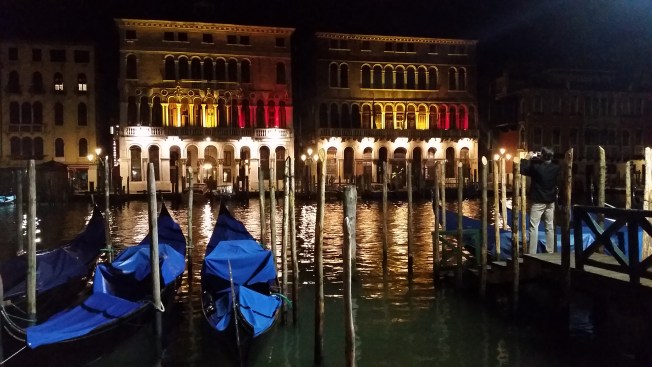
Buildings lit up in the colors of the Belgian flag to show solidarity after the Brussels bombings

20160328_191722
Easter menu at Il Ridotto (minus a couple off-menu courses)

20160328_201259
Roasted pilgrim scallops (“cappesante”):


GoOpti

After several days in Venice, it was time to begin our much-anticipated Balkan adventure. Research yielded the surprising news that no trains run between Venice and nearby Ljubljana, the capital of Slovenia. The trip can be made, but you have to train to the border, taxi across and then catch a Slovenian train. More hassle than we wanted. We also didn’t want to drive given Venice traffic restrictions and the cost of taking a rent car across a border, even within the EU. After weighing options, we decided to book with GoOpti, a van service that offers a sliding price scale depending on when you book and whether you are willing to share a ride. https://www.goopti.com/en/ I booked almost 3 months in advance and it was far cheaper than flying and without the attendant expense, hassle, and time always required for flying. (Our total cost for GoOpti was €48; €24pp–a great deal.) Even on budget airlines and traveling light to avoid luggage surcharges, you’ve got to factor in transportation to airports which are nearly always a distance from town as well as ever-increasing security delays. For short flights, it’s often quicker to travel by land.

For GoOpti, you choose from offered departure points and departure time windows (of 1-3 hours depending on the time of day) with a maximum arrive-by time at your destination given for each departure time window. GoOpti says they will text and email you the day before departure with a precise time, so wi-fi or phone service is necessary. As promised, GoOpti emailed us the day before saying pick-up would be at 2pm, but emailed again shortly afterward to say 1:30pm. The van arrived promptly. We chose Piazzale Roma (the plaza just across the canal from the main Venice train station, by the big pedestrian bridge) for our departure point. My only uneasiness about the arrangement was the failure of GoOpti to provide any details as to where in the big, busy piazza we were to meet our van. This meant we arrived extra early to allow time to find the van and David waited with our luggage on one side of the plaza while I made a circuit, asking random strangers and vendors about GoOpti to no avail. We finally decided to postition ourselves near the only traffic entrance to the plaza. Eventually, I spotted a GoOpti van stuck in traffic and was able to get him to roll down the window. While he wasn’t our driver, he pointed us in the right direction. So, here’s the scoop: If you arrive by vaporetto, motoscafi, etc., just walk away from the canal, past all the large buses and you’ll find a few benches built into a long planter where you can sit, facing away from the canal and buses, to wait for the GoOpti van. Just walk over to the van and identify yourself when it arrives. The GoOpti vans will simply park, head-on into one of the regular parking spaces. Walk up to the driver and identify yourself. They’ll have your name and reservation or direct you to the driver who does.

20160330_132343
GoOpti van picking up customers

20160330_132425
GoOpti van parking with bench/planter seating to the right of the man in blue. The People Mover station where you arrive from the cruise port is behind him.

Although we booked a shared ride, there was only us in the 9-person van. (This was a Wednesday.) The van was immaculate; our Slovenian driver, Petra, very friendly and English-speaking. We had control of our own air conditioning in the back. She stopped for a little snack and bathroom break when asked about 1.5 hours into the trip, but would have stopped, she said, whenever we asked. You can buy sandwiches and drinks (coffee, soft drinks, water, beer, etc.) at the convenience store/filling station where she stops. There’s also free wi-fi and clean toilets. The drive from Venice to the Ljubljana Airport took 3 hours. Highways and roads are excellent; the drive smooth and uneventful.

GoOpti provides transfers to many locations in northern Italy, as well as quite a few in Slovenia and Croatia. It also has connections as far as Munich, Vienna and Budapest.

Although we planned to spend some time in Ljubljana, we chose to be dropped off at the airport so we could pick up a rent car as well as the Slovenian Visitor SIM card I’d pre-ordered and had delivered to an airport café. A terrific convenience! More about that in the next post.

March 30, 2016

error: Content is protected !!