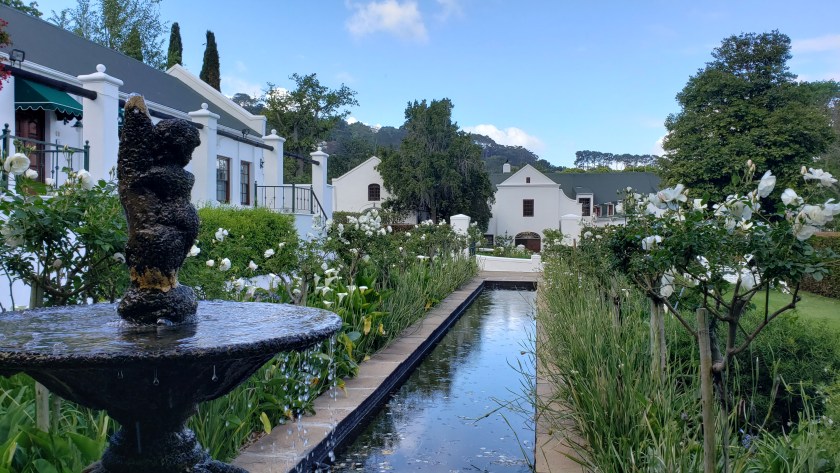
Although the room we stayed in listed online at over $700/night, our stay at The Cellars-Hohenort was completely free thanks to Hyatt credit card “annual” certificates which David had accumulated over the pandemic as Hyatt and other hotel chains extended the validity of such certificates during the worldwide shut-down. (We used my three certificates for our stay at The Marine Hermanus.) The Cellars-Hohenort is part of the Liz McGrath collection of three 5-star hotels which, along with The Marine Hermanus, had just come under the Hyatt umbrella. We couldn’t have been happier with this use of the certificates!
Magnificent camphor trees and other idyllic spots on the grounds of The Cellars-Hohenort
The Cellars-Hohenort is housed in several gleaming white, traditional-style buildings of a former winery. The hotel sits on grounds that could rival any botanical garden with flower beds, fountains, ponds, a small vineyard and a stand of immense 272-year old Camphor trees (planted in 1760). We loved exploring the grounds and ate every breakfast enjoying the view of Table Mountain.
View from our indoor breakfast table. The weather was so nice we moved outside for our last two mornings
Due to our Hyatt status, the Cellars-Hohenort comped us our “continental breakfast,” an ample spread that went beyond the usual. This is a perk they probably weren’t obliged to offer during a free stay and really added to the value of our certificates. We ate dinner twice in their excellent restaurant, too. We charged to the room then paid at check-out with a Hyatt credit card so that we earned 9x the points for those expenses. (The bonus points did not automatically show on my statement, probably because of the affiliate-status of the Liz MacGrath hotels, but a call to Hyatt had those extra points quickly added to my account.)
More of The Cellars-Hohenort
The Cellars-Hohenort could not be more conveniently located for wine tasting in the Constantia region. We made stops at Klein Constantia, Eagles’ Nest and Constantia Glen, the furthest from our hotel being a 12-minute drive away. The wines were all good and we really loved the views from the pretty terrace dining area at Constantia Glen. Eagle’s Nest was particularly family-friendly with children playing around picnic tables scattered around a back lawn.
We spent our last full day wandering the spectacular Kirstenbosch National Botanical Garden, a mere 6-minute drive from The Cellars-Hohenort. The Kirstenbosch website justly boasts “Kirstenbosch National Botanical Garden is acclaimed as one of the great botanic gardens of the world. Few gardens can match the sheer grandeur of the setting of Kirstenbosch, against the eastern slopes of Cape Town’s Table Mountain.” I could do a post just on the garden, but enough for now. Suffice it to say, we loved it, it’s more than worth the trip, and the on-site restaurant moyo Kirstenbosch is delightful, too, especially if you can snag a table outside on a gorgeous day.
Kirstenbosch National Botanical Garden, founded in 1913
Although we felt far from the bustle of Cape Town proper, it’s only an easy <25-minute drive from The Cellars-Hohenort to the Cape Town airport. We did leave a little earlier than necessary to avoid rush hour, though, on the advice of the hotel.
Skeiding ostriches were as curious about us as we were about them.
I’m behind on blogging having been distracted by the holidays and then the heartbreaking last weeks with my beloved, nearly 18-year old dog, so am finishing up the end of our South Africa trip while on a transAtlantic cruise from Florida back to Europe. I’ll keep it brief, but I hated to let two favorite South African stays (and a pair of awesome Qatar Airways Qsuites flights home) go unreported.
Looking for something different after our time driving South Africa’s Garden Route, I was intrigued to find Skeiding Guest Farm, billed as a working ostrich farm. How fun!) Turning inland from the Garden Route, the drive to Skeiding took us through dramatic mountain passes into the Little Karoo, a rugged high plains area. We stopped for lunch at a funky little roadside café and gift shop called Bella de Karoo and descended back through the mountains to the ostrich farm at the end of some miles of unpaved road. (Bella de Karoo apparently has guest rooms elsewhere, but we didn’t check those out.)
The main house at Skeiding Guest Farm where meals are served.
Skeiding Guest Farm is run by a married couple, Neels and Anné-Lize, who both trace their ancestry back to the earliest Afrikaner settlers. Skeiding is a working farm on 1200 hectares (appx. 2965 acres). We were met at the main house by Neels who checked us in and showed us to our charming cottage with its big covered patio overlooking a sweeping vista. After settling on a dinner time, David and I headed out to hike the farm (a working ranch as well as a farm), accompanied by Clara, the friendly doberman.
Skeiding farm (clockwise from top): views of the Langeberg Mountains, a curious ostrich, view from the living room of our cottage, and hiking with Clara the doberman
On this first ramble, we saw lots of sheep, but no ostriches. We also marveled at the local birds, particularly the brilliant yellow and red weaver birds who flitted back and forth among their woven nests that dangle like straw Christmas ornaments from so many African trees.
Brilliantly colored weaver birds
We found the farm’s flock of ostriches on a later hike, laughing as the big-eyed creatures at first ran from us, then approached, looking for treats. Neels told us he’d greatly reduced the flock as selling meat became a money-losing business due to international restrictions following an outbreak of bird disease in Africa. He now mostly keeps the ostriches for guests and to sell their eggs to race horse breeders who use them for feed to enhance the horses’ coats and general health.
Neels at the braai and an excellent dinner
Food at Skeiding Guest Farm deserves a special mention as it was abundant and outstanding. Anné-Lize is the main cook while Neels is in charge of the indoor braai (barbecue). We opted for ostrich steaks, of course, which Neels barbecued to perfection in front of us. The rest of the meal, accompanied by local wine, was equally delicious. The next morning revealed an extensive spread of a dozen cheeses(!), picture-perfect fruit plates, and cooked-to-order scrambled ostrich eggs. More food that we needed, but we enjoyed every bit of it!
The Indian Ocean at The Heads, Knysna, South Africa
The famed Garden Route along the southern coast of the Western Cape of South Africa stretches from Mossel Bay to Storms River. I’d planned our first two nights officially on the Garden Route at an AirBnB apartment in Mossel Bay. The drive from Hermanus was just under 3 ½ hours along an inland stretch of the N2 highway. It wasn’t the gorgeous coastline we’d enjoyed en route from Cape Town to Hermanus via the Cape Peninsula, but it had had its own rugged vastness with mountains looming beyond plains off to our left. We loved a lunch stop at Ou Meul Bakkery in Riviersonderend where kudu venison meat pies and sweet pastries were delicious and cheap.
Our AirBnB apartment in Mossel Bay was on an upper floor of an oceanfront complex with a wall of glass overlooking the water from the enclosed balcony where we ate breakfast. Our hostess had said whales and dolphins could be sighted from the window, but we didn’t see any, which was a bit of a let-down after non-stop whales in Hermanus. We took long strolls along the wide, nearly deserted beach both days we stayed in Mossel Bay. It seems there’s not a lot to do in the town in the off-season.
View from our Mossel Bay AirBnB apartment
A casual waterfront restaurant (Delfino’s) recommended by our hostess served uninspired food in a nothing-special atmosphere. It wasn’t horrible, but not a stellar start. A sea of small campers and tents parked next to the restaurant parking lot; I guessed them to be the local version of the “snow birds” that frequent my home state of Texas in the winter. We found a better dinner option on our own at pretty Café Gannet the second night, and really enjoyed it. I just wish we’d found it sooner and worked in time to try the picturesque make-your-own-gin micro distillery on their premises. Still, we were left looking for much to do in the cool spring weather. We watched waves crashing near a zip line that dropped to the shore from a peak where a lighthouse overlooked the waterfront, but no one braved dipping through the icy spray. We tried Big Joe’s, a local franchise meat pie shop whose gravy-filled meat pies couldn’t hold a candle to the meat-packed kudu venison pies at Ou Meul. We wandered a bit on the local main street. Hmm. After all the build-up for the Garden Route, our first stop wasn’t stacking up to charming Hermanus nor the spectacular views around the Cape Peninsula. We were looking forward to moving into the heart of the Garden Route. Hopefully, we’d see what all the fuss was about.
The beach is wide and beautiful at Mossel Bay, but this pic is a reminder that security is always an issue in South Africa. We enjoyed the freedom of driving ourselves and exploring, but we remained extra vigilant and barbed wire, warnings of “armed response,” guards, etc. are the norm.
I’d booked a guest house in Knysna (“nize-nuh”), but the drive was less than 1 ½ hours, so we decided to drive on past another 50 min, to the Bloukrans Bridge before coming back to check in. This would put us near to the far east side of the Garden Route so we’d see most of it before we settled in at centrally-located Knysna. The drive did give us some lovely views of the coast, as promised. Was it prettier than the Cape Peninsula? Not really.
The Bloukrans Bridge boasts the “highest commercial bungee jumping site in the world,” and it’s pretty spectacular, whatever its current ranking. Neither David or I had any interest in jumping, but it was fun to see. (If you are interested in jumping, learn more here.) We enjoyed lunch at a picnic table overlooking the bridge, feeling a little bad about the empty main building and vendors with wares set out for no one but us (and we weren’t interested). Tourism was clearly taking a big hit due to the pandemic. One other couple arrived while we were there, also Americans, but that was it. Entrance to the Tsitsikamma viewing area is free; we were just stopped at an entrance booth where we gave our names for some unknown reason. No one stopped us on the way out and the booth seemed deserted.
Bloukrans Bridge
After navigating a steep road and a dicey uphill turn-in through a quick-closing electric gate, we found our Knysna guest house to be all we’d hoped for. Perched on a slope overlooking the Knysna “Lagoon” (an estuary) and The Heads (headlands opening onto the Indian Ocean), the house was beautiful and clean, our hostess welcoming and very chatty. We loved our room with two walls of windows and a nice balcony offering that gorgeous view.
Our Knysna guest house balcony with view of the Lagoon and The Heads
We soon learned that the estuary fills and drains each day and it was fascinating to watch shallow islands emerge and retreat. Birds flocked to the islands to feed. We rented a canoe one day and paddled out to one of the islands. The Steenbok Nature Reserve on Leisure Island provided more (free) bird watching and a nice walk along the water with lots of local dog owners. A short drive to The Heads offered spectacular views from the East Head overlooks, some jutting over the cliff edges facing the Indian Ocean. East Head Café is a real treat with outdoor seating overlooking the pass between The Heads. We enjoyed local craft beer at Red Bridge Brewing Co. and toasted our last night in Knysna with champagne and local oysters waterside at Drydock.
Summing up the Garden Route for us: We enjoyed our four nights on the Garden Route, but in hindsight, we would have skipped Mossel Bay altogether and gone straight to Knysna. (We’d spend those two nights in the Stellenbosch wine region instead.) If you’re looking for beach time and the weather is warm, I’m sure Mossel Bay is fun, especially for families with kids, but we’ve got lots of warm beaches at home and we weren’t in South Africa for that, even if we’d been there in summer. Also, I’d debated between Knysna and Plettenberg Bay, and am glad I chose Knysna. It’s bigger (appx. 70,000 pop. vs. PB’s 19,000) and just had more to offer us.
Tip: I found canoe and kayak rentals in a tourist brochure and debated booking via the website listed there, but decided to just drive to the physical site first. (Located at Kalaideskoop on Thesen Island, across from the Gastropub, despite the brochure putting it at restaurant Sirocco) The price was substantially less on-site than what I saw in the tourist brochure at a purported “discount”. This may have been partially due to the depressed tourism due to Covid-19, but just FYI.
Six free-annual-night Hyatt certificates first put Hermanus, South Africa, on my radar screen. David and I each had accumulated lots of hotel certificates over the pandemic and we each had three Hyatt nights that we needed to use. We get one certificate/year with certain credit cards and, although they usually expire within a year, Hyatt had extended the expiration due to the pandemic. This created a great opportunity to use those certificates for an extended stay. We often use these certificates for a 2-night stay, using each of our 1-night certificates, then calling the hotel to make sure we can stay in the same room, rather than checking out and then in again as the booking switches from one of our names to the other. So, we could have lumped our nights together for a 6-night free stay somewhere, but that really didn’t suit our plans on this trip.
With travel so restricted due to the pandemic, a lot of the usual best-use locations (like Asia) were closed to us. When the idea of a trip to Africa started to come together, I searched Kenya and South Africa for interesting-looking Hyatts. As luck would have it, Hyatt had just added three new Small Luxury Hotels (SLH) to its lineup in South Africa and two of them fell under the eligibility requirements for our certificates. (The certificates are good for hotels in Hyatt Categories 1-4. The idea is to use the certificate for the poshest Category 4 available in order to maximize the value of the certificate.) I decided to use my three certificates at The Marine Hermanus. What a great find that turned out to be!
We arrived just after dark at The Marine after our day exploring the Cape Peninsula. After a quick stop at the guard post, we were let into the gated parking lot and shown to the registration desk. The welcome was very friendly and, after confirming we were hungry, we were promised a table would be waiting in the dining room as soon as we settled into our room. I had reserved a standard king room and it was charming. On the side of the building facing away from the town of Hermanus, we had a very oblique view of the water, I think. It was dark and morning would tell. Or so I thought. After a quick wash-up, I went to put our valuables into the safe and discovered it to be old and not functioning. Oh well, I wasn’t overly concerned, but did want to lock things up so mentioned it to the man at Reception on our way to dinner. Midway through an excellent meal, he arrived, apologizing again and saying he was moving us to a suite and would escort us there with our luggage as soon as we were finished with dinner. Well, that called for a toast!
The Marine Hermanus
The suite turned out to be enormous, easily three times the size of our original, comfortably-sized room. Our new digs had a king-sized bed, sofa and coffee table, small dining table and two chairs, a minifridge stocked with free beer, soft drinks and snacks under the tv, a vanity, and enough open space for a rousing game of ping-pong. The bathroom sported a huge shower, a massive tub, a toilet, and three(!) sinks. To top it all off, we had one of the few balconies in the vintage hotel, and the biggest one at that. Our balcony sat atop the covered entrance to the hotel so, straight ahead, we looked down the street towards downtown Hermanus. The bay was just to the left, but since our balcony was so big we had a table and chairs and lots of room. Once the sun was up (and rain showers cleared), we could sit outside and watch whales any time of the day! [An internet search showed this suite was running about $560/night at the time, making this stay an excellent use of my Hyatt certificates.]
It’s always fun to survey your new surroundings after arriving in the dark. Morning revealed to us a picture-perfect waterside town with a paved walk meandering along the cliffs. The weather proved to be fickle, changing quickly from sunny with scattered clouds to squalls that moved through quickly. We nevertheless set out for a walk along the cliffs to the main town pier. We spied our first whales in no time and had fun watching them until the weather drove us to shelter. We explored semi-sheltered booths of local items for sale then moved on to indoor shops as rain came down in earnest. Our first day in Hermanus continued like that with us moving in and out-of-doors as the weather dictated. Fortunately, the town is small and The Marine was in easy walking distance. Our spacious suite wasn’t a shabby retreat either!
Whale breaching just off shore by The Marine
In addition to a view of the bay and of the town, we had a view of the modestly-sized parking in front of The Marine. We were impressed to see men washing every car in the lot… and repeating the wash after every frequent shower. Unemployment is high in South Africa and perhaps as a result there seem to be many such service jobs, making us feel very pampered, if a bit uncomfortably so.
Over the three nights we spent in Hermanus, we explored the cliff walk for long stretches in both directions. The cliffs along the town front invariably offered excellent whale watching, with several whales to be seen at almost any time, some very near the land. We saw mother whales with calves, whales breaching, spyhopping and fin waving. It was magical! Wandering past the main town pier we found lots of “dassies” (large brown-furred rodents also known as rock hyraxes) grazing among whimsical sculptures. Rounding a curve in the coastline, the water became less sheltered with big waves breaking on huge rock slabs. Wildflowers and birds, including a pheasant-like Cape Francolin mama with chicks, wandered the wildflower-laden greenery that decorated the upper portion of the rugged coast.
The rugged coast of Hermanus
In addition to two excellent meals at The Marine, we had seafood with a view of the water at Lemonicious and wood-fired pizza at Embers Wood Fired Oven which also offers a surprisingly good selection of Belgian beers, thanks to input from a Belgian couple who retired from their own restaurant in Hermanus a couple of years back. They were in Embers the night we ate there, visiting with the owner, and we were delighted to find they were Antwerpers by origin with a daughter still in school there. On a sunny weekend afternoon, we ate a tasty lunch outside at Pear Tree Bistro with a view of the bay while a talented local musician played with the aid of an amplifier set up beside his van.
The Hemel-en-Aarde Valley (“Heaven and Earth”), a popular and scenic wine region, is located a short drive from Hermanus and we drove one day to a wine tasting at Ataraxia, a pretty winery with a tasting room designed to look like a chapel. We were surprised to find our choice of wineries really limited on a weekend. For some bizarre reason, many of the wineries were either closed entirely on the weekend or only open from 9 or 10am to noon. Who wants wine for breakfast?! It seemed really crazy since it would seem their main source of steady businessduring the on-and-off travel bans due to Covid-19 would be daytrippers from Cape Town, most of whom would be presumably working during the week and free on weekends. In fact, we shared a table at Ataraxia with a group of women doing a girls’ weekend away from husbands and kids. (These ladies were tons of fun and apparently had no problem with breakfast-time drinking.) They told us they thought the weird winery hours were due to the pandemic. I’m not sure how that makes sense, but there you have it.
Ataraxia Winery in the Hemel-en-Aarde Valley
All in all, we loved Hermanus. It’s not a big-event place, but a charming town to pass some days whale-and-wave watching and enjoying the local food and wine. I can’t say enough good things about The Marine or its parent group, The Liz McGrath Collection. We had to call them twice, once to ask to move our reservation at The Marine up a day and another time to advise them of a late arrival. Both times, the phone line was answered immediately by someone eager and able to help. Would that all customer service lines were like that!
This post is not as fun as some, but I wanted to share practical travel-during-Covid info that took me awhile to pull together for our recent travels to Belgium (via the UK), France, Kenya and South Africa.
This year was a big birthday for me, so I was hoping we’d be able to do something special after last year’s pandemic isolation. We were thrilled when Europe opened up to (non-essential) American travelers again after we’d been banned for so long during the pandemic. When Antwerp friends asked us back for a favorite house- and cat-sit in September, we decided to launch my birthday trip there. I came up with a 2-month/4-trips-in-1 birthday trip that included Belgium, Paris, Kenya and South Africa. I made plans with the understanding that any portion of our travels could be canceled at any time given the vagaries of ever-changing Covid restrictions. I researched travel requirements throughout the summer, thinking early on that South Africa might be out when that country raised its Covid Level from 2 to 3 to 4. A ban on all alcohol sales and the closing of many venues would make our planned Garden Route exploration and wine tasting impossible. Fortunately, South Africa was back to Level 2 by the time we traveled there. When –just prior to our September 2 departure– the EU recommended member nations consider banning Americans as our Covid numbers spiked, we started to wonder if we’d even make it to our first stop in Belgium. I decided each and every step of the trip would be a gift. As each portion of our trip materialized, we counted ourselves lucky and crossed our fingers for the next. In the end, all four portions of our trip worked out and we had a wonderful time: We spent three weeks in Antwerp, two weeks in an apartment in my beloved Paris, a week on safari in Kenya, and 15 days in the Western Cape of South Africa.
Traveling to these four countries required the usual check of entry requirements, visas, etc. plus country-specific Covid requirements. A useful, but not perfect, starting place for determining Covid travel requirements is the site Sherpa. Happily, Belgium had dropped all entry restrictions for vaccinated Americans like us. Unfortunately, flying American Airlines meant we were once again funneled through Heathrow which meant we needed a PCR test for the dubious “pleasure” of connecting through Heathrow to Brussels. A suddenly-filled CVS schedule meant an expensive trip ($139pp) to a Denton, Texas, testing clinic. Aggravating, but necessary. (Surprisingly, our health insurance did cover $51.31pp of these tests, so even if you need a totally discretionary Covid test for travel, it’s worth filing a claim.) The UK also requires a passenger locator form submitted within 48 hours of departure. Belgium, too, required us to fill out a passenger locator form prior to arrival and we had to show it at Belgium customs.
Entering France (via Thalys train) from Belgium was no problem. We did fill out the “required” French Covid Statement of Honor just in case we needed it to board the train, but no one asked us for it. I applied online at the French government website prior to our trip for an EU Digital Covid Certificate giving me a QR code establishing that I was vaccinated with an approved vaccine (Pfizer, in my case). This arrived prior to our trip and I was then able to upload that to the French TousAntiCovid app. In the app, I was able to mark this certificate as my “favorite” which then let me create a widget on a home screen so I always had the QR code easily to hand. This is important in France as nearly every restaurant, museum and venue requires a quick scan of that “passe sanitaire.” The French government has recently done away with the online application, and tourists can get the QR code establishing their vaccination status at local pharmacies, potentially at a cost. In a pinch, showing your American vaccination cards should work most or some of the time, but the passe sanitaire is the norm and definitely preferred. Alternatively, visitors can test at the many tents around Paris and provide a negative Covid test for entry.
To fly from Paris to Nairobi, Kenya, we again needed a PCR test. I found several sites offering the tests online and some by simply walking around. We opted for a Biogroup lab at 134bis, rue de Vaugirard, in the 15th arrondissement which did not require an appointment, was fast, and reasonably-priced at €45 (appx. $52pp). Once again, it was necessary to research entry requirements. Kenya specified the test must be 96 hours before our flight and we needed a special health surveillance form with QR code. Officials were waiting to check that form (digital or printed) as we deplaned in Nairobi. It was possible to look up the form by phone number, too, if the actual form was lost. Kenya also requires an eVisa that must be printed. Our flight was delayed an hour as Air France staff sorted through many passengers who thought a digital copy was sufficient, as apparently it had been in the past. [Note: The Kenyan eVisa is easy to apply for and relatively cheap at $51 including a $1 credit card fee. Use the official link above and don’t be fooled by much more expensive online “facilitators.” Also, although the Kenyan government said they’d email the eVisa, they didn’t, but it was online very quickly. We just had to check back to the accounts we created.]
To fly from Kenya (Nairobi) to South Africa (Cape Town), we needed yet another PCR test within 72 hours of our flight and a health screening form completed within 48 hours of travel. The PCR test was problematic as we would be in remote Masai Mara on safari during the window we needed the test since PCR results can take up to 24 hours and the labs are back in Nairobi. Searching online, I found a group offering tests at Masai Mara (on site for $110pp or at our lodge for $140). I arranged with our safari company to go to this testing site. In the end, they arranged for the doctor to come to us for no extra charge. There was a delay and some confusion in getting the results, but all worked out in the end.
[In addition to Covid tests, South Africa requires proof of yellow fever vaccine for travelers arriving from Kenya (and other yellow fever zones). The lifetime vaccine must be gotten at least 10 days prior to arrival in a yellow fever zone. We got ours at the Institute of Tropical Medicine in Antwerp; easy, extremely knowledgeable, and much cheaper than in the United States. We booked an appointment by phone before leaving the United States. Prior to boarding in Nairobi, Kenya Airways staff checked that we had our yellow booklets proving our yellow fever vaccination status. We also got prescriptions for anti-malarial medicine at the Institute, not required to travel to Kenya, but highly recommended.]
Finally, we needed an antigen test to return to the U.S. from South Africa. The test had to be done 3 days (not 72 hours, which potentially allows a little more time) prior to our departure flight. In another online search, I found a testing center at a Cape Town rugby club less than a 10 minute drive from our final hotel. I booked an appointment and paid 450 rand ($30pp) for the tests online via EasyTesting while we were in Paris. This worked like a charm and we had results emailed to us within 30 minutes.
All of this extra Covid testing and documentation is expensive and a hassle, but it’s doable. (Our total out-of-pocket costs for Covid tests for this trip was $559.) Travel now requires both expense and research, planning and constant checking for changes. In normal times, I usually keep a folder with all the documents David and I need for travel, stacked in chronological order, this includes any visas, tickets (many countries require printed proof of departure tickets), etc. These days I’ve separated documents in the folder into a manila folder for each of us to accommodate the increased number of documents: our proofs of vaccines, Covid tests results, contract tracing forms, etc. Note: Printing can be tricky, depending on where you’re staying, so planning and attention to detail is essential.