Dutch Harbor (Aleutian Islands), Alaska

20160907_085847

The first stop on our trans-Pacific Vancouver-to-Tokyo cruise was Dutch Harbor, Alaska, in the Aleutian Islands. Dutch Harbor was a substitute stop, replacing the originally-scheduled Petropavlosk, Russia, on the Kamchatka Peninsula. I’d been really looking forward to the remote Russian stop and, while I was disappointed to miss the Kamchatka, Dutch Harbor was a happy surprise for me, personally. My grandfather (my father’s father) had been stationed there in WWII as a Navy dentist. My dad still has a scrapbook of his father’s from that time and I’d taken a photo of every page, eager to see if I could find anything recognizable in this remote port.

20160818_095940

Dutch Harbor turned out to be a hit on all fronts for us. The only downside was that sunrise came an hour later than the day before so that, although we docked at 7am and David and I were ready to disembark at 7:30am, it remained pitch black outside. Hmm. Somehow we’d missed the captain’s notice that sunrise would come at 8:28am that day. So, we twiddled our thumbs until first light, then headed out for our planned hike up nearby Mt. Ballyhoo to the ruins of Fort Schwatka.

20160907_110156

The local chamber of commerce had set up a table just outside the gangway with maps and other information. Unfortunately, they had forgotten the land use permits which we were told to buy ($6pp) before hiking any of the local trails. Someone had gone to fetch the permits, but the lady in charge told us to go on and, if stopped, just say they didn’t have them yet and could we pay whomever stopped us. Sounded good to us, so we headed off. (No one did stop us, so the hiking was free.)

20160911_134507
Wellused map of Unalaska/Dutch Harbor provided by local chamber of commerce. Cruise port is at top right.

Before we even left the parking lot by the ship dock, we spotted our first bald eagle perched on the rocky mountain face opposite the ship. This boded well for our wildlife spotting! Sure enough, we saw many more during the day and someone likened them to pigeons in other cities. There are even signs in Dutch Harbor and Unalaska warning of eagle attack if you venture too close to nests! That was a new one.

The road to Fort Schwatka lay a short distance to our right as we walked out of the cruise port. The road is gravel and well-maintained, but a fairly steep 9° uphill via several switchbacks. All in all we spent 3 hours hiking up the mountain and around the old ruins, with a distance of about 6.5 miles. The views are spectacular at the top and we lucked into pretty good weather, although clouds snagged on the very top of the fort ruins and we got some drizzle. All the old wooden buildings have collapsed and no structure was identifiable as the places in my grandfather’s photos I carried on my phone. We could place some rock formations, though, and everything about the terrain looked the same. The old bunkers, dug a surprising way into the stone mountain, are still mostly intact and open for exploring.

20160907_091808

20160907_091859

20160907_091954

20160907_094212

20160907_093039

The appearance of a red fox was extra fun as we wandered the ruins. He seemed more curious than afraid of us and actually seemed to wait at one point for us to catch up. Then, he ducked behind a bush and ended up behind us, continuing to follow for a bit. What a great encounter! (…and fun to see that my grandfather had a photo of a similar encounter. It seems foxes in Dutch Harbor have long been used to having humans around.)

20160907_100456

As we headed back down Mt. Ballyhoo, we spotted a whale feeding in the harbor and a nearby group of twenty or so otters floating on their backs. Smaller water birds abounded as well. With the fresh, crisp air and the smell of wildflowers, it was a beautiful hike.

20160907_092123

We had to pass back by the ship to continue our explore of Dutch Harbor and Unalaska, so we ducked in for a quick early lunch. Since Dutch Harbor is a commercial port, not really a tourist destination, the only transport were local school buses and vans the town dedicated to the cruise ship until the schoolchildren needed to be picked up and 12 taxis that serve the local population. We had to laugh when we learned that the buses took everyone to the Dutch Harbor Safeway grocery store. So much for exotic cruise locales! A guide on the bus announced they were going on to the old Russian Orthodox church in Unalaska. When we saw the huge double line of people waiting at Safeway for the bus, we opted to stay on and ride to the church. [Nomenclature is a little confusing. “Dutch Harbor” is the name the military and locals use for the whole area. There’s a Dutch Harbor post office near the Safeway and an Unalaska post office across the Captain’s Harbor bridge on the Russian church side of things. Technically, though, both sides are in the town of Unalaska.]

20160907_121927
Long lines of cruise passengers waiting for schoolbuses in the Safeway parking lot

My grandfather visited this church back in the 1940’s and little appeared to have changed since then. I got a kick out of getting my photo taken there as he and a friend had.

20160907_123154

20160818_100237

Then, we wandered back down what passes for the main street of Unalaska (lots of small, ramshackle houses, the modest courthouse, and a restaurant) before taking a detour across a footbridge spanning a small river. There, we got a great view of salmon spawning as bald eagles glided above. A perfect mini-Alaska vacation!

20160907_124430
Salmon spawning in Unalaska river


20160907_123721
Salmon spawning near Russian Orthodox church

Across the bridge and to the left is the Unalaska Public Library where we’d been told free, if slow, wi-fi was available. True to billing, we managed to connect momentarily, but most sites resulted in the dread spinning donut of death. Oh well, the world could no doubt manage without us. Phone service was actually reasonably good, though, with my regular AT&T service, and I was able to get a call out to my parents and one to my older son who’d returned from an Iceland/Norway trip after our departure and from whom I was dying to hear details. Voices were clear although we were cut off several times.

We decided to walk back across a large bridge spanning Captain’s Harbor to Safeway. Bunker Hill loomed across the road to our left with clear, shallow water full of starfish in the harbor to our right. We saw two more eagles nesting on Bunker Hill while another glided nearby. We’d been lucky with the weather, but wind began to pick up as we reached the coast at the base of Bunker Hill. The temperature reached a delightful 56F. [Online weather forecasts I’d scanned prior to leaving home showed rain to be nearly a daily possibility in Dutch Harbor, and even my grandfather’s old letters and postcards spoke of the rain, snow, howling wind and even earthquakes.]

20160907_135502

20160907_141757
Starfish in Captain’s Harbor

Walking the long curve of coastline until we were just across from the Safeway, we reached huge stacks of crab pots interspersed with a series of WWII bunkers. Just beyond is a local bar/restaurant called Norvegian Rat Saloon. Dutch Harbor is featured in the popular show, “Deadliest Catch” and we were eager to try fresh king crab while here which we’d heard the Norvegian Rat prepared. However, the cruise director had warned that on the only previous stop the ship had made here, the lines were long and the crab sold out early. Of course, that had probably been at lunch and here we were mid-afternoon. We found a nearly empty parking lot and not a line in sight. We assumed the crab was long-gone, but seeing good beer on draft (always a draw for David), we couldn’t resist. When a tablemate from the ship informed us that a fresh batch of red king crab was being prepared, we happily placed our order. Ten minutes later, we tucked into a plate of crab, simply cooked and served with nothing but drawn butter. Absolutely perfect! [I’ll review the Norvegian Rat Saloon separately.]

20160907_143831
Crab pots

Unfortunately, our break at the Norvegian Rat Saloon left us with too little time to comfortably visit the small World War II Visitor Center which lay between us and the ship. I really regret missing it as I had some questions about my grandfather’s photographs, but something had to give and I’m hoping to contact them when we get back home. If it comes down to seeing the museum or the actual locations, I’m glad we made the choices we did. It’s the nature of cruise stops to be left wishing for a longer stay. I’d say “Next time!”, but that seems unlikely: A local told us Dutch Harbor is a 2-3 hour, $1000 flight from Anchorage in a small plane through often-turbulent skies.
______________________

Cruise port details:

Ships dock on the “Dutch Harbor” side of the town of Unalaska, 1.3 miles north of the airport and the WWII visitors center. The area is industrial.

Free shuttles via 4 local school buses and a few vans to the Safeway were provided by Celebrity. Later buses extended their route to the Russian church. The buses and vans pick up on the dock a short distance from the gangway. Although the ship docked at 7am, buses were not available until 10am. Two of the four school buses stopped running at 2:30pm as they were needed to pick up school children. Vans continued to shuttle passengers.

There is no handicap-friendly transport for wheelchairs, etc. available on the island so you have to be able to negotiate the few stairs of a school bus or van.

12 taxis (some of which are vans) are the total sum of cabs in Dutch Harbor. A couple were waiting in the dark when we docked.

Our hike up Mt. Ballyhoo and back to the ship was about 6.5 miles. We walked approximately another 3.5 miles on our ramble from the Russian Orthodox Church back to Safeway.

There are no sidewalks in Dutch Harbor and we were warned to stay on the shoulder of roads (mostly paved and in good shape) and be alert. Most of the traffic is pick-up trucks and larger commercial trucks.

Lots of “Deadliest Catch” t-shirts, sweatshirts, etc. and other souvenirs are for sale in the store next to Safeway by the red-roofed Aleutian Hotel and in Safeway itself.

Plitvice Lakes National Park, Croatia. Wish granted!

20160420_100749

I spent nearly two weeks in Croatia with my sons years ago and the place I’d always regretted missing was Plitvice National Park. As far as I was concerned, Plitvice was #1 on my list for this Croatian vacation with David and now, as our trip neared an end, we were finally going to be there…and it was storming. Not just light rain, but a downpour. Aaargh!

The weather in Zadar had been overcast with occasional drizzle, but cleared to sunny the morning we set out on the drive to Plitvice. It’s an easy 2-hour drive from Zadar to Plitvice and the scenery is beautiful as you head into the mountains and cross over impressive bridges spanning wide inlets of water.

20160419_114306

As we climbed higher into seriously rugged mountains, the weather began to deteriorate.

20160419_115415

When we exited the truly impressive Sveti Rok tunnel (over 3.5 miles long!), wind buffeted our car to the point I was getting a little nervous despite the excellent, wide highway. Thankfully traffic was light. By the time we neared Plitvice Jezera, the skies had opened up and we pulled into the parking lot of our AirBnB apartment in the driving rain. Our lovely hostess awaited us in raincoat and hood and we left our luggage to dash inside, umbrellas held high.

Despite that inauspicious beginning, the next day dawned bright and clear and all we could have hoped for for our day at Plitvice. I was as excited as a child!

We got an early start, planning to park at the Hotel Bellevue near Entrance 2 to the park and avoid the less-convenient, paid parking designated for the park. As we turned in a guard stopped our car, asking where we were going. I just looked bemused and answered we were going to the Hotel Bellevue, of course, and he waved us in. Instead of turning left into the main hotel parking, we drove to the end of the short street and parked, near the pedestrian path into the park. This put us not far from a ticket office and park bus stop #2 (“ST2” on the map below). Perfect!

Our AirBnB hostess, Jelena, was a font of knowledge and she’d given us a park map and laid out an optimum walk for us. We followed all her suggestions and could not have been happier. Day tickets to the park were 110 kuna apiece (about $17 each). We caught the park bus (included in our tickets) heading toward Entrance 1 and got off at the bus stop #1 (“ST1” on the map below) to walk along the water (on our left) to view the largest waterfall Veliki Slap (literally “Big Waterfall”) on the far bank.

20160420_091718
Park map posted near Entrance 2 ticket building/bus stop

The path to the waterfall itself was closed, for which I was just as glad. I was happy with the view from the opposite bank and, once I saw the scattered nature of Veliki Slap and a building at the summit of the waterfall, I was even less interested in going. I’m a waterfall junkie of sorts and have been to the top of lots of waterfalls, but I was fine with missing the top of this one. Maybe it was just me. Anyway, there was so much I wanted to see in the lower lakes and we headed back to continue the route Jelena had recommended.

20160420_095921
An early view of Veliki Slap

We hiked down to the water, making our way along the water (now on our right) and past another four wide waterfalls before crossing over to the far bank where Jelena had told us to catch a boat at P3 (also included in our tickets).

20160420_095439
View of wide waterfall from above

20160420_101305

20160420_102113
At water level
20160420_102213
Crossing the water
20160420_104427
Boat approaching the dock
20160420_105937
Off the bow of the boat

We got off the boat at P2 (see map above) and began an amazing wander through seemingly-endless waterfalls.

20160420_111217

20160420_112835

20160420_113039


20160420_120404

DSCF2980

We spent several hours hiking the park. We found it to be a moderate hike, with occasional steep stretches and some dirt paths getting narrow and muddy from the previous day’s rain. Plitvice Lakes National Park is so large that we never felt crowded and while we did see other people (and there was a fair-sized Asian tour group at the boat stop) we also had plenty of space to take in the incredible, tranquil beauty of the park.

We ended our hike at bus stop 3 (“ST3” on the map above) where we caught the bus back to ST2 where we began our day. From there, we walked the short distance back to the national restaurant “Poljana” for lunch. It’s located just by the Hotel Bellevue with lovely views of the park. Unfortunately, we found both the food and service to be inferior to its sister national restaurant, Licka Kuca, near Entrance 1.

For more information, see: http://www.np-plitvicka-jezera.hr/en/

You can check out our 2-bedroom/1-bath AirBnB apartment at: https://www.airbnb.com/rooms/4699728?sug=50 At $75/night and a 10-minute walk to the park (in good weather), it’s a deal worth considering, especially so if you need two bedrooms.

If you’re new to AirBnB and want to give it a try on this or any other apartment, you can use my referral link which should get both of us $30 in AirBnB travel credit: http://www.airbnb.com/c/tcuthrell Let me know if you have any questions.

Roman amphitheater at Solin, Croatia

20160415_155421

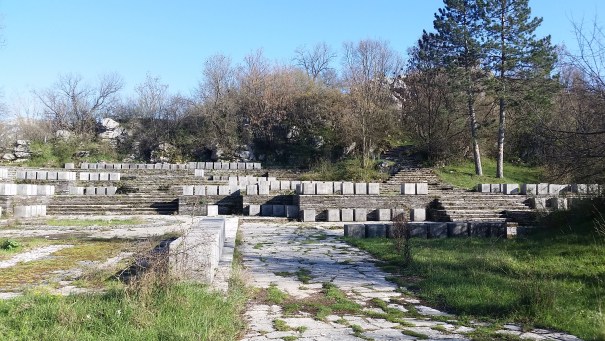
On our way back from Krka to Split, we made a short detour to visit the ruins of a Roman amphitheater in Solin, a small town on the outskirts of Split. With no address to go by, I guessed at street names hinting at an amphitheater or forum…which resulted in quite a few wrong turns on narrow streets. For anyone preferring a more direct route (which should be everyone), the amphitheater is at the intersection of Put Salone and Paraci ulica (“ulica” being simply Croation for street). The path is neither well-marked nor straightforward due to the way streets are set up, dead ends and the like. The ruins do show up on Google Maps now, so go with that if you have access.

I’ve visited plenty of Roman amphitheaters–the Romans built them everywhere they conquered–and found this one to be pretty and worth a stop, if not exceptional. The setting provides a sweeping vista and it’s fun to imagine Romans of Diocletian’s time making the trek up from the palace for the entertainment offered at the amphitheater.

Admission is free; parking is free. There are no guides, but there aren’t any crowds either. A few signs provide historical information,

20160415_160034

20160415_155657

20160415_160200


Krka Park, Croatia–walking on water

20160415_095418
Krka Park pathway

The waterfalls, lakes, rivers and pathways of Krka Park lure visitors from Croatia and beyond. We got up early to start our daytrip to Krka, hoping to avoid the crowds we’d heard could be a problem. The park lies an easy hour’s drive from Split. We drove the vast majority of the way on the excellent A1/E65 highway, then followed signs (and Google Maps) along the equally well-maintained E33 to the park’s main entrance at Lozovac. The enormous parking lot was mostly empty, but cars and tour buses were already beginning to arrive. We bought entrance tickets at the booth in the parking lot then realized we’d just missed the free shuttle bus that takes visitors into the park. [The free shuttle service runs from April to October.] Unwilling to wait for the bus to return, we opted to hike instead downhill through thick forests. The walk is pretty and not overly-difficult for the fit, but views of the lake below are blocked and we actually saw more of that particular vista by riding the bus back to the parking lot at the end of our visit. Our hike deposited us just up the road from the bus drop-off.

A few yards beyond a concession stand we stepped onto the raised wooden path that snakes its way through the myriad waterfalls, streams and lakes of Krka. In mere yards, we’d left the world of parking lots and buses behind to lose ourselves in a fairytale world of green. Water rushed and burbled all around us, even visible between the planks beneath our feet. Small fish darted about or clumped in schools swimming against the currents. Sunlight glinted off moving water and the air smelled deliciously of water, flowers, herbs, grass and trees.
20160415_095837

20160415_100235

We caught up to a tour group, but they branched back towards civilization and we soon had the park seemingly to ourselves. We came across other hikers from time to time, but mostly in twos and threes. Paths snake all through the area, sometimes as the raised wooden walkways over water, others as dirt footpaths through the trees. A group of mounted posters along the way describe local flora and fauna. We spent a couple hours exploring this area before we came to a footbridge over a large basin with multiple waterfalls spilling into it. The largest of these is Skradinski buk. Several buildings cluster around this spot, including a restored mill, souvenir shop and a historical display of weaving and traditional costumes. Things got crowded in this part of the park which is evidently easily accessible for tour groups not going as far into the park as we did.

20160415_100802

20160415_100902

20160415_105423
Stradinski buk waterfall

20160415_104625  20160415_102655

20160415_101355

20160415_112333

Walking across the bridge and past the buildings brought us back to the concession stand and parking circle where the park shuttle bus picked us up. It is a full-sized bus, accommodating far more people than were waiting when we were there. The bus dropped us off at the big parking lot by the Lozovac entrance where we’d left our car.

20160415_122819
View from the shuttle bus that we missed on the hike into Krka

Several small restaurants line one side of the parking lot. We chose one at random, Lapis Alba, and enjoyed a cheap late lunch of hot sandwiches and cold beer before heading back to Split.

There’s lots more to Krka than what we saw, but it would probably take at least two full days to see it all at leisure. Boat rides are available on the river between falls and going out to Vivosac Island, home to a small monastery. You can find out more at: http://www.npkrka.hr/stranice/krka-national-park/2/en.html

Split, Croatia: Old Town, Diocletian’s palace & Marjan Park


20160416_161307

Split had been a favorite of my boys and mine on that first visit to Croatia 13 years ago, and I was excited to return with David. It’s a fascinating place: a medieval city built into and incorporating the ruins of Roman emperor Diocletian’s palace. Happily, Split proved to be one of those places that’s just as good the second time around.

20160416_160256
Narodni Trg (National Square) in Split

As with Dubrovnik, tourism has boomed in Split in recent years and cruise ships periodically dump large crowds on the city, but Split managed to retain the charm I remembered in spite of it all. It’s popular with Croatians from surrounding areas as well and the cafés were filled on sunny weekend days. We ran into our young guide from the Winery Miloš with a girlfriend one evening and caught up with the status of the wine competition in the US. There’s always a kick to actually recognizing a familiar face in a foreign city.

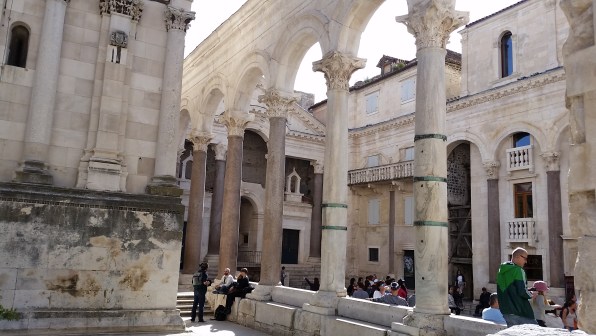
Simply wandering the streets or the waterfront, enjoying a drink or a meal in one of the many cafés or restaurants constitute some of the greatest pleasures of Split. There aren’t a lot of paid must-see destinations in the old city. It’s more a matter of taking in the atmosphere and the most beautiful sights are free. The peristyle of Diocletian’s palace is magnificent and there for anyone to see, and you can wander for free among the vendor’s counters in the dark, cool cellar of the old palace. Likewise, the harbor front is open to everyone. There’s a fee to get into the church and crypt by the peristyle, but I was honestly underwhelmed. There’s a separate 20 Kuna charge to climb the bell tower and a fee to view some of the preserved ruins inside the cellar, neither of which tempted us.

20160416_160740
Diocletian’s peristyle
20160417_125237
Street entertainers by the peristyle
20160416_161624
Shopping in the cellar of the old palace

Another free outing, open to anyone who likes a hike is Marjan Park (“MAR-yan”) which occupies a large hill on a peninsula west of the city. The steps to access the park from the city begin off Marasovica ulica. There’s also an old Jewish cemetery in the park, old churches built into the hill and a zoo (not free). David and I spent hours walking the many steps to the top of the hill where a large cross perches high above the city then wandering footpaths down the other side. The terrace there offers spectacular views of water on three sides and the city. Continuing on small paths through the pine forest on the far side of the hill, we explore an old stone hut where I nearly stepped on a snake. Finally making it to the foot of the far side of the hill, we walked back to our left (west and then south) along the water. Unfortunately, the map we’d brought from our apartment didn’t show topography, so the restaurants we’d hope to stop at for lunch were on a beach far below the road we found ourselves on. It was a long hike back to Split proper and, while we enjoyed it, we were tired and very hungry by the time we made it back. (There were a bus stop or two, but none seemed to be running.)

20160416_121333
View back over Split from the overlook at the top of the first flight of stairs to Marjan Park
20160416_121203
Steps up to the topmost terrace with Croatian flag (and large cross beyond)
20160416_121526
Marjan Park main terrace
20160416_121735(0)
Large cross just beyond main terrace of Marjan Park
20160416_125947
Smaller cross heading down mountain on the far side from Split
20160416_130705
Marjan Park: abandoned hut
20160416_130857
Snake near Marjan Park hut; I nearly stepped on this one

April 15-17, 2016

Dubrovnik: Still beautiful, but…

DSCF2145
Dubrovnik roofs as viewed from the city wall

Before this trip, it had been nearly 13 years since I was in Dubrovnik. On that first visit with my boys, we’d been blown away by the beauty of Croatia, the friendliness of the people…and the fantastically cheap prices. It reminded me at the time of what Italy had been like back in my backpacking days, long before mass tourism, hordes of cruise ships, and the euro drove up prices. That earlier visit had been not so long after the Balkan wars; Dubrovnik was still severely damaged, we saw peacekeeping troops in nearby Bosnia, tourists were just venturing back to the area.

I knew tourism had taken off in recent years in Croatia, so I was not unprepared–and I’d planned only a short stay as a result–but still, I couldn’t help but be a little disappointed in the changes. Even though tourist season was not yet in full swing, crowds filled Dubrovnik, especially when the cruise ships docked. Prices had soared. Mercedes Benz had apparently bought the city for some weeks and large banners and cars were scattered throughout the old town. “Game of Thrones” souvenirs and tours abounded. It was kind of depressing.

Dubrovnik was still beautiful, though, and the locals were still friendly. And, it was fun to share with David. (Actually, everything’s fun to share with David which has a lot to do with why I married him.) We had a modest, but homey and excellently-located AirBnB apartment in the old town. Officially, our hostesses were two sisters, but they were out-of-town and it was their parents who lived next door who welcomed us and with whom we interacted during our stay. They could not have been nicer.

There’s lots you can pay for in Dubrovnik–including the 120 kuna/$18pp walk around the ramparts that yielded the lead photo above–, so I’ll just post some of the freebies below and review our apartment, a beer bar and a wine bar in future posts.

The best free entertainment in Dubrovnik is just wandering the medieval streets. It really is a beautiful city:

20160413_140749

20160413_141245

20160413_141901

20160414_110306crop

Churches are lovely and free to visit as well, although donations are always appreciated:

DSCF2087
Dubrovnik Cathedral altar
DSCF2086
Dubrovnik Cathedral organ
20160326_101010
St. Saviour Church near the main city gate

Crowds thin at night, so don’t miss an evening stroll. In peak season, you may need to wander further off the beaten path to avoid the blaring techno music some cafés and clubs prefer:

DSCF2062
Stradun at night


Perast, Montenegro

20160412_115018
View of the two small islands off of Perast

With some hours to spare before our motor coach to Dubrovnik, we took the opportunity to visit beautiful Perast which lies just a short distance north from Kotor. We’d driven past the town on our way to the Ostrog Monastery, admiring the lovely old town and the two achingly picturesque little islands just off shore. One island hosts a monastery which is closed to the public, but the church on the other island is open to visitors.

With directions from Maryjana, we caught the local bus just across the road from the modern Kamelia Shopping Centre, a mere block from our apartment. The bus ride is ridiculously cheap, about €1pp and takes only 30 minutes or so. We were let off near the spot where you can hire boats to take you out to the islands. Our boat ride cost about €5 apiece. We sailed around the islands and then were dropped off at the church island for 30 minutes. The boat continued to shuttle back and forth and we could have ridden back later, but we had plenty of time.

20160412_115356

20160412_115642

20160412_122911

The little church is a gem and the story behind it fascinating. The entire island is man-made and generations in the making. Legend has it that two brothers found a perfectly-preserved portrait of the Madonna floating in that spot and were told to build a church there. They shared the word with their fellow villagers and from then on, fishermen went out, dropping rocks until the island was formed. The miraculous painting hangs in the church today along with a collection of silver offerings to the Virgin. A docent told us about the church and then, for a small fee, we explored the collection of seafaring paintings and artifacts in a museum upstairs.

DSCF2004
Church ceiling with silver offerings running along the lower edge
20160412_121225
Museum above the church

Upon returning to shore, our boatman told us that we’d just missed the bus, which runs every half hour. He said we had time for a quick lunch and recommended a waterside Italian restaurant a short walk away called the Palace Jelena “caffe and pizzeria.” He also assured us that the bus would stop anywhere nearby if we just held out an arm.

We enjoyed delicious pizza, pasta and cold beer within eyesight of the boat and the spot where we’d been dropped off by the bus. We explained our time constraints to the waiter and food was on the table in no time. With the road just beside us, I figured we couldn’t miss the bus, but still couldn’t help worrying just a bit since we had to catch the motor coach to Dubrovnik. Oh well, worst case surely we could hail a taxi or…something.

20160412_124715crop

20160412_130530


20160412_130534

We had to walk past the boatman who’d instructed us on the hold-your-arm-out bit and got reassurance that the system would work and a promise that they’d keep an eye on us. Sure enough, the bus came along in a matter of minutes, we held our arms out, and were on our way back to Kotor. Clockwork!

April 12, 2016

Road Trip to Spectacular Ostrog Monastery, Montenegro

20160411_121936

A beautiful day in Montenegro is a great time for another road trip! This time we had our sights set on the locally-renowned Ostrog Monastery, a 2+ hour drive away. Once again our AirBnB host, Bojan, proved worth his weight in gold. When I asked about possible road closures in light of all the road work we’d seen on the way to Albania, he called the local traffic authority and got back to me with invaluable information: a major bridge and sole access to the monastery from Kotor would be closed for two 2-hour stints, one in the morning and one in the afternoon. The bridge was an hour and twenty minutes into our journey. Armed with that knowledge, we timed our drive to arrive a scant 5-10 minutes before the bridge reopened after the morning closure. Thank God we didn’t get up early just to sit in a line of cars and semi-trucks for two hours wondering what the heck was going on!

20160411_111309
Construction near the Moštanica Bridge. Bojan’s data was right on.

We drove out of Kotor in the opposite direction from our previous trips to Lovcen Park and Albania, this time heading north and then west along the water through the beautiful little town of Perast with its two small islands sitting just off-shore. One with a church and the other with a monastery. We vowed to try to come back and take a boat out to the church. At the far reaches of the inner bay of Kotor, we turned north onto the P11 and into the mountains. The highway is new and in great shape, offering a beautiful look back at the bay:

20160411_101737
View from the P11

Soon, we were out of sight of water and speeding along the sparsely-trafficked highways through the mountains until we came to the road closure just before the bridge. With that minor delay behind us, we drove over the bridge being treated to the magnificent vista of Slansko Jezero (Slansko Lake) with snow-capped mountains beyond.

20160411_111530
Slansko Jezero

We arrived in the valley below the monastery pretty much in the time expected. Past a small village, we began yet another switchback road leading up to the monastery. The road was in good shape, but once again there were those intentional gaps with a sheer drop off just inches from the pavement. It wasn’t as much of a drop as on the Kotor-Cetinje road, but just as deadly. At least there weren’t any car-caused gaps.

20160411_114326
Starting up the road to the monastery


20160411_115721
An early glimpse of Ostrog Monastery built into the sheer wall of the mountain

We reached a larger, more touristy village as the road narrowed. There’s a church and parking there, but we continued up the mountain and were happy to find plenty of parking just outside the monastery. [There are also public toilets at the far end of the parking from the monastery entrance.]

Just to the left as we approached the arches leading to the monastery plaza, we saw Lourdes-like fountains of holy water where people filled flasks or dabbed themselves with healing waters.

20160411_131042
Fonts of holy water
20160411_130911
Mosaic-decorated interior of the entrance arch

Of course, we couldn’t visit the monk’s quarters, but we could visit the church and the balcony above it which boasts several beautiful mosaics as well as a grapevine said to have sprung from the spot where Sveti Vasilije (St. Basil) died in 1671. The grapevine is considered miraculous as appears to grow from stone devoid of any soil.

DSCF1883

20160411_124123
View over the valley from the church balcony
DSCF1875
Miraculous grapevine at the place of St. Basil’s death


Several yards to the right of the doors of the church is the chapel housing the tomb of St. Basil. Goran, who drove us to Albania, was from Ostrog and had told us how the body of St. Basil is said to be perfectly preserved, that we could see his face, and that people came to his tomb to receive miraculous cures. A monk stands guard over the body of St. Basil, but we were disappointed to see that the saint’s face is covered with a cloth and his hands are encased in gloves. Hmm. Not to be disrespectful, but it’s hard to say whether St. Basil has escaped decomposition or not…or even whether that was his body or just an elaborately-dressed scarecrow.

DSCF1882

There’s a fair-sized gift shop off the main monastery plaza offering religious objects, books, jarred foods and beauty/health products. There’s also a ticket window for busier times, but we were blessed by few other tourists. In fact, the only “admission” was an honor-system minimal payment for small photo calendars set out on a table at the church entrance. There was no one to pay nor anyone to ask questions of, so I hope we did right there…but other visitors seemed to be doing the same thing.

20160411_124439crop
Monks on the monastery plaza with the entrance arches beyond leading to the parking area

A short way back down the mountain, we stopped to eat at Koliba, a restaurant recommended by Goran. Taking advantage of the glorious weather, we ate outside. The food was excellent and it was a perfect way to spend a little time while we waited for the afternoon bridge/road closing to end.

20160411_143251
Fresh fish, local cheese and grilled vegetables at Koliba (plus favorite local beer Nikšićki)
20160411_150924
Koliba terrace on a slow afternoon

Despite our lazy meal, we still had a little time to kill before the road reopened, so on whim we detoured through farmland at lambing season to follow a small sign indicating a roman bridge nearby. Fun!

20160411_154422

20160411_154548

About halfway back to Kotor, an intriguing monument on a large mound near the highway enticed us into another detour to the near-deserted hamlet of Grahovo.

20160411_164713
The monument that lured us to Grahovo
20160411_165958
Abandoned buildings in Grahovo
20160411_165721
Untended memorial blocks on the approach to the monument

The memorial park and monument are/were beautiful, but they’ve fallen into such disrepair. Most of the buildings in town are derelict, but there were a few old men in a run-down café that seemed to be the only functioning business in town. A few older school children went into the park as we left although we did not see their school. It was an odd and moving place even though we could only guess as to what had happened there until we got back to our apartment and wi-fi.

20160411_165434


20160411_165419

It turns out that although the town suffered much destruction during World War II, it did survive to create the once-lovely memorial park. Apparently, an earthquake in 1979 dealt the near-fatal blow to the town from which it has never recovered.


Lovćen Park and a drive of a lifetime: a vertical mile of switchbacks

20160410_120643
Above other mountains: View from the roadside of Kotor and the bay

One place in Montenegro I was absolutely sure we wanted to see was Lovćen Park. Now that we had good weather, we grabbed the opportunity. Bojan had secured us a rent car, delivered to our apartment and at a small discount to anything I’d been able to find. Bojan was turning out to be an AirBnB host extraordinaire.

There are two routes to Lovćen Park from Kotor: the longer route via Budva and new roads and the shorter route via an older narrow, switch-back filled road up the face of the mountain at the end of Kotor bay. The road leads to the community of Cetinje. We’d heard rumors that the older Cetinje road was closed, but Goran had assured us that was not the case and we were dying to try it. Actually, David was definitely eager to try it and I thought I was, too, but with some reservations. While the views were said to be breathtaking, I had some concerns about the condition and safety of the road.

LovcenRdMap
Google gives us an idea of what to expect: lots and lots of switchbacks

The quality of the road turned out to be pretty good. It was well paved and reasonably maintained, if a bit narrow in spots and with some truly alarming gaps in the stone safety wall. Some of the gaps were intentional, some clearly the result of impacts. As we climbed higher and higher, eventually well above many of the surrounding mountains, I tried hard not to think of what had happened to the people in vehicles that had crashed into those walls. It was impossible not to think of them, and of the sheer drop just feet away. I rolled down my window for a better (more terrifying view) and the sound added a whole new dimension; the abyss seemed to roar from each gap in the stone wall. While David enjoyed driving a stick shift up this mountain, I was not nearly as sanguine and maintained a nervous monologue. Sometimes, its scarier to be the passenger (as anyone who’s taught a teenager to drive can attest)!

Often, the road was not wide enough for two cars and I cringed at the thought of passing. When we did meet another car, David flashed lights to signal the other driver to proceed as we’d seeen Goran do. Fortunately, there was not much traffic.

20160410_114214
Oh, joy. Cows and a blind curve!
DSCF1753
No shoulder, a gap in the wall, and a sheer drop
20160410_121425
Narrow tunnel requires one-way traffic at a time

As we neared the top, we left the beautiful day below and drove into the clouds and the temperature dropped dramatically.

DSCF1666
Driving into the clouds

Reaching Cetinje, we found few buildings: a closed roadside restaurant and a zip line, both presumably set to reopen with tourist season. The way to Lovćen Park was well-marked and we had no problems finding the entrance to the park. At a gate, we paid €2pp to enter.

20160410_121749

The narrow road through the park traversed a rugged and often barren landscape and was not nearly as good as the switchback road. At one point it narrowed to a 1-lane raised stretch with no rails and a drop-off on either side. Thankfully, we didn’t meet another car there as maneuvering would have been a tricky business. The weather, too, was completely different and not nearly as good as below. The temperature had dropped, clouds filled the sky; there was even snow banked along the shadier sides of the road.

At the center of the park, we reached our ultimate destination, the tomb of Montenegro’s hero poet, Njegoš. Climbing 461 steps brought us to the imposing modern mausoleum. The mausoleum has been a source of some controversy, but Njegoš himself remains a popular source of pride. We paid a few euros apiece to enter the mausoleum in part to escape a sudden cold rain shower. The ticket seller kindly offered to loan us an old Yugoslavian-era guidebook with English.

DSCF1686
Steps to the tomb of Njegoš, with many more to go inside the mountain
DSCF1725
Courtyard of Njegoš’ Mausoleum

Beyond the somber mausoleum is a spectacular mirador with a sweeping 360° view.

DSCF1704

20160410_131826

New management had just taken over the restaurant space at the base  of the mausoleum steps and so we escaped the increasingly bad weather for the dry, but cold and cave-like interior of Restoran Vidikovac Lovćen. I mean “cave-like” in the most literal sense, the restaurant having been carved into the mountain. The location is fascinating and would have really spectacular views from its terrace on a sunny day. Today, however was not that day and we were happy to be inside. The manager (or maybe owner) greeted us warmly, eager to fill the empty space. Soon another group arrived and ordered drinks so things were not quite so desolate. Available menu items were limited, so we ordered what they had. An older woman behind the counter made the ubiquitous Montenegran pork cutlet to order. We’d quickly learned that despite our expectations of great seafood fresh from the Adriatic, other than squid, this country ate pork. And cheese. And pork with cheese, wrapped in ham. And ham and cheese sandwiches. According to Goran, a Montenegran’s idea of seafood is “pig that’s fallen in the sea.” Oh well, it was way too short on vegetables for us, but tasty nonetheless and very filling.

20160410_141316
Typical Montenegran lunch: pork, pork, bread and cheese

Daytrip to Albania

20160409_151022
Wildflowers and goats in Rosafa Castle grounds in Shkodër, Albania

I think nearly every traveler feels the urge of The Place Just Beyond. I try not to succumb to the temptation to waste my time in Place A running over to Place B, just because it’s further or–my personal peeve–just to “say” you’ve been there. I always wonder who exactly I’m supposed to “say” that to, and who the heck would care. Still, I can be as weak as the next person and ever since we’d planned this trip to Montenegro and I’d realized how close Albania was, I’d been tempted to make a dreaded “toe touch” run. I know, I know: Shame on me!

But wait, hear me out: I did have some rational reasons for going to Albania for the day beyond curiosity, which IMHO, is a perfectly good reason for most travel. First…well, first, there was curiosity. I’d started reading about Albania and I wanted to see for myself if the difference between Albania and Montenegro would really be as noticeable as some people claimed. Albania sounded like kind of a mess, and maybe a little bit dangerous, but also beautiful and remote, and Muslim, unlike the other Balkan countries we’d seen and would see on this trip and…Like I said, I was curious. Secondly, weather was now making this trip look more appealing. It had been cloudy and threatening rain since we arrived in Montenegro and the forecast for our second day there was calling for heavy rains. The rains were coming from Africa to the south and looked to push through Kotor by the following day. So, I reasoned, it might be a gamble worth taking to try to drive through the rains. Maybe, just maybe, we would luck out and end up in Albania with a little sunshine. David was game, so I emailed our AirBnB host, Bojan.

Months ago when I booked our apartment, Bojan had said he could arrange any tours, rent cars, etc. we might have in mind and reviews on AirBnB gave him high marks. He was a little surprised when I said I wanted to go to Rosafa Castle in Shkodër, Albania, in the pouring rain, but he said he’d make some calls. We decided we wanted a driver for this excursion since I’d read of problems at the border and thought a local who could speak the language would be a help. We also had some concerns that migrants moving through from Syria might also create complications at the border. Bojan got back to me promptly saying he’d found a driver who would take us for €150, and that others he’d asked were €250 to €300. A little worryingly, he did not answer my question about whether the driver spoke English nor how we’d recognize him, only assuring me that the driver would be downstairs at 10am the following morning. Oh well, we’d have an adventure!

Sure enough, promptly at 10am we spotted a large new car parked below our balcony by the canal. Suited up and with umbrellas at the ready, we dashed through the pouring rain and hopped in the stranger’s vehicle. Our driver, Goran, turned out to be a charming young man who spoke very good English. He was the married father of a little girl about whom he loved to talk. Goran was a native of Kotor and son of a prosperous local businessman. He was a font of knowledge and local perspective and a fun companion on what would turn out to be a longer day than any of us had anticipated.

Despite the rain, we made decent time along the coast past the town of Budva where the old town looked pretty in the distance. The rest of the city seemed an uncharming sprawl to me, though, and I was glad we’d chosen pretty little Kotor as our base. Goran assured me he felt the same way and said Budva had become a party town for tourists. Not what I’m looking for, but to each their own.

20160409_111727
Sveti Stefan, Montenegro, just beyond Budva

Water rushed over the road in Budva and other spots along the way, but Goran had no problem getting through and soon we were leaving the coast and driving up into the mountains. Our plan was to take the highway through Podgorica, the capital of Montenegro, and continue on to the new border crossing point north of huge Lake Shkodër. We’d gone only about 30 minutes, however, when we came to a line of cars backed up behind work trucks and heavy machinery. After we’d sat for 10 minutes or so, Goran got out to talk to people ahead and came back with news that there had been a rock slide and we’d need to retrace our steps back to the coast and continue on to Albania that way to cross the border at the small, rural checkpoint south of the lake. A delay, but not a threat to our outing.

When we arrived at the border, it turned out to be unremarkable in appearance and not nearly as bad as the impression we’d got from Goran. Goran had a low opinion of all things Albanian and had warned us to expect Albanians to yell at us because “they always yell.”  He claimed Albanians were the worst drivers in the world and we should keep an eye on them because they’d try to cheat us and they weren’t friendly. Frankly, I’d read some similar posts along with advice not to drive a rent car into Albania because car thieves were rampant. Hmm. I don’t know about all that and certainly had no experiences along that line. No one yelled at us, but it did take a long time to cross the border. (We discovered that Goran spoke no Albanian, so he wasn’t much help there although his familiarity with the process and local car and driver’s license no doubt made things more routine. In any event, details weren’t our problem and that was nice.). The worst part about the delay was that the break in the rain we’d had as we approached the checkpoint gave way as we waited to cross. It seemed to rain harder with each passing minute. It looked like our gamble might be a big failure.

20160409_123259
Montenegro/Albania border south of Lake Shkodër
20160409_121710
Goran at the helm in rural Albania

We arrived in the city of Shkodër in a heavy downpour, Rosafa Castle visible across the river. Goran asked if we wanted to go straight there, but since it was lunchtime, I suggested we eat first in one last bid for better weather. Having come this far, we were willing to explore the castle ruins in the rain, but we had to eat sometime, so why not now?

We chose a riverside restaurant at random and ran for the door in the deluge, umbrellas up and dodging puddles. The restaurant, Vellezerit Vataksi, turned out to be a delightful refuge. The food was good, the atmosphere lovely, prices wonderfully cheap, and the waiter–despite Goran’s misgivings–was courteous. He spoke a little English, so that turned out to be the common language for ordering. We lunched on fish soup, grilled shrimp (large and excellently prepared, large portion, shell-on), grilled sea bream with tomato sauce, and shrimp risotto (with small, bay-style shrimp). The huge window by our table overlooked a riverside terrace and the castle on a hill beyond the far bank. Miracle of miracles, the rain gave way as we ate and visited with Goran. By the time we left, the sun was shining!

20160409_143902
Our Albanian refuge in a storm
20160409_135529AlbaniaRestaurantRet
Goran and David
20160409_143137
After the rain: view of Rosafa Castle from the restaurant Vellezerit Vataksi

Rosafa Castle was only a short, 5-minute or so drive from the restaurant. Goran opted to wait with the car–still wary of thieves and reckless drivers, so David and I walked up the rest of the way up the castle’s hill via a cobblestone pedestrian road. We paid a modest fee to a man perched at the entrance and made our way through the dark castle gate that enticed with a glimpse of blue sky and wildflowers beyond.

20160409_145743
Entrance to Rosafa Castle

I’d chosen Rosafa Castle as our destination pretty randomly. Shkodër was the nearest Albanian city, the castle was one of its big tourist draws and our kind of thing; that was pretty much it. It turned out to be a great choice. The weather had turned nice–partly sunny and comfortably warm. The rocky terrain quickly absorbed the previous rainfall yet left everything fresh and clean with the smell of wildflowers permeating the air. We had a wonderful ramble through ruins that sprawled across the hilltop with only a few other local visitors, a goatherd and some goats. There’s a tiny military museum in the back keep. The ticket taker kindly let us peek in and told us there was no English. Not at all tempted, we opted to continue our time enjoying the beautiful day outside and the 360° views of Shkodër and surrounding valley. Had the nearby open air café been open yet for the season, we might have been more enticed by that.

20160409_151704
Ruins and wildflowers as Rosafa Castle


20160409_145922

20160409_154710
Mosque in the valley below Rosafa Castle
20160409_151818
View towards town and Lake Shkodër from the castle
20160409_152142
Rosafa Castle Museum

After we finished exploring the castle, Goran drove us into downtown Shkodër. We only had time for a quick view and then we were on our way back to Montenegro. This time, we drove north of the lake, crossed the border at the newly expanded checkpoint and headed on to Podgorica. Goran offered to stop to let us explore, but we declined. We were tired, already way behind schedule, and Goran had to drive us to Kotor, then turn around and come back to Podgorica to pick up his daughter. Roads all over Montenegro were torn up with repairs in a mad rush to be ready for the upcoming tourist season. We expected delays getting back to Kotor–we were right–and Goran was going to have to do it twice. We felt bad for his long day, but he was cheerful and matter-of-fact about it.

20160409_155805
Shkodër, Albania
error: Content is protected !!