En route from Jaipur to Agra: Chand Baori and Fatehpur Sikri

Chand Baori, an ancient step well

We opted to hire a driver to take us from Jaipur to Agra, splurging a bit for an SUV so David could stretch his legs. I wanted to make two stops en route: Chand Baori, an ancient step well and Fatehpur Sikri, a town founded as the capital of Mughal Empire in 1571 by Emperor Akbar and later completely abandoned in 1610.

Chand Baori is located in a small village a short distance off Hwy 21 that connects Jaipur and Agra. We’d heard mixed accounts of the road in India, but this stretch of Hwy 21 is modern, wide and in excellent shape. The road out to the village of Abhaneri where the step well is located is good, too. Our driver dropped us off just at the entrance of Chand Baori, parking to wait for us at a market set up across the street. Surprised to find free entrance, we ignored the many guides hawking their services and entered to stroll around the 100 ft. deep well, admiring its 13 story depth and 3500 steps. Architectural stone artifacts lined porticos around the well. The oldest parts of the well date to the 8th century, but upper parts date back to the Mughal period in the 18th century. Chand Baori has appeared in several movies, including the The Best Exotic Marigold Hotel.

The turn-off to Abhaneri and Chand Baori is only about a third of the distance between Jaipur and Agra, so we settled back in to continue our journey. Our driver stopped at a large, mostly empty, but tourist-oriented spot for lunch and a bathroom break before heading on to the main attraction before Agra: Fatehpur Sikri.

Fatehpur Sikri palace courtyard

Fatehpur Sikri is not far from Agra, maybe 5/6 of the distance we traveled from Jaipur and just off Hwy 21. There’s a lot to see here and we could have spent a lot more time, but I was focused on the red stone palace complex where Emperor Akbar built three palaces which legend claims to have been for each of his three favorite wives, one Hindu, one Muslim and one Christian. Architecture in the palace complex is an intriguing mix of the three cultures.

The minute we pulled into the parking lot, we were approached by tuk tuk drivers wanting to take us to the palace complex which is not within walking distance from the parking lot. I’d read that there was a cheap shuttle bus and didn’t like the idea of putting ourselves in the hands and vehicle of a stranger, so we declined and made our way along a wide sidewalk past several booths selling souvenirs to a parking lot with buses. We found the shuttle which was about to leave. We boarded with a crowd of tourists, asking about a ticket, but being waved on. We descended in a similar melee and were once again waved on by what appeared to be the guide for a tour group. Since no one would sell us a ticket, we got a free ride to the nearby palace. We weren’t going to raise a fuss over that so moved on to buy an entrance ticket to the palace complex.

We entered into a vast paved courtyard, a kingfisher bird perched on the wall making an iconic adornment to the elegant buildings. Again, we were approached by would-be guides, but plaques in English offered ample explanation for us, so we declined. The first building we came to was the Diwan-i-Khas or Hall of Private Audience, a square building with a famous octagonal central pillar carved with bands of geometric and floral designs. It supports a circular platform for Emperor Akbar, which is connected to each corner of the building on the first floor, by four stone walkways. Here the emperor listened to representatives of different religions discuss their faiths and gave private audience.

Carved central pillar in the Hall of Private Audience at Fatehpur Sikri

We wandered the complex exploring palaces and treasury buildings, pools and courtyards. We could only see a portion of the hilltop complex in the time we had, but we saw a lot and enjoyed the visit. With Agra and a visit to the Agra Fort yet ahead, we decided to head back to our driver. Things didn’t go as smoothly on the way back and we waited 15 minutes or so for the next shuttle bus back to the parking area. We had to pay this time, too, but the price was negligible.

Practical info:

Chand Baori was free when we went there, but I have read that the Indian government plans to start charging a 200INF ($2.80 US) entry fee for foreigners.

Entrance to Fatehpur Sikri is 550INR ($7.70 US) for foreigners. It is open sunrise to sunset. The shuttle bus from the parking lot is 10INR (14¢ US). The ride is 5 minutes or less. You could walk, but it’s a fair distance, uphill and hot. Take or buy water.

The driver I hired was supposed to be “Pushpendra” with Jaipertraveling.com, highly recommended on Tripadvisor. It turned out that he sent another driver. I booked well in advance and Pushpendra was very accommodating when PayPal would not let me pay a requested deposit in rupees. He took my reservation on faith, letting me pay on arrival. While that was good, communication was lacking when we got to Jaipur and I had some concerns although our driver showed up as promised. Also, there was some confusion as a guide was promised, but that turned out to be a guide we would meet in Agra for the Agra Fort and the Taj Mahal. Our driver spoke virtually no English which caused some confusion about the day’s plans and we had no guide for either Chand Baori or Fatehpur Sikri although that turned out to be no big deal at either place. The SUV and driver were not cheap by Indian standards at 8000INR ($112 US), but the driver was good and the vehicle new, spacious and immaculate. The non-stop drive alone is 4h30 and our driver waited patiently for us at three long stops, then had to drive back to Jaipur. Also, this included fuel and the guide in Agra, who ended up coming back the next day to take us to the Taj. Pushpendra later apologized for the communication gaps, and in the end, all was very satisfactory.

Jaipur and the Amber Fort by tuk tuk

The Amber Fort

We hired driver Abès for a full-day of Jaipur and environs by tuk tuk. David and I are both fans of tuk tuks. We enjoy the exhilarating feel of being in the thick of things, weaving through traffic, eye-to-eye with those in other vehicles, then enjoying the breeze when our driver hits a straightaway. I try not to focus on the fact there are no seatbelts much less airbags or even walls in these vehicles. They’re fun! Since tuk tuks are vehicles of southeast Asia, it’s often hot, but surprisingly not as much as you might expect. With the temperate springtime weather in Jaipur, we strongly preferred tuk tuks to taxis. And, boy, are they cheap.

Abès and his brother’s tuk tuk, our chariot for the day

We started our day early, heading back to the Pink City to visit the City Palace. Also known as Maharajah Sawai Man Singh Museum, the City Palace is much more extensive than Hawa Mahal (the Palace of the Winds) and houses artifacts including textiles, clothing, weapons and decorative arts. The palace was built between 1729 and 1732. Guards in period costumes stand watch at the many ornate gates and doorways in the extensive palace. There’s also a restaurant on-site. Entry to the City Palace is expensive by Indian standards at 700INR ($9.83 US) pp. There was even a special visit to the Royal Apartments on offer for 3500INR ($49.15). Photos of the apartments were lovely, but we declined. We spent an hour or so in the palace.

City palace guards
City Palace

After the City Palace, we left the Pink City to stop at the royal mausoleums. We were the only tourists visiting these beautiful white structures, a peaceful break after the bustle of the Pink City.

Royal mausoleums

Next up was our major destination for the day, the Amber Fort. (See top photo.) Also known as the Amer Fort or Amer Palace, the fort sits on a hill 11 km outside of Jaipur. Construction began on the Amber Fort in 1592 on the remains of an 11th-century fort. The Amber Fort and six other hill forts in Rajasthan were declared UNESCO World Heritage sites in 2013. Its architecture–consisting of four courtyards and gardens plus palaces and halls made of sandstone and marble–is a mix of Rajput (Hindu) and Mughal (Islamic) styles. This extensive palace and fort was the seat of power in Rajasthan until the capital was moved to Jaipur in 1727. Entry to the Amber Fort is 550INR ($7.71 US) for foreigners and 25INR for Indians. For students, it’s 25/10INR.

Traffic en route to the Amber Fort was interesting.
The Amber Fort is definitely more a palace than a fort here.

After spending almost two hours in the Amber Fort, we headed back to Jaipur for a quick stop to view the beautiful Jal Mahal (“Water Palace”) in the middle of the Man Sagar Lake. Then, Abès insisted we make a few shopping stops, assuring us there would be no pressure to buy. Right. We were skeptical, but the stops at a textile factory and a rug maker turned out to be interesting and there really wasn’t much pressure. But, David –who’d never been treated to the roll-out-the-rugs routine– was smitten by a large silk rug… so now we homeless vagabonds have yet another rug to add to our collection of rolled-up rugs. Oh well, the price was right and he’s a happy man (and he does unroll it in a back room when we’re at my parents’).

Block printing cloth in a textile factory

Our last stop for the day was the Hanuman Temple. Hanuman is the Hindu monkey god and we find his temples are usually interesting… and full of monkeys. We thought we were heading to the famous monkey temple outside of Jaipur, Galta Ji. And it turns out we did, sort of. Abes dropped us off at the base of a long uphill walk past many monkeys and other animals, including a deformed cow with a “twin” growing out of its rear which we were told was holy. We passed hovels with open walls where rats ran over and around beds. Residents came out to put vermillion on my forehead. I resisted at first, but finally gave in to a little girl who expected nothing from me. All along the way, monkeys slept, played, fought and fed on offerings left for them by pilgrims.

Beginning our walk up to the Hanuman Sun Temple. So much going on in this photo.
Woman at the entry to ruins along the way to the Sun Temple

At the top of our climb was a small temple with a sweeping view over Jaipur. Monkeys lounged on the walls around it, but the building was nothing like the photos I’d seen of Galta Ji with its large pool. I found out later this was the Sun Temple, a part of the larger Galta Ji complex which was another 2 km away along some path we never saw. Oh well, this temple was uncrowded and we were welcomed by a monk and encouraged to pray. We paid our respects to the god and enjoyed the view. This little temple was a fascinating stop in its own right and we were happy to call it a day.

Sun Temple of Galta Ji

The Pink City of Jaipur, India

Jaipur’s Pink City viewed from the Hawa Mahal (Palace of the Winds)

I was excited that Jaipur was our first stop in India after Myanmar. After last year’s visit to the west coast of India, it was time to do the famous Golden Triagle: Delhi, Jaipur and Agra. Flying from Yangon to Jaipur (via Bangkok) meant we could travel just two legs of the triangle since we planned to fly out of Delhi to Kathmandu.

I’d read about Jaipur for decades, dreaming over photos of the fabled Pink City, walled forts and luxurious hotels. Since Jaipur was just one stop on a 3-month odyssey, I skipped the expensive iconic hotels and found a wonderful bit of luxury at a very affordable price at the Pearl Palace Heritage Hotel. The Pink City and all the other wonders of Jaipur still awaited, though.

Our flight arrived at Jaipur in the wee hours, so we slept in before heading to my first must-see, the Pink City. Expectations exceeded reality a bit when our tuk tuk dropped us off just inside one of the main gates of this old section of town.

Pink City gate

Yes, there are lovely old buildings, but there’s also a lot that’s run down and strewn with trash. We wandered the sidewalks in front of the clothing section, admiring the brightly colored items on display, but quickly being reminded of a major downside of India: It’s impossible to stop without being swarmed by vendors and various “helpful” sorts. It can be exhausting. It’s frustrating, especially when we might consider shopping if only we could be left alone. I know it’s cultural and we find it many places, but India raises it to a new level. I laugh that I need to gird my loins and brace myself before heading out in India. The noise, the crowds, the squalor, the colors, the smells…and the beauty. It’s easy to reach sensory overload fast.

I had to snap this photo quickly before the next vendor descended.

We walked towards the famous Hawa Mahal (Palace of the Winds), opting to get lunch at the rooftop Wind View Café across the street before heading to the palace itself. The simple meal with an awesome view of the palace and bustling main street below was tasty and cheap.

The palace was built in 1799 and designed to look like Lord Krishna’s crown. With its shallow rooms, the building seems little more than a facade behind the many-windowed front where royal ladies would come catch glimpses of the market streets. (See top photo.) There’s little furniture, only a few displays, and not much in the way of historical explanation, but we had fun exploring and the courtyards and terraces are extensive, offering views over the city and the mountains and fortifications beyond. The graceful architecture and elaborate carved and painted designs on doors and ceilings provide the artwork on display.

View from Hawa Mahal. The sloped structure in the distance is the observatory, Jantar Mantar.

Hawa Mahal is connected by a passage to the City Palace, but the entrances are separate. We ran out of time to do the second palace, so saved that for our next day’s explorations. We wandered more of the fascinating and overwhelming streets of the Pink City before heading home to Pearl Palace Heritage Hotel.

Pink City street scene. The man in the foreground is making pots.

Practical info:

Entrance to Hawa Mahal is 200INR for foreign tourists and 25INR for foreign students. For Indians, the fee is 50/5INF. The palace is open 9:00am-4:30pm daily. The Hawa Mahal web site lists the prices as substantially less, but I’m giving the prices actually posted and charged at the palace. There is also a composite ticket for seven sites available, but it didn’t include the City Palace so we passed on that. To enter Hawa Mahal, go around the left side of the building (as you face the front), then turn right at the first pedestrian street to find the entrance.

Nyaung Shwe, Myanmar

Mingalar Market in Nyaung Shwe

When making plans to visit Inle Lake in Myanmar, I debated whether to stay on an over-water bungalow on Inle Lake or in the town of Nyaung Shwe near the lake. Both had their appeal, and town is definitely cheaper. In the end, I opted for two nights at each. In retrospect, I’d skip Nyaung Shwe and spend three nights on the lake. Most tourists stay in Nyaung Shwe simply as a more economical base for exploring Inle Lake. Still, we enjoyed our time in Nyaung Shwe (except for some noise issues), and it was an interesting short stay, although lacking in any big must-sees other than Inle Lake.

Our regular boatman took us from Ann Heritage Lodge to Nyaung Shwe. We wondered when he docked at what appeared to be an empty building, but we were let in to wait for a tuk tuk that arrived to take us to Inle Cottage Boutique Hotel. I had asked the desk clerk at Ann Heritage Lodge to coordinate with Inle Cottage Boutique Hotel, so they arranged this hand-off. I knew the hotel was only blocks from the boat docks, but the streets in Nyaung Shwe are often unpaved and confusing to navigate. Besides, we definitely didn’t want to be rolling our suitcases on dirt roads in the heat.

Bustling Nyaung Shwe street in front of Inle Cottage Boutique Hotel

I chose Inle Cottage Boutique Hotel for our stay and the restaurant, garden and our bungalow room were all stylishly decorated with local goods, comfortable, and clean. The bungalows clustered around a lush central garden. The hotel had the added bonus of being run entirely by young women as part of a program to educate women and encourage them in business. The staff did a great job. Their attentiveness bordered on the excessive as, each time we crossed from the garden door through the small lobby to the main door or vice versa, a young woman would leap up from behind the counter and race to hold open the doors for us.

Inle Cottage Boutique Hotel and the Minthamee Bar & Bistro

My choice was a big hit with David when we realized signs pointing to a craft beer bar were directing us to the restaurant located above the lobby in our hotel. The beer on offer was from Burbrit, the first microbrewery in Myanmar. We’d been wanting to try it, and we were in luck!

On our first evening in Nyaung Shwe, we decided to walk to the nearby night market. Set up on one end of a large open square, the event consisted of some food trucks and souvenir stalls. The market was popular with locals and we enjoyed wandering through, but opted for dinner back at our hotel.

Our first night was not the tranquil stay I’d hoped for. A rooster or two at the house next door to our wooden-walled bungalow crowed all night, sounding as if he were in our bathroom. Then around 5am, someone began the sinus-clearing hacking so popular in this part of the world. Music began blaring next door at an insane hour. Then around 8:30am, a van drove slowly past our hotel, blasting Burmese over a loudspeaker. We learned later that the music and van were part of a wedding celebration happening next door. I hoped fervently that rooster would be on the wedding feast menu. Oh well, noise just seems to be a part of Burmese life so it was on me to adjust.

After a night of little sleep–Not my finest moment

Our second night was quieter and I recommend Inle Cottage Boutique Hotel. Just in case, though, I’d ask for one of the bungalows to the right as you exit the lobby into the central garden. Those cottages are on the opposite side from the neighbors with the rooster, and fellow guests in those units heard none of the crowing.

We retraced our path past the night market venue the next day, then turned off to visit a temple en route to the Mingalar Market (see top photo). This last is a real market, full of local goods and shoppers wearing clothes representing the many tribes in the area. Small shops around the covered, open air market, teemed with daily life. It’s definitely not something to miss when in Nyaung Shwe.

A barber shop by Mingalar Market

Leaving the market, we walked to Tharzi Pond by the closest entrance to the town. We’d seen a golden pagoda near there and were curious. The Shwe Baww Di Pagoda turned out to be new construction so we shucked our shoes and made the circuit of its interior before heading to a nearby café, Mann Mann, for a cold beer on a cute rooftop seating area overlooking the pagoda.

Shwe Baww Di Pagoda with Mann Mann Café on the left

Despite mixed reviews, we really enjoyed a visit to the Nyaung Shwe Cultural Museum, housed in the former haw (palace) of the last saopha (sky prince) of Nyaungshwe, Sao Shwe Thaike, who also served as the first president of independent Burma. The palace is an elegant if somewhat dilapidated brick and teak mansion with a multi-tiered pagoda-style roof and spacious, mostly empty rooms.

After paying 2000 kyats apiece (appx. $1.32) for our tickets, we headed upstairs to begin a self-guided wander through dusty rooms housing wooden “thrones,” beds, photographs, clothes and other items of varying interest. An old photo of a western looking (princess) caught my eye and I snapped a photo for later research and so learned about the Austrian-American woman, Inge Sargent, who lived through Nazi occupation as a child, then married a Burmese prince, the last Saopha of Hsipaw. Her husband was killed in prison and she was lucky to escape Burma following a coup. I later bought her Kindle book, Twilight over Burma, My Life as a Shan Princess. What a fascinating, and sometimes tragic, life story! The basement of the museum houses the old treasury and government offices, now in ruins.

Photo of the western woman (a “devi” or Burmese princess) that caught my eye

We ate dinner both nights at the restaurant in our hotel, Minthamee, finding the food to be very good and reasonably priced. Plus, there was the Burbrit beer. Ingredients are imported, but it’s always fun to see craft beer spreading to a new country. We found the Burbrit beersto be tasty and worth the above-normal-for-the-area prices (4500 kyats or about $3 for 330 ml).

Burbrit Beer at Minthamee Bar & Bistro, Inle Cottage Boutique Hotel

For those staying in Nyaung Shwe as opposed to the lake, there are lots of options for boat tours around the lake. The town does not sit directly on the lake, but rather down a long canal, so the lake is not visible from town. Group boats are very cheap, running about $6pp for a day tour. There are also bike tours to surrounding areas and a local winery. The local wine is decent, but we just weren’t interested in another excursion having thoroughly enjoyed our private boat tour around the lake and its villages while staying at Ann Heritage Lodge.

Beautiful Inle Lake in Myanmar

Fisherman on Inle Lake

Inle Lake, in the mountains of central Burma was a highlight of our trip to Myanmar. Inle’s iconic fishermen have a peculiar one-leg rowing style they use while standing at the very bow of their boats, a method that allows them to navigate the weeds and shallow waters of the lake while looking for fish. They also use unique cone-shaped nets to fish, often raising them with a foot as they balance precariously on the other leg.

The nearest airport to Inle Lake is Heho (pronounced “hay hoe”) and it is a good 45-50 minute drive from the airport to the nearest full-sized town to the lake, Nyaung Shwe, which sits a fair distance from the lake down a long canal. Lodging options are split between lake resorts and hotels in Nyang Shwe. I loved the idea of an over-water bungalow on the lake, so was sure I wanted to do that. But, I also liked the idea of staying in town to see what that might offer. So, I decided to do both.

View of front steps of Ann Heritage Lodge and Inle Lake

I chose an over-water bungalow at Ann Heritage Lodge for our first two nights in the area. Reading the details of what it entailed to get from the Heho airport to the hotel made it an easy decision to let the hotel arrange everything, even though at $20 for a taxi to Nyaung Shwe and $10 for a boat fro Nyaung Shwe to the lodge, it was expensive transport by Myanmar standards. On the other hand, it wasn’t expensive for us and it sure was nice to sit back and let them handle what was totally familiar to them and totally unknown to us.

After walking from our plane across the tarmac to the tiny Heho airport, we found a young woman waiting with a sign bearing my name as promised. We joined a clump of our fellow passengers waiting for luggage to be handed through an opening to the tarmac (no luggage carousel here) then followed her to a very nice SUV. The 45-50 minute drive to Nyaung Shwe was a smooth ride along a brand new highway.

Collecting luggage at the Heho Airport. No baggage carousel here

In Nyaung Shwe, our driver stopped canal-side where lots of long, narrow wooden boats were moored. There, he handed us and our luggage off to a boatman who settled us into two free-standing wooden chairs set in the middle of the long boat while he manned the small but incredibly loud outboard motor at the back. In no time, we were sailing down the canal past stilt buildings where people bathed or washed clothes, bird and wildlife preserves, water buffalo and other water traffic.

The canal opened eventually into Inle Lake where we got our first glimpse of the famous fishermen, posing on one leg with their cone nets held aloft. The lake shimmered in the sun, nestled among the mountains and dotted with fishermen who crouched on the bows of their boats, plunging their nets into the water then stabbing into them with long poles…or standing as they rowed with one arm and one leg…or beat the water with oars before moving in in groups of two or three to plant their nets.

Among the fishermen, boats like ours with couples or larger groups of tourists sitting single file motored loudly across the lake, mixing with local family groups going between the villages scattered around the lake. Men also filled small and mid-sized boats with mounds of sea weed from the bottom of the lake. These weeds grow everywhere in the lake, clearly visible below and sometimes reaching the surface to mix with invasive water hyacinth.

About twenty minutes after leaving Nyaung Shwe our driver cut the engine to slip across a bamboo pole floating in front of Ann Heritage Lodge and delineating the watery “front yard” of the hotel. We glided past bungalows with woven walls and perched on stilts in the lake to a stop against wide steps that led from the water to the hotel reception area. (See second photo above.) A young woman waited there to greet us and check us in. It was beautiful!

Pool, spa area (stone) and main building/dining room of Ann Heritage Lodge
The living room area of our bungalow

Our bungalow turned out to be just what I’d hoped. Large, with a sitting area, bedroom and porch, it looked out across “floating gardens” and the lake. A large picture window onto our porch let us enjoy the view from bed, too. We spent lots of time just sitting on our porch with binoculars watching boats on the lake and the locals who sailed by in their boats on a small waterway that ran between the floating gardens and the hotel waters.

View from the porch of our over-water bungalow at Ann Heritage Lodge

The floating gardens are relatively new to Inle, started in the 60’s. Local villagers harvested weeds from the lake, pinned them in place with long bamboo poles, then planted crops on them. The crops thrived in the nutrient-rich environment. Tomatoes are particularly popular and delicious on Inle. Eventually, the floating gardens become attached to the bottom of the shallow lake. The downside to the success of the gardens is a serious encroachment into the lake, some 34% of the lake’s area having been lost to these picturesque gardens laced with small canals.

A highlight and absolute must-do was a day touring around the lake and nearby villages by boat. We chose to book a private boat through our hotel and had the same boatman who’d brought us to the hotel. We paid around $30, a lot by local standards, but very reasonable considering the full day, doorstep drop-off and pick-up and personalized service. Group boats are available in Nyaung Schwe for a pittance according to posters we saw there later. Around $6pp, I think. These small outboard motor boats are everywhere on Inle and they are ridiculously loud. David and I wore earbuds and I wanted to sigh with relief as the “cone of silence” descended when I switched on the noise-canceling function on mine. (Thankfully, boat traffic comes to a near complete stop at nightfall, so noise wasn’t an issue when we wanted to sleep.)

We let our boatman choose most of the itinerary, saying only that we were sure we wanted to visit one of the markets that opens on a rotating (and hard-to-decipher) schedule among various lake-side villages, Nga Hpe Kyaung monastery (the “cat jumping monastery”) and Schwe Indein Pagoda. We saw and did so much more.

Boats parked near the market

We started our day at the market which, while interesting and containing a few stalls for locals, turned out to be largely geared towards tourists. Fun to walk through, but we weren’t in the market for souvenirs.

Souvenirs for sale at the market
Locals examining a fisherman’s wares at the market

We did enjoy a quick duck-in to a local temple, viewing the produce. We passed on a silver jewelry “factory.” Other stops included more manufacturing displays including an extensive and rather high-end weaving factory and shop, a small rustic knife-making shop and a boat “factory,” these last two doing nearly everything by hand or with primitive hand-powered machines and tools.

Spinning lotus fiber for weaving. (The woman has thanaka on her face as is so common in Myanmar.)

Tiring of these tourist-geared stops, we passed on an umbrella-making shop only to realize that was the location with longneck women of the Karen tribe. We’d seen them before, but a woman who glanced out the window at our boat startled us both with the seeming length of her neck. (Modern x-rays demonstrate that the long-necked effect is actually the result of the collar bone and shoulders being deformed downward by the metal hoops the women wear around their necks, adding loop after loop over the years to distort their bodies for beauty’s sake.) We visited several large temples, including Phaung Daw Oo Pagoda with legendary Buddha statues so heavily leafed in gold that they seemed to be a cluster of large gold blobs. Lunch was at a small open-air restaurant with toilets that were surprisingly acceptable.

Phaung Daw Oo Pagoda with Buddha statues gilded to the point of being indistinguishable blobs

The pinnacle of the day for us was Schwe Indein Pagoda, but we nearly missed it entirely due to our boatman’s lack of English. Located far up a tributary of the lake, the “pagoda” is a large temple complex, not the Japanese-style tower we usually associate with the word in English. Our boatman docked our boat in a residential area of Indein village, then pointed vaguely ahead and sent us on our way. We came across a small cluster of old stupas eventually, and wondered if that was what all the fuss was about. Thankfully, we ran into a Frenchwoman and her husband who pointed us in the right direction where we found a long covered walkway lined with vendors’ stalls that mounted a low mountain to deposit us among a veritable forest of stupas. A breeze made chimes on the stupas sing as we wandered among them. Magical!

Covered walkway and stalls leading to Schwe Indein Pagoda
Golden stupas of Schwe Indein Pagoda
Musical chimes on the stupas of Schwe Indein Pagoda

We headed back towards Ann Heritage Lodge through a series of rough wooden “locks” resembling long beaver dams. Our boat shot through low openings in these dams, sometimes waiting to let a passing boat proceed before taking our turn. We turned off this main tributary to snake through floating garden canals just wide enough to accommodate our boat before a last stop at Nga Hpe Kyaung monastery, a place formerly boasting a show of jumping cats. We knew those were gone before we started our tour, but were happy to see one of the cats still in residence.

At Nga Hpe Kyaung monastery a/k/a the “jumping cat monastery”

Just past the monastery, the canal opened back into the lake where we came upon more traditional fishermen who we stopped to watch before returning to the lodge. What a great day!

Inle Lake boats are great fun…but loud! (I wore noise-canceling earbuds to dampen the sound.)

Practical info:

We really enjoyed our stay at Ann Heritage Lodge. I researched several over-water bungalow-style resorts on Inle and chose Ann Heritage Lodge for value and location. I was pleased with my choice. We paid $231 for 2 nights which included taxes, fees and breakfast. I booked on Agoda and, as usual, I booked through Topcashback for a cash rebate. (I’ll get credit if you use my link, so thanks to anyone who does.) There are cheaper, non-bungalow rooms available. I read about frequent upgrades, but didn’t want to gamble on that. We ate at the hotel restaurant as there isn’t much other alternative. It’s expensive by Myanmar standards, but cheap by western standards. I can’t find the exact costs now, but for example, a bottle of local wine at dinner was on sale for 16,000 kyat or about $10.43US.

I highly recommend staying in an over-water bungalow on Inle Lake, but do your research. Some over-water bungalow resorts are on tributaries rather than the lake itself and that would be a let-down, in my opinion. The lake is beautiful and unique and, as mentioned above, my worries about nighttime noise were groundless as boat traffic stops at dark. (The boats do start up fairly early in the morning, though.) We broke up our stay near Inle Lake into two nights at Ann Heritage Lodge on the lake and two nights in Nyaung Schwe town. If I had to do it again, I’d go for three nights on the lake and skip staying in Nyaung Schwe although we enjoyed it. I’ll write more about that in my next post.

Bagan at last!

Tha Kya Pone, Bagan

The final destination on our Irrawaddy flotilla steamer cruise was Bagan (sometimes spelled “Pagan,” always with the accent on the last syllable), an ancient city of thousands of Buddhist stupas and temples. Bagan rivals such sites as Angkor Wat in historical value and size. The 26 square miles of plains on the banks of the Irrawaddy River that comprise the Bagan Archeological Site contain over two thousand of these religious testaments to Buddhist belief that to build a temple or stupa is to earn merit. The temples date back to the 11th century and were built during the reign of the Bagan kings until their civilization was destroyed by earthquakes and Kublai Khan’s invading Mogols.

Many of the pagodas, stupas, and temples have been restored, but others crumble amidst the scrub brush, palms and tamarind trees of the plain. Everywhere we looked, we saw stupas and temples. At times, the wild-looking terrain would remind me of the rugged Texas Hill Country back home…except for the stupas. It’s surreal.

Bagan is one of, if not the, most popular destinations in Myamar. Although the country only opened to tourism in 2011, it’s made huge stride from articles I read from the first few years describing almost no visitors and decrying the abysmal state of the tourism, telephone and internet infrastructure. I was a little wistful for those who got to visit Bagan in the early days: It’s now well-served by hotels, souvenir vendors, tourist buses, taxis and horse-drawn coaches. (We’ve been surprised to find our T-Mobile internet service working well nearly everywhere in Myanmar we’ve been, including some of the smaller villages. Bagan service was strong.) Despite the growth of tourism, there’s still something appealingly less-jaded about Bagan and Myanmar in general than other Asian tourist hot spots.

Bagan carriage driver takes a break

Since Bagan is such a major destination with so much to see, our steamer cruise entailed two nights moored there. While I’m not usually a fan of organized tours, this week-long steamer cruise has been a great way to immerse ourselves in divergent slices of Myanmar before we strike out on our own again as we did in Yangon. With Bagan, it was nice to have our guide, Yen, to choose the sites we’d visit out of the huge selection available. We could spend weeks there and never see it all, nor would we want to. With so many smaller brick stupas, not every one merits a visit. With the larger pagodas, it was good to follow Yen’s lead. He clearly had a love of Bagan and chose wildly different places to visit, choosing one time a large cluster of crumbling temples that we had to ourselves saying it was his favorite as it was like Bagan used to be. It was shocking to hear him say that only 15 years ago ox carts were the primary mode of transportation.

We visited the large, elegant Ananda Phaya, circling the cool interior hallways which are ingeniously open to cooling breezes and light via various arched passages. Completed in 1105AD, Ananda Temple is said to be one of the most perfect in Bagan and it is spectacular.

Ananda Phaya

Totally different is the small, pre-11th century Pahtothamya Temple with its serene original Buddha and extensive wall art. It was one of our favorite spots.

Pahtothamya Temple Buddha

Later, we joined a large and growing group of tourists on a small rise to wait for sunset over the sea of stupas. David and I were lucky to nab a front row spot before the final bus-loads of tourists arrived. It was hot and the sun took a long time to set and I’m not sure the whole production was worth it or lived up to its hype. Oh well.

On our second morning, Yen asked if we were interested in visiting a local party, a unique event, not for tourists, but which we were fortunate to be in town for. He’d heard about the event the night before while visiting with locals and assured us we’d be welcome. We pulled up to a brightly lit archway to the sound of astoundingly loud music. Ah, Myanmar and its penchant for noise. We entered the archway to find a courtyard full of milling guests, a stairs to a two-story building to our left, and a covered tent-like area ahead where people picnicked on the ground in front of a stage where the band responsible for all the noise performed. As we walked past a large speaker, the singer hit a particularly strong note, so loud that it physically hurt. I really am beginning to believe everyone is hard of hearing around here!

Little prince and princesses

As we stood behind the picnicking crowd, children began to arrive in elaborate costumes. Yen explained that the party was to celebrate a group of children who would be leaving to monasteries, something most Burmese do, although they are free to leave again if monastic life doesn’t suit. For the send-off party, the children are dressed as princes and princesses. After circling the crowd of family and friends, they took seats on a raised dais where a photographer arranged them for their portrait. The smallest, a little boy, made me laugh as he refused to relinquish the sandals of the “princess” sitting next to him. Not long afterwards, he was in tears and being comforted by his father. I was surprised at how young some of the children were and tried to imagine myself or my sons heading off from home at that age.

On our last day with our ship friends, we visited beautiful Shwezigon Temple, the inspiration for Shwedagon Pagoda in Yangon that we loved so much. Built in 1086AD, 400 years before Shwedagon, Shwezigon is smaller but beautiful with its 140 foot golden stupa. It’s also a center of Nat worship, those good spirits of Buddhism that remind me of Christian angels.

Shwezigon Pagoda stupa

Yen’s favorite pagoda, Tha Kya Pone (see top photo), feels like a lost ghost town of brick stupas, still lovely, but isolated and remote in a rugged wilderness of scrub brush. None of the frequent tourist stalls had set up nearby and only one boy followed us. Offering to sell his own postcard-sized artwork, he fell in step with me, calling himself “Picasso.” I’d heard the same pitch at the sunset viewing spot, but it is clever. I had no need or desire for souvenirs, but hated to hear him say he was “not lucky.” He accepted my small gift of his asking price, but the whole thing left me with mixed feelings. He wasn’t begging, but I didn’t want anything and I didn’t want to throw his artwork away.

We saw a lot of Bagan in our days there and there is still so much to see. The heat makes the going necessarily slow if you want to enjoy, not endure, the experience. That said, it was nowhere near as hot and humid as Angkor Wat..


Practical info:

There’s a 25,000 kyat (pronounced, more or less, as “chut”), about $16.70, charge per person to enter the Bagan Archeological Zone which is good for three days. This was included in the price of our steamer cruise although we knew nothing about them until our last day since all entrances were handled for us by Yen. Since we stayed an extra night at a hotel in Bagan after the cruise were given the tickets that had been purchased for us so we could walk around our hotel in Old Bagan without having to pay the fee again.

Salay, Myanmar: Faded colonial glory

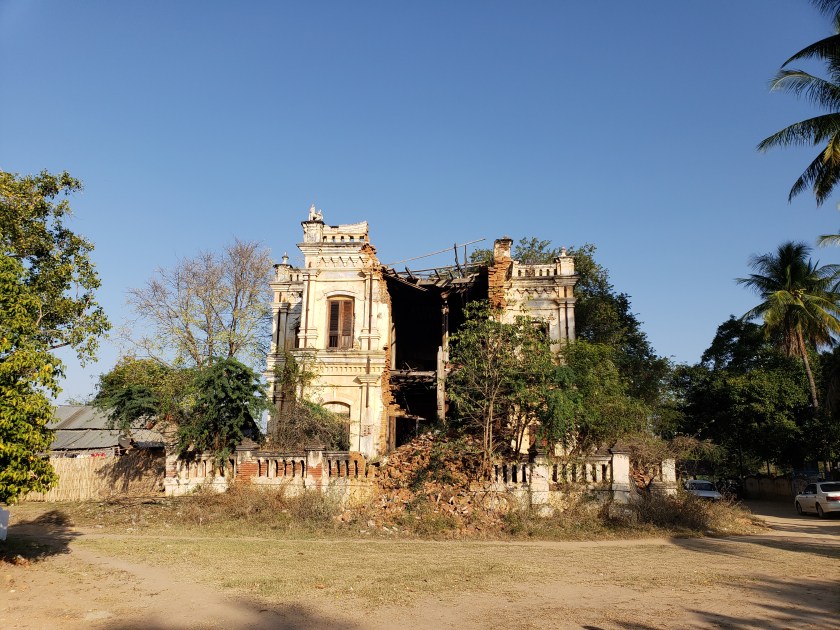
A Salay colonial relic: Beyond “faded” and all the way to “derelict”

The final stop on our Irrawaddy flotilla steamer cruise before Bagan was the former colonial outpost of Salay. We unfortunately arrived in the heat of the afternoon, maybe because our schedule had been off for the last couple of days due to a 3-hour delay when we ran aground on one of the Irrawaddy’s many sandbars. We’d been warned in advance to expect such minor mishaps and to be flexible, and the delay had been a non-issue for the most part (and actually kind of interesting to watch the maneuvers involved in extricating the boat from its predicament).

Anyway, for whatever reason, we trooped up to Salay in the heat of the afternoon, past small groups of locals resting in the shade and no doubt wondering what we were doing out and about at that inhospitable time of day. We wandered through an extensive group of monasteries and temples, to visit a small temple housing the Mann Paya Buddha, the largest lacquered Buddha in Myanmar. The Mann Paya is a hollow wooden statue said to date back to 1300AD that was found in 1888 bobbing in the Irrawaddy after a flood. Locals fished it out of the river, covered it with gold leaf and lacquered it. Yen speculated that it had come from a temple that had fallen into the river, a victim erosion.

Yoke Sone Kyaung monastery

Our next stop was a lovely old teak monastery, Yoke Sone Kyaung, built just prior to the British colonization of Burma. It housed many carved statues and wooden trunks and was decorated extensively with carvings inside and out. We laughed at one bas relief carving outside entitled “Passion for sensual pleasures (or) sensual bondage.” Hmm.

Something’s lost in translation with this carving outside Yoke Sone Kyaung monastery. I think it’s supposed to be about freeing oneself from earthly attachments.

Despite the scattered temples, stupas and monastery buildings, Salay derives its uniqueness from the once-elegant colonial buildings that line many of its main streets. These are remnants of the presence of British military and the Burma Oil Company which housed rig workers in the area starting in 1886. The owners have mostly abandoned the stately buildings to their fate and moved away, and we saw only one newly restored building, its bright pink paint standing out from the faded, peeling glory of its neighbors.

We wandered the streets as the afternoon cooled to evening, arriving at Salay House, another (the only other?) restored building dating back to 1906 that is now an inn and restaurant. It’s the only business of its type in tiny Salay and does boast a pretty garden and a nice river view (although I can’t imagine what I’d do in Salay on an overnight stay, much less for longer). There’s also a shop up front with a museum-style second floor that recreates rooms from the era. It was nice, but felt too touristy to us so we skipped the over-priced sunset drinks and headed back to the ship with a group of like-minded shipmates for our much-loved cocktail hour onboard.

Along the Irrawaddy in Burma: Tant Kyi Taung Pagoda and an Elephant Dance

Main stupa at Tant Kyi Tuang Pagoda (Can you spot the little bird with nesting material in its beak in the metal “flower tree?”)

Although Bagan and its 2000 stupas was the ultimate destination of our river cruise on an Irrawaddy Flotilla Steamer, the first time we saw the city was from across a wide spot in the river and only a few days into our week aboard the steamer. We stopped overnight at Tant Kyi village, so we could visit the hilltop Tant Kyi Taung Pagoda with its sweeping view of the Irrawaddy and Bagan in the distance. Also, being there in the morning allowed us to see the many boats full of locals arrive at sunrise to visit Tant Kyi Taung Pagoda before heading back across the river to Bagan. The point of this early pilgrimage was to try to visit four special pagodas in one day, Tant Kyi Taung and three in Bagan. Yen explained that doing this is said to bring about the granting of a prayer, but the only way to visit all three is to begin in at dawn.

Boatfuls of Burmese arrive at dawn at Tant Kyi to begin their four-pagoda pilgrimage

Sure enough, we heard the loud roar of local boats starting before sunrise. (It’s a miracle everyone in this country isn’t deaf by thirty given the onslaught of loud noises in so many places: engines, pounding hammers, slamming looms, blaring music… and no ear protection in sight. Thank God things quiet down fairly early in the evenings!) Boat after boat moored along the dirt bank as crowds of locals streamed ashore. In the distance, as the sun came up, we watched the first hot air balloon launch over Bagan, soon followed by more.

Sunrise over Bagan and the first hot air balloon is up (to the right of the sun). Meanwhile, boats of pilgrims still stream towards Tant Kyi.

Although visiting the Tant Kyi Taung Pagoda was on our agenda, too, we had no intention of trying to do the holy four so were able to get a more leisurely start to our day. Vans drove us through the village into the countryside and dropped us off at the base of a hill. We followed yen up what was nothing more than a forest path, past an ancient man-made reservoir with a naga-sheltered Buddha overlooking the quiet spot.

Buddha watching over an ancient reservoir on the path to Tant Kyi Taung Pagoda

Further up the hill, we reached steps that took us into the shops and monasteries surrounding the steps and tall, free-standing elevator up to the main stupa of the pagoda. This might be a good place to explain the terms “pagoda,” “stupa,” and “temple” as used in Myanmar. In Myanmar, “pagoda” refers to a whole religious complex and may contain many stupas and temples. A stupa is a solid religious structure, often but not always, bell-shaped and frequently gilded. A “temple” is a hollow religious structure that may be entered and/or that houses a Buddha. At least, these are the definitions I’ve been given and how I’ll use them here.

Tant Kyi Taung Pagoda centers around a large golden stupa (see top photo). Several smaller temples surround it, including one with a tall golden Buddha pointing east towards Bagan across the river. The view from the terrace surrounding the main stupa is, pardon the pun, stupendous.

View from Tant Kyi Taung Pagoda

After visiting Tant Kyi Taung Pagoda, we stopped at Ayardaw Clinic, one of eight in the area supported by Pandaw, the company that owns the fleet to which our riverboat steamer belongs. The clinic has an indoor waiting area, one small examining room, and outdoor seating on a porch overlooking the river. A sign informed us that 76,804 patients had been seen since 2011 at a cost of pennies/patient. Most received simple care, while some 543 had received “treatment” or more complicated procedures. The clinics are open two days a week and doctors travel a circuit to man them.

Elephant dance acrobatics. I loved watching the children, especially the boy holding his little sister (whose face is fully covered with thanaka). We saw lots of older siblings cheerfully caring for the younger ones.

Our last stop for the day was an “elephant dance” set up on the river bank near our boat, something that turned out to be charming and much more fun than we expected. Two men danced inside an ornate elephant costume to the music of a live band while local children and adults joined us to laugh and clap.

The men manipulated the heavy costume in head-wagging, trunk-swinging moves, then climbed atop a table or stairs to a small disc to continue their dance on the precarious perch. At times, one man would hold the other so that the elephant stood on its front or hind legs. Impressive!

Irrawaddy riverboat cruise continued: Pakokku

My Pakokku friend with her pretty longyis and scarves

Another fun stop on our river steamer cruise down the Irrawaddy was at the large town of Pakkoku (population of about 100,000). As always, we moored at a rough bank of the river, no pier in sight. This time, we hiked up a steep flight of narrow stairs to find ourselves at a single-file footpath along the side of a field. As soon as we made the top of the river bank, we found women waiting to sell us the ubiquitous souvenirs: longyi (the local tube skirts worn by nearly everyone), jewelry, scarves and the like. One woman latched onto me immediately and we went through the now-familiar “you like?/maybe later?” routine. Although they can be persistent, we’ve found the Burmese to be much less pushy than other Asian vendors. Burmese are generally a friendly, cheerful group; the people on the street tend not to make overtures to us first, but they beam back when we smile at them and wave, or greet us with a bright “Mingalaba!,” the local greeting that is sort of a combination of “hello” and “auspiciousness to you.” Vendors do approach or call to us, of course, but they’re not overly aggressive, just hopeful. There was something particularly charming about my new friend, and I found myself considering that “maybe later” as she followed along the footpath with me. At the far end of the field, three larger, truck-style tuk tuks awaited our group. Climbing aboard, we were off on a dirt road through fields and past ox carts until we came to the intersection with a major paved road.

Our tuk tuk passes an oxcart on the road from our riverbank mooring to the main road to Pakokku.

We followed the paved road into town and our first destination, a large food market. Here, the boat organized something clever and fun: We were each given a scrap of paper with the phonetic spelling of the Burmese word for a vegetable and sent us off with 1000 kyat (about 66 cents) to try to buy the indicated item. We quickly realized the vendors nearest the road couldn’t hear us over the traffic noise much less understand our poor attempts at Burmese, so we headed toward the interior stalls, but found the vendors there just grabbed our scraps of paper and tried to sound out the word themselves using their school-learned knowledge of English. (We’ve found all over that a fair number of Burmese know some English, but, in general, their pronunciation is extremely difficult to understand, they often don’t comprehend what we’re saying, and there is a lot of confusion on both sides before some level of understanding is worked out.) The first stall I asked, took my paper, then pointed me to another stall, calling to the woman there the name of the vegetable I was to buy. That woman gave me a light green vegetable looking a lot like chayote squash…and handed me back 700 kyat. Hmm. Asking others in our group, I decided to go back and buy another two of the things, leaving me with 100 kyat in change. Alrighty, I was feeling like a success. Our guide, Yen, quickly popped my bubble when we got back on the boat and I showed him my purchase and my slip of paper. Apparently, I was supposed to get some sort of chilies. I wasn’t alone in my failed vegetable search, but we had fun listening to Yen explain what the unknown items were, how to cut and prepare them, and the dishes they were popularly used in.

In the Pakokku vegetable market

After the market, we made a stop at a school supply store to let us buy some items for a local “orphanage.” Although the home for children is labeled an orphanage, the children have parents who’ve sent them away to be raised and schooled as monks/nuns. The children ranged in age from 6 or so to a few older teenagers. Boys dressed in orange robes, girls in pink, all had their heads shaved. We noticed several with bald patches on their scalps, skin disease which Yen said resulted from sharing razors. We glimpsed the girls’ dormitory, a jumble of plywood beds, pink robes…and a favored teddy bear.

Girls’ dormitory at the Pakokku “orphanage”

We watched the children begin their lunch with a chanted prayer as they sat cross-legged at long tables. This mid-day meal would be their last of the day, and they ate breakfast at 4:30am.

I tried to picture my boys on such a restricted diet at the ages of these children. Growing like weeds, my children were ever-hungry at those ages. I remembered, too, all the hugs, love and attention I lavished on them and all the love I received in return. It saddened me to think of the circumstances that would make this poor orphanage seem like a better option for my child than home.

Lunchtime prayers at the Pakokku orphanage.

My friend from the first moments off the boat had preceded us to both the vegetable market and the orphanage, she and a friend speeding ahead on motorbikes. She’d greeted me at both places, making sure I didn’t forget her and that “maybe later.” We posed together for photos at the market as she’d asked when we first met, wanting a photo to show her children she said. (Of her with one of those strange-looking foreigners, I guess.) Now, back at the footpath through the field, I gave in, haggling with her a little to buy a pretty, tourist-style longyi (which have waist ties, unlike the tube skirts worn by the natives which they simply fold and tuck). Just as we were parting, she told me she’d sold a longyi to another woman in our group for more than she’d sold me mine and asked me not to tell the other woman. I thought it was sweet that she didn’t want the other woman to feel bad…but had to wonder if maybe she’d sold me mine for more and didn’t want me to know. Oh well, the difference couldn’t be much as the price was not expensive in any event. Later, a friend on the boat who saw I’d bought the same longyi as her in a different color asked me what I’d paid. I wouldn’t have said anything if she hadn’t asked me directly, but I couldn’t see not answering her since neither of us would ever see my Pakokku friend again. Anyway, it turns out I did get the cheaper price.

Yandabo Pottery Village, Myanmar

Yandobo potter with finished works

One of my favorite stops on our Irrawaddy riverboat cruise was Yandabo, a village known for pottery production. Yandabo is cleaner and more prosperous looking than many of the villages along the Irrawaddy. The government is assisting with funds to build a river wall (erosion being a big problem along the Irrawaddy) and the locals organized to clean up trash (another big problem along the river and in the villages). We were impressed to learn that the entire family of potters we visited had university degrees. Sadly, though, they could earn more making terracotta pots.

Corn cobs and husks are used in pottery making. Corn husks are also used to roll cigars. The kernels are exported, mostly to China.

The pottery-making process was interesting and impressive, in part because the methods and equipment are so primitive and labor-intensive. The potter’s wheel is powered with the help of an assistant manning foot pedals. Pots are shaped and stamped by hand, each decorative pattern indicative of the family who made the pot. We see the distinctive-shaped pots everywhere on the many water stands provided free to all by families who establish these stations as a way of obtaining good karma. Clay pots are also the preferred cooking vessel in Myanmar, metal said to give certain curry dishes a dark color.

Stamping the family design onto a pot (This lady has a degree in history.)

As always, we found the locals to be exceedingly friendly and welcoming. A boy of twelve or so gave me a tiny clay dog figurine. Unsure if I was expected to pay, I asked our guide, but he assured me it was a gift and nothing was expected in return. Later, after demonstrating the making and decorating of pot (and also how to carry three at a time, one on each arm and one on the head, see the top photo), our main hostess did offer small pottery souvenirs for sale, but there was absolutely no pressure to buy.

In Yandabo, we lucked into arriving while the village was preparing for the sticky rice celebration. These celebrations were taking place all over Myanmar because of the full moon. We’d gotten a kick out of joining a sticky rice street party in Mandalay where a mob of young boys danced to blaring music around big paella-style skillets of cooking sticky rice, but this was different. Unlike sticky rice in the city which is made by machine in factories, the village makes its communal sticky rice with a large pounding mallet-like contraption requiring the efforts of five people.

Preparing for the sticky rice “festival.” The celebrations take place on the full moon. Once the rice is poured into the stone bowl (which serves as a sort of mortar), the girls to the right will provide the pounding action while the young man reaches in between beats to pull and turn the glob of rice. The women to the left are making the sticky rice into balls.

We found the process as interesting as the scheduled pot-making. I couldn’t help but snap several photos of a beautiful little girl dressed in emerald green finery for the celebration. Looking no more than three or four, she was pensive with expressive little hands as she crouched or stood by her mother who was one of a small group of women rolling balls of sticky rice as it came from the mallet-machine. She wore a gorgeous emerald green blouse and longyi, her face made up with ever-popular thanaka. This little beauty is the focus of some of my favorite photos of the trip so far.

Although everyone around her was laughing and chattering, this little one remained serious and quiet.
error: Content is protected !!