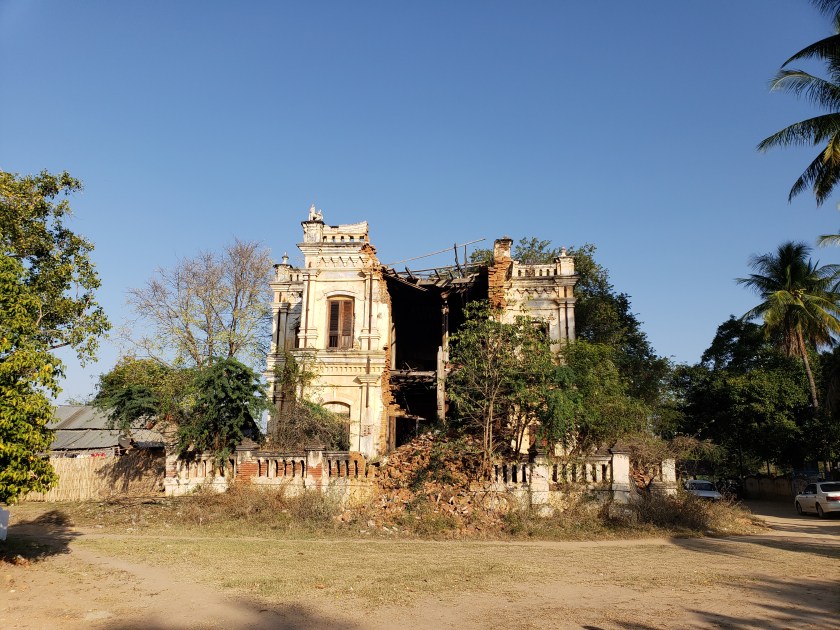
A Salay colonial relic: Beyond “faded” and all the way to “derelict”
The final stop on our Irrawaddy flotilla steamer cruise before Bagan was the former colonial outpost of Salay. We unfortunately arrived in the heat of the afternoon, maybe because our schedule had been off for the last couple of days due to a 3-hour delay when we ran aground on one of the Irrawaddy’s many sandbars. We’d been warned in advance to expect such minor mishaps and to be flexible, and the delay had been a non-issue for the most part (and actually kind of interesting to watch the maneuvers involved in extricating the boat from its predicament).
Anyway, for whatever reason, we trooped up to Salay in the heat of the afternoon, past small groups of locals resting in the shade and no doubt wondering what we were doing out and about at that inhospitable time of day. We wandered through an extensive group of monasteries and temples, to visit a small temple housing the Mann Paya Buddha, the largest lacquered Buddha in Myanmar. The Mann Paya is a hollow wooden statue said to date back to 1300AD that was found in 1888 bobbing in the Irrawaddy after a flood. Locals fished it out of the river, covered it with gold leaf and lacquered it. Yen speculated that it had come from a temple that had fallen into the river, a victim erosion.
Yoke Sone Kyaung monastery
Our next stop was a lovely old teak monastery, Yoke Sone Kyaung, built just prior to the British colonization of Burma. It housed many carved statues and wooden trunks and was decorated extensively with carvings inside and out. We laughed at one bas relief carving outside entitled “Passion for sensual pleasures (or) sensual bondage.” Hmm.
Something’s lost in translation with this carving outside Yoke Sone Kyaung monastery. I think it’s supposed to be about freeing oneself from earthly attachments.
Despite the scattered temples, stupas and monastery buildings, Salay derives its uniqueness from the once-elegant colonial buildings that line many of its main streets. These are remnants of the presence of British military and the Burma Oil Company which housed rig workers in the area starting in 1886. The owners have mostly abandoned the stately buildings to their fate and moved away, and we saw only one newly restored building, its bright pink paint standing out from the faded, peeling glory of its neighbors.
We wandered the streets as the afternoon cooled to evening, arriving at Salay House, another (the only other?) restored building dating back to 1906 that is now an inn and restaurant. It’s the only business of its type in tiny Salay and does boast a pretty garden and a nice river view (although I can’t imagine what I’d do in Salay on an overnight stay, much less for longer). There’s also a shop up front with a museum-style second floor that recreates rooms from the era. It was nice, but felt too touristy to us so we skipped the over-priced sunset drinks and headed back to the ship with a group of like-minded shipmates for our much-loved cocktail hour onboard.
My Pakokku friend with her pretty longyis and scarves
Another fun stop on our river steamer cruise down the Irrawaddy was at the large town of Pakkoku (population of about 100,000). As always, we moored at a rough bank of the river, no pier in sight. This time, we hiked up a steep flight of narrow stairs to find ourselves at a single-file footpath along the side of a field. As soon as we made the top of the river bank, we found women waiting to sell us the ubiquitous souvenirs: longyi (the local tube skirts worn by nearly everyone), jewelry, scarves and the like. One woman latched onto me immediately and we went through the now-familiar “you like?/maybe later?” routine. Although they can be persistent, we’ve found the Burmese to be much less pushy than other Asian vendors. Burmese are generally a friendly, cheerful group; the people on the street tend not to make overtures to us first, but they beam back when we smile at them and wave, or greet us with a bright “Mingalaba!,” the local greeting that is sort of a combination of “hello” and “auspiciousness to you.” Vendors do approach or call to us, of course, but they’re not overly aggressive, just hopeful. There was something particularly charming about my new friend, and I found myself considering that “maybe later” as she followed along the footpath with me. At the far end of the field, three larger, truck-style tuk tuks awaited our group. Climbing aboard, we were off on a dirt road through fields and past ox carts until we came to the intersection with a major paved road.
Our tuk tuk passes an oxcart on the road from our riverbank mooring to the main road to Pakokku.
We followed the paved road into town and our first destination, a large food market. Here, the boat organized something clever and fun: We were each given a scrap of paper with the phonetic spelling of the Burmese word for a vegetable and sent us off with 1000 kyat (about 66 cents) to try to buy the indicated item. We quickly realized the vendors nearest the road couldn’t hear us over the traffic noise much less understand our poor attempts at Burmese, so we headed toward the interior stalls, but found the vendors there just grabbed our scraps of paper and tried to sound out the word themselves using their school-learned knowledge of English. (We’ve found all over that a fair number of Burmese know some English, but, in general, their pronunciation is extremely difficult to understand, they often don’t comprehend what we’re saying, and there is a lot of confusion on both sides before some level of understanding is worked out.) The first stall I asked, took my paper, then pointed me to another stall, calling to the woman there the name of the vegetable I was to buy. That woman gave me a light green vegetable looking a lot like chayote squash…and handed me back 700 kyat. Hmm. Asking others in our group, I decided to go back and buy another two of the things, leaving me with 100 kyat in change. Alrighty, I was feeling like a success. Our guide, Yen, quickly popped my bubble when we got back on the boat and I showed him my purchase and my slip of paper. Apparently, I was supposed to get some sort of chilies. I wasn’t alone in my failed vegetable search, but we had fun listening to Yen explain what the unknown items were, how to cut and prepare them, and the dishes they were popularly used in.
In the Pakokku vegetable market
After the market, we made a stop at a school supply store to let us buy some items for a local “orphanage.” Although the home for children is labeled an orphanage, the children have parents who’ve sent them away to be raised and schooled as monks/nuns. The children ranged in age from 6 or so to a few older teenagers. Boys dressed in orange robes, girls in pink, all had their heads shaved. We noticed several with bald patches on their scalps, skin disease which Yen said resulted from sharing razors. We glimpsed the girls’ dormitory, a jumble of plywood beds, pink robes…and a favored teddy bear.
Girls’ dormitory at the Pakokku “orphanage”
We watched the children begin their lunch with a chanted prayer as they sat cross-legged at long tables. This mid-day meal would be their last of the day, and they ate breakfast at 4:30am.
I tried to picture my boys on such a restricted diet at the ages of these children. Growing like weeds, my children were ever-hungry at those ages. I remembered, too, all the hugs, love and attention I lavished on them and all the love I received in return. It saddened me to think of the circumstances that would make this poor orphanage seem like a better option for my child than home.
Lunchtime prayers at the Pakokku orphanage.
My friend from the first moments off the boat had preceded us to both the vegetable market and the orphanage, she and a friend speeding ahead on motorbikes. She’d greeted me at both places, making sure I didn’t forget her and that “maybe later.” We posed together for photos at the market as she’d asked when we first met, wanting a photo to show her children she said. (Of her with one of those strange-looking foreigners, I guess.) Now, back at the footpath through the field, I gave in, haggling with her a little to buy a pretty, tourist-style longyi (which have waist ties, unlike the tube skirts worn by the natives which they simply fold and tuck). Just as we were parting, she told me she’d sold a longyi to another woman in our group for more than she’d sold me mine and asked me not to tell the other woman. I thought it was sweet that she didn’t want the other woman to feel bad…but had to wonder if maybe she’d sold me mine for more and didn’t want me to know. Oh well, the difference couldn’t be much as the price was not expensive in any event. Later, a friend on the boat who saw I’d bought the same longyi as her in a different color asked me what I’d paid. I wouldn’t have said anything if she hadn’t asked me directly, but I couldn’t see not answering her since neither of us would ever see my Pakokku friend again. Anyway, it turns out I did get the cheaper price.
One of my favorite stops on our Irrawaddy riverboat cruise was Yandabo, a village known for pottery production. Yandabo is cleaner and more prosperous looking than many of the villages along the Irrawaddy. The government is assisting with funds to build a river wall (erosion being a big problem along the Irrawaddy) and the locals organized to clean up trash (another big problem along the river and in the villages). We were impressed to learn that the entire family of potters we visited had university degrees. Sadly, though, they could earn more making terracotta pots.
Corn cobs and husks are used in pottery making. Corn husks are also used to roll cigars. The kernels are exported, mostly to China.
The pottery-making process was interesting and impressive, in part because the methods and equipment are so primitive and labor-intensive. The potter’s wheel is powered with the help of an assistant manning foot pedals. Pots are shaped and stamped by hand, each decorative pattern indicative of the family who made the pot. We see the distinctive-shaped pots everywhere on the many water stands provided free to all by families who establish these stations as a way of obtaining good karma. Clay pots are also the preferred cooking vessel in Myanmar, metal said to give certain curry dishes a dark color.
Stamping the family design onto a pot (This lady has a degree in history.)
As always, we found the locals to be exceedingly friendly and welcoming. A boy of twelve or so gave me a tiny clay dog figurine. Unsure if I was expected to pay, I asked our guide, but he assured me it was a gift and nothing was expected in return. Later, after demonstrating the making and decorating of pot (and also how to carry three at a time, one on each arm and one on the head, see the top photo), our main hostess did offer small pottery souvenirs for sale, but there was absolutely no pressure to buy.
In Yandabo, we lucked into arriving while the village was preparing for the sticky rice celebration. These celebrations were taking place all over Myanmar because of the full moon. We’d gotten a kick out of joining a sticky rice street party in Mandalay where a mob of young boys danced to blaring music around big paella-style skillets of cooking sticky rice, but this was different. Unlike sticky rice in the city which is made by machine in factories, the village makes its communal sticky rice with a large pounding mallet-like contraption requiring the efforts of five people.
Preparing for the sticky rice “festival.” The celebrations take place on the full moon. Once the rice is poured into the stone bowl (which serves as a sort of mortar), the girls to the right will provide the pounding action while the young man reaches in between beats to pull and turn the glob of rice. The women to the left are making the sticky rice into balls.
We found the process as interesting as the scheduled pot-making. I couldn’t help but snap several photos of a beautiful little girl dressed in emerald green finery for the celebration. Looking no more than three or four, she was pensive with expressive little hands as she crouched or stood by her mother who was one of a small group of women rolling balls of sticky rice as it came from the mallet-machine. She wore a gorgeous emerald green blouse and longyi, her face made up with ever-popular thanaka. This little beauty is the focus of some of my favorite photos of the trip so far.
Although everyone around her was laughing and chattering, this little one remained serious and quiet.
We’ve really been looking forward to our time on a wooden Irrawaddy Flotilla Steamer. Prior to WWI, the largest river flotilla in the world was on the Irrawaddy River in Burma. Most of these classic teak wood boats were destroyed, either by bombs or by scuttling. Pandaw, the river cruise line I’d chosen, salvaged and restored one of these boats, then built others, copying the original 1930’s style, but with modern updates. I’d carefully chosen our intimately-sized boat and even the side of the boat I wanted our cabin on. So, I was worried and disappointed to read an email from my booking agent the day before we boarded in Mandalay saying we’d been changed to a larger riverboat. A little research revealed this new boat, the Pandaw Orient, was 8 years older than the original, Pandaw Kindat; worse, the Orient had 30 cabins vs. 18 on the Kindat.
My agent contact, as always, was quick to respond when I voiced my concerns. She did her own research and found that only 12 of the cabins were booked and the cabins were the same size and layout as the original. I felt much better after her reply and after seeing deck plans that showed we were actually gaining a deck and more common space.
Outside our Upper Deck cabin
Sure enough, on boarding, we found a charming and spacious teak wood riverboat. Teak deck loungers, wicker sofas and potted plants give a wonderfully period feel to the boat. Modern touches like air conditioning, common-area wifi and updated bathrooms make for a luxurious cruise. The crew pampers us so much it’s almost embarrassing. Food has been elegant, fresh and plentiful, exceeding expectations. There’s a nightly happy hour on the sun deck with appetizers. Musicians and dancers from a Mandalay school boarded last night to provide a surprisingly high-quality show to our little group of twenty.
Lots of room on the Sun Deck of the RV Orient
We’re only into our second full day as I type (on a teak lounger, watching river life pass by), but already we’ve had several well-thought-out excursions including a sunset outing where we were rowed out, 4 at a time, in small boats for the perfect view. When our oarsman stopped our boat and positioned us among others to watch the sunset, our guide and crew paddled up to deliver cocktails in champagne glasses. Lovely!
Cocktails on a rowboat near Mandalay
We spent our first day aboard moored at Mandalay. After lunch, we were taken on local excursions, first in large tuk tuk trucks to a hilltop pagoda with sweeping views, then by motor coach through Mandalay to the sunset rowboats. As we drove through Mandalay, we got a surprise treat when our bus came upon a sticky rice street party. When we were all curious, our guide Yen asked our bus driver to stop so we could get out and mingle with a group of young men who were dancing (to music blaring, in typical noise-loving Myanmar fashion, from across the street) around two big paella-style vats of cooking sticky rice. They welcomed us to their bash, most dressed in green polo-type shirts…save for one young man who showed up to great fanfare dressed in women’s clothes.
The next day the ship sailed upstream to the village of Mingut before returning to Mandalay for the night.
A “taxi” at Mingun. Thankfully, we could just walk from where we’d moored.
The approach to Mingun is impressive with the large brick remains of a square stupa looming over the river. At first, I wondered if it was some dramatic natural rock formation, but as we walked up to it, we could see the thousands upon thousands of bricks comprising the structure which was severely damaged over a century ago by a violent earthquake. Huge cracks cut through the stupa threatening to cleave large sections of the building away.
Mingun stupa, severely damaged by earthquake
Two enormous lion statues are also in ruins nearby. The king who ordered the building of the structure hoped to build the world’s largest stupa. Instead, our daily briefing describes the Mingun stupa remains as the world’s largest pile of bricks. You’ve got to love Burmese “bright side” thinking! Along the same lines, they describe the huge nearby bell as the “second largest bell in the world that can be rung.” They admit that the largest bell in the world is in Russia, but say you can’t ring that one. Of course, “ringing” the Mingun bell doesn’t involve an interior clapper, but rather pounding on it with logs on the outside.
So, I think I’ll end here with the focus on the boat and our first days. I’ll post more about the river cruise stops later when and if I get time, internet, and the inclination.
Practical info:
I booked our Pandaw Cruise via Happy Travel Asia. My agent, Ms. Hong Nham, was exceedingly responsive and helpful. I am very happy with her and the agency. Our cruise was a Mandalay – Pagan – 8 day/7 night downstream cruise. The total price for the two of us in what was originally to be a main deck cabin on the Kindat and was upgraded to a upper deck cabin on the Orient was $3,352.00. We paid 30% upon booking in July and the balance in November for a February cruise.
All cabins are identical in layout, cozy at 16m squared, and totally paneled and outfitted in teak wood. (Even our shower has a louvered teak door!) Each cabin has two single beds that can be configured as one large bed. The front is further from the engine, but closer to bridge crew activity and the horn. The stern has crew activity as well.
There is a lot of noise on the Irrawaddy in general and boat traffic starts early. Engine noise on passing boats can be almost absurdly loud; it seems you’d have to try to create a motor that loud. No one navigates the river after dark as it is perilously studded with ever-shifting sand bars. We’ve been stuck once for a few hours. Boats moor for the night and villages are quiet soon after dark as well. Our boat had considerable engine noise at times, depending on the maneuvering. The higher deck must be quieter than lower one simply because it is closer to the engine, but that is simple deduction, not personal experience. Front cabins seem to be quieter than those near the stern, but pulling in and extending the gangplank is said, by those with the bowmost cabins to be extraordinarily loud. Despite the occasional noise, nights are quiet and we sleep well.
Local beer and spirits (gin, rum, vodka and whiskey) are included. Wine and premium (non-Burmese) spirits are extra, but not unreasonably priced.
The makeup of our particular group is all British save for 3 Americans (including us) and two Frenchwomen. We have an English-speaking guide who goes everywhere with us when ashore. We’re as well looked-after ashore by helpers who greet us with icy disposable wipes after each stop where we take off our shoes (every temple and monastery) so we can clean our feet. Very nice.
Some stops require climbing up dirt or sand banks which could be difficult for persons with mobility issues. Crew do stand along the way to lend a hand and help, though, and at least partial steps are dug out to make the going easier. We had no problem at all with any of this.