As I’ve written many times, one of the best benefits of collecting Chase Ultimate Rewards points is their partnership with Korean Air which offers lots of good-value award availability between the U.S. and Asia. We’ve used our points for two fabulous first class flights to Asia and have booked a third. We had a fourth in our sights, but Chase just announced they’re ending their partnership with Korean Air SKYPASS. And in only ten days! This is terrible news.:
“We want to let you know about an important change we’re making to Chase Ultimate Rewards®.
• Beginning August 25, 2018, Korean Air SKYPASS will no longer be a participating point transfer travel partner.
• If you’re planning to transfer Ultimate Rewards points to Korean Air SKYPASS, your order must be placed by August 24, 2018.
What’s not changing You can continue to transfer points to any of our other 12 airline and hotel travel partners at 1 to 1 value. You can also redeem your points toward cash back, gift cards and travel directly through Chase Ultimate Rewards.
Thank you for being a valued Chase Sapphire Reserve cardmember.”
Horrible. And “thanks a lot” for the short notice, Chase.
We got our first chance to try De Waterbus yesterday, the river bus that leaves from Antwerp’s Steenplein and makes a 30-minute run to nearby Hemiksem via Kruibeke. De Waterbus is new as of July 2017 so not yet in service when we were here last spring and not so appealing during the cold days when we were in Antwerp last October-November. Yesterday, however, was perfect: warm and sunny; just right for an explore.
The Waterbus leaves every 30 minutes on the hour and half-hour from Steenplein (the pier where the free cross-river ferry to Linkeroever docks, near Het Steen castle). The cost is €3 for a one-way trip or €5, round-trip. De Waterbus has plenty of room and racks for bikes and a nice, air-conditioned interior and public toilets.
It’s fun to watch the bustling water traffic on the Schelde while the banks are mostly high water reeds and grasses or industrial structures. Antwerp is the second largest port in Europe after all.
The Waterbus made a quick stop on the right bank at Kruibeke, but we stayed on to Hemiksem on the opposite bank where walked a short distance to De Veertoren Taverne a pub I’d spotted online for lunch. There’s nothing else near the dock save tidy new homes.
Terrace at De VeertorenWednesday lunch special at De Veertoren: a hearty and tasty steak/frites
After a nice lunch of steak, frites, salad and ice cold Gouden Carolus Tripels, we hopped the free cross-river ferry to the Kruibeke side of the river. (This ferry runs every half hour on the 14 and 45.) I’d seen Castle Wissekerke in the village of Bezel online and wanted to visit, but had been discouraged in the past by the apparent need for a car. I was excited to realize we could actually walk from a Waterbus stop. Checking Google Maps, I saw it’s actually a much shorter walk to the castle from the bank opposite Hemiksem (2 km) than it is from the Kruibeke Waterbus stop (2.5 miles) even though Bezel is in the Kruibeke municipality. The ferry dropped us off at a small parking lot that gave way immediately to the bike trails of the Kruibeke Polder. “Polders” are manmade emergency flood plains that also serve as extensive biking trails connecting towns throughout Flanders and the Netherlands as well as being nature preserves and walking paths. We were the only pedestrians getting off the ferry and we would have loved to have bikes, but it’s still a nice walk and we enjoyed our stroll through wild wetlands and marshy forest. The bikes are routed away from the cobblestone walking path which is an added benefit for those on foot.
Kruibeke Polder just off the cross-river ferry from HemiksemWalking path in Kruibeke PolderMarshy alder tree forest in Kruibeke polderSluice in Kruibeke Polder
In no time, we arrived at picturesque Castle Wissekerke surrounded by a little lake populated with swans, geese and ducks.
Castle Wissekerke
Entrance is €5/adult and happily included an English-language booklet with two paths through the castle, one for the nobility and one for servants. We were turned loose to explore the castle which we had almost entirely to ourselves. It was fun and refreshing to be allowed to look through documents, open secret doors, climb a bell turret, descend to the medieval cellar and kitchen, and generally wander and indulge our curiosity with minimal restraint. (There’s a children’s academy of some sort using a portion of the building and that was one of the few areas we weren’t encouraged to visit.)
“Vestibule” of Castle WissekerkeGothic-style living apartment, a change from the majority Napoleonic/Empire decorServant’s stairway to bell tower
The castle was the home of the family of Count Philippe Vilain XIII and is mostly decorated in restored Napoleonic glory. There are many original items as well as period pieces. Although the castle dates back to the middle ages, it’s current iteration is more a mansion than a fortification. We thoroughly enjoyed our visit to Wissekerke and are happy the Waterbus and ferry made it doable on foot from Antwerp.
Neglected belfryDining room with original china, crystal and silver on displayChapel of Castle Wissekerke
We wandered through the terrace of a charming café called Bistro Den Duiventoren next door to the castle and peeked in a little “free museum” and bar across the street which is only open on the weekends before retracing our steps to the cross-river ferry and then catching De Waterbus back to Antwerp.
Cross-river ferry dock at Kruibeke Polder with ferry visible on opposite bank at Hemiksem
Drop-off point for shuttles to and from the Civitavecchia cruise port. Note Hertz sign circled in green across the street where rent car companies pick up their customers. Cruise shuttles let passengers off in a big parking lot to the right of where I’m standing to take this photo.
Our month cruise from Singapore to Italy was better than we could have hoped for, but now it was time to be back on our own and we were looking forward to it. Civitavecchia is the nearest port to Rome and most information about the port assumes people are going to Rome either to stay or to fly out of the airport. We’d used a driver in the past to get from the port to Rome, but this time we were skipping the Italian capital and heading north. I wanted to rent a car for the 2+ weeks we planned to tool around Umbria and Tuscany, but I had trouble finding clear info online. I knew the port was too big to walk out of and that passengers not wanting to rely on expensive cruise ship excursions and transfers needed to get out of the main port gate to get to other modes of transport–taxi, train, rent cars–but the info was vague. This short post is just to clarify transport options and the lay of the land at the Port of Civitavecchia.
The ship offered a free motor coach shuttle to an area just outside the port gates where other transportation is offered. Buses for the train station pick up here for €2 per person. Rent car pick up is just across the street. I’d booked us a Hertz rent car and emailed with them from the previous port. When we left the ship, I called them (Hooray again for T-Mobile international!) and a van arrived to pick us up shortly after we got off the ship’s shuttle. Another 5-minute drive and we were at the Hertz office in a nearby strip center where we did paperwork and were on our way in short order.
Katakolon, Greece, is an easy port for cruise passengers. Although Ancient Olympia is the main draw, the quaint waterfront town of Katakolon sits just at the end of the cruise pier. I’d visited Katakolon and Ancient Olympia years ago with my sons. We’d taken an excursion to Ancient Olympia then, but I wanted more freedom on this visit so I’d arranged a Sixt rent car for the day.
In doing my pre-trip research, I found Sixt to offer the best price as well as port-side car drop off. Sure enough, a nice young woman was waiting with a car when we walked off the pier. Some paperwork and a quick inspection of the car to make sure there were no dings or malfunctions that might later be attributed to us and we were off.
Doing a little paperwork for our Sixt rental car
I’d downloaded driving directions to Olympia and the Mercouri Estate winery pre-trip and added them to my calendar. Coordinates and addresses at the ready made it easy to program in our destinations and T-Mobile had us connected in Greece and data-ready so Google Maps had us covered. The roads in the area nice and well-signed and it was an easy 30-40-minute drive to Ancient Olympia. Our only slight snag was when Google Maps took us to the tour bus parking. A few questions and a little luck put us in a free parking lot right by the Ambrosia Garden Restaurant and a wide paved footpath that lead across a small creek to the Archaeological Museum of Olympia. (The path is wide with white stone lines laid across concrete and regular intervals. If Ambrosia is on your left, the museum is ahead. The path is visible on Google satellite view of the area.)
Archaeological Museum of Olympia
We paid €12 apiece for a ticket that granted entrance to the archaeological site and three associated museums: the Archeological Museum, the Museum of the Ancient Olympic Games and the Museum of the History of the Excavations at Olympia. We decided to save the museum for later and went straight to the archaeological site where we spent a couple of hours wandering the many ruins.
Ancient Olympia Archaelogical SiteTemple of Hera in Ancient Olympia
The Archaeological Museum was a great ending to our site visit. Although not large, the collection is impressive and well laid out. The building is modern and well lit and there are clean modern toilets available in an area accessible downstairs and to the left of the main doors as you exit into the outside courtyard. We opted to forego the other two museums.
Praxiteles Hermes, superstar of the Archaeological Museum of Olympia
Walking back along the footpath to our car, we decided that Ambrosia offered a too-easy and appealing place to stop for lunch. We ate outside under a vine-covered lattice and thoroughly enjoyed our Greek lunch.
Hearty Greek lunch at Ambrosia
Back in the car, we drove about 30 minutes straight to Mercouri Winery only to slip through their wide gate just before closing time. I’d downloaded their brochure, but completely forgot that they close at 3pm, Monday through Saturday. Our hostess was a little less than welcoming, but all turned out well. She sold us a tasting of wine and left us to wander on our own, just asking that we avoid a cruise ship tour that was on the property. We preferred to be on our own anyway, so that was no problem…if a little less-than-flattering in her delivery. Oh well.
We explored the gorgeous grounds, sipping our wine and charmed by the peacocks we found, especially the male in full display, slowly rotating at the top of a split stairway leading to the slightly-crumbling original estate house.
Old Mercouri Estate House (with a peacock in full display on the landing just above the main arched door)
A marble marker proclaimed a self-rooted vineyard to have been planted in 1870. Oranges and flowers, antique wine-making equipment and an old well decorated the winery while the sea sparkled in the distance. It was all achingly picturesque.
From Mercouri, it’s a less than 10-minute drive back to Katakolon. With plenty of time until we had to be back aboard ship (and the car rented for 24-hours), we decided to check out a local beach before heading back to town. We found long, sweeping beaches near town lined with houses and totally deserted but with tire tracks showing that these were, as in my native Texas, drive-on beaches. When you have a wealth of beach, it’s a thing.
Beach near Katakolon (cruise ship was visible in the distance to the right)
We dropped off the car in the same spot we’d left it, rendezvousing with the same nice young woman. In our remaining time, we explored the quaint, touristy streets and waterfront of Katakolon. We sampled local food and drink set out in the many shops, finally buying a bottle of honey wine before heading back to the ship.
______________
Practical info: I rented our little 4-door Volkswagen hatchback online from Sixt for €38.49 including all taxes and fees. (There were lots of taxis waiting at the port as well as cars and vans available for on-the-spot rental. There is also a €10/person train that runs from near the port to Ancient Olympia, but if you miss it coming back, you’re on your own.) Entry to Ancient Olympia and its museums was €12/person. Mercouri Winery usually charges €10/person for a tour and tasting. We were charged something less, but I forget what.
By way of comparison, the ship offered a 5h30min. excursion to Olympia and the Mercouri Winery for $179/adult and $159/child. A 5h15min. excursion including a tour of Ancient Olympia, the Archaeological Museum and free time cost $119/adult and $99/child. Neither excursion appeared to include lunch.
On the Acropolis: The Erechtheion and its beautiful caryatids
After transiting the Suez Canal, our first port in Europe was Piraeus, Greece, the nearest port to Athens. I’d been to Athens a couple of times before, but it had been awhile and I’d never been with David, so we were both really looking forward the day. We wanted to do Athens on our own, though, and planned to take advantage of the Metro system. Not only did the Metro offer freedom of movement, but it is also very cost-effective, particularly when compared with exorbitant cruise line excursions.
Celebrity “Constellation” docked at Terminal C, Gate E12 of the Port of Piraeus
Our ship docked at Cruise Terminal C “Alkimos” of the massive Piraeus port. Our Gate was E12, although the gate itself referenced Terminal B “Themistocles” which I think was the terminal building just next to ours where another Celebrity ship was docked. In any event, cruise ships dock at Gates E11 and E12; Gates E1-E10 are docks for the many ferries that service Greece’s scattered islands. The Piraeus Metro station is near Gate E6, a walk we made in about 30-35 minutes. There are buses that run between the far gates and the Metro Station and nearby train station, but we had too little information regarding buses at that point to be sure which one to choose (although we could have asked a driver or waiting passengers) and we were curious to at least see a little of Piraeus before we headed into Athens for the main show.
We started walking down this road from Gate E12 towards the Metro and train stations. The water is on the left here. To catch a bus going to the stations, we would have had to wait at a stop on the opposite side of the road from the bus approaching in the photo.
We walked on a wide sidewalk with the water of the port on our left. The Metro station was eventually on our right, across a broad street. There is usually a pedestrian bridge over the road to the Metro station and nearby train station, but it was closed due to construction along that stretch of the road. Still, between Google Maps (thanks to our T-Mobile international data plans) and following the crowds of people moving with the purposefulness of commuters, it was easy to find the crossing to the station. Just inside the station, we split up with me heading to a bank of ticket machines to the left of the main doors and David getting in line for a live teller to the right. I was easily the “winner” and flagged him away from his slow-moving line as soon as I had our 5-ride passes in hand.
Live tellers to the right as we entered the Piraeus Metro StationTicket machines to the left of the Piraeus Metro Station doors as we entered
Since Piraeus is the terminus of the Green Line 1 of the Athens Metro system, there was nothing to picking the right train. Metro Line 1 that runs between Piraeus and Athens is the descendent of a steam railway opened between the two cities in 1869. It’s the only one of the three Athens Metro lines that runs primarily above ground. The cars are nice and modern, although on our return to Piraeus in the late afternoon our car lacked adequate air conditioning and I was too warm until I could move into a seat where a breeze through a high, open blew directly on me.
All departing Metro trains in Piraeus are going to Athens
Hoping to beat the worst of the day’s heat, we wanted to check the Acropolis off our list first. We rode the Green Line 1 eight stops to Omonia and changed there for the Red Line to ride three stops to the Akropoli Metro station. We just followed signs and found navigating the Athens Metro to be easy.
Athens Metro signs are easy to follow
The escalator from the Metro station opened onto a cobblestoned, mostly-pedestrian street. A short walk straight ahead in the direction we exited the Metro and a turn to the left found us at the entrance to the Acropolis. Unfortunately, a not insubstantial line was already formed. Given the docking time of our ship, the 8am opening time at the Acropolis, and the travel time to Athens (which was not appreciably longer by Metro than it would have been by bus or car through traffic), we knew there was no way to beat the crowds, but this was daunting.
Line for tickets to the Acropolis
The hold-up appeared to be only two tellers and an inefficient charging system. Guides hawked tours, promising to the ability to cut the line, and we considered it, although we didn’t want a guide, just the cut. A nearby sign tantalized with the information that online tickets to the Acropolis will be available soon. Oh well, we just waited. It actually wasn’t too bad and we through the line in about twenty minutes. (It did get warm in the sun, though, even in early May. An umbrella/parasol wouldn’t be a bad idea, especially if you find yourself at the Acropolis in the summer.) Although a €20 ticket for just the Acropolis and its slopes is available, we opted for the €30 package ticket that includes the Ancient Agora, Roman Agora, Hadrian’s Library and more.
Crowds were spread out across the expansive slopes and walkways leading up to the Acropolis, so we could view the approach, theater/odeon, etc. relatively comfortably. But, crowds were funneled back together at the main stairs.
Southwestern slopes leading to the AcropolisOdeon of Herodes Atticus
This is one of the frustrating facts of visiting someplace on a cruise or when a cruise ship or ships are in port: hordes of people wanting to visit a major site all at once. Having visited on much less crowded occasions, I regretted that this was David’s first glimpse of the famous ruins.
Hordes on the main stairs to the Acropolis
Moreover, extensive work is being done on the Parthenon and other structures, so large areas are cordoned off and work-in-progress is visible from nearly every part of the Acropolis. Despite the drawbacks, it is still one of the great wonders of the ancient world and it was good to be back.
ParthenonParthenon
Descending from the Acropolis, we headed north this time, following signs to the Roman Agora. We wandered this small rectangle of ruins, admiring its unique octagonal Horlogion or Tower of the Winds which once housed a 2nd century BC water clock.
Inside the Roman Agora with the octagonal Horologion of Andronikos of Kyrrhos a/k/a Tower of the Winds in the background
Leaving the Roman Agora, we walked down a street bordering a fenced off area containing the ruins of the Library of Pantainos, then turned right down a street (Vriskaiou) drowning in graffiti towards the ancient Plaka district and the much larger grounds of the Ancient Agora.
Acropolis beyond the ruins of the Library of PantainosVriskaiou Street
Like the Roman Agora, the Ancient Agora was included in the combination ticket we’d bought at the Acropolis. Highlights of the Ancient Agora area include the massive Temple of Hesphaestus and the beautifully rebuilt Stoa of Attalos, a many-pillared, 2-story building with long open porticos and which houses a small museum.
Temple of HesphaestusLooking over the Ancient Agora with the Stoa of Attalos to the left and the Acropolis in the distanceLower portico of the Stoa of Attalos (The museum is inside to the left.)
The grounds are also lovely with paths wandering through flowering plants. There’s also a small Byzantine church on the site dating back to the 11th century, The Church of the Holy Apostles, with stunning wall paintings once hidden beneath plaster.
Frescoes inside the Church of the Holy Apostles
Hungry after our busy morning and ready for a break from the heat, we chose a restaurant, To Uovli, just outside the entrance gate to the Ancient Agora. Their lunch special offered “homemade” fare, including great bread, a hearty Greek salad for 2, moussaka and chicken gyros plus two glasses of beer for €28. Sitting outside in the shade and overlooking the Ancient Agora, it was a near-perfect break, marred only a tiny bit by the too-dry gyros.
Happiness is a great Greek salad and ice cold beer in the shade on a beautiful day in Athens
Sated, cool and happy, we headed off after lunch to explore the rabbit warren of shops in the Plaka a we made our way to the Athens Flea Market.
Old mosque near the flea market
Syntagma Square and the hourly changing of the guard in front of the Parliament building was my ultimate destination. There was no way I would let David miss that unique ceremony!
We arrived at the front of the Parliament right on schedule and staked out a spot at the front of a growing group of people. The ceremony was everything I’d remembered from previous visits, the unusual uniforms, over-sized pom-pom-bedecked shoes, and almost-absurdly-stylized steps a unique mix of solemn and almost funny. I couldn’t shake images of Monty Python’s Ministry of Silly Walks no matter how hard I tried to focus on the somber symbolism of the ceremony and the eternal flame in front of the tomb of an unknown World War II soldier.
After the ceremony, we ducked into the iconic Hotel Grande Bretagne to admire the beautiful lobby before taking an elevator upstairs to admire the view over Syntagma Square from the top-floor bar. (We also availed ourselves of very nice bathroom facilities. An early lesson I taught my sons when traveling with them: You can often skip unpleasant–and often for-pay–public bathrooms by dressing neatly and walking confidently into a high end hotel. I’ve never been stopped.)
View from the Hotel Grande Bretagne’s rooftop bar: Parliament, Syntagma Square, and the Acropolis
Happy with our day and ready to head back to the ship, we got on the Metro at the Syntagma station, rode two stops to Omonia and changed to Green Line 1 for Piraeus. Scanning a bus schedule at the Piraeus Station, we saw we had several options for buses back to the ship. We walked back to the main road on the waterfront to a nearby bus stop and caught bus 843 which dropped us off in less than 10 minutes right at Gate E12 and our ship.
Piraeus bus to Gate E12; enough English to get us there
________
Practical info: The Athens Metro/Tram/Bus tickets cost €1.40/ride and are sold on a non-personalized ticket for €7 for 5 rides in 24 hours and €14 for 10 rides in 3 days. You can reload the cards at machines in every Metro station. I had no trouble paying at the machine in Piraeus with my Chase Sapphire Reserve credit card.
The Acropolis is open 8am-8pm with the last entrance at 7:30pm. Tickets to the Acropolis and its slopes are 20 and the combination tickets are 30 and include 1. Acropolis and its slopes, 2. Ancient Agora and the museum at the Stoa of Attalos, 3. Roman Agora, 4. Hadrian’s Library, 5. Olympieion, 6. Kerameikos (Archaeological Site and Museum), and 7. Aristotle’s Lykeion. Pay in cash or card and the entrance to the Acropolis. Hopefully, TICKETS SHOULD AVAILABLE ONLINE SOON to avoid the long queues.
By way of comparison, Celebrity offered a 6h45m excursion which included motor coach transportation, entry to the Acropolis, the New Acropolis Museum (which we decided to skip in favor of the Agoras and Syntagma, but which does look excellent), a souvlaki lunch and free time in Plaka for $179/adult and $159/child. We spent €102 (about $119) in total for our day (Metro/bus tickets, Acropolis combination tickets and lunch).
A highlight for me of taking a ship from Singapore to Europe was getting to go through the Suez Canal, one of the manmade wonders of the world. The canal opened in 1869 and has been expanded several times over the years, most recently by a 22-mile expansion opened in 2015. Our journey through the Suez Canal turned out to be a fascinating, nearly 11-hour transit (just over twice the length of the Panama Canal).
Ships gathered pre-dawn, waiting to enter the Suez Canal
We arrived at the south entrance to the canal in the wee hours of the morning and joined a group of ships waiting to enter the canal. Because stretches of the canal are too narrow for ships to pass, vessels must join a convoy and go through with others headed their way. We ended up joining a convoy of thirty ships headed north. One of the largest container ships in the world was just ahead of us.
Barren banks near the southern entrance to the Suez Canal
The Suez Canal is much more than a simple waterway. We entered the canal at a narrow stretch of tan and nearly barren banks with glimpses of towns, minarets and palm trees beyond. Less than halfway through our passage, the canal entered the Great Bitter Lake and we passed lovely lakeside homes and hotels. Great Bitter Lake is a saltwater lake since there are no locks in the Suez Canal and water flows freely through the lake between the Red Sea and the Mediterranean.
On Great Bitter Lake
North of Great Bitter Lake, the canal separates into parallel waterways, the eastern canal with northbound traffic and the western canal supporting southbound vessels. We could see other ships heading south in the distance beyond the sandy expanse between us. It was an odd effect with the other ships seeming to glide across the sand. We could also see the towers of the city of Ismail in the distance although only the west portion of the canal runs directly past that city.
A container ship passing in the southbound lane at a spot where the two lanes are particularly close to each otherLooking off the stern along the northbound lane of the Suez canal with southbound traffic visible to the right
We did not sail right past Ismail because our south-to-north journey put us on the new portion of the canal opened in 2015. We passed monuments standing at the mouth of the smaller new canal that connects the north- and southbound “lanes” of the Suez Canal at the level of Ismail. This new canal was opened in 2015 to free ships from the necessity of joining convoys, at least for a portion of the canal.
Monumental statuary on either side of the smaller new canal connecting the two larger canalsSmaller new canal with Ismail in the distance
One of the monuments is a pharonic-style winged figure of Isis positioned in front of an obelisk and flanked by small sphinxes. Another statue celebrates the workers who built the canal. A large sign in front of a ferry dock proclaimed this the “Suez Canal,” lest we had any doubts.
Statue honoring workers who built the Suez Canal
All along the east bank of our “lane” of the canal near Ismail, new building stretched as far as the eye could see. It seemed a sea of apartments and/or hotels. Despite the mind-boggling expanse of new buildings, on-going construction was everywhere. It made me think of the movie tagline: “If you build it, they will come.”
New apartments and/or resorts along the new portion of the canal as far as the eye can see
With such a long transit, we had time to vary our viewing positions between our own port-side balcony and the upper decks and dining areas. The effect on the upper decks was strange as we seemed to sail through sand rather than water.
On upper decks at a narrow stretch, the ship seems to glide through sand
We dropped in for a portion of a lecture on the history and engineering of the canal, made all the more interesting as we were able to continue watching our passage through the surrounding windows of a forward lounge. The Suez Canal was designed and built under the direction of Frenchman Ferdinand de Lesseps who obtained a concession from Sa’id Pasha, the Khedive of Egypt and Sudan. The canal opened under French control. It was interesting to learn that British prime minister Disraeli originally opposed the canal, objecting to forced labor and sending agents to stir up revolt among workers, but possibly more motivated by the threat to British naval dominance for the long ship journey around Africa. In 1875, when the Egyptian government faced financial difficulties require the sale of shares in the Suez Canal, Disraeli bought up shares conveying 44% ownership of the canal to Britain.
Crossing under the suspension bridge at El-Qantara el-Sharqîya; viewed from a dining area on our shipEl-Qantara el-Sharqîya
Just past halfway through the canal, we crossed under the impressive suspension bridge that connects the two sides of the city of El-Qantara el-Sharqîya. We had fun sitting on our balcony, binoculars in hand, observing snatches of local life. I was intrigued by large conical structures punctured with patterns of holes. I soon realized they were dovecotes. An internet search (thanks to T-Mobile’s international data coverage) revealed that pigeons are a popular in the diet of many Egyptians and the mud pigeon houses are iconic in certain regions. Bird droppings are also a valuable fertilizer source.
Ferry dock with the El-Qantara el-Sharqîya suspension bridge in the distanceFrom time to tme, local boat traffic mixed with the ships moving through the canal
There was less to see as we neared the exit of the canal into the Mediterranean Sea near Port Said. All along our transit through the canal, we would see people come out to wave. So it was nice as we neared the end to see a small, well-worn boat with “Electrician” printed in English on the wheelhouse pull alongside and the captain and his mate step out to wave farewell.
Waving goodbye
With such a long transit, I can’t say that every single minute is riveting, but overall, cruising through the Suez Canal is a fascinating and unique experience.
Cruising from the Middle East to Europe via the Suez Canal means going through the Gulf of Aden. Unfortunately, that also means passing through waters plagued by Somali pirates. After a relatively peaceful period, pirates have increased their activity in the area again. I knew this before we booked our cruise and knew there would be blackouts imposed for the nights we crossed, but still, it was strange to return from a day in Muscat, Oman, to find a letter in our cabin from the captain describing mandatory upcoming “pirate drills.”
Sure enough, the speakers soon blared, “Safe Haven, Safe Haven, Safe Haven…” and we exited our balcony cabin to join our outward-facing neighbors in the hall. For several nights, we made sure our curtains were drawn tight and the balcony light extinguished. Other than that and darkened, roped-off upper decks, there was not much to the pirate precautions.
The letter also warned that we might need to take evasive action if a smaller vessel pulled too close. We’d seen the same thing with Indian fishing vessels in the Laccadive Sea that came right along side our ship, shouting greetings, waving and taking photos while passengers on our ship did the same. Our captain hadn’t worried about those boats, but he’d have to be more wary in the Gulf of Aden. As it turned out, no vessels approached ours and we had an uneventful passage through the gulf… save for spotting whales breaching off the coast of Oman, an unexpected treat.
Fishermen in the Laccadive Sea; they came right along side our ship then drifted behind us. The zigzag wake of our ship shows how the captain tried to avoid them and discourage them from coming too close.
Our favorite guest relations officer had also told us there would be snipers brought on board during our time in the Gulf of Aden. Sure enough, we ended up on an elevator with one of these guys, a heavily-muscled man with buzz cut and skull tattoo wearing a black polo with the name of a security outfit stitched on his shoulder. Other than that, the snipers stayed out of sight until the day they left.
We came up on deck several days into this period to see people gathered at the port rails. Joining them, we saw an inflatable heading towards a small ship floating not far away. At first, we wondered whether this was security checking out out a suspicious boat, but that seemed improbable. Why get down there on the level of such a small vessel that we could easily outrun and avoid? It turned out, this was our some of our security taking the guns off the cruise ship to the smaller vessel which would then run the weapons back to another passenger ship about to begin its voyage across the Gulf of Aden. It was a neat way to avoid taking weapons through customs of the ports on either side of the gulf.
It was interesting to see how the cruise lines view and handle the pirate situation. We never really considered ourselves in any danger, but it was good to be out of the Gulf of Aden nonetheless. Next up, the Suez Canal!
I’d been longing to visit Petra for many years and at last we made it! Not wanting either a big group or to pay the cruise line’s exorbitant prices, I booked a private tour with Go Jordan, a company highly recommended on Tripadvisor. Using our Cruise Critic roll call message board, I found 4 other people to share the trip with us – another couple from Canada an a mother-daughter pair from Australia – which dropped the price from $185 to $149 per person. Not bad at all since the price included entry to Petra which costs 50 Jordanian dinar ($70.41) per person. [More practical info follows this post.]
Things got off a little slowly when Go Jordan was not among the many tour operators holding up signs when we debarked the ship at the port of Aqaba. They showed up within fifteen minutes, though, so it wasn’t a huge deal, just not ideal. The drive to Petra from the port is about 2 hours, and we sped along nice roads through desolate countryside much like we’d seen in Oman but with less imposing mountains in the background.
Pretty bleak en route to Petra from Aqaba, but the roads are nice
Around mid-way, we stopped at a shop with a terrace overlooking a magnificent canyon. I was tempted by the ornate knives on display, but put off by the triple digit prices for pocket knives, etc. Before getting back in the van, I asked our driver, Aladdin, about water since none of us had brought any in reliance on Go Jordan’s promise to supply it. He went back into to buy bottled water without complaint, but I was surprised to find it wasn’t already stocked.
We drove through Wadi Musa, the town closest to Petra and Aladdin’s hometown. Our Australian companions had been to Petra nine years earlier and they noted that much had been built since then. Our guide asked us how long we wanted to spend in Petra asking if we wanted 3, 2, only 1 hour, maybe more? I expected more guidance from him and had no idea how long we might want. The Australian ladies were vague as well, possibly because neither of them was in good physical condition for much walking. In the end, we opted for 3 hours a choice I came to regret as we could have spent another hour or two and still gotten back to the ship in plenty of time.
Entrance to Petra
Parking near the entrance, Aladdin walked us into the Petra welcome center, an open complex surrounded by shops, a small shaded amphitheater, a museum and public toilets. The Australians remarked that all of this was new, there having been only a small, remote hut when they last visited. Our driver confirmed that the welcome center had just opened last year.
New welcome area just inside the main gate to Petra
Our driver went inside the visitor’s center to get us a guide and returned with Saleh, someone he apparently knew as both are locals. Saleh’s English was OK, but I wish we’d had another guide… or none at all!
Saleh talking. Of course. (While not nearly as hot as we feared, his choice of a down vest was downright mystifying.)
Strike one for Saleh came when he informed us that horses haltered near the entrance were free and included with our ticket to Petra. “Just tip them a dollar or two.” While being led on a horse a few hundred yards wasn’t particularly enticing, David and I decided to go for it as part of the experience. The ride was OK, but at the end we were beset by demands for much more than a dollar or two and we had to find Saleh to deal with the angry horse handlers. Saleh’s “solution” was to just pay them a couple of dollars and ignore them, but that really wouldn’t satisfy and we doubled that just to get away. Not exactly breaking the bank, but definitely not pleasant.
Just past the welcome area, heading into ancient Petra with horses waiting to the left and walkway on the right.Only the locals get to ride on their own. Sitting atop a horse while some guy leads it by a halter is not riding…unless you’re 3-years old. (I’m from Texas, for crying out loud.) And then there’s the demand for a “tip.” Skip this one!
Strike two – a big one – came when Saleh stopped our little group next to a trashcan by an ancient drainage tunnel just outside the enticing canyon walls of Petra to talk interminably about history, drainage, what we would see and on and on as our time slipped away. When we finally moved on, he quickly stopped us again to talk and talk.
Caleche and pedestrians in the early Petra canyons
While we did appreciate him pointing out some nearly invisible remains of large wall carvings, we found much of what he had to say superfluous, repetitive or of questionable scientific/historic accuracy. After a couple of more such long-winded stops, we called strike three and decided to leave the group. We left money for a tip just so the others wouldn’t feel obligated to make up our share and strode off to finally see the famous Treasury and explore the rest of Petra while we had time. Excellent decision. If only we’d done it from the start!
The crowd thickens at the first exciting glimpse of the TreasuryThe size of the Treasury is hard to convey.
Petra itself is incredible. It bustled with people both local and western tourists like us. Horse-drawn caleches clattered along the stone pathway through the canyon. A camel lounged among a throng near the Treasury. Young locals hawked jewelry and other momentos. I couldn’t resist an exotic young woman dressed all in black with head scarf and eyes thickly lined with kohl. Ten US dollars bought me three necklaces, one she claimed was made of camel bone. Maybe. It didn’t really matter; the necklaces are pretty and will always remind me of Petra. A young boy among a flock of vendors that had gathered took heart when he saw my purchase and followed me for some time. I finally bought 3 “silver” bracelets from him for $5. Despite the steep entry fee to Petra, a little cash goes a very long way among most of the locals.
David and I took the canyon-like walkway to the right as you look at the Treasury, peeking into ancient doorways to find cave-like spaces offering no glimpse of their former function, now serving as dark makeshift stables, reeking of camel urine.
The walkway opened up into a wide space with a coliseum on the far side and ancient tombs carved into the steep hill to our right. We wandered, climbed and explored, passing a fascinating mix of people, camels and caleches.
Coliseum
Trinkets for sale on long tables; there were small cafés as well. We saw so much more ahead and were frustrated to know we had to turn back soon, to meet up with the others at our three hour deadline. Sadly, I had no way to contact them or our driver to beg for more time. Petra is one place I’d love to return to.
The ride back to Aqaba and the ship was uneventful save for one more stop at a tourist trap souvenir store of the spacious, “People’s Store” variety. We milled around browsing the wildly over-priced souvenirs while Aladdin had a leisurely coffee, then were off.
Overpriced tourist store; typical waste of time hazard of so many tours
We turned down an offer (for a price) to do a jeep tour through Wadi Rum at sunset. (We had that much time.) None of us were interested, thanks in no small part to a growing sandstorm in that direction visible from the road.
Roadside camelsBeginnings of a sandstorm
Back at the ship, we found our T-Mobile phones, while not yet offering service in Jordan, did allow us to connect to via Israel, a short distance across the harbor. (Jordan is now covered by T-Mobile. We’re super happy with our new T-Mobile plans and how well and easily service picked up from one country to another. I’ll write more about that later.)
Looking across at Israel from the port of Aqaba, close enough for cell phone service
____________
Practical info: I wish I’d made note of the Celebrity excursion price for Petra, but it was considerably more expensive than Go Jordan Tours. Other Cruise Critic members booked larger buses which were cheaper than the cruise, but more expensive than what we paid. I booked Go Jordan via their website which has a page just for cruise excursions and found them to be quick to respond to my emails. My contacts were Haneen Al Helali and Fidaa Hlalat who both responded to info@gojordantours.com. (Also, Tel: +962-3-215-5551| Fax: +962-3-215-9400)
I assured Go Jordan that I wanted this tour whether I found others to go with us or not. They required no prepayment. The pricing, inclusions and exclusions sent to me was: “Rate per persons: 2 persons 3 persons 4 persons 5 persons 6 persons 7 persons 185 USD PP 155 USD PP 149 USD PP 135 USD PP 128 USD PP 123 USD PP
Price includes: – Meet and assist upon arrival at the port in Aqaba – Transfer in modern air-conditioned vehicle – Entrance fee to Petra – Local tour guide in Petra for 3h – Mineral water in vehicle
Price excludes: – Tips – Personal expenses – any optional tours – Lunch”
Muscat is an intriguing cruise port and turned out to be a favorite. Unlike the all-new mega city of Dubai that left me cold, history and local culture are still preserved and visible in the old port area of Muscat. The ship pulled into the ancient harbor dotted with old fortifications and traditional buildings with ornate wooden balconies. There’s not a skyscraper or gaudy new mega-structure in sight.
Our ship docked close to the spiffy-looking Muscat cruise port terminal on both our visits to this exotic port. Nevertheless, passengers are forbidden from walking the 50 or so yards to the building, but must instead board a port shuttle (a big, air-conditioned motor coach) even if they just want to walk into nearby Old Muscat. When the shuttle bus is loaded, it drives the <20 seconds to the terminal building and everyone must disembark and go through security. The same routine is followed for ship excursions.
The terminal building had big signs proclaiming duty free shopping and “Wifi Hotspot.” However, in our quick walk through for security (a basic scanner) on both our stops, we found everything to be closed. Since we were on a 9-hour excursion the first time we stopped in Muscat (4 days before our return on the back-to-back we took), we’d hoped to use the wi-fi in the terminal. A fellow passenger informed us that she’d tried it on the first stop and found that only 7 people were allowed online at a time, so she spent most of her time waiting for a connection, despite paying a small fee for the wi-fi. We didn’t bother to even try on our 2nd stop, deciding we’d look for wi-fi in portside Old Muscat where we decided to spend a leisurely day exploring.
After security, the shuttle dropped us off near the port side of the main port gates. We walked through immigration to the left of the gate as we exited, showed our pink, credit-card-sized Omani shore pass (handed out by the ship when we disembarked), and moved right on.
Standing in the parking lot just outside the main port gate after passing immigration; the port gate is behind me to my right. The Fish and Produce Market can be seen in the distance, a short walk down the road exiting the port entrance (to the left as you leave).
Leaving the port parking lot, we headed left and followed the road a short distance to the big, air-conditioned fish and produce market under a large white roof on the left side of the road.
After looking around the fish and produce market, we continued on along the water to the main waterfront promenade called locally by the French word, corniche.
On the corniche in MuscatBuildings and mosque along the corniche, facing the harbor
Just past the blue-domed (Muslim-only) mosque (maybe a 10-minute walk from the port exit), we arrived at the first entrance to the large souk (market), called Souq Al-jumlah. It’s a beautiful, authentic souk, unlike the Disneyland tourist version in Nizwah we’d seen on our previous stop in Oman. Locals are actually shopping in the rabbit warren maze of shops where we saw clothing, hats, sandals, cookware and more along with items aimed at tourists including more clothes, local hats, spices, incense, jewelry, rugs, brass and silver goods and more.
Gorgeous ceiling at a main “intersection” in the Muscat souk
Souk Al-jumlah, not just for tourists
Free wi-fi is offered under a covered area near the center front of the souk, facing the corniche. Unfortunately, I was never able to access it since it required me to enter a code that the government-run service texted to me. Every time I opened the text to read the code, the window asking for the code closed itself and could not be retrieved. I had the same problem even when I tried using split-screen mode on my Android phone. David, however, was finally able to get it to work after many tries. (I’ll provide an easier solution to finding wifi below.)
Inside the souk
Leaving the souk, we continued along the increasingly hot corniche toward a fort perched on a hill overlooking the harbor. The temperature reached into the 90’s, but was actually comfortable whenever we could find a spot in the shade with a breeze. Barring that, it was stiflingly hot. Unable to see the entrance to the fort from the corniche, we asked inside the Modern Art Museum and were told to head up the hill on the road behind the museum for about 200 meters. There, on the right side of the road, we came to an empty parking lot where steps lead up to the fort.
A hot climb up the stairs to the fort
A couple of what looked to be fellow ship passengers were descending with a uniformed guard and we figured the fort must be closed. We decided to wait in the shade until they came down and ask to be sure. It turned out that the guard had opened the fort for them and just locked it. I thought we were out of luck, but he just said he was too tired to walk back up but that he’d give me the key and we were welcome to explore the fort on our own if we’d just lock up when we left and bring him back the key. Awesome! So, we got to explore the fort and enjoy the views alone, with no one to block our view, no lines and no entrance fee. There were even nice bathrooms available (albeit lacking in paper, as usual, in this part of the world–I always bring my own!).
Muscat fort on a hill overlooking the harborOld Muscat fortView of Old Muscat from the fort
We strolled back along the corniche to duck into the souk once more before heading to a café we’d seen sporting a wi-fi sign. We didn’t expect much since it was located in a hotel, but I really needed a little time online and we figured we could at least buy a tea or water and a pastry if that was all that was on offer. We were charmed by Royal House Restaurant, a beautiful (and well-air-conditioned) restaurant offering Omani specialties as well as Indian dishes and more.
Interior of the Royal House RestaurantMandi, an Omani chicken dish
Carved wooden benches with brightly-colored pillows provided the seating at heavy dark-wood tables. The food turned out to be fresh and delicious and the wi-fi reasonably good. We settled in happily. Royal House Restaurant accepts credit cards and also offers outdoor seating in the shade.
Royal House Restaurant is located at Muttrah Corniche, Al Bahri Road, Muscat 114, Oman. Phone: +968 9314 1672
Central courtyard of the Sheikh Zayed Grand Mosque in Abu Dhabi
The one thing I was sure I wanted to see during our port stop in Abu Dhabi was the newly-opened (in November 2017) Louvre Abu Dhabi. With that in mind, I bought e-tickets online weeks before our arrival for 63 dirham (60+3 dirham tax or about $17.15 US each). Not wanting to use the ship’s overly-expensive and overly-structured excursions, the only question was what would we find in the way of local transportation, would we need local currency, and how would we get it if we did.
Abu Dhabi cruise port terminal
The cruise port terminal turned out to be spacious and modern with a very helpful, completely-fluent-in-American-English lady at the information desk. She told us taxis were available just outside and they were trustworthy and metered. She pointed to an ATM near her desk where we quickly got cash and headed out the main door. A minute in the taxi line and we were settled and on our way. Our cab driver spoke good English and in 15 minutes, we pulled into the Louvre Abu Dhabi parking lot. The ride cost 36 dirham (about $9).
(The Louvre Abu Dhabi is visible from the cruise port, but you have to go out and around the water to get to it. Walking is virtually impossible and absolutely impractical.)
Dome of the Louvre Abu Dhabi viewed from the cruise port; no way to walk there.
The Louvre Abu Dhabi is a must-see for its architecture alone. A huge metal latticework dome covers the airy white building, creating a delightful “terrace” area of dappled light. There’s an upscale restaurant as well as cafeteria with good sandwiches, salads and the like and large walls of glass looking onto the water and the city beyond.
Courtyard beneath the lattice-work dome; the café and restaurant are in the white structure.
The museum itself is set up as a sort of history of man with exhibitions of things like religion, motherhood, maps and navigation, views on death, etc. from all over the world. There are sarcophagi and statues from ancient Egypt, artifacts from ancient Greece and Arabia, African and Pacific masks and idols, Western paintings from the Impressionists to Pollack, Asian silks and statues and more. Items from various cultures are placed side-by-side to show how different peoples viewed or represented different ideas and ideals of similar subjects.
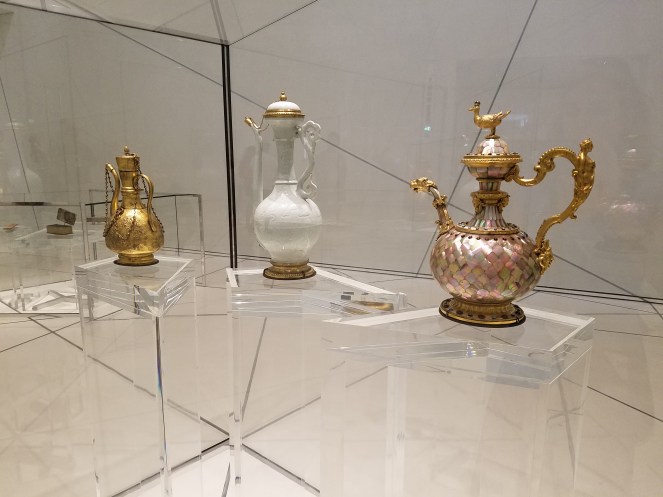
Similar objects from different places and timesIslamic “automaton” lion by a medieval European tapestry
Unlike Louvre Lens (in the north of France), which shows a timeline of history and where different cultures were developmentally at any given time, Louvre Abu Dhabi clusters items together to show the similarities–and differences– of humankind with items from vastly different locations and/or eras sometimes placed side-by-side. It’s fascinating.
After a leisurely museum visit and lunch in the cafeteria, we caught another taxi (plenty were waiting in the Louvre Abu Dhabi parking lot) and headed to the Sheikh Zayed Grand Mosque, about a 30-minute drive from the Louvre Abu Dhabi. The drive, along an excellent city highway, cost us 51.25 dirham (about $12). Our driver, from Pakistan, spoke fluent English and was eager to tell us about Abu Dhabi and how much he liked it because it was the “most peaceful place in the world.” We enjoyed visiting with him, but had to wonder about his claim that there is “no crime” in Abu Dhabi and “no punishment or prison”; “They just kick you out.” When we asked him about citizens (who comprise only about 10% of the UAE’s population), he claimed they never commit crimes because everyone has everything they need and gets the same amount from the government so there is no jealousy. Hmm.
Early view of the Sheikh Zayed Grand Mosque. Jaw-dropping.
I’m pretty sure my jaw literally dropped as we pulled up to the Sheikh Zayed Grand Mosque. I had no idea of the scale and grandeur of the place. I mean, wow. Taj Mahal-like with its gleaming white dome and minarets, the Sheikh Zayed Grand Mosque is nothing short of spectacular. And spectacularly beautiful. Our driver dropped us off near the front, assuring me that I didn’t need the sarong, long-sleeved shirt and headscarf I’d brought since the mosque would loan me an abaya.
45-minute complimentary tours are available at the mosque without reservation
David and I entered through separate men’s and women’s doors into the same room, but through different security scanners, and then I was directed to a small room in the back left where a lady chose an abaya for me from among a large collection hanging there. I pulled the dusty-blue hooded gown on over my street clothes and I was set. There is no charge to enter the mosque and no charge for use of an abaya. [Note: I had a pair of scissor-style tweezers in my purse that showed up on the scanner–never before a security problem–and I had to leave them in a box at the front and retrieve them when I left.] Also, those entering with tour groups through another entrance used their own headscarves, etc. and apparently either were not offered or weren’t required to use the borrowed abayas. I, personally, liked the abaya and felt more comfortable that I was respectfully dressed –and more part of the scene– wearing it. (I met at least one woman who found the required abaya a little offensive, but I didn’t feel that way at all. Everyone at the mosque was friendly and welcoming. I viewed it more as a “when in Rome” moment, no big deal … and actually kind of fun, almost like being in costume for a renaissance festival.) The only real downside is that the abaya added one more layer of clothing in heat that was pretty oppressive.
Meeting David after donning my abaya, we stepped outside to hear birds singing and a call to prayer sounding over the loudspeaker. We continued on the long and incredibly hot (106F) walk around the huge mosque along a white marble walkway to the front entrance. With the sun beating down from a cloudless sky, we paused only briefly along the way to admire the many views of the mosque.
Decked out in my borrowed abaya
We deposited our sandals on shelves provided outside the main entrance before entering the reflecting-pool-lined arcade of arches that surrounds the sweeping, marble-paved inner courtyard of the mosque.
The central courtyard of the mosque
The floors of the arcade and courtyard are inlaid with colorful flower designs as are the columns of the arches that surround the courtyard. It is all exquisitely beautiful and struck me as very feminine.
At the far side of the courtyard, after strolling under the arched walkway, we entered the main area of the mosque (and were delighted to find it air-conditioned).
Antechamber leading to the interior hall
Inside, beyond a soaring antechamber with a large flower-like chandelier, the world’s largest carpet covers the massive 3-domed hall in elaborate patterns on a jade green background. Three truly enormous Swarovski crystal chandeliers hang under each dome, almost jarringly gaudy with their red and green crystals after the delicate floral beauty of the outer pillared arches and courtyard.
Main hall of the Sheikh Zayed Grand MosqueDetail of the largest carpet in the world
I’d wondered if the mosque was worth the trip. I can’t believe we even considered not going. It’s an easy, inexpensive cab ride and the Sheikh Zayed Grand Mosque is simply not to be missed when in Abu Dhabi!
[Practical note: There’s a modern gift shop and café near the exit to the mosque. It’s air conditioned and equipped with toilets and an ATM machine.]
Our taxi ride from the mosque back to the ship cost 53 dirham (about $13) and took about 30 minutes at around 4 – 4:30pm on a Sunday. Like Dubai, there are plenty of skyscrapers and modern architecture in Abu Dhabi as well as upscale homes our driver told us were provided to citizens by the government. Having only a brief glimpse of the city to base our opinion on, we came away with the impression of a more accessible, less over-the-top place than Dubai.
Intriguing architecture in Abu Dhabi
Back at the port, we browsed the shops in the cruise terminal, spending our last dirham on postcards and stamps and a bar of camel milk chocolate. Why not?!


 Trinkets for sale on long tables; there were small cafés as well. We saw so much more ahead and were frustrated to know we had to turn back soon, to meet up with the others at our three hour deadline. Sadly, I had no way to contact them or our driver to beg for more time. Petra is one place I’d love to return to.


 After looking around the fish and produce market, we continued on along the water to the main waterfront promenade called locally by the French word, corniche.




 We deposited our sandals on shelves provided outside the main entrance before entering the reflecting-pool-lined arcade of arches that surrounds the sweeping, marble-paved inner courtyard of the mosque.


 I’d wondered if the mosque was worth the trip. I can’t believe we even considered not going. It’s an easy, inexpensive cab ride and the Sheikh Zayed Grand Mosque is simply not to be missed when in Abu Dhabi!
