Port of Mormugao (Goa), India: Old Goa and Colva Beach

Colva Beach in South Goa

12-2019 NOTE: SEE COMMENT FROM MARTIN FOLLOWING THIS POST REGARDING CHANGES FOR THE WORSE AT THE MORMUGAO PORT.

I decided that Goa was the Indian port where we’d go it on our own. Researching ahead of the trip, I’d read warnings about Goa port taxis (the “taxi mafia”) and local newspapers decried the state of affairs at the port and the port authority’s slow pace at installing a promised taxi stand with fixed prices that cruise ship passengers could trust. Happily, we arrived to find that a taxi stand was now in place and the system works smoothly and cheaply. Goa turned out to be fun, cheap, and just what we wanted.

Immigration booths are set up on the dock just outside the ship’s ramps. Just beyond immigration is a money exchange that takes both cash and debit cards. Right next to the money exchange is the official taxi stand. Cash is required for the taxis. Eight tours are offered in guests’ choice of a compact car or SUV. Alternatively, you can create your own itinerary and rent either a car or SUV for 8 hours with either 100, 125 or 150 kilometers. Any overage is charged at a very reasonably 14 rupees/km to be paid directly to the driver. All vehicles are air-conditioned.

Ship-side immigration booths in Goa; convenient and fast

We opted for 8 hours with a compact taxi and 100 kilometers since I wanted to see Old Goa (“Velha Goa”) and then spend time on one of Goa’s famous beaches. (I calculated distance and drive time in advance using Google Maps: We’d basically be traveling a triangle with about 1 hour of driving on each leg.) Our total cost was 1700 rupees (just under $30), an awesome deal, especially when compared to the sky-high tour prices offered by Celebrity. (For example, Celebrity wanted $109.75 each–$219.50!–for transfer to and from a beach where we’d get 4 hours free time and lunch at a beach-side restaurant. And no Old Goa included in that excursion.)

Money changing under the blue tent to the right; taxi/tour vouchers for sale under the blue tent to the left
Simple, cheap options for hiring taxis and booking tours on the spot at the Mormugao (Goa) port dock

We paid for our taxi, got a voucher in exchange with the license plate number of our taxi and the driver’s name and were directed to walk to the nearby port gate where someone would help us find our taxi.

Voucher we gave to our taxi driver (with personal info redacted)

There’s a bit of a chaotic air outside the gate with lots of taxis and drivers milling about, but with the help of some of the drivers standing around, we quickly found our taxi.

Interesting traffic on a Goa road

I was a little worried at first when our driver brusquely shrugged off my first choice of a South Goa beach, saying he would take us to another just a bit farther on that was also on my list of 3 beaches I was interested in (provided by a native-Goan assistant waiter on the ship). Not absolutely wedded to my first choice, I went along with his suggestion. Our next point of contention came when we pulled out of the port and he seemed to disagree with David’s request to roll up the window and turn on the air conditioning. A crazy idea in the brutal heat! We told him we’d get out of the car if he didn’t turn on the air conditioning and he acceded. After those initial conflicts, I was worried we’d be stuck for the day with a surly driver, but he was fine after that and took good care of us for the rest of the day. His English was limited, so some of the subtleties were no doubted missed on all sides.

The main roads we traveled to Old Goa were in great shape and obviously newly paved and expanded. Still, it’s an hour drive from the port at Mormugao to Old Goa due to winding roads and small towns that we had to pass through. We drove through the city of Vasco da Gama, pausing for a quick visit at a Hindu temple before continuing to to Old Goa.

Hindu temple in Vasco da Gama

Our first stop in Old Goa was at the ruins of the Church of St. Augustine, built in 1602 by the Portuguese. The sole remaining tower belfry created a dramatic highlight to the extensive ruins of the church and adjoining convent.

St. Augustine belfry
A nice visual aid at St. Augustine belfry

Convent ruins at St. Augustine

Our driver waited while we wandered the ruins, then informed us that we would stop at 3 shops before continuing on to the churches that form the center of Old Goa. We weren’t thrilled about the all-too-common store detour, but quickly realized this was something our driver needed to do. We gamely looked around the first store, a glitzy place reminiscent of People’s Stores in China, offering high-priced trinkets, jewelry, furniture and more. There were some lovely things, but we had absolutely no interest. Heck, most of our belongings are in storage during this vagabond period of our life! I tried to talk our driver out of the second store, but had no luck so we made an even shorter stop. (We ran into a group cruise excursion at that 2nd store and we were more than happy to be free to leave as they were stuck until the last person had made a purchase or made their way through the long line for the toilets.) Back in the taxi, I told our driver we would go in the last shop, but only “for him.” No, he insisted, “for you.” We back-and-forthed that a couple of times, but all in good humor. David and I made one last, speedy stop in a nearly empty store–taking advantage of the clean, western-style toilets and no line–and finally we were on our way the few blocks to the center of Old Goa.

Bom Jesus Basilica
Courtyard attached to Bom Jesus Basilica

Our driver let us off near some souvenir stalls, pointed the way to the Bom Jesus Basilica and then indicated how we should proceed to the other sites and where to meet him when we were through. He left the length of our visit entirely up to us.

With the Indian school summer vacation (April-May) in full swing, most of the tourists to the basilica appeared to be Indian families, although we spotted some fellow cruise ship passengers inside. We joined a line to file to the right of the main altar and to a back section of the church that held a holy relic, a large excessively-bloody crucifix and other religious items. We circled an inner courtyard before exiting the basilica to head across the road to the main grounds of the Archeological Survey of India, which consists of a manicured lawn area surrounding seven churches, cathedrals, the basilica and an archeological museum. We opted to skip the museum, but took in the grand Se’ Cathedral and the smaller, but beautifully-painted Church of St. Francis of Assisi (both free-of-charge).

Archaeological Monuments of Old Goa: Se’ Cathedral and the Church and Convent of St. Francis of Assisi
Detail of ceiling painting from Church of St. Francis of Assisi
Interior of Se’ Cathedral

Walking the short distance back to the road, we met our driver and started off on the approximately 1-hour drive to Colva Beach. I’d originally wanted to visit the smaller, less-visited Betelbatim Beach which is adjacent to Colva, but at our driver’s suggestion/insistence, Colva it was. At first, I was worried that he’d steered us to an over-crowded, cheesy touristy beach, thinking that was what we Westerners must want. The area just around the main access to the beach is dotted with tourist shops and little dive-y cafes. Lots of people milled about, too. Hmm. Not looking great. At least they were locals and we weren’t stuck in a Western-style resort. We walked over a small footbridge to the beach and saw that a string of casual waterfront restaurants spread out to our left along a naturally wide white-sand beach.

The beginning of restaurants along Colva Beach near main entry road

Happily, we could see that the throng thinned out pretty quickly further away from the main access road. We took off our shoes and strolled through the delightfully warm water to the last restaurant, Luke’s Place, attracted by both the look of the place and the location in spite of the uninspiring and less-than-exotic name.

Lots of free lounge chairs in front of Luke’s Place

Noticing another Western couple on two of a string of otherwise-unoccupied lounge chairs under an umbrella in front of the restaurant, I asked if they spoke English and discovered they were English and had been staying near this beach and frequenting this restaurant for two weeks. The woman was wearing a bikini and assured me I’d get no odd looks or hassles for wearing my bathing suit at Colva, despite the fact that all the local women were wading into the ocean in full saris. (I couldn’t believe how casually they treated those gorgeous dresses!) We did have the usual people wanting to take photos with us pale-skinned foreigners. I told David that in our “skimpy” Western bathing suits, it must be for them like Victorian travelers posing with topless natives! The Brits also informed us that the restaurant made excellent food, the large (strong) Kingfisher beer was a good buy, and that the owner would watch our things if we used the lounge chairs and they’d had absolutely no problems. Proving their point, they wandered off for a long stroll, leaving their belongings. This sounded perfect and turned out to be just that.

Luke’s Place, empty on an early afternoon on a weekday

We enjoyed a good, made-to-order Indian food meal (only Indian rupees accepted) with a great view, then planted ourselves on the cushioned loungers to sunbathe a little before swimming in the ocean. I lost my sunglasses to some great body-surfing and stupidity, but oh well. It was high time I retired those anyway…and I felt pretty sure I could find a cheap pair in India to tide me over until I got back home where I had a good pair waiting.

The ride back to the ship was about another hour and we rolled into the port parking lot, using all but about a half a kilometer of the 100 km we’d paid for. Not bad!

Port of Cochin, India: Houseboat through the Alappuzha Backwaters & Old Cochin

Our first stop in India was Cochin (a/k/a Kochi) in the state of Kerala on the southwest coast. My first time in India, Cochin was a port I was really looking forward to and it didn’t disappoint. We loved this stop! I used Cruise Critic connections to book us with a group of ten fellow cruise passengers on a full day tour, including lunch and a cruise on a traditional houseboat on the Alappuzha (a/k/a “Alleppey”) Backwaters near Cochin. (Find details at the end of this post.)

It’s about a 2-hour drive from the port of Cochin to the Alappuzha Backwaters where we boarded our houseboat. Kerala is one of the most prosperous and well-educated states in India with a nearly 94% literacy rate. Women have higher standing than elsewhere in India as it is a traditionally matrilineal society with inheritance following the female line and mothers the heads of households. While more than 50% Hindu, there are large populations of Muslims and Christians in Kerala. The drive to the Backwaters took us through lush green rural areas, small towns, markets, ubiquitous garbage and ramshackle buildings, as well as some upscale-looking homes and apartment buildings; the chaotic hodgepodge we came to expect of India.

Our Backwaters houseboat turned out to be a 2-bedroom, 1-story boat of the traditional type, in very good condition. We sat in the bow, just behind the captain at his wheel, on benches that ran along the sides of the boat under the shade of a canopy. Four chairs around a cocktail table and a large dining table occupied the center of the space.

We spent a couple of hours leisurely cruising the Backwaters, making a lazy loop that took us out into a big wide-open lake. We spent most of the time in narrower canals bordered by homes that sit below sea-level and flood regularly each year despite low dams built along stretches of the canals. We passed people bathing, doing laundry, fishing and, in general, going about their daily lives.

Life in the Alappuzha Backwaters
Fisherwoman and child
Duck farm

The call to prayer began as we passed a small mosque, music played from somewhere out of sight. Many other houseboats and smaller boats plied the waters. It’s a unique place and I really enjoyed the whole experience.

A cook prepared our Indian food lunch in the galley at the stern of the ship, then served us buffet-style on the dining table under the canopy. Due to recent regulations in Kerala, beer is not allowed and we were served juice and water. The food was good and plentiful, if not spicy enough for my tastes.

Alappuzha Houseboat buffet lunch
Boards served as walkways between houseboats which docked several deep.

After our Backwaters cruise, we drove back into Old Cochin. We visited the dhobi khana or town laundry operated by Tamil-speaking members of the Vannar Sangham community of untouchables whose ancestors were brought here by the Dutch in the 1700’s to wash army uniforms. (Even though our guide told us the caste system was no longer followed in Cochin, he seemed to think the Tamil origin of these people explained the difference.). The only woman ironing at the time was using an old ember-filled iron since the electricity was out due to a recent electrical storm. Old-fashioned, labor-intensive cleaning and ironing methods are used. Clothes are starched prior to ironing by dipping in rice water.

Ironing with an ember-filled iron
Each family of Vannar Sangham has their own washing station in the laundry

Washed clothes are hung to dry on wooden frames in a large field. In monsoon season, they use dryers, but it takes a long time as the workers hang the clothes out whenever they can so have to continually hang them and take them down. Washermen and women can lose half of their income during monsoon season.

No clothespins: Clothes are fastened for drying by tucking ends into twisted rope

We walked along the riverfront to view fishermen using “Chinese nets,” fishing nets of ancient design, operated with weighted structures of the size and shape of a fair-sized sailboat sail. Some of the seafood on offer was entirely new to us like weird, flathead “river lobsters.”

“Chinese net” and fishing boats
Framing photos wider shows the less-picturesque aspects of India
Flathead river lobsters (front left) were new to us

In another historic neighborhood, we took a short walk to the only remaining synagogue in Cochin which occupies a dead end on a shopping street. The Paradesi Synagogue was built in 1568 by descendants of Spanish, Dutch and other European Jews and is now maintained by the five remaining Jews in the city. A clock tower attached to the synagogue, built in 1760 and under restoration, adds the only architectural detail of interest visible from outside the plain blue synagogue (which is not open to the public). We had a little free time to explore the many shops on the street leading to the synagogue before heading back to the ship.

Paradesi Synagogue clock tower
Old Cochin shopping street viewed with the synagogue’s blue wall on the right
Spice shop. What great smells from this place!

Practical info: Our tour operator was Muziris Heritage Day ToursOur pre-trip contact (not our guide) was Lijo Jose who was recommended by a fellow cruiser who’d used him before. The company apparently does a lot of cruise excursions and their site has a whole section on those. They were waiting to meet us, holding signs, as we debarked. They did several similar-sized tours on the day we were in port, so have the capability to handle a fair number of customers. We were very happy with the tour, pre-trip communication, houseboat, and the value (especially when compared to the cruise price and product as discussed below). The only snafu in the tour came at the very end when we spent about 15 minutes parked on the side of the road in the middle of nowhere while we waited for someone from the tour company to arrive with a credit card machine for those wishing to pay by card. (We paid cash in U.S. dollars. There was a small charge for credit cards, I believe 3%.)

To give you an idea of just how outrageous cruise excursion prices usually are: We paid $80 each versus the $220.75 apiece the cruise ship wanted for the same itinerary. We had ten people in a very nice, mini-van-style small bus vs. a cruise excursion which would have been 40 or so people on a motor coach. From complaints we heard later, our houseboat was nicer than what the cruise excursion people got. The only downside to our mini-bus was that, while we had three “captain’s chairs” on either side of our main aisle, the remaining four us had to take the four seats across the back that were not as spacious. We had a great group with us, though, and volunteers swapped the front seats for the back seats on the return ride. Given the huge price difference, the small size of our group, and the quality of the tour, we were more than happy.

Port of Colombo, Sri Lanka: Daytrip to Colonial Galle and the Galle Fort

Galle Lighthouse

In doing my pre-trip research about Colombo, Sri Lanka, I found little specifics on the port itself and not too much about the city of Colombo that inclined me to want to spend much time there. The one universal bit of info I came across was that traffic in and around Colombo (and much of Sri Lanka) was usually awful. Once again, cruise excursions did nothing to tempt me, but as always, I scanned them to see what the cruise line thought was worth a visit. I decided on the town of Galle as our destination and concluded that a local driver/guide was the way to go. Reviews lead me to choose Sanki Leisure and I found them easy and prompt to deal with by email. I paid 50% down via PayPal (a compromise I proposed when they first suggested an online payment company I wasn’t familiar with and read mixed reviews of).

We were to meet our guide at Gate 02 of the Port of Colombo. I knew it was a big industrial port with no walk-out allowed or doable, but I had no idea what would be offered in the way of transport upon our arrival. It turns out that the Port provided free motor coach shuttles to Gate 01, but the driver was happy to let us off a gate earlier at Gate 02 after instructing us to be sure to go to Gate 01 for our return shuttle back to the ship.

View from the Port of Colombo shuttle; not a walkable port

Sure enough, our Sanki guide was waiting as promised with an air-conditioned car. He did not, however, speak more than a few words of English. So much for a driver/guide; we had a driver. Oh well, it would have to do.

We did a quick stop off at Independence Memorial Hall on our way out of Colombo, then quickly found ourselves caught in a traffic and pedestrian snarl among shops thronged with people celebrating the Hindu New Year.

Independence Memorial Hall in Colombo
Colombo taxis
Colombo taxi driver and passengers

While the scene was fascinating to watch, that famous Colombo traffic was now all that much worse. The plan was to make Galle our primary destination–I really hoped to see those iconic fishermen perched on stilts above the water and the Galle Fort and colonial Old Galle looked intriguing. If we got back to Colombo with enough time, we’d take in the sights there, but if not, Galle was our priority.

Colombo traffic

Once we finally got out of Colombo, we opted for the wide inland highway rather than the probably more-scenic coastal road since that would shave an hour off our travel time. The highway was in great shape and offered a smooth journey through lush hills dotted with rubber trees and tea plantations. We made pretty good time once David convinced our driver to at least drive the speed limit of 100km/h rather than the 80km/h he seemed inclined to do.

Boats on a Galle beach. Hard to believe that it would be pouring rain in a few hours!
Fishmonger and his wares

When we arrived in Galle, our driver informed me that the stilt fishermen would not be out at this time of day and it was for tourists anyway. To alleviate my disappointment, I guess, we made a couple of stops along the roadside beach to watch groups of fishermen hauling in big nets from far out in the harbor and then to explore the adjacent fish markets.

Fishermen pulling in big nets
Fish market

From the largest of the fish markets, it was a short drive to the entrance to the ruins of Galle Fort where our driver dropped us off. Surprised to find no entry fee, we wandered into the fort then along the seaside fortifications mingling with tourists and locals strolling and picnicking in the sweltering heat. Hearing English, we joined a group that had spotted a sea turtle in the surf below then checked out a large iguana-like lizard that appeared over the wall nearby.

Clock tower and entry to Galle Fort

Inside Galle Fort

Lizard on a fort wall

Rather than a separate structure, it turns out that Galle Fort actually encompasses Old Town Galle that lies within the protective walls. The original Portuguese fort was apparently more of a separate structure. The Dutch captured Galle in 1640, though, and later they expanded its walls to encompass the town and the entire peninsula creating a major stronghold. The fort and Old Town Galle are now a UNESCO World Heritage site.

Old Town Galle viewed from a fort seawall

Rejoining our driver, he drove us a block or two within Old Town to Elita Restaurant, a café clearly geared to tourists, but offering really delicious seafood (at tourist prices). The chef is a local guy who trained in Belgium. We’d hoped for Sri Lankan food, but couldn’t find it in ourselves to be the least disappointed in fresh tuna steak and shrimp … and cold Lion beer!

We sat on a pretty front porch, painted bright yellow, where a wall-mounted oscillating fan offered fleeting, heavenly respite from the heat. While sipping our beers and waiting on lunch, we chatted with a pair of young Belgian women who’d been traveling in Sri Lanka for three weeks. Their glowing reports combined with similar we’d heard from a German man we met in Munduk (who’d spent a month in Sri Lanka and raved about the wildlife) were definite enticements to return for a real stay.

David at our table under cover of the porch with the Belgians braving the darkening skies. (They soon moved up to share the shelter from the rain… and the ceiling fan.)

Post lunch, we were driven another few blocks to the Galle lighthouse. The sunny day had given way to drizzle while we ate and a major storm was gathering in the distance, so we grabbed our umbrellas before walking along a jetty-like wall to the lighthouse then set out to explore the shops and old buildings of Old Galle.

To the Galle Lighthouse
Storm clouds gathering at a beach by the Galle Lighthouse, prelude to a downpour

Spices, tea and jewelry are major commodities in Sri Lanka and on offer in nearly every Galle shop. Needing nothing but a little nutmeg for rum punches aboard the ship, we bought only a pack of 5 fresh nutmeg pods.

Old Galle

Back on the street, we kept exploring the narrow roadways of Old Galle until increasing rain led us to take shelter in a little free museum called the Historical Mansion. The cluttered museum is a lure for jewelry shops, but it’s interesting nonetheless set in an old Portuguese building and displaying artifacts from colonial days, an old kitchen, and a central courtyard complete with well. A jewelry maker demonstrated metal work beside the courtyard where a deluge of rain now created waterfalls from the roof. We briefly browsed the jewelry–some of it of impressive quality–then set out into the downpour and booming thunder to find our driver since it was time to head back to Colombo.

Historical Mansion in Old Galle
Cluttered museum area of the Historic Mansion
A jewelry maker works beside the Historic Mansion courtyard as heavy rain falls.

Heading back to the carHeavy rain continued all the way back into Colombo and we declined the chance to visit a Hindu temple in the deluge, opting to head back to the ship nearly an hour early. Oh well, we got to see Galle in sunny weather and do most of what we wanted, so overall, we counted the day a success. We saw just enough of Sri Lanka to leave us pondering a return visit when we’re back in this part of the world next spring. The Port shuttle was waiting as promised when we arrived at Gate 01 .

___________

Practical info: We paid Sanki Leisure a total of $195 US for our private driver/”guide” for the day. I paid $98 deposit via PayPal and the balance in cash (US dollars) to the driver upon arrival. For comparison’s sake, Celebrity wanted $179.75 per person for a daytrip to Galle which included lunch at the Jetwing Lighthouse Hotel and a folk museum.

Port of Phuket, Thailand: tenders to the beach, an aggressive Thai massage and local food

Patong Beach with cruise ships anchored in the distance.

After a day at sea from Singapore, the first stop of our one-month cruise to Europe was Phuket, Thailand. During prime season, ships anchor just off the town of Patong and tenders drop passengers off at floating docks right on a beautiful beach. This is one of those rare cruise ports where tenders are not bad; ten minutes on the tender lands you at a spot you can actually spend the day. (The short distance and smooth water meant that there wasn’t much of a wait for the tenders either as they were able to shuttle back-and-forth pretty quickly.) That said, Patong is a touristy, party town full of restaurants, bars and shops, and isn’t exactly pristine Thailand.

Cruise ship tenders drop off at this floating pier, right on Patong Beach. Nice!

This post is not going to offer anything for cruisers interested in excursions or tours around Phuket. (However, there is some practical info for cruisers at the bottom of this article.) Since we’d spent a few weeks in Thailand less than a year and half earlier and had dove the Phi Phi Islands on the other side of the Phuket peninsula then, we had no desire to make a long, expensive day trip only to compete with hordes of cruise passengers snorkeling and taking boat trips around the Phi Phis or touring the plantations and elephant “sanctuary.” (The Queen Mary 2 was in port the same day we were, so her passengers were adding to the influx.)

Our ambitions for the day were modest: one of those dirt-cheap, vigorous Thai massage sessions, some good Thai food and a little beach time, maybe just strolling in the surf. I did some research pre-trip and settled on Sweet Lemongrass Phuket 2 for the massage. I read good reviews about them in a local publication and was able to make a booking by messaging them on their Facebook page where they post photos of their price list. I booked us two 1.5-hour Traditional Thai Massages for 350 baht each ($10.90 per person). I don’t know that a reservation was essential, but with limited time in port, it seemed like the best idea.

I really wanted David to experience a Thai massage, too. We’d done a side-by-side massage in Chiang Mai, but he’d opted for a more traditional, Swedish-type massage then. I’d gotten the full Thai bordering-on-assault treatment and words just really don’t do it justice. (Even though side-by-side, it’s pretty impossible to see the other person since you’re either face-down or with eyes closed or covered.) David needed to experience it for himself, and I wanted something to compare my first experience to.

An easy 10-minute walk from the floating tender pier found us opening the door to the air-conditioned refuge of Sweet Lemongrass Massage 2. We were greeted with icy water and cold washcloths in the nice front room before being led upstairs to our curtained massage room.

Reception area of Sweet Lemongrass Phuket 2

The last curtain on the right led to our massage “room.”

Our masseuses left us alone to change into the loose-fitting short set favored for these massages. The shorts are huge, but a tie wraps around the waist as much as needed to cinch it in.

Big shorts!

When the ladies returned, the “fun” began. Thai massage is like none other I’ve tried. I’ve been pretty aggressively massaged — and exfoliated to the edge of blood-letting — by hammam ladies in Paris, but Thai massage is a whole different game. There’s the usual kneading and pressing of knots, but it focuses much attention on stretching, and that can push right up against alarming. There’s also a certain amount of light hitting. (Sounds great so far, right?) My diminutive Thai masseuse soon climbed up on the table with me, bending me in half from the waist, as she knelt behind me, one knee tucked under my arm against my side while she put my neck and shoulders in a lock to twist with all her might. Lying on my stomach, she placed a foot behind one knee, then pushed on the raised foot in a move my brother and I deemed “unfair” when wrestling as children. It still hurts!

Back up on the massage table, my masseuse begins a hair-styling finale to my massage.

For an hour and a half, I passed from blissful massage to occasionally painful body locks, stretches, aggressive pressure point moves and jabs. Once or twice I yelped an “ouch!” that caused the masseuse to apologize and ease off. Beside me, I could hear the occasional grunt or “oof!” from David and wondered what he was thinking about this whole business. To top off my massage, my masseuse pulled the clip out of my hair and began a scalp massage that devolved to little snatching motions with her fingers followed by jerking on handfuls of hair. Hard! Ow! I struggled not to laugh at the thought I was paying her (albeit a pittance) to beat me up. Oh well, I was going to see it through to the end and gauge the therapeutic effects of the full package. David hadn’t called “uncle” yet either, so I assumed he was in the same mode. (He later informed me his experience had been similar to mine, but he’d been spared the hair-yanking I was treated to. He was glad he’d tried it, but isn’t going to be seeking out Thai massage back home.)

To wrap things up, my masseuse climbed back up on the table with me and began braiding portions of my hair. At first, I thought she was just pulling it out of my face since the scalp massage and hair-pulling had made a rat’s nest, but she kept going until I had a full French braid as, I don’t know … a peace offering , maybe?

I like my new hair-do!

For all that Thai massage can be excessively “vigorous,” the whole process left us feeling relaxed and “worked out.” I was a little sore later that evening, but by the next day aching neck and shoulder muscles that had been nagging at me for some time were improving.

We went straight from the massage to little Thai restaurant I’d read about as being popular with locals as well as the ubiquitous tourists of Patong. (A short walk of maybe 5 minutes) It was nothing fancy, but it was pleasant, and we had a solid Thai lunch for reasonable prices at S&G Family restaurant, a place that’s been in business since 1985. Like most little restaurants and shops in the area, it’s open to the outside with only ceiling fans for cooling. Service was friendly and prompt.

Our main goals were to get our curry fix. My only minor complaint was that my green curry chicken was lacking those tiny, round and bitter eggplants that are so unique to Thailand and that I’ve been unable to find in the States.

Curries at S&G Family Restaurant

After lunch, it was time for the beach. Feeling lazy and full, we opted to just walk along the lapping surf, people watching and enjoying the scenery. There were plenty of places offering lounge chairs, umbrellas and refreshments if we’d been so inclined. There were also small boats and jet skis pulling multi-person floats on offer. Patong Beach is bustling and lively, but even with two ships in port, it wasn’t unpleasantly crowded.

Patong Beach with two ships in port. Not bad!

_____________

Practical info: 

The floating pier for our tenders dropped us off just in front of the Avantika Boutique Hotel which you can find on Google Maps. (There was another floating pier a block or so NE up the beach where tenders to and from the Queen Mary 2 used.) Tenders ran back and forth to the ships regularly throughout the day, so going back to the ship and returning again would have been an option.

Sweet Lemongrass Massage 2 is at 7.884975, 98.293699 on GPS; ถนน ราษฏร์อุทิศ, 200 Pee Rd, Pa Tong, Kathu District, Phuket 83150, Thailand. Phone: +66 76 349 847

S&G Family Restaurant is at  104/2 Soi Post Office Thaweewong Rd, Tambon Patong, Amphoe Kathu, Chang Wat Phuket 83150, Thailand. Phone: +66 76 340 151


The start of a one-month cruise from Singapore to Italy

The 8 “Sweet Sixteen” port-side cabins on Celebrity Millennium class ships are just above the “S” through the blue space after the “N” in “CONSTELLATION” the photo above.

As part of our 3-month around-the-world journey, we spent one month on the Celebrity ship Constellation. This was actually two 2-week, back-to-back (“B2B”) cruises. The first two weeks were more a traditional cruise with many stops: Phuket, Thailand; Colombo, Sri Lanka; Cochin, Goa and Mubai, India; Muscat, Oman; Dubai and Abu Dhabi, U.A.E. The second two weeks were more along the lines of a repositioning cruise, i.e., fewer stops and a bargain price as the ship moved from one region to another for a season. This cruise took us from Abu Dhabi back to Muscat, Oman, through the Suez Canal, to Piraeus (Athens) and Katakolon (ancient Olympia), Greece, and dropped us off at Civitavecchia, Italy (the port nearest Rome, although we did not go back to Rome on this trip, but rather picked up a rent car to spend a couple weeks in Umbria and Tuscany before flying from Florence to Belgium).

Upcoming posts covering the cruise period will have more information on ports, directed to cruisers, in addition to regular travelogues. [I’m not that into cruise ship activities and such, but tend to view ships as moving hotels and chose cruises based on itinerary, i.e., ports-of-call and transportation from one point to another. Click here for an earlier post on my philosophy on cruising as well as tips for finding the best deals.] I had some misgivings that a month might be too long on a ship, but we had an amazing time and my only regret is that I can’t do it all for the first time again!

With regards to Constellation, one of Celebrity’s Millennium class ships: I once again booked one of the “Sweet Sixteen” cabins about which I blogged when we sailed trans-Pacific on Constellation‘s sister ship Millennium. [Click here for that post.] These cabins offer a suite-type, double-sized balcony for the price of a regular balcony cabin. For some reason, the extra-large balconies do not appear on the ships’ diagrams and the cabins are categorized as regular balcony staterooms. I prefer the rear-most of these cabins because they offer extra privacy from the cabin just sternward and a more open view. (Both times I booked one of these staterooms, the booking agent had no idea that these cabins existed.)

Off the ship and back on our own tomorrow

20161009_102028
Naha, Okinawa: Naminoue Beach with Naminoue Shrine in the background to the right

We’re off the RCL Mariner of the Seas tomorrow and back on our own. I haven’t written travelogues about the cruise portion of our 2.5 month odyssey just because I don’t know that I’ve got much new or useful to offer. It’s been fun and we loved the itinerary–both for the ports and for its transportation value as part of our overall trip, but the ship’s service has been a let-down, not nearly as good as we experienced on our trans-Pacific crossing on the Celebrity Millennium. It was my first time on RCL, and I’d heard good things, so maybe this is just a function of changes as the ship has been fairly-recently based out of China. Definitely, cultural and language aspects were a challenge, but food, service, efficiency of on- and off-boarding left a lot to be desired. Oh well, hardly a hardship, just a little disappointing. Still, it’s been nice to have this 10-night break with someone else in charge of our itinerary before we begin our last month of travel through southeast Asia.

In the spirit of completeness, I hit on a few highlights below from our ports-of-call with Mariner that might be of interest to someone doing this cruise or making these stops:

First up was Naha, Okinawa. It was good to be back in Japan, but while we avoided the forecast rain, the sunny day brought some pretty serious heat and humidity. The highlight was definitely the hatagashira parade on Kokusai street, part of an annual festival and prelude to world’s largest tug-of-war set to take place the following day. Groups of costumed young men performed amazing balancing acts with decorated 10m poles called hatagashira to the chanting of crowds:

I couldn’t find much information about the Naha cruise port itself, so am happy to report that we docked at the Wakasa Berth, much closer in than I’d feared. (Apparently, it is possible for a ship to dock in the “spare cruise ship berth” on the far side of the container port that lies behind Wakasa Berth.) The small cruise terminal offers ATM machines, free wi-fi, helpful information staff, and plenty of taxis. There’s a nice little beach (see photo above) not 10 minutes’ walk from the the dock (walk to the right out of the port, cross the street, and take the path on the side of, not over, the bridge), or you can skip the beach and shrine and walk directly to the monorail (to Shuri Castle) and main shopping street, Kokusai Street, in about 20 minutes. Stopping at lovely Fukushuen Garden along the way will slow you down, but is worth the delay. Just beyond the beach, and accessible from the beach by a flight of stairs, is a pretty Buddhist Shrine. The surprise gem of our visit came when we cut through a park just to our left as we descended the main shrine stairs. We were just planning to cut back to the street leading from the port to Kokusai Dori Street. The park turned out to be a memorial park adjacent to the Tsushima-Maru Memorial Museum to the mostly-children who lost their lives when the ship on which they were being evacuated was torpedoed by an American ship. Like the Peace Museum in Hiroshima, this little museum is dedicated to providing rest to the souls of those who died, to memorializing their lives, and to displaying the consequences of war. It’s a sad, but welcoming little tribute with children’s belonging and a recreated classroom. Everything save a video with English subtitles and the transcript of messages from the American warship (targeting the destroyers and military personnel accompanying the evacuation, and apparently unaware of the children) is in Japanese…so the nice lady at the desk refused to accept our payment for tickets and allowed us in free. The video alone was worth the stop. (And the air conditioning is welcome, too.)

20161009_124607
Naha, Okinawa, Japan: Hatagashira parade on Kokusai Dori Street

Our next port-of-call was Hong Kong. I’d long wanted to visit, and had been disappointed when a schedule change left us with only 10 hours in port, rather than the two days initially planned. Still, we made the most of our time. The new cruise port is at the old airport and, while the terminal is huge and modern, it’s an inconvenient location and the massive size just makes for a lot of walking through empty spaces. (I measured .4 miles on my Fitbit from the shuttle bus to the ship on our return, 90% of that simply walking back and forth through the maze-like terminal.) Despite my misgivings about the location, free shuttles provided by local malls turned out to be a really convenient launch to our day. We chose a shuttle that dropped off at Hollywood Plaza mall, and after snaking through a Marks & Spencer (weird), we ended up in a mall by multiple ATM’s, grabbed some cash, then descended an escalator to the Diamond Hill subway station. We bought tickets at machines (that require bills of 50HKD or less) and give change. For less than a couple of US dollars apiece, we rode all the way to Central station on Hong Kong Island (starting on the green line, then changing at Mong Kok so that we just had to step across the platform and onto the red line). From Central station, we took Exit J and followed signs to the Peak Tram, rode ding ding double-decker trams along Bank Street, then caught the Star Ferry back to Kowloon. We checked out the famous high tea at The Peninsula, but opted for a drink at the Intercontinental with its spectacular view of Victoria Harbor as evening fell and the lights came on.

20161011_171958
Hong Kong: Beautiful Victoria Harbor

After Hong Kong, we had our first stop in Vietnam. The port at Chan May is a very industrial port, a long way from anything of interest to most travelers. The nearest tourist destinations: Danang, Hoi An and the former imperial city of Hue are all worth seeing, though. In fact, the hard part is choosing which to see since Hoi An and Hue are in opposite directions. There’s no cruise terminal. Knowing we needed to make plans (and not a fan of large cruise ship excursions), I’d signed us up for a private tour via Tommytours with people I’d met on Cruise Critic. [If you don’t know Cruise Critic and you cruise or plan to cruise, you need to get familiar with it. Join your ship’s “roll call,” sign up for the Meet & Greet on-board, read tips from your fellow cruisers, pool resources for tours. You’ll meet a lot of people who want to do nothing but cruise which may not be your thing, but they know the ropes of their chosen line and they’re good friends to have: We boarded with Diamond-Plus level friends, so were 5th and 6th on the ship, avoiding lines and getting to settle in early.] The Chan May port charged $25pp for a tour company to drive in to pick up, so we walked out of the port to meet our guide. I’d been leaning towards Hue, but David was taken with photos of Hoi An, a small group tour was available to Hoi An, so that’s what we did. Hoi An has the advantage of being a lovely city that was saved from destruction during the war. Heavily reliant on tourism, it’s still a beautiful glimpse at an older way of life and we really enjoyed our visit. Hue, site of the Tet Offensive, was destroyed and the former “forbidden city” is a reconstruction of the original. Our guide picked us up in a brand new, 16-seat van with great air conditioning and 2 fast wi-fi hotspots. Cold water and cold towels made the van a delightful refuge from the humidity and passing showers. On the way to Hoi An, we stopped at Danang Beach where some of our group bought live crabs to be cooked later for lunch. Our next stop en route was at the Marble Mountain area which actually consists of 5 holy mountains representing the 5 elements of local religion: metal, wood, fire, water and earth. We rode a free-standing elevator up to Water Mountain. A sudden downpour left only David and me with the guide to explore the pagoda, temple and cave shrines on the mountain. (We had rain gear while our companions did not. Although the guide handed out ponchos, the others were already wet and wearing shoes that couldn’t handle the sudden rushing water that cascaded down the steps and paths of the mountain. David and I wore made-for-fly-fishing Teva sandals–our faves for such travel–and just waded on until the cloudburst ended.) Hoi An turned out to be the kind of place where you just want to ramble. Our guide took us through a Buddhist Temple and classic long, narrow, two-story house with balcony overlooking the bustling street. We walked past river boats and through an ancient Japanese covered bridge before David and I ducked out for a little time on our own. Back with the group, we enjoyed at 7-course feast of Vietnamese food on an open-air veranda by the river. Back at the ship, our guide was able to drive into the port, bypass tour buses and drop us off right at the ship. This was a good thing, since a storm had rolled in. It was pouring raining and howling wind. David and I were fine in our rain gear, but a lot of people were drenched in the unsheltered line trying to get back on the boat.–The poor organization of Mariner striking again. [We used Tommy Tours for our Hoi An tour. You can find Tommy at: http://tommydaotours.com/. Ty (prounounced “Tee”) was our guide. They were very professional. The only slight negatives I’d point out are that lunch was very late in the day, 2pm, so we were hungry after our early start, and Ty’s accent sometimes left us guessing, but we’ve found that to be a very common problem in Asia. We paid $75 apiece and did tip.]

20161013_130111
Hoi An, Vietnam

Our next port, Phuy My, Vietnam, was as industrial and remote as Chan May, also offering no cruise terminal, but at least a few vendors under tents. The place to see here is Ho Chi Minh City, Vietnam, the former Saigon. Knowing it was a nearly 2-hour drive, I debated whether we wanted to make the trip at all, but decided it made no sense not to. One again, we pooled with some Cruise Critic friends, walking out of the port to board another private van (booked through Tours By Locals). Another 16-seater, this van had great a/c, but only room temperature water and a non-functional wi-fi hotspot. Not as nice as the Hoi An set up, but our guide, Tam, turned out to be very interesting. The son and relative of many refugees (aunts and uncles escaping to Australia and his father imprisoned for 5 years after a failed attempt with the 6-year old Tam), his family suffered punishments in the past and job discrimination that continued. Still, he was upbeat and informative. Braced for the bustle of the big city, we were still blown away by the massive, chaotic crowds of scooters that swarmed the streets darting between trucks, buses and cars. Tam assured us traffic was actually light since it was a Saturday. Oh, good Lord, I could only imagine “rush hour!” We peered out the windows of the van, fascinated as we moved past the Saigon River from large roads to narrow, byzantine streets filled with shops offering nothing but scissors, others offered dragon costumes, medicinal herbs, and so much more. Stepping out of the van for the first time, I was hit by the smell of incense, but couldn’t tell where it was coming from. Tam let us down a narrow passage between buildings to arrive at the courtyard of a 300 year old Buddhist temple. The smell of incense definitely emanated from the building, growing to a cloud as we moved past a raging fire in a big free-standing “furnace” in the middle of a second courtyard. The temple bustled with activity, worshippers lighting 1 or 3 (never 2) sticks of incense and waving them before them before planting them before altars to bow and pray. Overhead, a myriad of spiral, cone-shaped incense burned, adding to the thick atmosphere. Ceramic statues crowded the roof of the temple, ornate and beautiful in a way completely unlike the temples we’d seen in Japan and Korea. After the temple, we visited the biggest, dirtiest market I’ve ever had the fascinating but dubious pleasure to visit. This place offered wholesale goods only and burst with hats, clothes, food, herbs, sugar and more, overflowing from an enormous covered area to sprawl into trash-strewn streets alive with pedestrians, porters with every imaginable bundle, and–of course–scooters. It was a relief to return to the sanctuary of the van for the drive to the War Remnants Museum. This museum, surrounded by captured American military vehicles, gives the (mostly-Northern) Vietnamese view of the Vietnam War. It’s uncomfortable to see, particularly the many photos of those injured by Agent Orange and the horrible birth defects suffered by multiple generations of those exposed. The famous “We hold these truths to be self-evident…” quote is displayed with jarring impact. The culpability of the North is glossed over (much like we saw in the Military Museum in Belgrade, Serbia, and unlike the more balanced approach of the Hiroshima Peace Museum), but it’s still worth seeing and acknowledging the horrible price of war. We moved from war to lunch, pushing away for a time thoughts of man’s inhumanity to man. We’d asked Tam for a local food lunch and he delivered with a noisy Vietnamese “pancake” restaurant. Crispy shrimp and pork “pancakes” cooked outside in iron skillets were served piping hot and folded over bean sprouts. We broke off pieces, rolled them in lettuce leaves and dipped in a special sauce. Delicious! Other courses included crab spring rolls and small beef rolls served with dry rice paper for rolling with various condiments and yet another sauce. We had pho and local beer and deep red watermelon, too. Messy, but fun, and lots of new things to try. We ended our day with visits to the French colonial-era Notre Dame cathedral, post office, opera house, city hall, and the classic Rex Hotel. It was a fascinating day and fun; I’m so glad we went…and I doubt I’ll need to do it again. [Tam a/k/a “Tony” can be reached at http://www.saigonmekongtours.com and sales@saigonmekongtours.com. Split 8 ways, we paid $75 apiece for all transportation, entries, and lunch and did tip afterwards. The tour lasted approximately 8 hours. Tony did a good job despite a few language/accent struggles for us, but again, we’ve found that to be the norm in Asia.]

20161015_100215
Ho Chi Minh City, Vietnam

So, now I’ve caught this blog up to date. We know that when we get off the ship tomorrow, we’re probably in for more travel uncertainty than in more-developed Japan and South Korea, but we’re excited…Besides, we definitely won’t be roughing it our first couple of nights in Singapore. We’ve booked the Intercontinental, courtesy of easy points via an IHG promotion and David’s IHG credit card. (The promotion ended before I started blogging or I would have definitely shared. I got over 60,000 IHG points for sending in some postcards, enough for a night at the Intercontinental. David racked up points with postcards, too, then scooped up the rest with a credit card signing bonus.) After Singapore, we’re off to Kuala Lumpur, Malaysia, before heading to Cambodia and beyond. Here’s hoping the adventures that lie ahead are good ones!

Celebrity Millennium-class “Sweet 16” cabins: double the balcony at no extra charge

20160902_173308
Celebrity Millennium “Sweet 16” balcony, cabin 6030. The balcony of our neighbor to the right ended at the midpoint rib in the privacy wall.

The “Sweet Sixteen” cabins on Celebrity’s Millennium-class ships are a little-known anomaly: 8 cabins on each side of Deck 6 offer double-deep balconies for the same price as their otherwise-identical neighbors. For some reason, the Sweet Sixteen don’t appear on the deck plans (which depict the cabins as having shallow balconies just like the others on that deck). In researching our trans-Pacific cruise, I came across mention of these cabins and, since we booked very early, I found that nearly all of them were still available. (My booking agent had never heard of these cabins, but secured my preferred cabin.)

celebritymillenniumdeck6zoom
Close up of Deck 6 plan showing no difference in balcony size between the Sweet 16 and their neighbors

I deliberately chose the aft-most cabin on the starboard side, 6030, as I was curious about the view toward the stern and liked the idea that one of our neighboring balconies would be set back from our own. I liked my choice and we did have an extra element of privacy and a more open view sternward.

20160914_165406
View toward the stern from balcony of 6030
20160914_095409
Sweet 16 cabin 6030 is just above the “C” in “Celebrity” with the other Sweet 16’s on starboard going to the right until just over the “E” in “Millennium”

20160914_165355

While these cabins don’t come with lounge chairs, there is plenty of room for them and I did read of one cruiser who was able to have two delivered after tipping his steward. The primary negative of these balconies is that the people above you can look down on the front half of your balcony. I knew this going in, and it didn’t bother me at all, but it might be a consideration for some.

20160914_165425
Looking up and toward the bow from the balcony of 6030. Shows “gap” in deck over the balconies above

All of the Sweet Sixteen balconies are not identical. The first 3 have thick support columns that run from 3 levels above to the front of their balconies and a full roof at that level above them. (The smaller balconies above these Sweet Sixteen are in a recessed, cave-like setting that wouldn’t be at all to my liking.) The lowest numbered of the Sweet Sixteen on the starboard side (6016) has a solid wall on the left as you look off the balcony, rather than the usual opaque privacy walls. The front half of our balcony and those of most of the remaining 6 cabins on each side are shaded by a deck overhang 4 stories above. (The back half of each balcony is shaded by the 3 levels of balconies immediately above.) However, cabin 6026 on starboard and cabin 6031 on the port side fall within a gap in the above deck and might get more sun (and less protection from rain).

Celebrity has four Millennium-class ships: Summit, Constellation, Infinity and Millennium.

Repositioning cruises and my personal philosophy on cruising

My personal verdict on ship vs. plane when crossing an ocean: Boat may be way slower, but this is way better than any airplane seat I’ve ever had!

I’ve been on quite a few cruises over the years, but they’re the minority of my travels. Very occasionally we just want an easy getaway, but most often lately we use cruises as transport from one point to another. I’d eyed “repositioning” cruises with envy for years, but could never take advantage of them due to my sons’ school schedules. With my boys off on their own now and David and I both retired, I’m loving taking advantage of these seasonal moves of ships from one “theater of operation” to another. Prices on these cruises are usually much lower than comparably-long regional cruises. The lines are basically trying to make some money while relocating their ships. The trade-offs for the passengers are fewer ports and frequent time changes (albeit incremental–an hour a day or so–rather than the large time-changes you get with an overseas flight).

We meet lots of people who take repositioning cruises and then fly straight home, but for us they’re a way to launch travels on another continent. When it’s time to come home, we use miles and/or points to buy one-way tickets home. (While one-way plane tickets purchased with cash can be ludicrously expensive–often more than a roundtrip ticket–, most mileage programs allow one-way tickets at a simple and fair one-half of the roundtrip mileage cost.)

Not only are repositioning cruises one of the best travel values out there, they’re a great way, if you’ve got the time, to get somewhere far away, comfortably and with no jet-lag. A trans-ocean cruise can give you 2 weeks (or more) of room, board and entertainment for much less than a first class flight and sometimes for less than a business class flight. (Any cruise ship cabin is infinitely more comfortable than either a first or business class seat on a plane…and economy seats are hardly worth a mention in a discussion of “comfort.”) This is especially true if, like us, you don’t gamble, don’t drink much alcohol, don’t like soft drinks, don’t do the overpriced cruise excursions, aren’t tempted by “specialty” restaurants, spas, “duty free” shopping, onboard internet, or any of the other myriad ways cruise lines seek to pull more money out of you. For us, they’re primarily moving hotels where we enjoy our time alone together and meeting new people, reading and watching the water from our balcony, disconnected from the rest of the world for a while. We also plan our own time ashore. If you love all those cruise extras– and many do–your costs can be substantially higher. It’s a matter of choice and preference, of course, just be aware.

Cruise stops are, by their very nature, a quick peek at a location. Often no more than a classic “toe-touch”, say-I’ve-been-there, remain-in-a-protected-bubble kind of affair (usually a pet peeve of mine), they can be fun and they do have their place in my travel plans. The ports can be limited on a repositioning cruise, but we look at them as an added bonus. And, like Dutch Harbor, they can be unusual–and unusually remote–locations.

Visiting somewhere via cruise can also be a good option if it’s a place you’d like to see, but aren’t really sure you want to spend an extended amount of time there. Cruise ports of call also make for good reconnaissance; sometimes I find a place begs for a longer return visit. And, of course, if mobility is an issue, cruises can be perfect for people who would otherwise find their travel wings clipped.

“Sweet Sixteen” cabin balcony: Not on the deck plan, but twice the size for the same price as a regular balcony.

Anyway, since they’re not my focus, I don’t plan to do too much in the way of cruise reviews. I will share, though, if I come across a particularly good deal or interesting angle. E.g., see my review of the “Sweet Sixteen” cabins on Celebrity’s Millennium-class ships: double-large balconies that don’t appear on the ship deck plans and for which there’s no extra charge. Since we prefer to avoid cruise ship excursions and do things on our own or in smaller tours, I’ll also document port details if the port of call is one (like Dutch Harbor) for which I had trouble finding information, pre-trip, on one of the many cruise-focused web sites.

There are lots of web sites out there that offer cruises, but I find vacationstogo.com to be one of the best sites for exploring cruise options and I always start there. They often have the best prices, too, but if not…well, I can be bought!

Hakodate, Japan – Trying out a bargain tour guide

20160915_133729

I arranged a private guide in Hakodate through the Hakodate Goodwill Association. http://www.hakodategoodwill.com/indexeng.html The Association offers tours for up to 6 people on a pre-arranged basis for an unbelievable 3000 yen total ($29.41) plus any expenses of the guide which was explained to be a day-pass for the tram (600 yen or $5.88) and maybe some entrance fees, although those might be free for the guide. How could I resist?

A few weeks before our departure, I posted on our Cruise Critic roll call and 4 shipmates quickly jumped on this deal. In about a week, I got an email response to my online application to the Hakodate Goodwill Association from a local named Kensuke (“Ken”) who agreed to be our guide. He responded promptly to my few email questions about payment and again the day before we arrived in Hakodate to give me a weather forecast and assure me he would meet our shuttle bus from the ship.

When I’d asked him by email how we’d recognize him, he wrote back to say he was “a 5’7″ Japanese man with black hair and brown eyes” and would be holding a sign. (I’d been really grateful for that last, since the physical description did little to set him apart from the vast majority of his countrymen.) Anyway, I’d created a mental image of a slender man, dressed in typical Japanese business black-and-white. His emails indicated a pretty good command of English, but I knew Google Translate could have something to do with that.

As promised, Ken was front and center, holding up a sign with my name as soon as we stepped off the shuttle bus from the port just after 11am. In contrast to my imagined guide, he was round-faced and a bit rumpled, wearing a black t-shirt with a large graphic design, and army green pants with a thick chain hanging from the wallet he kept in his pocket. It was also immediately apparent that his English was limited. Oh well, he was there and he knew where to take us, so all in all, things were OK. Ken walked us briskly into the nearby train station to buy day-passes for the tram saying we needed to hurry so that we could experience the morning fish market before it closed at noon. We pitched in 200 yen for his ticket, a whopping $1.96 per couple.

We walked the few blocks to the market where we found a teeming mass of activity. Hakodate is famous for squid. In the center of a big covered market, we watched people fishing for live squid in a tank to be summarily turned into sashimi. At Ken’s urging, David prepared to join the queue, but when 9 school kids piled in ahead of him, he changed his mind…and one squid got a temporary reprieve.

20160915_112305
Fishing-for-squid tank in the Hakodate Morning Market
20160915_111920
Inspecting the goods

20160915_111638

Ken’s English was limited, but it was great to have him identify some of the mysterious things for sale: whale bacon, smoked scallops (I’d thought they were caramel candies!), herring roe (the only item we didn’t like on our sushi lunch in Otaru–a strange, solid rubbery mass of tiny yellow beads) and so much more.

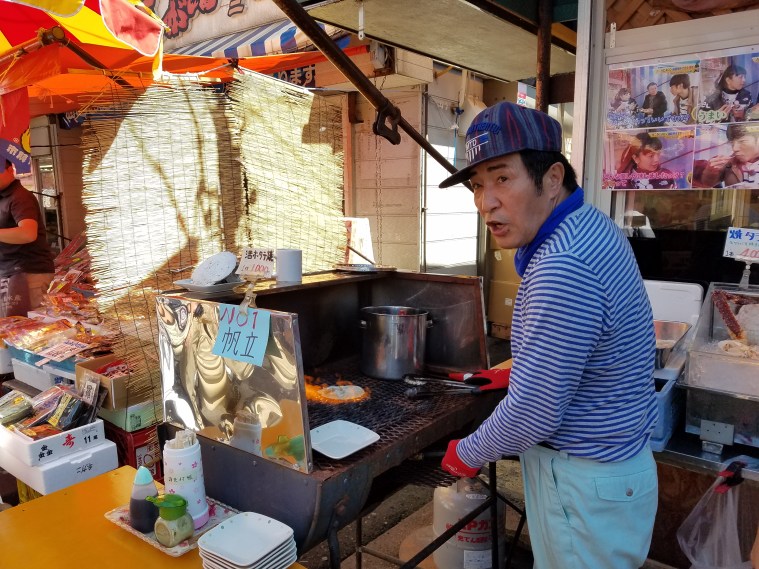
The covered market opened onto a busy, sunny street filled with vendors and tiny restaurants of all types. David bought a luscious slice of canteloupe, eating it perched on a bench beside his fellow customers. We bought “barbequed” scallops piled high on a shell and cooked on an open pit fired by a handheld propane torch until the broth around them boiled. Delicious! A little further on, I couldn’t resist squid ink soft serve ice cream that turned out to be surprisingly good…probably because there was little of the squid ink to be found other than the odd gray color.

20160915_113307

20160915_113839
“Barbequeing” scallops
20160915_114331
David finishes off the last of the broth while the chef and his wife wait for the final thumbs-up
dscf3319crop
Squid ink ice cream!

Leaving the market, we headed towards restored brick warehouses which Ken explained were now shopping malls. Their brick construction and the brick pavers we saw on roads belied the strong European influences in Hakodate. None of our group was interested in shopping, so we breezed past more music boxes and souvenirs, stopping only for cold local beers and a melon drink at a grocery store/deli.

Our path took us up an increasing slope to Higashi Honganji Temple, a beautiful Buddhist temple. After repeated destruction by fires, the current building was erected in 1915 and was the first reinforced concrete temple in Japan. Apparently, the construction caused some concern, both as to whether the material was strong enough to hold the massive roof…and as to the purity or lack thereof of a material that people had walked on and therefore made impure. Geishas were hired to dance on the floor and somehow that resolved all. The temple shows some western influence, one main depiction looking as much like a Catholic saint as anything. Nearby Catholic, Protestant and Russian Orthodox churches emphasize that influence.

20160915_125755

20160915_130010

20160915_130257

Continuing our uphill climb, we boarded the gondola up to the Mt. Hakodate Observatory House for a sweeping view of the city and the surrounding waters of the Tsugaru Straits. The Hakodate Ropeway (gondola) tickets turned out to be the biggest expense of the day at 1280 yen pp, roundtrip ($12.55). Sure enough, after a little negotiation between Ken and a lady at the ropeway office, Ken was free so long as we paid for the group of six at once. No problem. We were a cooperative group and we settled up quickly.

20160915_133123

We finally used our tram tickets for a long ride to Goryokaku Fort, a star-shaped fort of European design. The grounds of the fort are now a park and people rowed small rental boats on the moat waters. At the center of the fort the former magistrate’s office has been rebuilt and provides an interesting glimpse of classic Japanese architecture. Tatami mats felt delightfully cool under my bare feet, giving off a fresh scent of straw. The large wooden sliding doors to the building were thrown open as well as the paper interior doors allowing in both sunshine and a light breeze from the beautiful day outside.

20160915_155417 20160915_154635

20160915_152326

Pleasantly tired and happy after our long day and nearly 6 miles walking, I thought it a perfect end to our tour. The rest of the group agreed and we followed Ken to the tram for our ride back to the train station and the ship shuttle bus.

It was 4:45pm by the time we reached the station and Ken had had nothing to eat and only a few canned soft drinks despite our offers. We felt guilty that he was to receive only 3000 yen for nearly 6 hours of time with us. Conferring among ourselves and worried about the Japanese aversion to tips, we offered him an extra 3000 for his dinner which he very happily accepted. We parted with positive feelings all around.

I’d recommend the Hakodate Goodwill Association to anyone looking for an unbeatable deal, willing to try an amateur guide with unknown language skills, and physically able to handle a good deal of walking, often uphill. (We walked about 6 miles with Ken.)

______________________________________

Cruise port details:

It’s about a 15-minute shuttle bus ride from the port to the train station. There’s no realistic way to walk. Celebrity and/or the city provided the shuttle at no charge.

Free wi-fi was offered just beyond the gangway in the passenger welcome area.

Otaru, Japan – The Carmel of northern Japan?

20160914_110641
Rickshaw in passing mode, Otaru

I was totally charmed by Otaru. The old buildings of Sakaimachihondori Street, the main shopping area, are almost achingly picturesque…reminding me, in some ways, of a Japanese Carmel. We began our explore of the area at the Otaru Music Box Museum in a 3-story wooden building across from the towered post office. The “museum” is really more of a large souvenir shop selling every kind of music box imaginable. A tall clock outside the music box museum surprised us when it blew the half-hour on a train-like whistle, emitting a gray puff of smoke.

20160914_102645
Otaru Music Box Museum

It’s an easy stroll from the music box museum down Sakaimachihondori Street toward Otaru Canal. Vendors on both sides of the street offer free samples: chocolate, sweet cakes and cookies, sake and other more exotic spirits like kelp “wine.” I found the seafood shops especially intriguing with all sorts of live and dead offerings, many of which I couldn’t identify. “Hairy crab” is a local specialty.

20160914_104657
Sakaimachihondori Street

20160914_105002

20160914_105338

20160914_155622
Kimono for sale just off Sakaimachihondori Street

At the end of Sakaimachihondori Street, we crossed a small canal and–after procuring some yen at the post office ATM–headed toward the main Otaru Canal and the sushi restaurant I’d booked for my birthday celebration. Otaru is famous for sushi and I wanted to be sure to get a seat at Mazasushi as it got great reviews, but I’d read that there were often long lines and that little English was spoken there. I booked through Savor Japan, the only service I could find that made booking in English in Otaru doable. https://savorjapan.com/ Although the maitre d’ had a little trouble finding the reservation, he did eventually locate it and we were seated at a window overlooking the canal across the street, just as I’d requested. Yay for Savor Japan! [There wasn’t a line, though, so we might have been alright without.]

20160914_120222
Sushi lunch at Masazushi Zenan

The sushi was excellent and we had fun trying a new dish of squid, sea urchin and raw egg. To eat, we mixed the uni (sea urchin) into the raw egg, then dipped the squid in that. The “noodles” were cold and crunchy and made a really good accompaniment. I found the uni surprisingly mild, not at all fishy. This dish made me a convert.

20160914_115609

We took a post-lunch stroll along the canal which is lined down one side with restored old warehouses. Otaru’s fortunes were built on the herring fishing industry before the fish left for different waters.

20160914_125409
Otaru Canal

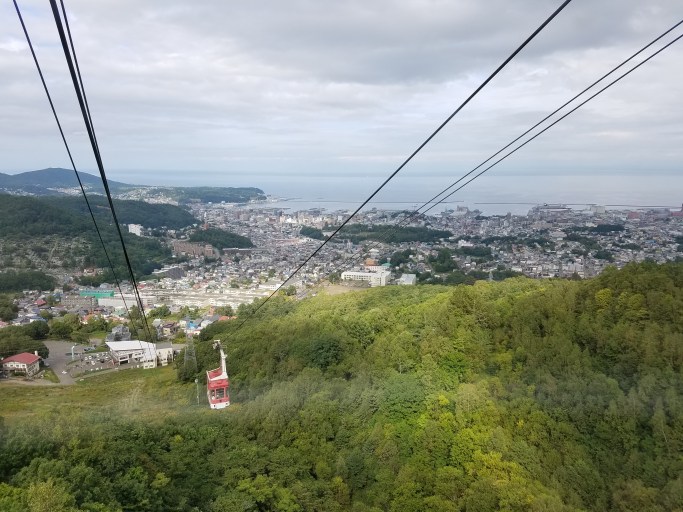
Leaving the canal, we walked a few blocks to the Otaru Train station to catch the #9 bus (220 yen pp one-way, about $2.15) to Mt. Tengu (Tenguyama) where we rode a gondola to the summit for a sweeping view of the city and harbor. A beautiful little meditation path leads past Shinto shrines through the woods to another overlook.

20160914_140203
Mt. Tengu gondola


20160914_140736
Mt. Tengu meditation path and Shinto shrine

20160914_141031

The city bus picks up and drops off in the parking lot across from the base gondola station. There’s a glass shop across the parking lot with windows where we watched glass blowing going on in a downstairs workroom before catching the bus back to Canal Station. (You pay the driver via a machine when you exit the bus.)

20160914_133643
On the bus from Mt. Tengu. I love the white gloves!

Because David always wants to try local beer, we made a quick stop at the Otaru “Brewery” and Restaurant which is really a German-style beer hall (kind of weird) with big brass beer tanks in the center of communal tables. The beer was nothing special, but we enjoyed sitting outside at a small table on the canal (which had the added benefit of letting us escape the pervading odor of smoked sausage inside–not exactly unpleasant, but we didn’t want to end up smelling the same way).

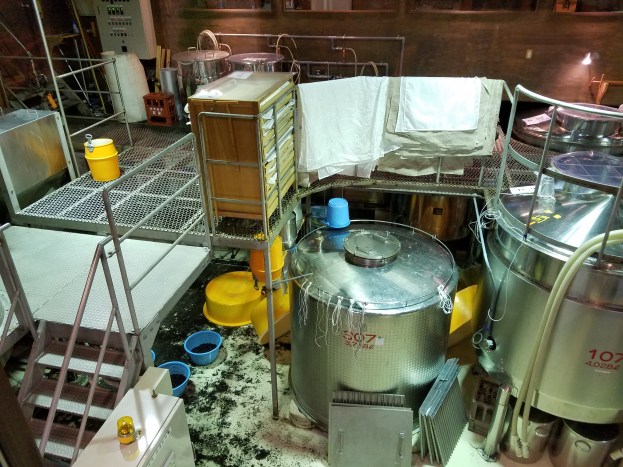
With David’s beer stop out of the way, it was time for my sake stop. The Tanaka Sake Brewery Kikkogura sits just north of the cruise port terminal so it made a convenient stop on our way back to the ship. A very friendly, giggling young woman poured 4 sakes and 3 fruit wines (blueberry, plum, and peach) for us to taste. Instructing us in the Japanese version of “Cheers!” she wrote out “KANPAI” to be sure we got it right. After purchasing a bottle of the really delicious plum wine, we toured the working brewery with the aid of an English self-tour handout. It was all very interesting and fun. Both the tasting and the tour are free.

20160914_170702
Many little cups later
20160914_171829
Overlooking the working part of Tanaka Sake Brewery Kikkogura

____________________________________

Cruise port details:

The city of Otaru set up information tables with maps and staff perfectly fluent in English.

Stalls selling food an souvenirs were also set up just off the ship.

A stall with free wi-fi was also provided.

It’s about a 20-minute walk from the ship to the Music Box Museum. It’s an easy walk with no hills, but several intersections. It’s not particularly scenic, but seemed perfectly safe. The guest information people were happy to mark the route on our map and point out ATM machines, points of interest, etc.

error: Content is protected !!