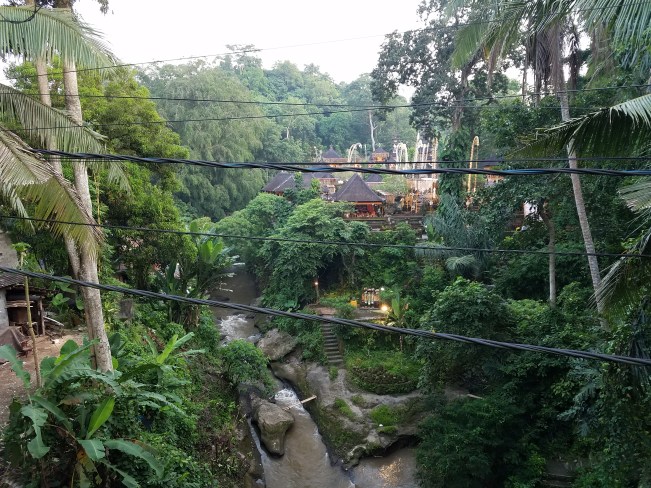
Eschewing the Manohara Hotel next to Borobudur Temple for something more exotic, smaller and with better dining reviews, I chose Amata Borobudur Resort for our 4-night stay in Central Java. At about $80/night, it was more expensive than a lot of options in the area, but about $60 cheaper/night than the Monohara and with what looked like a lot more local charm and an interesting setting. Amata also provides free transportation to Borobudur Temple (including for sunrise) which is only 10-15 minutes away.
Our 1.5 hour flight from Denpasar, Bali, was delayed just long enough that we arrived in Yogyakarta, Java, at rush hour. Fortunately, the driver Amata sent for us knew the back roads and was able to dodge some of the traffic once we were out of the city, but what we hoped would be an 1h 20 min drive still stretched to two hours and we arrived after dark. So, the layout of the little resort remained shrouded in mystery and we could only explore our bungalow…which we loved!
Flower petals on the big, comfy bed (along with a tiny salamander) were a nice touch.
Done in classic Javanese style with wooden walls and high ceiling, someone with an artistic touch had really raised it to the next level. The little attention to details charmed us.
What a dramatic and unusual light fixture!Great organic design. The bag was a sample from the shop in the main building which also sold jewelry and other handmade items.
The shower room, while un-air-conditioned as usual, was surprisingly fully-enclosed. Save for Nusa Dua, all the bathrooms we’d had had openings to the outdoors. This makes large wood ants wandering the bathrooms a common occurrence. We learned to just ignore them. At Amata, no bugs! We did however have a large salamander that lived high in the rafters and “barked” occasionally. Oh well, when in Asia…
The first fully enclosed bathroom we came across in Bali, with a glassed-in skylight.
The next morning dawned bright and sunny and we could survey our new domain. We discovered we had the bungalow furthest from the main building, which we thought was a plus. The distance wasn’t far, but we had lots of privacy and looked out over adjoining rice paddies in the opposite direction.
View from our porch to a neighboring bungalow and the pool. The open-air dining pavilion is beyond the bungalow and the main building/lobby just beyond that.Beautifully-kept pool. Only minor downside for some is no shade anywhere on the pool itself.
Breakfast in the nearby open-air pavilion turned out to be a multi-course affair served at table.
Javanese rice porridge with hot cane sugar syrup. Yum!View from our breakfast tableBanana spring rolls for breakfast. Food, like much else at Amata, was artistically presented.
Later, we found dinner to be tasty and even simple dishes we’d grown accustomed to were presented with an extra flair. A limited selection of beer and wine is available, something not always on the menu in Muslim Java.
Amata’s version of one of my favorite Indonesian vegetarian staples, gado gado. It’s not usually served as as a wrap.Nasi goreng (fried rice) and satay
From Amata Borobudur Resort, it’s a short walk to Mendut Temple which is definitely worth a visit, and very cheap (less than a $1, if I remember correctly).
Inside Mendut Temple
All in all, we really enjoyed Amata Borobudur Resort. I’d stay there again, and feel like we got decent value for the money. I paid 4,500,000 idr ($320 US) for 4 nights, or about $80/night for a “deluxe bungalow.” (Our bungalow was named “Sunibya” and I recommend it for style and location within the resort.) This price included breakfast, 10% tax and 10% service charge. The price is relatively high for the area, but provides a measure of luxury with local flair and is substantially less than the $140 or so rate at the Manohara Hotel next to Borobudur Temple, even factoring in the reduction offered there for entry to the temple. (There’s a spa on-site at Amata as well, but we did not use it.) Plenty of budget options exist in the area, for those looking for more basic accommodations. I booked via Booking.com as they had the best rate at the time and I used Topcashback to get even more off. (Currently, Topcashback is offering a 7% rebate on Booking.com bookings. If you’re not a Topcashback member, you can use my link here.)
Amata arranged a driver for us to and from Yogyakarta Airport for 300,000 idr each way ($21.34). There was no additional charge for our pre-dawn departure. They also arranged a driver for us to explore the region for a day which turned out to be a great experience and far less touristy than we feared, a bonus of choosing a car which could wander much further than the horse-drawn tourist cart tour they initially suggested. (A car also offers air conditioning, a huge and irreplaceable bonus is steamy Central Java.) The cost was around $30. We paid via credit card for the 3 drivers when we settled our room bill.
The only minor “complaint” I have about the location of Amata Borobudur Resort is that the several mosques in the area begin an almost comical competition of calls to prayer many times a day, some starting in the wee hours and all over loudspeakers. I’m not sure it would be much better elsewhere in the area, though.
When Bali topped the list to kick off David’s “3-month birthday party,” I knew I had to add Borobudur Temple in Central Java to our itinerary. I first heard of Borobudur 15+ years ago from a Frenchwoman at a conversation group in Paris. Her description of this once-lost magnificent Buddhist temple in the jungle sounded magical. An Internet search confirmed everything she said. Now, after all these years, Borobudur was going to be a short flight away from where we planned to be. The opportunity was irresistible!
Planning months in advance, I had my choice of hotels. The most logical first choice seemed to be the Manohara Hotel, located next door to the temple and the sole source of Sunrise Borobudur tickets. At around $140, it was expensive by local standards, but more of a turn-off were the mediocre reviews of rooms and the restaurant. The grounds looked lovely and the location couldn’t be beat, but the rest looked uninspiring. Hmm. Searching further, I hit on the Amata Borobudur Resort, a place that looked romantic and that seemed more like my ideal of a Javanese retreat.
Amata offered free transportation to Manohara (a ten-minute drive) for Borobudur Sunrise, which was the ticket I wanted. Post-sunrise tickets are cheaper, but also more crowded…and minus sunrise! (The sunrise ticket also includes the loan of a flashlight, a post-temple snack at the hotel and a souvenir batik scarf.) Our mini-van driver walked our little group into the hotel and stood in line to buy the tickets for us which we reimbursed him for in cash or credit card. Tickets are unlimited, so are sold on the morning of entry. Another advantage of the sunrise timeslot is that, while popular, the price and hour mean the crowds are less. (Cruise ships even run tours here from the port at Semarang, which I gather is about a 3-hour drive each way. That means hordes from a ship could descend later in the morning. I’d check online port schedules if doing Borobudur later in the day.)
Sunrise behind Mt. Merapi
Sunrise admission to the temple starts at 4:30am. It was a short walk from the Manohara Hotel to the stairs that lead to the top of the 8-9th century temple, which is an atypical structure for Buddhist temples, consisting of a large square pyramid with 72 Buddhas in open, lattice-style stupas on the topmost levels. (“Stupa” is Sanskrit for “heap” and refers to those bell-shaped holy structures common to Buddhist temples.) Borobudur Temple (or “Candi Borobudur” in Indonesian) consists of three tiers comprised of a base of five concentric square terraces, a cone-shaped center with three circular platforms and a large stupa at the very top. When we arrived at the next-to-the-top level, just below the giant stupa, a fair number of people were already waiting in the dark for sunrise. It was not so crowded as to be a problem, disturb the peace of the place, or hinder photography to any great extent.
Early morning visitors assembled for sunrise atop Borobudur TempleBuddha inside a lattice-work stupa
We were blessed with a perfect morning; blue skies and sweet, fresh air. Birds sang and roosters crowed in distant farms as the sun rose. A light mist filled the valley below. Volcanoes rose in the distance, becoming clearer as time passed. I found the changing light and its effects on the scene mesmerizing and could not help taking way too many photos.
We took our time, admiring the carvings and the view. More people began to arrive at the temple as time passed. A few hours was plenty to arrive before dark, enjoy sunrise, and make a leisurely descent. The temple is large, but a single edifice and nothing on the scale of, say, the temple complex at Angkor.
Looking back up towards the central stupa atop the temple
The base of the temple pyramid is surrounded by a stone terrace. The temple is so large, that we had to walk a distance out to be able to take it all in. To our pleasant surprise, the temperature remained delightfully comfortable throughout our visit, another benefit of the sunrise visit. I was totally braced for another sweltering day and expecting to be a sweaty mess a la Angkor in Cambodia (and most places we’d been in Indonesia), so couldn’t have been happier.
Tip for exiting Borobudur: One of the complaints I read repeatedly in reviews of Borobudur was that there seemed to be no way to exit the complex without being routed through a maze of tourist stalls and pushy hawkers. Some claimed it took them 45-minutes to get through this gauntlet. To avoid this, take a path which is to the left of the top of the stairs in the photo below, ignoring the “Exit” signs which direct you to the opposite side of the temple, and follow the signs to Manohara. Even if you did not buy the sunrise ticket, there’s no reason you can’t exit this way toward the hotel and avoid the vendors.
The people in this photo are descending the exit path to Manohara.
The exit to Manohara routed us to an open-air restaurant on the hotel grounds where we were offered coffee, pastries and a souvenir batik scarf. It was a nice gesture, but we only nibbled. Given our early start, we were back at our hotel in time for an 8-8:30 breakfast.
Station at the restaurant offering pastriesCoffee, pastries and a souvenir scarf
Practical info: Tickets for Sunrise Borobudur are available through the Manohara Hotel or “Center for Borobudur Study” as it bills itself. The cost is 450,000 idr (about $32pp) for foreign visitors, 325,000 for domestic visitors, and 275,000 (about $19.60pp) for visitors staying in the hotel. Manohara also offers sunset tickets for the same prices. Tour operators may also supply these tickets, but they’re buying them at Manohara.
Regular (not sunrise or sunset) tickets to Borobudur Temple cost 325,000 idr (about $23.15) per adult in 2018. Combo tickets for Borobudur, Mendut and Pawon temples are also available, although we found tiny Pawon temple (which we visited the following day) was open and free with not much to see. Mendut, which we could walk to from our hotel, cost a negligible price at the site. I think less than a dollar, but am not sure.
This post is long enough (all those photos I couldn’t resist!), so I’ll do a separate post on our hotel, Amata Borobudur Resort, just after this one.
We spent four days at gorgeous INAYA Putri Bali entranced by the tidal pools that emerge each afternoon and are filled with all kinds of beautiful and unusual sealife. There were thousands of starfish, large sea hares, any number of little fish, sea slugs, eels and more.
Eel in Nusa Dua tidal pool
On the second day, I was able to trail along behind a banded sea snake as he tried to make his way to deeper water. I knew it was a fatally venomous snake (50x more poisonous than a cobra per Bali Animal Welfare Association), but non-aggressive and I didn’t crowd him.
Deadly venom: Banded sea snake in the ankle-deep water of a Nusa Dua tidal pool
The next day, I was watching a small eel when a little octopus showed up. I trailed him with my camera. When I looked him up later, I found he’s a blue-ringed octopus and “recognized as one of the world’s most venomous marine animals,” having “enough poison to kill 26 adults within minutes.”
Lethally poisonous: Blue ringed octopusWay too close!
There’s no antivenin for either of these critters.
Quite a few people enjoyed the tidal pools and we saw lots of parents scooping up marine critters to put in pails for their children to see. We saw no warnings posted about the dangers posed by some of the local sealife, so be advised. Sea creatures are fascinating and often beautiful, but never try to touch or pick up what you aren’t familiar with.
Lovina, in the north of Bali, is famous for its black sand beaches and early morning boat rides among large schools of dolphins. Wanting to try something different from our other destinations, I booked us 4 nights at the Starlight Hotel, a cluster of small cottages on the beach owned by a Dutchman. We enjoyed our stay, but found the location to be lacking in much to do outside dolphins and diving. Our hotel restaurant (open-air like every single restaurant we found in Bali) was hotter than most and sadly lacking in ocean breeze or ceiling fans although the food was good, service very friendly (and their frozen “welcome drink” the best we had on the island).
Beautiful view from and of Starlight Hotel restaurant
Our cottage also sported an inadequate a/c, even after a repair attempt so we moved to one adjacent to the lobby area; not as secluded, but cooler. The cottages were identical inside; pretty if simple with mosquito netting draped over the bed and a high Balinese-style ceiling. We had a small flat-screen tv I only glanced at, a coffee/tea pot set up, a small fridge and a nice little porch.
Starlight Hotel cottage
The grounds are lovely and well-maintained with the many fruit and flowering trees labeled, a nice touch. The property, like most we saw in the area, is long and narrow with beach front on the narrow end, obviously a precious commodity. The beach was quaint with the black sand and dolphin boats looking like oversized water bugs with their thin pontoons, but it is narrow and not groomed so sea refuse makes it not overly appealing for spending any time there. The Starlight Hotel does offer a nice pool, though and we made good use of that.
The ungroomed beach didn’t inspire us to linger thereStarlight Hotel grounds with Bali “cannonball tree” in foreground and pool in the distance
Quite a few dolphin boats anchor along the narrow stretch of beach in front of the Starlight so it was easy to book a 6am trip for our first morning. The hotel offers to book these trips for 100,000 and our boat “captain” made us the same offer, but quickly came down to 75,000 rp each. The ride out to the dolphin-spotting area is short, and visible from shore. In no time, we counted right at 100 small, motorized pontoon boats milling around and darting after the numerous dolphins. It’s certainly not a tranquil moment with wildlife, but the whole event was fun in its own way. (While I sort of assumed the dolphins were always there, we met a Hungarian couple a few days later in Munduk who made the pre-dawn trip down to Lovina to see the dolphins and saw none.)
We had a great day scuba diving Menjangan Island, part of West Bali National Park, with Arrows Dive Centre. They picked us (and 4 snorkelers from different hotels) at 8am and drove us in an air-conditioned (seatbeltless) van the 1.5 hours to the park where we boarded a small, ratty dive boat–one of many identical boats docked there–for the island. We were back at our hotel around 5pm.
Not the swankiest of dive boats, but functional
We saws lots and lots of dolphins on the way out to the island. (Sadly no pics due to a camera glitch.) Apparently, this is unusual as our guides were very excited about it, whistling to call the dolphins closer. Pairs and groups swam right up to and under our boat. With no other boats in sight, it was that tranquil moment with wildlife that the previous day was not. Wonderful!
The diving itself was good, but not great only because the visibility was just OK. The coral was lovely and the fish abundant. We didn’t see anything too unusual: a lone barracuda, a grouper in a small cave, lots of small lionfish which we’re sadly familiar with from the Caribbean where they are an invasive species. Still, we really enjoyed the 50+ minute dive and moderate depth. I get cold on long dives even in warm water and was happy with a long wetsuit, but David was content with his shortie. Both suits were in excellent condition and well-fitted as was the other equipment. Yay for Arrows!
Good-condition Scubapro equipment at Arrows Dive Centre
Lunch was a nasi goreng (Indonesian fried rice) picnic affair (packed from a restaurant near where we boarded the dive boat) on a remote little dock on the island we shared with a few other boats.
Stopped for lunch on Menjangan Island
I spotted one of the island’s sacred deer near a small cliff-top temple nearby. Unafraid, he followed me back to our little group at the lunch spot.
Small temple on Menjangan IslandSacred Menjangan Island deer
A few other boats docked near ours, but there was no crowd at all and no one already on the island itself in this area. Our second dive after lunch was much like the first and we enjoyed it thoroughly. We ran into a few other divers briefly down below, but there was no crowding. All in all, I highly recommend Arrows Dive Centre and our divemaster, Wayan (“Yani”) who David and I had to ourselves.
We used Arrows again for muck diving the following day. Muck diving is an unusual form of diving and some of the best spots in the world are in north Bali. I really wanted to try it while in Lovina. We chose Puri Jati as our dive spot, a mere 30 minutes from our hotel. Yani and a driver picked us up at 8:30am and we at the beach site in no time, a pretty spot with a Hindu temple and Hatten vineyards adjacent to the beach.
Temple, rice fields and vineyards at Puri Jati (beach is behind photographer)Black sand beach at Puri Jati where we waded in to muck dive
This was a beach dive, i.e., we waded into the water rather than take a boat out to a remote location. As opposed to the more usual coral reef or wall dive, a muck dive is a shallow dive over silt or “muck” where you search for often tiny and unusual bottom dwellers that live in this environment. It turned out to be spectacular. We saw a mimic octopus in action, ghost bone fish, thousands of a type of white sea urchin, thousands of live sand dollars and several oddities I can’t name. The few bits of flotsam we saw formed mini-reefs with colorful coral, tropical fish, an eel, and shrimp of various kinds.
Mimic octopus, Puri Jati muck divingSeahorse at Puri Jati
I highly recommend Lovina for the dolphins and local diving opportunities (or snorkeling, if that’s more your speed) and I’m glad we went. As a place in and of itself, though, the city and adjoining little towns don’t offer a lot. Also, way too many roaming dogs lead to a lot of barking at night that mingles with the ubiquitous Bali noise of crowing roosters.
____________
We paid Arrows Dive Centre 1,400,000 rupiah (about $102) each for the 2-tank day of diving at Menjangan Island and 750,000 rupiah (about $55) each for the 2-tank muck diving half-day. Both dives included all equipment and transportation to and from our hotel. The Menjangan day also included entrance to the national park and lunch. Yani was an excellent divemaster, respectful of the environment, and very good at spotting camouflaged sea life.
The drive from Ubud was about 3.5 hours and we paid 600,000 rupiah for a driver who took us by a luwak coffee plantation and the Jatiluwih rice terraces. The driver was arranged through our Ubud hotel, Sri Ratih Cottages. Luwak coffee is touted as “the most expensive coffee in the world. “Luwak” is the local name for the palm civet, a raccoon-like animal that likes to eat coffee beans. Beans processed through the digestive system of a luwak are the basis of luwak coffee. That’s right, they collect civet poop to get the “specially treated” beans that are then roasted to make luwak coffee. You’ve got to wonder who first thought they’d give that a try!
The big bowl in the front holds dried luwak poop.
A “luwak” or palm civet. A nocturnal animal, but maybe all that caffeine was keeping him awake.
Trying my hand at roasting luwak coffee.
As improbable as it seems, the coffee is actually delicious and has become a delicacy in coffee-loving circles. Apparently, it’s possible to pay $30 for a cup of Luwak coffee in California. Not worth it to me, but we were definitely willing to give it a try at Balinese prices. (50,000 idr or about $3.60/cup) And yes, it is delicious, mild and unusual with an almost sweet taste.
Coffee beans on the plant
Many teas and coffees were offered to us at the plantation free, along with banana chips, in the hopes of selling us more to go. In addition to full-sized cups of luwak coffee, we sampled mangosteen, ginger, lemon, herbal, rosella and lemongrass teas and Bali, coconut, vanilla, ginger, ginseng, Bali cocoa, Bali mochacino and durian coffees. The locale is lovely and our traditionally-dressed guide (a friend of our driver) was friendly and in no way pushing any of it on us. The stop was definitely on the touristy side, but fun and interesting nonetheless. And, yes, we did buy some luwak coffee to take with us.
Tea and coffee tasting beside a rice paddy. So many flavors! (
Our other bonus stop along the way to Lovina was Jatiluwih rice terrace. We really just gave it a quick look and stopped for lunch with a view since we wanted to get on to Lovina. It’s possible to spend lots more time there hiking among the paddies. There is a 40,000 idr entrance fee (less than $3pp).
Hindu ceremony in progress at Pura Gunung Lebah in Ubud
In making plans for our 2+ weeks in Bali, I chose 4 very different locations and accommodations to try to give us a real sampling of the island. Our destinations included 2 interior locations: a boutique hotel in cultural-center Ubud and a homestay in rural Munduk for its waterfalls and rice terraces; and, 2 waterfront spots: a little beachfront hotel in backwater Lovina in the north for narrow black sand beaches, dolphins and scuba diving and a sprawling resort in gated-enclave Nusa Dua for wide white beaches and a little luxury.
I chose Ubud as our first destination because I wanted to start with the cultural heart of Bali. I also wanted to organize our trip so that we ended up in Nusa Dua, our closest stop to the airport. With traffic notoriously bad to Denpasar International Airport (DPS) especially during ongoing construction of an underpass intended to alleviate the problem, I wanted the shortest trip possible when it came time to leave Bali.
Denpasar International Airport
We arrived DPS from Singapore in the early afternoon and found a lovely airport and a horrendous line at customs despite the recently-enacted 30-day visa waiver. The line moved relatively quickly, though, and we were out the other side in about 25 minutes. (Note: There’s a shorter line for locals and those over 60 and those traveling with small children. Although shorter, it did not seem to move very quickly. There are also toilets just to the side of the line if you need to dart over there while someone holds your place in line.)
Expect to search through this mob if you’re meeting a driver at DPS
A driver from our boutique hotel in Ubud, Sri Ratih Cottages, was waiting for us when we landed at DPS. Although Ubud is only 38km (less than 24 miles), the drive takes about 1h30 due to traffic. (The main roads are actually in good shape; it’s just a matter of too many cars and motorcycles, especially near the airport where clubbing hotspots like Kuta add to the crush. Further into the central hills and mountains, the going is slowed by winding narrow roads.)
The lobby of lovely Sri Ratih CottagesWe woke the first morning to find fresh offerings and incense burning on the “toad god” in front of our cottage.
We found ourselves charmed by Ubud. Although brutally hot and humid, the town defines exotic. Every doorway seemed to open onto a gorgeous hidden courtyard replete with temples, tropical flowers, statuary and incense. The traditional dress of sarong (k), sash, 3/4 sleeve lace blouses for women and tied “udeng” head scarves for men are commonly worn.
Again and again, some beautiful door would beckon and we’d duck in to find a gorgeous courtyard and temple or achingly beautiful guesthouse and temple…Behind one of those doors. A breakfast area for a guest house.
Offerings are made throughout the day to the many Hindu gods and little banana leaf trays with flowers, snacks and often with burning incense are left everywhere. You actually have to watch your step as they are left in doorways and in the middle of sidewalks. David twice stepped on incense sticks, one still burning, that lodged in his sandal. Ouch!
One of the many ubiquitous offerings found everywhere in BaliA gate in Ubud Palace from inside the main courtyardGods are often dressed in bright cloth. Workers wear traditional clothing.
Our hotel offered free shuttles into town that dropped us off in front of “Ubud Palace.” (It was about a 15-minute walk.) The place is free to the public and consists of several open courtyards with altars and raised roofed seating areas. Just across Jalan Raya Ubud (the main street) from the palace begins the byzantine Ubud Market, a combination of open-air stalls and a rabbit warren maze of covered stalls selling items of all kinds: sarongs, dresses and shirts, sandals, jewelry, spices, and other souvenirs.
Ubud Market
Back on the main street, we wandered into the spectacularly beautiful Pura Taman Kemuda Saraswati, a large temple fronted by a massive lotus pond. Entrance is free to the garden and front area, but the temple itself is closed to the public. We enjoyed a delicious lunch at adjacent Café Lotus, sitting cross-legged under a thatched roof overlooking the lotuses. A tiny alligator made an appearance among the flowers as we ate.
Pura Taman Kemuda SaraswatiTasty Indonesian lunch with a view
Another day took us to the Sacred Monkey Forest Sanctuary, a 15 minute walk down Monkey Forest Road from the Ubud Market. We weren’t expecting too much, probably something uber-touristy and kitschy. Instead, we found a large and breathtakingly beautiful jungle park filled with exotic statuary, free-roaming macaques and a river gorge. An active temple sits among all this beauty.
If you go to Ubud, don’t miss Monkey Forest! Entrance is 50,000 rp/adult. Also, beware the monkeys. They’re little thieves. I watched one jump on a girl and wrest the water bottle she had tucked into a side pocket out. He ran off with it, bit holes in the bottom and drank. Not far from him, another monkey was drinking from another pilfered water bottle. Before we entered the forest, I took the precaution of removing my jewelry, too. I had no desire to have a monkey rip the earrings out of my ears. For the most part, though, they were busy doing monkey things and not all that interested in the people among them. Vendors sell bananas and sweet potatoes to feed them, but I didn’t want to start that kind of attention. Signs also warn against making eye contact as that is seen as a sign of aggression. We saw many mothers with babies, some clearly newborns. The interaction among the troupes was fascinating and delightful to watch. We laughed as one older monkey kept grabbing a little would-be runaway by the tail.
We were surprised to see a small monkey swimming underwater in a little pond. A larger monkey with him was very defensive whenever the little one was under water and was the most aggressive with a human that we saw. She tugged on the leg of a man who got to close trying to take a picture, snarled, and literally chased him away.
One morning, we got up early for a sunrise hike along Camphuan Ridge, a paved trail through picturesque rice terraces to end in an area dotted with homes, some for tourist rent, artist studios, a few cafes and a little spa. A temple called Pura Gunung Lebah at the beginning of the ridge trail had caught our interest for some time. It’s large and beautiful and had been the focus of local activity.
This view of Pura Gunung Lebah from a bridge over the River Oos caught our eye from our first day in Ubud.Pura Gunung Lebah from the beginning of the Camphuan Ridge Trail (to get to the temple and the hiking trail, go down the road to the Ibah Warwick Villa & Spa of Jl. Raya Ubud (main street), but turn left before you enter the hotel compound.Camphuan Ridge Trail in the early morning. The best time to go. It would be brutally hot midday!Rice fields at the end of the trail
A highlight of our trip came when some of the staff at our hotel invited us to join them for a Hindu ceremony at this temple when the saw how intrigued we were by small parades filing past our hotel entrance carrying musical instruments and things similar to Chinese dragons to the temple. A waitress we’d made special friends with, Ugune, told us there was a 4-day celebration going on and we were welcome to come, but that traditional Balinese dress was required to attend a ceremony. Sometimes, sarongs or long skirts are required to visit active temples, but this was something more. We needed sarongs, sashes, long-sleeved shirts and a udeng head scarf for David. We bought the sarongs, improvised sashes from my scarves, used our own long-sleeve shirts (my long-sleeved t-shirt decidedly less beautiful than the lace blouses of the other women) and borrowed an udeng.
When the time came, we met the others in the hotel parking lot where our fleet of motorcycles and scooters assembled. Our new friends ferried us on the backs of two bikes and we were off.
Lovely in their finery, women in the group also brought baskets full of offerings. After parking the motorcycles, they carried the baskets on their heads as we walked the final way down a steep hill to Pura Gunung Lebah, the temple which sits on the Oos River near the start of the Camphuan Ridge Trail.
Before entering the main gate, Ugune dipped a bundle of straw-like leaves in a container of water then flicked it on each of our group for cleansing before we entered the gate into the first courtyard of the temple.
Cleansing water
The temple was beautifully decorated for the ceremonies, which seemed to be on a rolling hourly basis. Long bamboo pole decorations called “penjor” dipped gracefully overhead and flowers and bright cloth adorned the platforms and idols. We proceeded into the next courtyard where we joined others waiting for the preceding ceremony to finish.
We weren’t the only ones admiring the decorations.
David and I were the only Westerners present, but everyone was very welcoming. We felt comfortable taking photos and videos as the Balinese were doing the same thing, snapping photos of family and friends dressed in their holiday best. It was a cheerful, happy crowd.
We could hear the voice of the priest leading the ceremony in the main courtyard and glimpse some of the worshippers through the main gate. Eventually, things seemed to be winding up then we saw people filing past a side gate, evidently having left the main courtyard by a side exit. People in our courtyard began to line up by the main gate and our group joined them.
The gate to the main courtyard is just opened for the waiting congregants to enter
A guard/usher opened the gate and we entered the spacious main courtyard Women with offering baskets headed to the right and around the main area to mount the raised front area to leave offerings on the altar. They filed from right to left, descending again to find a seat, kneeling or sitting cross-legged on the ground with the others. They kept some flowers in their baskets to take back with them to be used in the ceremony. Men, women and children sat together on the ground. Agune told us we were welcome to stay for the ceremony which would go on for an hour, but we decided to excuse ourselves thinking we’d be more than a little out-of-place. And not wanting to intrude or treat their religious ceremony like some sort of tourist entertainment. We found a spot in a side courtyard, though, where we could watch the ceremony.
Presenting offerings and taking seats before the ceremony at Pura Gunung Lebah
The priest, who sat in a small structure behind and to the side of the worshippers rather than in the front, led the congregants over a loudspeaker in a series of prayers while chimes tinkled all the while. Each time they prayed, a bell would ring along with the chimes, then increase in volume to indicate the approaching end of the prayer. Worshippers would lift a flower between their pressed palms which were held as Christians would in prayer but raised so that the thumbs pressed against their foreheads. Then, they would place the flower before them and put a petal behind an ear (men) or tuck one in their hair (women).
Agune later explained the priest would tell them to which god they would pray next and that the petals were to indicate a sort of blessing. It was a beautiful ceremony!
Castle Hill, topped with the old Texas Military Institute (TMI) “castle” has been around since 1870. “Grafitti Park” below it, though, is a 2011 South By Southwest (SXSW) art exhibit that has obviously been wildly popular. Visitors are invited to bring their own spray paint and paint away. Even though David and I both went to law school in Austin, we were surprised and intrigued to stumble across the graffiti-covered park while looking for a parking spot the past Friday near favorite restaurant Wink. With the sun sinking low, lots of people clambered over the brightly painted walls.
Always curious, I had to look up this strange and popular park–otherwise I’d have had no idea about its SXSW origins. The park is officially known as HOPE Outdoor Gallery. For those few unfamiliar with the ever-growing event, SXSW is a huge annual festival that started back in the 80’s as a music/conference event and has expanded over the decades to include interactive media and film. In looking into Graffiti Park, I also learned that it’s been slated for destruction, a victim to Austin’s rampant (and city-ruining, IMHO) growth.
If Austin’s in your plans and grafitti in a funky Austin setting is your thing, head to 1008 Baylor St. in Austin before the end of June when it will be bulldozed. The good news is the park will be reopened in East Austin. Six acres of Carson Ranch have already been bought for a new Graffiti Park near Austin-Bergstrom International Airport. Plans are for 48,470 square feet of graffiti-able wall space. The new space looks to be sleek, new and still fun, but unavoidably lacking in castle and that charming old Austin weirdness.
I just had to share a quick post on this bit of Texas quirkiness. It’s got its issues, but I love my home state! David and I have been enjoying some downtime before our upcoming 3-month around-the-world extravaganza (leaving next week!). I haven’t been posting on Wanderwiles lately, but plan to get back to it on this trip. Our plans include 21+ hours of first class Korean Air flights, Singapore, Indonesia (Bali and Java for a few weeks), a month on a ship from Singapore to Italy (including Thailand, Sri Lanka, India, Oman, UAE, Jordan, a Suez Canal passage & Greece). After a Perugia farm, small-town Tuscany and Florence, we’ll wind up with a few-weeks return to our beloved Antwerp, Belgium. As always, comments, suggestions and questions are more than welcome! – Tamara
Massage and lounging area of the hammam of the Grand Mosque of Paris
I visited my first hammam years ago in the Marais during my second stint living in Paris. I’d been super intrigued and curious about the hammam experience, but with my then-fairly-limited French, cultural uncertainties, and doubts about dress and modesty and expectations and such, I hesitated to go. When a friend who’d been living in Paris many more years than I had and who swore by semiannual “gommage” (exfoliation) treatments at a favorite hammam invited me to go with her, I jumped on the chance. It was a fun–and kind of crazy–experience, lounging around with lots of other naked and semi-naked women in clouds of steam, then being roughly scrubbed by a burly Tunisian woman (who nearly smothered me with her ample bosom as she leaned over me to work) before sending me off to recover with hot mint tea. I felt like a prize heifer ready for the show. The hammam was a far cry from the gentle, pampering spas favored back home in the States, but boy, was I scrubbed pink and seriously exfoliated!
On our current stay in Paris, I’d put another round of gommage high on my to-do list. Older and more confident, less modest, with my one hammam experience under my belt, and with much-improved (if still sadly lacking) French, I was ready to give it another go. The old hammam in the Marais is now closed, but I’d always wanted to try the hammam at the Grand Mosque of Paris so figured now was the perfect time.
A quick check online showed that reservations aren’t required and that the hammam at the Grand Mosque is open every day but Tuesday. I settled on Wednesday, reasonably early (around 11am), hoping for a less-busy time, and that’s what I found. So, for those intrigued by a visit to the Grand Mosque’s hammam but maybe feeling a little intimidated, here’s a step-by-step walk-through of my experience and what to expect:
Start by entering at the corner of rue Geoffroy-St-Hilaire and rue Daubenton (across from the southernmost corner of the Jardin des Plantes). The door is literally set into the corner. [The entrance to the mosque itself is a block away, on the far side of the building from the Jardins des Plantes on rue Georges Desplas, although the mosque gives its official address as 2bis Place du Puits de l’Ermite, 75005 Paris, which is a small square off rue Georges Desplas.]
Main entrance to cafe and hammam on the corner of rue Geoffroy-St-Hilaire and rue Daubenton
You walk through a pretty little courtyard and enter as if you were going to the mosque’s café.
Courtyard between street entrance and the entrance to the café and hammam
There’s a counter with pastries on display; the cafe is to the right, the double doors to the hammam are tucked inconspicuously in the corner, just to the left of the pastry counter as you face it. No need to talk to anyone at this point, just push the door and go on in.
You’ll find yourself in a colorfully painted waiting room/seating area with another set of double doors on the far wall. Go through those doors to find the welcome counter/front desk of the hammam where you choose and pay for the services and any items you’d like to purchase or rent for the day (exfoliating glove, soap, towel, bathing suit, etc.)
Waiting room/seating area. Go on through the double doors to the hammam front desk.
Options ranged from a simple entry to visit the hammam and enjoy its sauna and bathing facilities (18 €) to various “forfaits” or package deals, the most expensive of which includes lunch. I chose the “Forfait 53 €” which included:
1 Entrée Simple (unlimited time to use the hammam’s facilities for the day)
1 Massage 20 (a 20 minute massage with orange blossom-scented oil)
1 Gommage (exfoliation)
1 Savon Noir (a packet of special black soap of a soft-wax consistency)
1 Thé à la menthe (a hot, sweetened mint tea to finish off my visit)
I also paid €6 for an exfoliating glove (“gant”). The hammam accepts cash or credit cards.
JAN. 2024 UPDATE: The package I chose (which now includes an exfoliating glove) is currently called “Massage et décontraction” and costs 70€. An 11€ increase doesn’t seem bad at all after nearly six years.
The lady at the counter gave me three plastic disks on stretchy wristbands to act as tickets. These were engraved with “GOMMAGE,” “MASSAGE 20M,” AND “THÉ.”
The hammam front desk where you pay in advance for the day’s visit and treatments. The massage area around a central fountain is in the middle background. The white door in the far background leads to the shower/gommage and toilet areas and then into the steam rooms beyond.
The lady indicated two boxes of plastic shower slippers behind me opposite the desk and told me to take off my shoes and choose a pair of slippers. I wore these for the rest of the day until ready to leave.
Adorned with my “bracelet” tickets and carrying my glove and packet of soap as well as the bag containing the towel, a hair clip, dry underwear and a few toiletries I’d brought, I headed across the massage area and through a door to the right that leads to the long, narrow locker and changing area. Only one other woman, a Frenchwoman of about my age, was in the changing area when I arrived. We exchanged a few words as we disrobed and tried to figure out the system; it was both of our first visit.
I chose a locker near the door. A popular choice, I found out later, when several of us were trying to use side-by-side lockers while a vast expanse of space was left wide open.
Unlike the previous hammam I’d visited, signs state that the hammam of the Grand Mosque requires a “bathing suit” in the interests of hygene; total nudity is not allowed. The term “bathing suit” is very loosely interpreted, though. Panties/underwear or bikini bottoms are fine. Tops are optional and quite a few women, myself included, opted for topless.
On a slow Wednesday, there were many unused lockers. The hair dryers on the wall require payment.
Be sure to bring a 1€ coin to operate the lockers. You can’t lock or remove the key (also on a stretchy wristband) without the coin. It will be returned to you when you return the key.
Insert a 1€ coin at the top of the lock, inside the locker, to allow you to lock the locker and remove the key. The coin will be returned (as in the photo) when you return the key and unlock the locker.
Leaving the dressing area, the showers and toilet areas are through a door to your right (directly across the vaulted massage area from the front desk). Toilets and sinks are to the right through that door. Showers and hard plastic gommage tables are to the left. Showers are mandatory before using the hammam, but I wasn’t exactly sure how that would work, so I originally brought my towel with me to the showers. Mistake. Leave your towel in the locker until the end of the day, or at least until just before your massage. There’s nowhere to set down a towel that isn’t wet and you’ll be soaking wet (and plenty warm) from the steam anyway.
[Photos aren’t allowed in the hammam and I was able to take these after I’d re-dressed only because it was a slow day and no women were in the rooms at the time. From here on out, I can’t offer any more photos from inside the hammam.]
Communal, two-headed showers are on either side of the gommage space with a stone ledge along one wall between the showers. When I arrived, a gommage was in progress and two ladies were lounging on the ledge. One, an older, solid-built woman was topless and had her underwear pulled aside while she did a bit of exfoliating on her own with one of the rough green gloves sold at the hammam and a bucket of water. So much for American modesty! The other, smaller woman appeared to be in a bra and panties. Above them on a high ledge, stacks of plastic buckets were available for visitors. On a central table, a hammam employee scrubbed away at a guest on one of the hard plastic gommage tables. (There is a small private room with tables just outside the shower and toilet area that I gather can be booked for those uncomfortable with the communal atmosphere of the hammam.)
The showers were so hot as to be nearly scalding. Attempting to moderate the heat simply turned off the flow. Hmm. I made quick work of the shower, using a bit of the oily black soap from the packet I’d bought with my package.
Finding the shower/gommage area to be small and not particularly attractive, I moved on to the next room which was mildly heated with a ledge and garden hose with sprayer on the far wall. A couple of women were sitting there, but I moved on to the next room, the main steam room, a lovely and large, multi-vaulted space.
Two long marble ledges run down the long sides of the room, divided into six separate seating/lounging areas (three on each side), each with an alcove on the back wall with hot and cold water faucets and a little basin. These long ledges flank a large round central platform (10′ or so across), also of marble and sporting a large 8-sided star motif in red, yellow and black. A central dome rose above, collecting a cloud of steam. A couple of women sat on one of the side ledges, splashing water from a plastic bucket onto themselves as they leisurely washed and visited. I chose the central space on the opposite side and stretched out on the warm, wet marble. I closed my eyes or gazed up at the mottled blue of the painted vault above me, occasional drops raining down. This room has the look of a classic old hammam: off-white marble covers the floor and ledges; red granite lower walls give way to blue mosaic tiles on columns which in turn support the mottled blue upper columns and vaults. Small colored windows high on the walls let in a soft light and a little occasional sound from the street, but offer complete privacy.
When I felt ready for a little more heat, I moved into the farthest room of the hammam. This smaller space offers a low marble ledge to the left, a faucet straight ahead with delightfully cool water, and a raised, red granite hot-tub-sized dipping pool to the right, all under a high vaulted ceiling. Today, the pool was unfortunately empty–but pristine–for some sort of maintenance. The heat is such in the room that there is a huge difference depending on where you sit. On the lower ledge to the left, it wasn’t so bad. If I moved to sit by the little pool, up higher, the moist heat was so intense it burned my lips. I could only take short stays in this room, but enjoyed moving back and forth between this space and the large vaulted steam room. I soon claimed a plastic bucket and would fill it up with the relatively cooler water to splash on myself from time to time as I lounged in the large vaulted room and daydreamed. It was a pattern the other women followed as well.
I exchanged a few words with the other visitors, but mostly people kept to themselves or visited with the friends they’d come with. The older lady from the gommage/shower area asked me to hand her down a stool from a high ledge. People commented on the heat or shared info about the hammam, but mostly we just lounged about. At most, there were maybe only a dozen women, of various ages and body types. I felt like I’d entered a scene from some long-ago-far-away place, relaxed and dreamy in the clouds of steam, unselfconscious in the all-female atmosphere.
Periodically, one of the gommage or massage ladies would walk through the steam rooms, eye the tickets on our wrists and beckon to one of the guests. Eventually, it was my turn to follow one of these women back to the gommage area. I laid down on the hard white plastic table and handed her the gommage glove I had purchased. She put it on and went to work. Wow. At one point, I wondered if she might scrape me down to raw meat. (I think I should have re-slicked myself with the weird black soap beforehand, although when I asked her about that, she told me it wasn’t necessary. She may have been more worried about her schedule than my skin, though.) She scrubbed me pink, lifting my arms, pulling aside my bikini bottoms to get at my haunches, the dead skin sloughing off onto the table. (Sorry! But, that’s how gommage works.) When she was done, she hosed off the table and floor while I hit the showers again before heading back to the steam rooms.
I visited with two English-speaking ladies in traditional bathing suits in the smaller, least-heated room until I was called for my 20-minute massage in the beautiful main massage area by the front desk (see top photo above). I went to my locker to deposit my glove and soap packet and dry off beforehand.
The massage began face-up on a padded, towel-covered table. The masseuse used copious amounts of orange blossom-scented oil, covering me from head to toe, even oiling my chin and the sides of my nose, massaging my temples and scalp. If your complexion can’t handle oil, just let them know not to do your face. It was delightfully relaxing, though, albeit leaving my hair a total oil slick. Oh well, I’d known a shampooing was in my future after the hammam anyway.
Once again, modesty is at a different level than in the States or many anglophone countries: Another masseuse worked on another guest at a table maybe six feet away. Oh well, I closed my eyes and totally forgot about them. “My” masseuse rubbed chest and belly as well as back, neck legs and arms. The hammam massage is more a firm rubbing and kneading than some sports massages I’ve had where elbows and knuckles are used to break the grip of painful knots. It’s relaxing and luxurious and a delightful way to end the day (and recover from the more business-like work of the gommage).
With the massage done, I tried rinsing some of the thick oil off in the shower, but found it pointless. So, I just wiped off as much as I could with my towel and got dressed save for my shoes and coat. (The plastic grocery bag I’d brought for wet things was put to good use.) My hair was so oily that I just slicked it back and re-clipped it for the ride home on the Métro. Not exactly glamorous. Again, oh well.
I exchanged my one remaining plastic ticket at the front desk for a small tray with paper napkin and a steaming glass of sweetened mint tea. I carried these to one of the padded ledges around the massage area where I kicked off my slippers and stretched out my legs to enjoy my drink. I’m generally not a fan of sweetened tea, but this was delicious! As I sipped, the older full-figured lady I’d first seen topless in the shower/gommage area added her last layer of black, traditional Muslim clothing before heading out. I bid her “au revoir” and a “bonne journée” which she returned. It’s good to be reminded how we’re all just people under our clothes.
In the gardens of the Grand Mosque of Paris
Practical info: I spent about 2 hours total at the hammam, feeling that I’d done things at a comfortable, leisurely pace. With company, it wouldn’t have been hard to stay longer. The hammam at the Grand Mosque of Paris is open every day but Tuesday from 10am to 7pm. Details about the hammam are online here. Note: the hammam is cleaned with chlorine for anyone having a sensitivity.
The nearest Métro stops are Jussieu (lines 7 and 10), Place Monge (line 7) and Censier-Daubenton (line 7).
Things to bring: a towel, a euro coin for the lockers, a credit card or money, a clip or tie to get hair off your neck, dry undergarments, basic toiletries (shampoo, if you want it; cosmetics, etc.), a brush or comb, a plastic bag for your wet towel and bathing suit.
Don’t wear much or any make-up to the hammam, especially mascara; it will be steamed off you or smeared down your face in no time. Don’t expect to get out of the hammam with presentable hair.
David and I visited the adjacent mosque before I sent him away to enjoy my time at the hammam. Entrance to the mosque and its gardens is €3 per person. Head coverings are not required for women, although I did wear a scarf out of respect. Prayer rooms are off-limits to tourists. Open 7 days/week, find more about the Mosque here.
A manageable crowd on Free First Sunday at the Louvre
Yesterday was the first Sunday of the month (December), which means Free First Sunday of the Month at the Louvre and many other Paris museums. (The Louvre and the Rodin Museum are free on first Sundays between Oct. 1 and March 31. Other museums offer Free First Sundays all year. See the bottom of this article for more info.) I’ve heard and read the horror stories about Free First Sunday hordes, so wanted to check it out myself so I could report what I found on Wanderwiles. I’ve been to the Louvre more times than I can remember and am a past member of Amis du Louvre, so I’ve always avoided these Sundays. Since we’re just in Paris for a month this time, David and I decided we’d give the Louvre a miss on this visit unless First Sunday surprised us…and it did!
No hordes here!
First off, we decided NOT to be waiting when the museum first opens at 9am. Although I’ve seen recommendations to do that, I’ve also heard that there are huge lines waiting at the opening which thin over time. Also, we wanted to go to the first Sunday of Advent at the American Cathedral at 11am. So, we went to church, walked the pedestrian-only Champs-Elysées (another first Sunday of the month thing), then rode line 1 of the Métro to the Palais Royal-Musée du Louvre stop so we could enter the museum by the underground Carrousel du Louvre entrance (thereby hopefully avoiding any line at the above-ground pyramid…and the cold drizzle of the day).
UPDATE: As of June 2018, the Porte des Lions entrance on the Seine side arm of the Louvre has re-opened to regular individual ticket holders. (It had been designated group-only for awhile.) This has always been my favorite every day entrance for quick access to La Grande Gallerie and the Mona Lisa (just up the stairs from this entrance and mid-way down the gallery on your left). However, the Porte des Lions entrance has previously been closed to all on free first Sunday and may still be so. Also, the Porte des Lions entrance is now only open to individuals who already have a ticket or museum pass. Buy Louvre tickets online here. (As mentioned below, this portion of the Louvre is more prone to excessive crowds on free first Sundays.)
We could see the line still formed outside the glass pyramid from inside the Louvre where we’d been happily touring for over an hour.
Walking past the shops (put l’Occitane on your left) towards the upside down pyramid suspended from an atrium, our first glimpse of a huge line of people was disheartening.
Uh oh. Line to Carrousel du Louvre security entrance
We slipped around them to the upside down pyramid where we could see that things were backed up and crowded in the hall beyond (which leads to the main atrium of the Louvre below the courtyard glass pyramid). It seemed the horror stories were confirmed.
Yikes! Not looking good. View from upside down pyramid, looking back towards shopping area from which we’d just come.
But, I wanted to give it a little time to be sure the crowd we were seeing wasn’t just a backlog of groups. (That seemed to be a possibility.) So, we browsed the shops for maybe 15-20 minutes. Stepping back into the hall, we saw that the line had completely disappeared. We walked back to the upside down pyramid atrium and crossed right into the hall beyond which leads to the main atrium/ ticketing and information center of the Louvre.
15-20 minutes later, the line was gone and we walked right in.The main atrium, under the glass pyramid, was bustling with people.
Once in the main Louvre atrium, you are presented with three escalators going up to the three main wings: Richelieu, Sully and Denon. I figured most people would be going to Denon to see the Mona Lisa and other Renaissance paintings, Winged Vicory, etc. Although the Denon hall of paintings (“La Grande Galerie”) is one of my favorite places on earth and I like the museum “stars” as well, we’ve seen those many, many times, so I opted for Richelieu. I love the French sculpture rooms of the Richelieu wing and thought they might be less crowded, too. Sure enough, they were delightfully uncrowded.
Plenty of open spaces and free benches among the French sculptureThere were other visitors, but the numbers were very manageable
We found much of the Egyptian exhibit and earlier Mesopotamian exhibits to be equally horde-free. As were the Louis XIV rooms and objets d’art exhibits in the Sully wing. Sure, there were other people, but there really wasn’t a problem or anything remarkable about the numbers. This was great!
Enormous column capital from the palace of Persian king Darius I, 510 BCMarie-Antoinette roomEgyptian bust “Salt’s head” in a beautiful setting
We ended up spending four great hours wandering our favorite museum. We saved the Denon wing for last (5-5:30pm) and were able to visit a popular, but easy-to-view Winged Victory.
Free First Sunday crowds around Winged Victory didn’t interfere with the view.
I got to say hello to my favorite Botticelli “frescoes” just beyond Winged Victory (look for the lady with the giant scorpion), and the Grand Galerie, that wonderful long hall of Renaissance masterpieces. There were a lot of people, but not much if any more than I’ve seen on other busy days at the Louvre. I had no trouble viewing my favorite Raphael works in peace.
Botticelli’s “A Young Man Being Introduced to the Seven Liberal Arts”La Grande Galerie, around 5pm on Free First Sunday in December (The Mona Lisa room is ahead on the right.)
We even stepped into the Mona Lisa room, mostly to marvel at the throng straining to get close and taking selfies with the famous painting. It was crazy, but then again, not really out of the ordinary.
Not much more than the usual frenzy at the Mona Lisa
Practical info:
Free First Sunday hours are 9am-6pm. Entrance is via the main glass pyramid or the Carrousel du Louvre. Happily, as detailed in the update above, my favorite little-known entrance from the past, the Porte des Lions, is now open again for individuals with tickets or museum passes (not only for booked groups as it has been for awhile). On Free First Sunday, the Porte des Lions was completely closed and we could not even exit there, so had to retrace our steps down the hall.
Exiting via the same Métro entrance we came in at below the Carrousel du Louvre proved to be problematic: A huge crowd filled the area in front of the stiles. So, we exited onto the street instead and walked the short distance to the above-ground entrance to the Métro. There we could access the stile immediately and found no crowds on the quai. Just be sure you descend into the Métro so that you’re going in your preferred direction (toward La Défense or Chateau de Vinennes).
Bear in mind that French school holidays and those in other countries may well effect the crowds on Free First Sundays. Yesterday wasn’t a school holiday in France. The next Free First Sunday in January may well be more crowded as it will be a school holiday in France and elsewhere.
The Louvre and the Rodin Museum are free on first Sundays between Oct. 1 and March 31. Other museums offer Free First Sundays all year. Find many other Paris museums that are free on the first Sunday of the month on the official Paris tourism web site page entitled Free Museums and Monuments in Paris.
While I drop in Notre Dame Cathedral in Paris any time I walk by and there’s not a line, it’s always extra special to visit during a service. One particularly special ceremony to look out for is the Vénération de la Couronne d’épines (Veneration of the Crown of Thorns).
Everything about the veneration contributes to the beauty and religious aura of the famous cathedral: The clouds of incense, the music, the cloaked men and women, the ritual kissing of the gold and glass reliquary which houses a woven crown of reeds, now minus its thorns. The thorns were dispersed over the centuries, some 70 of which have been affirmed as original by the Catholic Church.
The Veneration of the Crown of Thorns takes place on the first Friday of every month and every Friday of Lent at 3pm. On Good Friday, the veneration lasts from 10am to 5pm. Dressed in white cloaks, the Knights of the Holy Sepulchre of Jerusalem (“les chevaliers du Saint-Sépulcre de Jérusalem”) assist the church canons with the service and help maintain order and a prayerful attitude. (They keep a watchful eye for the over-zealous. Apparently, one or two fervent worshippers have “rushed” the crown in the past.)
Like most things at Notre Dame, the Veneration of the Crown of Thorns is free and open to the public. You can participate in the service (including kissing the relic) or simply view the proceedings while standing on the sides, just beyond the roped off area (from where I took these photos). Just remember to be quiet and respect the dignity of the ceremony and the sanctity of the moment for participants.