Visiting the Fondation Louis Vuitton (“FLV”) was high on our list of things to do during our current month in Paris. Under construction for twelve years and costing nearly $135 million dollars, the privately-owned contemporary art “museum”/exhibition hall is a one-of-a-kind work of art itself. The building was still under construction on our last visit to the surrounding park, so we were really looking forward to seeing the finished structure. All I can say is “Wow!” Talk about exceeding expectations. An immense assymetrical collection of gleaming white structures clad in glass “sails” on steel and wood supports, FLV joins the panoply of great Parisian landmarks. It’s an architectural and engineering feat not to be missed.
Visitor entrance to FLV
Through March 7, 2018, FLV is hosting Being Modern: MoMA in Paris. It’s an impressive exhibit of some iconic works of modern art from the famous New York museum and we thoroughly enjoyed it: Picasso, Litchenstein, Rothko, Pollack, Warhol, Kahlo and many, many more. There’s sculpture and film, a wonderful 40-speaker audio of the Salisbury choir, whimsical found objects, industrial “art”, architectural maquettes and actual pieces of dissembled buildings.
High ceilings and good lighting make the FLV a pleasant art venue
It’s all big fun and I highly recommend “Being Modern: MoMA in Paris” for modern art fans, but the real show for us was the FLV building itself. We spent over four hours wandering the wild, sweeping expanses of the FLV, enjoying the art as well as the rooftop terraces, sky-lit rooms and exposed stairways.
Looking down on the lobby from the 2nd floor of the MoMA exhibition
The rooftop terraces offer intriguing insights into the building as well as sweeping views over the adjacent Jardin d’Acclimitation (a charming old children’s amusement park, petting zoo and equestrian center) and La Defense, Paris’ skyscraper dotted western business district.
Stairway between rooftop terraces
We bought amazing rich, dark hot chocolate by renowned Belgian chocolatier, Pierre Marcolini, from a cart on one terrace. On another terrace, Alto Café provided refreshments.
FLV has no standing art exhibit; it’s really just an enormous exhibition hall(s) and auditorium. The only standing display is a multi-story offering on the design and construction of the building contained in small spaces on each floor. One staircase was deliberately left “unfinished” as well so visitors can view the exposed structural elements.
Stairs with exposed structural elementsAuditorium with waterfall in background
For an added bonus, we exited through the back of FLV for a better view of the waterfall we’d see on our approach and free access to the Jardin d’Acclimatation. Trees in blazing fall finery made the pretty park even more spectacular than usual.
The Jardin d’Acclimatation in fall splendorLooking back at FLV from the Jardin d’Acclimatation
Practical info: Buy tickets for specific times online (every half hour from around 9am-7pm, with some variation). Tickets for the MoMA exhibit are €16 for adults, €10 for 18-26, €5 for under-18’s. There are reductions for teachers, artists, unemployed-seeking-work, etc. Check the web site to see if any of that applies.
FLV is about a 10-minute walk from Les Sablons Métro stop on Line 1, west of the Arc de Triomphe/Étoile. There’s also a FLV shuttle that runs from near the Arc de Tiomphe directly to FLV for €2 per person.
Find lots of useful info here, including a handy calendar that shows peak and lull times so you can try to avoid crowds. The building is so large, though, that we never really felt crowded.
There is a gift shop with items related to FLV and the current exhibition. There’s also a pricey restaurant, Le Frank:
Fish lights by FLV architect Frank Gehry “swim” over restaurant Le Frank
How could I pass up the chance to see the inside of a private mansion (“hôtel particulier”) on swanky Avenue Foch and a reputedly extensive oriental art collection for free? Obviously, I couldn’t!
Front exterior of the Musée d’Ennery
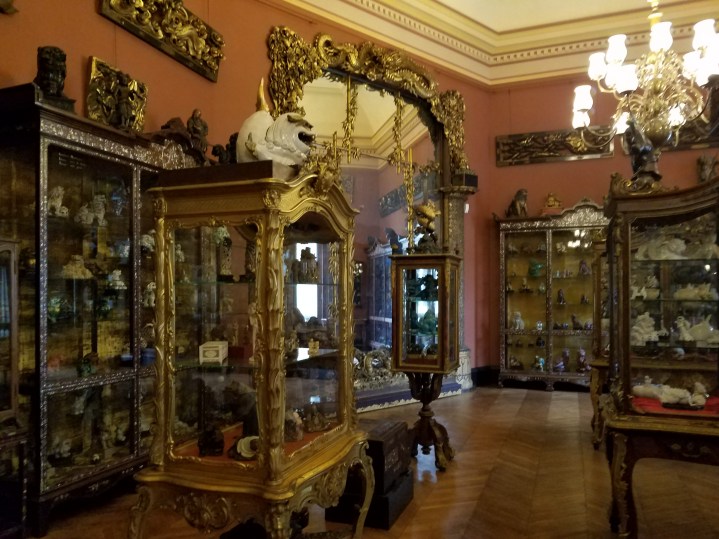
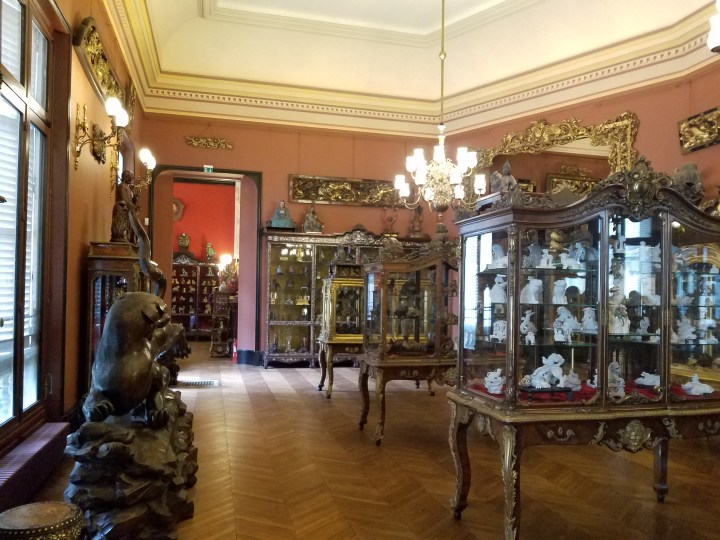
The Musée d’Ennery is the former home of Clémence d’Ennery, a well-known actress of her day and an avid collector of oriental objets d’art. She deeded her collection to the Musée Guimet with the proviso that the collection be kept intact in her home. After some legal wrangling with her older playwright husband, who unexpectedly outlived her, her wish has been fulfilled (save for one lacquered trunk on display at the Guimet as an enticement to visit the Musée d’Ennery).
After stowing things in a locker, we waited here for the tour to begin.Details of the main foyer
The Musee d’Ennery is only available by pre-booked 1-hour guided tour, in French only. (Details are at the bottom of this post.) That said, it’s easy to book online by email and, even if you don’t speak French, it’s a real treat for the eyes. (My husband’s French was not fluent enough for him to keep up with the rapid-fire French of our knowledgeable guide, but he was not at all bored and glad we took the tour.)
First room with display cases
Our guide did not neglect the basics of her subject. For example, she explained the difference between the little netsuke figurines and the smaller ojime “beads” used to fasten clothing cords in place of/in addition to knots. She also explained the lack of pockets in Japanese clothing that led to the use of these objects. When an item held particular interest, was unusual or unusually valuable, she paused to elaborate.
First room clock, display case and architectural detailsTransition room/antechamber between first room and main salon with more display cases of netsuke (figurines) and other oriental objets d’art
While I enjoy oriental art, I am no connoisseur and was primarily interested in getting inside a new-to-me Parisian mansion. I wasn’t disappointed. The mansion is gorgeous, the architectural details fabulous. Our guide offered insights into the collection and the former owner. Apparently, Clémence d’Ennery didn’t actually know a lot about oriental art; she simply bought what she liked. She did develop relationships with knowledgeable dealers, though, and her taste matured. The result is that there are cheap pieces among her collection along with priceless items. I thought her simple desire for beauty, as she saw it, it added to the charm.
Main salonDisplay case with netsuke in the main salonMain salonArchitectural details of the main salonCeramic deer and netsuke (figurines) in main salon
I love the Parisian museums located in former homes, giving a glimpse into another lifestyle. (The Nissim de Comondo is one of my favorites of the type, preserving living quarters, kitchen, bathrooms as well as living and entertaining rooms. More often, personal rooms have been converted into typical museum-type spaces or closed to the public; a little disappointing, but still worthwhile.) Visitors to the Musée d’Ennery are only allowed into the common areas/salon and entertaining rooms, which are all overflowing with the sheer volume of Clémence d’Ennery’s amazing collection. Bedrooms, the kitchen, etc. are not open to the public.
Salon with oriental masksView of interior courtyard from salon with masksLacquered trunks (rounded tops made for European export) in salon with masks
The lighting is unfortunately poor in the many display cabinets, but the guides had no problem with people using their phones to occasionally shine lights on the curios. They also did not stop anyone from taking non-flash photographs (which people were openly doing) although the confirmation email said they were forbidden. There were 12 people in our group, so maybe it is more a matter of photo-taking causing logistical problems with larger groups.
Ornate salon with giant mirror, alcove (opposite mirror to left out of photo) and display casesDetail of decorative column bordering alcove in ornate salonOrnate salon looking back towards salon with masks (alcove behind display cases in back right corner)
Practical Info:
The Musée d’Ennery is only open to individuals on Saturdays (except holidays) at 11:30am by pre-booked guided tour in French only. To book the tour, email the Guimet at resa@guimet.fr. I emailed on a mid-November Friday and asked to be included either the next day or the following Saturday and received a prompt reply saying we were in the following Saturday’s tour and asking us to arrive 10 minutes early. Names were checked off when we arrived. There are free, keyed lockers on the ground floor to leave coats, bags, etc. before beginning the tour.
See details and possibilities for pre-booked group tours online here. (Scroll to the bottom for specifics on the Musée d’Ennery. If you do not read French and are using the Chrome browser, just right click anywhere on the page and ask Google to translate to English.)
Find more on the history of the Musée d’Ennery here.
We joined a group waiting on the sidewalk at 11:20am until the gate was opened promptly at 11:30am.
Museum aan den IJzer (Yser Tower Museum for peace)
We just made our now semi-annual pilgrimage to Westvleteren to pick up more of the “best beer in the world.” We admit it; we’re hooked…and are possibly beer hoarders as well. But, this post isn’t about beer, it’s about our latest exploration of West Flanders which took us this time through picturesque countryside and villages to the restored WWI Dodengang or “Trench of Death” and the Museum aan den IJzer (Yser Tower Museum) housed in the 22-story tall iron cross tower that’s both a memorial to Flemish soldiers who died in WWI and a sometimes-controversial rallying point for Flemish Belgians.
Brussel sprouts in a western Flanders field
Leaving the Sint-Sixtus Abbey (where Westvleteren beer is brewed), we drove rural back roads past fields of brussel sprouts and farm animals. It always pains me to think of the absolute destruction wrought by WWI on this peaceful countryside. And, of course, WWII was no kinder to Belgium.
Flemish work horsesHappy Flemish cows
We stopped in the pretty little village of Lo-Reninge, lured by the medieval West Gate beside which stands a tree to which, legend claims, Julius Caesar tied his horse. We admired the UNESCO-designated town hall and belfort, and a lovely old Sint-Pieterskerk (St. Peter’s Church) before continuing on to The Royal Museum of the Army’s venue at the Trench of Death outside of the town of Diksmuide.
West Gate in Lo-Reninge, one of the few surviving medieval gatehouses in the region, built sometime around 1250. (And the “Caesar tree”)Lo (now part of Lo-Reninge) UNESCO-designated city hall and belfortSint-Pieterskerk and a WWI memorial to war dead from Lo
Diksmuide is strategically important in WWI history as the site of a line held by defenders after the Belgians flooded large portions of their country to stop the German advance.
The Trench of Death museum was refurbished in August 2014 as part of the WWI centenary and includes videos, photographs and memorabilia from the Royal Army Museum’s collection.
Trench of Death Museum, a venue of the Royal Army MuseumExhibits in the Trench of Death Museum
Modest-sized, but effective, exhibits on the second floor (1st floor, european) attempt to tell the story of the Trench of Death from both Belgian and German perspectives. A rooftop viewing deck lets visitors get an overview of the trenches and the adjacent Izjer River before descending to walk the extensive rebuilt trenches.
View of the Trench of Death and the Ijzer River from the museum’s rooftop
The museum’s website tells the story of the Trench of Death in 100 words as follows: “In 1915 the Belgian army tries to dislodge the Germans from the petrol tanks north of the city of Dixmude (Diksmuide). After two failed attempts the Belgians decide to dig a trench towards the drums. The Germans however manage to capture part of it. In order to suppress the German threat, Belgian military engineering creates, by the end of 1915, a breach in the Yser dike. The two camps are now only separated by a mere ditch. The trench is then transformed into an impregnable position, called Trench of Death because of the victims buried there after the German attack.”
Beginning the walk from the museum to the Trench of Death
The museum is well-done and the trenches, like those at the Passchendaele Museum, give a sobering glimpse of trench warfare.
Km 16 marker, the Trench of Death
Germans attacked the Belgians on three sides. German trenches lay less than 50m from the Belgians. Belgian soldiers lived under the constant threat of both conventional and gas attack, and kept gas masks with them at all times.
Concrete bags in the shape of the original sandbags have been used to rebuild the trench. Gravel spares visitors the mud that WWI soldiers endured.
A mere 1.5 km away and visible from the Trench of Death Museum stands the 22-story tall Museum aan den IJzer tower and museum (also “Yser” in English), a giant iron cross in the shape of Flemish headstones used to mark the graves of Flemish soldiers.
A large stone “peace arch” with the inscription “PAX” stands at the entrance to the museum grounds. It incorporates the rubble of the original Ijzer tower which was dynamited following WWII in protest of Flemish Nazi collaborators. (Apparently, the Nazis often exploited separatist sentiments to try to drive wedges between social groups in the countries they sought to invade and conquer.) The remains of the original memorial tower are surrounded by its crypt and a circle of Flemish headstones.
The “crypt” with Flemish gravestones at the base of the destroyed first Yser Tower
Later, as we toured the museum, we learned that after the war, the Belgian government decided to install uniform headstones for Belgian soldiers killed during WWI; the headstones were inscribed “Mort pour la patrie” (died for the homeland), in French, with no Dutch (the Flemish language). Existing Flemish headstones were removed and, in at least once case, broken up and used to make a road. Flemish outrage led to the construction of the first memorial Ijzer Tower, constructed as is the present tower in the form of Flemish gravestones with the letters AVV-VVK, representing “Alles Voor Vlaanderen, Vlaanderen voor Kristus” or “All for Flanders-Flanders for Christ.” Given how much time we’ve spent in Belgium in recent years, we’re always trying to understand the complicated history of Belgian society and the rifts between French and Flemish Belgians. Here was a new and fascinating learning opportunity.
22nd floor of the Museum aan den IJzer
Proceeding past the crypt to the tower, we immediately took an elevator to the 22nd floor, the topmost enclosed floor of the tower. There we found 360 windows surmounted by a painted panorama showing the surrounding countryside as it looked during WWI. Labels with directional lines indicated the names of villages, cemeteries and other sites.
Climbing a few more flights of stairs, we came to the open-air rooftop offering an even more dramatic view. The afternoon sun cast the shadow of the tower well beyond the crypt and peace arch below and into the town.
After taking in the views, we began the floor-by-floor descent through the museum. With so many levels to work with, some of the floors were almost throw-aways, one offering only wall-sized black-and-white drawings and another displaying shelf-upon-shelf of ordinance. But, there were fascinating floors as well. One had us wandering a wooden maze of recreated trenches while speakers played the labored breathing of gas attack victims. Around some corners, a large photograph of victims would suddenly light up. A particularly poignant floor offered a display of clothing along with photographs of Belgians fleeing the war. It posited the question, “What would you take if you had only moments to choose before fleeing your home?” It reminds people that their grandparents were the ones fleeing war with the clothes on their back just as today other peoples are fleeing wars in distant lands. The museum is dedicated to peace. “No more war” is printed in Dutch, French, English and German on the four sides of its base.
Clothing display with photographs of Belgians fleeing WWI along the “Via Dolorosa”
Leaving the museum, we walked back past the crypt with a new understanding of what we were seeing. Looking back at the enormous tower with its “AVV-VVK” we now knew that it, and its predecessor, had become a rallying point for Flemish Belgians and has been the site of annual gatherings. After WWI, the Flemish Movement organized pilgrimages to the graves of fallen Flemish soldiers and the first Yser Tower was built in 1930. After the first tower was destroyed in 1946 and the new tower was built, “Flemish minded people” continued to hold large gatherings at the site that attracted a radical, separatist element as well that was sometimes invited, sometimes not. In the 90’s, the organizing committee distanced itself from this radical element. The current museum focuses on promoting peace and tolerance. While the red poppy is the symbol of WWI remembrance for soldiers, the Museum aan den IJzer chose a white poppy with the word “peace” at its center to commemorate all victims of war, both civilian and military. The Museum asks the question, “What remains of life?” addressing the ongoing loss after war, including the mental suffering and difficulties adjusting to civilian life of returning veterans.
________
Practical info: The Royal Army Museum’s center at the Trench of Death is located at: IJzerdijk 62, 8600 Diksmuide 051 50 53 44 Open daily from 10am-6pm, April 1- Nov. 15, Tues. & Thurs. only the rest of the year. (Check online for details and holiday changes.); admission €4 for adults, children under 8 are free.
The Museum aan den IJzer (Yser Tower Museum) is located at: DE IJZERTOREN – IJzerdijk 49 – 8600 Diksmuide – T 051.50.02.86 – info@aandeijzer.be Open daily, check online for seasonal variation in times. Entrance is €8/adult, €2.5 for children 7-17, and free for children under 7.
A Koninklijke Moedige Bootvissers tour boat on the River Nete in Lier
Pretty Lier, Belgium, is only a 10-minute train ride from our local Antwerpen-Berchem station and it was top on my day trip wish list for our current cat- and house-sitting stay in Antwerp. (The trip is another 5 minutes or so if you leave from Antwerpen-Centraal, the architectural gem that is the only other train station in Antwerp.) With our sights on weekend-only boat tours of Lier, we took advantage of our first gorgeous October Saturday to make the short trip. Our Belgian Rail weekend fare tickets cost €4.40 apiece, round trip. (Choose the “weekend ticket internet” option when given a choice for the half-price weekend fare. Print your ticket and show it to the agent on board the train when asked.)
It’s about a 10-minute walk from the train station to Lier’s lovely Grote Markt (main square) dominated by the stadhuis (city hall) and it’s attached UNESCO-designated belfry dating to 1369. On this sunny Saturday, the square was filled with market stalls selling everything from clothing to cheese, produce, meats and more.
Lier’s Saturday market with the 1369 UNESCO-designated belfry and stathuis in the background
As always, high on our list of to-dos in a new Belgium town is to try the local beer. Lier, which rhymes with “beer,” is known for beer and has 6 such brews. We ordered two with our light lunch at ‘t Goemerke, a market-side café on the main square with a simple menu. I opted for the unique Caves (pronounced more or less like “cah fess”) and found it to be an enjoyable if somewhat sweet sour along the lines of a Rodenbach Grand Cru. David chose the Sint Gummarus Tripel, a crisp version of the Belgian classic. We’ll do a separate write-up on Lier beers in an upcoming post, so I won’t go into more detail here.
With an hour between the end of lunch at the boat tour, we figured we had time to take in the Breugelland exhibit at the modestly-sized Stedelijk Museum Wuyts-Van Campen en Baron. These paintings are on loan from the long-closed-for-rennovations Koninklijk Museum Voor Schone Kunsten (Fine Arts Museum) in Antwerp so we were glad for the chance to see them. This is apparently the seventh and last such collaboration between the two museums (although the Antwerp Fine Arts Museum is not set to reopen until 2019).
We finished up the art museum with just enough time to walk to the riverside starting point for the boat tours put on by Koninklijke Moedige Bootvissers (Royal Brave Boat Fishermen). We spent 45 minutes gliding through Lier in a converted eel-fishing boat (with a non-stop Dutch commentary that our companions–all Dutch-speaking–found very amusing). While we would have liked to have learned more/anything from our guide, we really enjoyed the boat ride and the perspective of Lier from the River Nete. Boat tours are offered Saturdays, Sundays and holidays April 1 – October 31, 2-6 p.m. Prices are €3.50 for adults, €2 for children.
View of Lier from a tour boatOld lock house, end of the river for the tour boats
After our boat ride, we wandered charming cobbled streets of the adjacent begijnhof (“beguinage” in French). There are begijnhofs in many Belgian towns and I think all of them are UNESCO-listed. I like to describe beguines as “almost-nuns.” They were religious ladies who lived in these communities and took vows, but these vows did not include forsaking marriage or vows of poverty. The Lier begijnhof is particularly picturesque and the begijnhof church is really spectacular (and a far cry from the tiny chapel in the Antwerp begijnhof). We had the church to ourselves save for an older man playing magical music on the organ. Lovely!
A cobbled begijnhof street. The arch at the end of the lane leads to the tree-shaded riverside walk and park that circles the city.Begijnhof church in Lier
We exited the beginjof onto the tree-shaded riverside walk and park that circles the city. We shared the path with other walkers, families and couples, bicycles and baby carriages. This area was part of a walk through town laid out by the nice man in the tourist office in the stadhuis. The downstairs of the stadhuis is open to the public and is worth a look just for the elegant architecture and painted walls and ceilings:
Curved staircase in the stadhuis foyerLier Tourist Office in the stadhuis. Maps and lots of brochures (mostly in Dutch) are available along with friendly English-speaking help at the desk.
Back in town, we headed to Sint-Gummaruskerk, Lier’s main church. As we approached, the bells began ringing madly, an at-first-charming call to vespers that continued for 30 minutes, including our quick exploration of the church and our escape to the nearby Sint-Pieterskapel, an unremarkable old chapel save for its painted ceiling. Back outside the chapel, the clanging of the bells of Sint-Gummarus continued to echo off the surrounding buildings and the otherwise-quiet and immaculate residential neighborhoods, a racket that must get old if you live nearby. Enough already!
The bell tower of Sint-Gummaruskerk in the backgroundInterior of Sint-GummaruskerkPainted ceiling of Sint-Pieterskapel
After wandering a further stretch of the riverside park circling the town, we strolled back to the Grote Markt, now empty of the market and glowing in the afternoon sun. Clearly, this was prime time for a couple more local beers at café het Moment. I opted for the Pallieter tripel (a true Lier beer) while David had the Kempisch Vuur (an abbey tripel from Brewery Pirlot in nearby Zandhoven). Again, we found both to be really good, and better than their Rate Beer reviews, especially mine. More details on the beers in a later post.
Afternoon beers on the Grote Markt
Somewhat full from the beer and accompanying snacks, we opted for a light dinner on Zimmersplein, a narrow plaza lined with restaurants and bracketed on one end by the town’s iconic astronomical clock tower, the Zimmertoren, and on the other by the “Prisoner’s Gate” an old jail and part of the long-gone medieval city wall.
Zimmersplein
We snagged another prime outdoor seat, this time just in front of the complicated clock tower in a restaurant aptly-named Café Refuge. We ordered a couple of beers and quiche and salad, not expecting anything remarkable from the food. Happily, both the quiches (one pumpkin and chevre, and one broccoli and nuts) and salads (made with mixed greens, herbs, raisins, grapes, apple, strawberries, cucumbers and tomatoes) were atypical and excellent. A just-right end to a delightful, low-key day!
Zimmertoren astronomical clockQuiche and salad at Café Refuge by the Zimmertoren astronomical clock
Find out more about Lier (in English, Dutch, French and German) at the Visit Lier website.
David and I are happily back in Antwerp, Belgium, for 6 weeks once again cat- and house-sitting for some of our favorite people and cats in one of our favorite cities. As always when in Belgium, we’ll be exploring this beautiful country and scouting great beer. We’ll spend a month in Paris when we leave here, just to touch base in my old home and enjoy the holiday season before heading back stateside.
Coming up in the spring [March-June]: Another Korean Air First Class mega-flight from DFW to Seoul to Singapore(!), a few weeks in Indonesia (Bali, Java, etc.), then back to Singapore to catch a month cruise to Europe (via Sri Lanka, India (Cochin, Goa, Mumbai), Oman, UAE (Dubai, Abu Dhabi), Suez Canal, Jordan (Petra), Greece, Italy). When we get off the ship in Italy, we’ll spend a couple of weeks in Umbria (in an agrotourism farm) and Tuscany (at a small-town apartment) before flying from Florence back to Antwerp.
If any of these interest you, check back in. I’m also always open to suggestions!
Mt. Rushmore. The flags of all 50 states line the main approach (see below), but I couldn’t resist this Texas flag view.
Mt. Rushmore should be on every American’s bucket list, and judging by the crowds and prices every summer, it probably is. If you can wait till fall, though, you’ll find the crowds gone and hotel prices much more reasonable. My husband and I did just that, waiting until the third week in October. Yes, the Flintstone Village was closed as was the faux Independence Hall and some mining-themed amusement parks, but we didn’t miss them at all. The Mt. Rushmore National Memorial was open, as was the Badlands National Park, Custer State Park (including Needles Highway), and Devil’s Tower in Wyoming. We stayed at K Bar S Lodge an terrific, rustic-but-lovely hotel just outside of Keystone, South Dakota, 30 minutes from the Rapid City Airport, where we could see Mt. Rushmore in the distance and hike a nearby abandoned mine. Yes, it was chilly at night and, yes, we risked things like Needles Highway being closed for the winter. But, the flight from DFW to Rapid City, SD, is an easy two hour and fifteen minute non-stop flight on American so we could monitor the weather forecast. [Although pricey in dollars, the flight was a cheap award using our British Airways Avios. We use BA Avios for those short hauls since BA is distance-based and charges us less miles for those flights that AA does.]
Mt. Rushmore exceeded my expectations. Not only are the famous statues impressive, but so is the park itself. The buildings and approach are sleek and stylish, the walkways around the base of the mountain pretty and well-maintained. We really enjoyed a free return visit at night to see the carvings illuminated. The main walkway is not lit until you reach the flags, though, so bring a flashlight.
Mt. Rushmore is especially magical at night, and free!
Custer State Park lies a thirty minute drive south of Keystone. Although we missed the September bison roundup at the park we got to see lots of bison up close in their winter habitat. Pronghorn antelope, big horn sheep, elk and whitetail deer also call the park home. Entry is $20/vehicle for a 1-7 day pass.
Bison in Custer State ParkPronghorn antelope in Custer State Park
Needles Highway (Hwy 87) runs through the Cathedral Spires Area of Custer State Park. Sitting around a campfire at our lodge one night, I mentioned my huge disappointment in being told on check-in that Needles was closed for the season. The mother-daughter pair who’d offered to share their s’mores with us did even more to make my night when they informed me that they’d driven the Highway that day and that it was open and easily drivable despite a sign at the pay booth saying otherwise. Sure enough, the next day proved them right and we enjoyed a spectacular drive.
Spires along Needles Highway
Another day, we drove an hour and twenty minutes west to Badlands National Park. Entering through a vast prairie dog town, we found an otherworldly landscape of painted canyons. We pulled over to hike out to high observation points providing sweeping pastel vistas and explored walkways through the desert where big horn sheep fed nearby. Like Custer, entry is $20/car for a 1-7 day pass. The passes are not combinable as one is a state and one is a national park.
Bighorn sheep in Badlands National ParkThe Badlands: immense and otherworldly
We crossed the South Dakota border into Wyoming for our final destination, Devil’s Tower National Monument, a little over two hours’ drive from Keystone. Made famous in the movie Close Encounters of the Third Kind and wildly popular with motorcyclists and other tourists, we arrived to find only a few cars in one of its two large parking lots.
Devil’s Tower, WyomingWe found another large prairie dog town near Devil’s Tower. They’re adorable, but be careful getting too close or letting pets near: The prairie dogs have plague!
A ranger assured me that, in summer, the lots were full and the web site warns of difficult parking. She particularly noted the craziness at Devil’s tower when the Sturgis Annual Motorcycle Rally is in swing. A half million motorcycle enthusiasts descend on Sturgis, SD, for the famous summer rally. That group makes an excursion to Devil’s Tower. The Sturgis rally lasts ten days and is set for August 4-13 this year. Check the calendar to avoid this horde unless you’re going to the rally. On this gorgeous October day, however, we saw more birds, squirrels and rabbits than people as we hiked the perimeter of the tower. Entry to Devil’s Tower is $15/car, $10/motorcycle, $5/person arriving on foot or bicycle.
For a fun, economical, but limited-choice dinner, try the antique-filled Alpine Inn in Hill City, a short drive through wooded hills from Keystone. Dinner entree choices are large steak, small steak or vegetarian. [Dinner menu: 6oz. filet mignon = $11.95, 9oz. filet mignon =$13.95 (both steaks served with baked potato, wedge salad and Texas toast); German dumplings and cheese with vegetables = $11.95] Lunch offers more variety. The Alpine Inn is renowned for its steaks and its house-made desserts. It’s closed Sundays and doesn’t accept credit cards, but it does have an on-site ATM machine. It’s popular, so make reservations.
Finally, if you like to gamble, South Dakota is for you. In addition to casinos, nearly every business establishment from doughnut shops to nail salons has a slot machine or two. Kitschy Deadwood is at or near the top of gaming towns in South Dakota. We’re not gamblers and didn’t get much out of casino-filled Deadwood’s recreated western town brimming with casinos, but we met people who loved it and went every year. So, if that’s your thing, Deadwood awaits. The people are friendly and the hotels offer some pretty great deals to lure in the gamblers. Enjoy!
Located on a sheltered bay with broad, beautiful beaches, Pärnu, Estonia, has been a popular spa town since the 1800’s with Estonians as well as visitors from nearby countries. Wanting to get into the spirit of things, I booked us into the seafront Rannahotell, a white nautically-inspired spa hotel dating to 1935-37. A “landmark of Estonian Functionalism,” the Rannahotell is listed as a cultural heritage site.
Rannahotell
Completely remodeled since its early days as a “sanatorium” or place to restore health, our room was decorated with sleek modern furniture, light woods and neutral colors. Big windows looked onto an expansive stretch of beach.
The hotel offers attentive service along with an airy piano bar and truly extensive breakfast buffet in a window-lined room overlooking the beach. David and I both booked spa treatments at the hotel which nowadays offers traditional massage treatments rather than the local mud. We both thoroughly enjoyed our massages, but we were shocked to find that it had begun to snow while we were in the spa. Soon, the beach was blanketed in white!
Snow on the beach in Pärnu
The unseasonably cold spring was a topic of conversation everywhere we went in Parnu. Several people suggested we should come back for the bustle of summer and all the beach-y activities at that time of year, but we kind of liked the laid-back, uncrowded vibe of this chilly spring.
Beautiful Apostolic Orthodox Church of the Transfiguration In Pärnu
Driving the short distance into town, we enjoyed strolling in old Pärnu. As elsewhere, things were slow at this off-season time. Since we weren’t really interested in shopping or specific sight-seeing, we merely wandered.
Tucked into a courtyard just inside the arch at 21 Rüütli Street, we came across this intriguing relic from the past, a granary from the 1600’sStylish Rüütli StreetWhimsical statue on Rüütli Street
Of course, David had to try local beer (not that I resisted) and we found a nice venue at Wirre Craft Beer Bar. Tucked in to a cozy cellar space, Wirre was empty when we got there early on a Tuesday evening and stayed nearly so until we left. This gave us time to visit with the knowledgeable young owner who tended bar. Wirre offers lots of Estonian beers along with many foreign beers. We particularly enjoyed the Óllenaut SimkoEil APA.
Ducking inside Wirre for a little local craft beerInside Wirre Craft Beer BarOn tap at Wirre
Our post-beer dinner was pizza at Ephesus, located at one end of Rüütli. It was OK for a simple meal, but nothing to write about.
Another night, on the other hand, we opted for receptionist-recommended Pärnu Kalamajaka Kohvik for seafood and enjoyed an excellent dinner. Although unimpressive from the outside, the restaurant is pleasantly stylish inside.
In the dining room: another table joined us and our fellow diner before we finished our mealThe bar and café side of Pärnu Kalamajaka Kohvik
Apparently, Pärnu Kalamajaka Kohvik is also a seafood market and one of several Kalamajakas restaurants in Estonia, named among the best restaurants in Estonia in 2016. We enjoyed a delicious seafood dinner for €59, which included an appetizer, two entrees, crusty bread, 2 glasses of wine and a dessert .
Scallop and bacon starterFresh seafood pasta and a generous saladDavid’s entree: local fish and polentaKalamajaka Kohvik is proud of their desserts
Pärnu Kalamajaka Kohvik is located at Suur-Sepa 18 in Pärnu.
View from the Pavilion on the Promenade in Haapsalu
Despite the unseasonably cold spring, I really wanted to see the seaside resort town of Haapsalu while we were in the area, en route from Tallinn to Parnu. Renowned for centuries for curative mud and a popular spa resort with the Romanov family, Haapsalu is actively seeking to reassert itself as an international resort destination. [We were in Haapsalu May 2017. I’ve been enjoying a low-key summer and have been slow about finalizing my last two Estonia posts–this and one more on Parnu. We were supposed to be in Miami and Havana this coming week, but those plans are canceled due to Hurricane Irma, so I’m taking the opportunity to catch up blogging our Baltics travels before we head back to Belgium in October.]
We turned out to be the only guests at Lahe Guesthouse, the bed and breakfast I’d chosen for our stay. Our hostess was waiting for us when we arrived, showed us the rooms available, then left us on our own in her big, beautiful guest house with a key and the run of the place. It was fun!
Lahe Guesthouse. The two windows on the second floor, left, were our bedroom and offered views of the bay and marshes.Dining area of Lahe Guesthouse with no one else around on our off-season stay. (Our hostess did return to fix breakfast in the morning.)One side of our spacious guest roomMarshes and bay behind Lahe Guesthouse
After settling in, we walked away from the marshes and into town.
We saw few people on our way into Haapsalu town
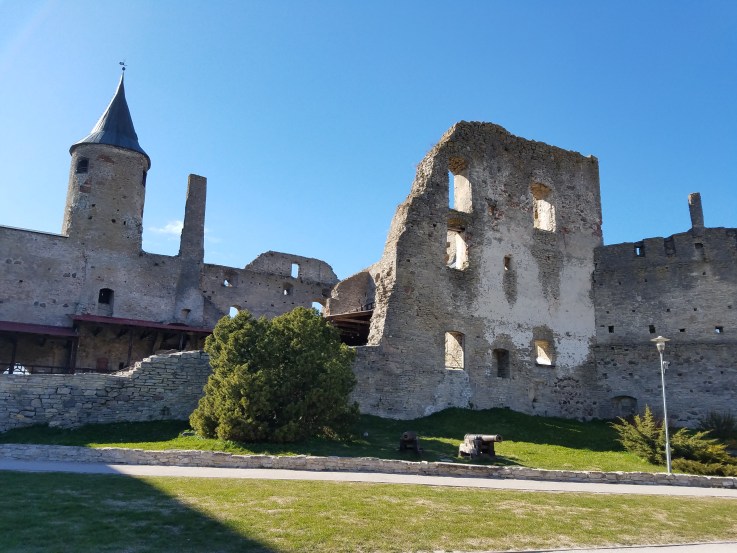
Haapsalu is small, so in a few short blocks, we arrived at the remains of the 13th century Haapsalu Episcopal Castle, the former residence of the Bishops of Saare-Lääne. The semi-restored castle grounds and walls are open to the public without charge. We had fun just strolling and people-watching. Perched atop a portion of the wall, we laughed at the antics of a little boy zooming endlessly around the inner grounds on his foot-powered “motorcycle” while an older sibling ran after. There’s also a museum, encompassing the castle’s cathedral, that we did not visit, but it’s closed now until 2019 for renovations.
Entrance to Haapsalu CastleEntering Haapsalu CastleHaapsalu Castle ruinsHaapsalu Episcopal Castle cathedral
Leaving of the castle, we walked through the old town towards the waterfront Promenade.
Old Haapsalu
The pretty Russian Orthodox Church of Mary-Magdalene sits between old town and the Promenade, overlooking the water.
Russian Orthodox Church of Mary-Magdalene
The Promenade is the pride of Haapsalu. Lovingly decorated by Estonian Roman Haavamägi in the 1920’s, Haapsalu suffered during WWII and many of Haavamägi’s wooden sculptures that decorated the seafront Promenade were burnt. Recent restoration was completed and the Promenade reopened in 2010.
Haapsalu Sundial on the PromenadeHaapsalu Promenade with the Assembly Hall and iconic wooden polar bear statue (a replica) in the water
We enjoyed walking the Promenade, but it is definitely a sleepy place in the non-summer months. After dinner downtown followed by a shot of the local, vodka-like birch water alcohol, we called it a night. The next day, we strolled the paved walkways through the wild marshland behind our guest house before setting out again to explore the back roads of Estonia. Haapsalu made for a fun short visit and I’m glad we went, but there’s not much to keep a visitor there for long off-season.
Looking back towards the neighborhood of Lahe Guesthouse from the marsh paths
More retro blogging from our May 2017 Baltics travels. I’m trying to catch up before we’re off on our next trip:
The Great Coastal Gate and Fat Margaret Tower once protected Tallinn from seaborne threats
Tallinn, the capital of Estonia, has long been popular with tourists taking the two-hour ferry ride from Helsinki. More recently, cruise ships also discovered the picturesque Baltic port city. The result of all the boat traffic is a constant swell and ebb of humanity in the city and a very touristy, if lovely, Old Town. (In the summer, cruise ships can bring over 4600 tourists to Tallinn in a day!)
Tallinn Old Town main squareTallinn flower market
Hoping to dig just a little deeper and see the city during some of those less-crowded ebb times, I booked us a 4-night AirBnB apartment in the heart of Old Tallinn. I had trouble finding an apartment with secure, dedicated parking, but finally settled on a chic, all-white (but small) studio in a terrific location with covered, gated parking. I’m usually not a fan of studios, but this time our options were really limited and we did have a semi-private seating area we shared with two other apartments. Prices are higher in Tallinn than elsewhere in the Baltics, too, albeit still lower than you’ll find in most of Western Europe and much cheaper than Scandinavia. Anyway, our apartment and landlords turned out great and our only complaint was too much sun in the mornings.
Fortified walls of Old Tallinn
We enjoyed wandering the cobbled streets and found simply enjoying the atmosphere to be our favorite part of Old Tallinn. The shops in Old Town are nearly all of the tourist souvenir variety and not of much interest to us, but fun if that’s what your looking for. At this stage of life and travels, we don’t buy a lot of souvenirs and are more excited to see shops and markets selling local products we might not be familiar with to locals. In this modern, small world, those sorts of shops are rarities, though.
Just down the road from our apartment on Uus. It seemed a miracle the old wooden building was still standing.
Old Tallinn consists of both a lower and an upper town. This was most easily visible from the tower of St. Olaf’s Church, a few blocks from our apartment in Lower Town.
View of Old Tallinn, both Lower and Upper, from St. Olaf’s Church tower.It’s a steep climb and 232 steps to the observation level of St. Olaf’s Church tower
St. Olaf’s Church itself is simply adorned with some interesting archaeological pieces on display along the side aisles of the nave. Completed in the 1600’s, the original church dated back to the 1200’s. It’s the tallest medieval structure in Tallinn. Admission to the church is free, but there’s a €2/adult -€1/child fee to climb the tower.
Interior of St. Olaf’s ChurchIn the lower portion of Old Town TallinnHistorical walk at Estonian History Museum in Lower Town
Hiking up to Upper Town, we visited the Alexander Nevsky Cathedral, a 19th century Russian Orthodox church with characteristic architecture including three cross-topped onion domes. Former and current mansions of Estonian aristocracy abound in this area interspersed with terraces overlooking Lower Town, where we common folk could share the view.
Alexander Nevsky Cathedral, a 19th century Russian Orthodox church in upper Old Town
The oldest church in Tallinn, the medieval St. Mary’s Cathedral, with its baroque tower also sits in Upper Old Town. Coats of arms of Estonian nobility cover its interior walls. There’s a €5/adult -€3/child fee to enter the church, although you can admire many of the coats of arms from before the ticket booth.
St. Mary’s Cathedral (also known as “Dome Church,” the oldest church in TallinnFamily crests and coats-of-arms adorn the interior of Dome Church
Having time to spend in Tallinn let us extend our wanderings beyond Old Town. The modern city offers much in the way of shopping, dining, bars and coffee shops. We loved the futuristic additions to old warehouses in the Roterman City area. This chic neighborhood, in easy walking distance of Old Town, bustles with a hip young clientele.
Roterman area buildings
One day, a long walk to us to Kadriorg Art Museum in a baroque palace commissioned by Peter the Great in 1718. The palace itself is as worthy of a visit as the park. The palace is surrounded by Kadrioru Park, a place popular with locals.
Kadrioru Park leading to Kadriorg Art Museum and palaceInside KadriorgSchoolchildren visiting Kadriorg
We enjoyed a delightful late lunch for €20 (total) at Katharienthal, just inside the park grounds. It occupies an elegant building and offers French-style patisseries downstairs and a pretty dining room upstairs.
Katharienthal cafe exteriorDownstairs at KatharienthalUpstairs dining room at Katharienthal
Walking further beyond Kadriorg palace, we came to the residence of the president of Estonia, an interesting woman who had to be drafted into the job. We were surprised to find we could just walk into the front parking area to snap a photo. Guards at the front door had no problem with us.
Residence of the Estonian President
Just beyond the president’s residence is the fantastic Kumu museum of modern art. Again, the building is as much an attraction as the art.
Kumu – Art Museum of EstoniaInterior of the Kumu
At last treat in Tallinn was a visit to the Estonian National Opera to see a performance of Tosca. The opera house is nowhere as ornate or large as the opera house in Riga and the staging was minimalist, but the performance was excellent and, for €31 apiece, we had front row center seats on the first balcony.
Interior of the Estonian National Opera House in TallinnTosca
_____________
Tallinn has a great beer scene and we definitely explored that. More on beer in a soon-to-follow separate post.
Viljandi church (“Jaani Kirik”) just across a ravine from the castle ruins and park
The drive NNW from Valga toward Tallinn took us through woods and farmland dotted with traditional wooden houses.
Traditional Estonian farm homes
The highlight of the drive was a stop at pretty Viljandi, a popular Estonian tourist town that prides itself on preserving Estonian traditions. Considered a center of culture and folk history, Viljandi hosts popular outdoor concerts in the summer in the ruins of Viljandi Castle on the banks of a deep blue lake. Water sports are popular on the lake as well and the small town is surrounded by parks and green areas.
Footbridge from town to the ruins of Viljandi CastleRuins of Viljandi CastleLake Viljandi viewed from the castle ruins
There were no concerts or swimming on the crisp spring day we were there, but we still enjoyed wandering the ruins and admiring the gorgeous scenery. We crossed a pedestrian suspension bridge to continue our ramble on through yet another park and the modern Ugala open-air concert/theater venue.
The preserved Old Town is small, easily walkable and picturesque. We found plenty of cute restaurants and cafés in addition to a the Estonian Traditional Music Centre, a puppet theater, art center, museum and more. There’s an old brick water tower you can climb for the view for €2/adult, €1/child. The Tourist Information Centre offers free parking and free maps within eyesight of “Jaani Kirik,” the church shown in the top photo. Viljandi is a place to relax and take in the atmosphere rather than visit major sites.
Old Town Viljandi
We opted for lunch at stylish Kohvik Fellin on a corner across from the Tourist Information Centre. The food was excellent, if pricier than elsewhere in rural Estonia, something we found true of Viljandi in general. We liked the bread at Kohvik Fellin so much we convinced them to sell us a loaf, something they apparently don’t ordinarily do. We paid a pretty exorbitant €6, but the dense sweet bread provided several breakfasts and we did love the way our waitress wrapped it for us!
Delicious but pricey bread at Kohvik Fellin in Viljandi
____________
The Viljandi Tourist Information Centre is open M-F 10am-5pm and Sat.-Sun. 10am-3pm. English speakers there are happy to offer advice on sights and dining. Parking is free (and conveniently located to sights) in the lot in front of the tourist center. Email at viljandi@visitestonia.com or phone (+372) 433 0442.