One thing we knew we wanted to do while in Thailand was attend a cooking school. After doing a little research, I’d decided Chiang Mai was the ideal place for this and had booked a day at Thai Orchid Cookery School before we left the States. Like so much on this trip that we planned in advance, there’s a sense of unreality when the day finally arrives…but here it was!
As promised, a brand new van arrived shortly after 9am to pick us up at our hotel. Another couple was already in the van and we picked up a third couple before continuing on the short distance to Thai Orchid which is located in the center-east of Old Chiang Mai. Cooking schools have boomed in Chiang Mai and there are a bewildering amount to choose from. I’d narrowed it down to two before picking Thai Orchid over a school far out of town located in a farm where you can pick fresh herbs. After all the driving we’d done the day before on our Doi Suthep-Blue Elephant day, I was happy with my choice. Moreover, Thai Orchid offered air-conditioned space for dining and classroom portions of the school, something the farm didn’t have.
We were greeted by our cooking instructor and owner, “A” (“My Thai name is too long!”) and dove right in by choosing the 5 dishes we’d prepare, marking our selections on a paper checklist before moving to the “classroom” for our first demonstration: spring rolls and fresh rolls.
Thai fresh rolls
David and I both chose fresh rolls as we’re fresh roll junkies. I make my own at home anyway, but was curious as to what A could offer in the way of variations. Fresh rolls are more Vietnamese than Thai, but the Thais have adopted them, giving their own twist by briefly sauteeing the main vegetables in a light sauce before adding lettuce, shrimp and herbs and rolling in softened rice paper. I’d always made mine fresh (save for when I add boiled shrimp)–and actually prefer them that way. Still, I liked the extra seasoning provided by the sauce.
A with other students, frying spring rolls
For our next course we made soup; me choosing Tom Yum (in a clear broth) and David opting for Tom Yum Gai (chicken soup with coconut milk). Both were delicious and easy-to-make. The school ran super-efficiently, with our cooking stations prepped and ready to go when we came back from classroom or eating. We did much of the chopping and all of the cooking, but herbs and veggies were washed, meat chopped and apportioned, etc.
After our first two courses, A and her assistant Kong, drove us to a local market where she guided us around the stalls explaining unfamiliar items and showing us practical things like what sort of coconut milk at home would be equivalent to Thai “coconut cream.” (i.e., So long as it says “100%”, it’s the same as “coconut cream” even if it’s labeled as “milk.”) We had ten minutes to explore on our own, then it was back to the school for more cooking.
A demonstrating “century eggs” that are buried for 100 days then boiled. Gooey and black–No, thank you!Market ingredients including white flowers for curry and 3 types of basil: Thai sweet, lemon & “holy”Fish sellers at the market
Fresh fried banana slices welcomed us back to the school as we prepared for the last courses. A demonstrated each option, showing us what ingredients our different choices shared and where they differed. She would prepare a dish with a “mild” level of heat (usually 2 small red peppers), then let us taste it to gauge whether we wanted to prepare ours with more or less heat. David and I usually opted for more heat, all the while being highly respectful of those blazing Thai peppers.
David at his cooking station
David made chicken with cashew nuts while I opted for classic Pad Thai with shrimp. Both turned out really well, and I was surprised how easy and past the Pad Thai was. David made a really fantastic panang curry with shrimp while I went with my fave, green curry chicken. Unfortunately, my green curry was probably my least favorite creation, turning out saltier than I wanted. I think I added too much soy and fish sauce given that I went for a thicker sauce than the usual Thai soup-style green curry. Next time!
Panang shrimp curry and green curry chicken…We made these! 😀Pad Thai shrimp and green curry chicken
A laid out fruit snack from the market, showing us how to eat mangosteen (press the “button” end to open the small black fruit, then pull out the yummy white sections from inside). She even provided Thai durian which are much more mild than the revolting Singaporean variety we’d tried in Singapore: Edible, but still foul-smelling and never going to be a favorite of ours. Besides, durian “sticks with you” and the recurring taste in your mouth is something to be avoided!
Mangosteens (on the tray) and durian (in the bowls)An opened mangosteen
For dessert, our options were steamed banana or pumpkin cake or mango sticky rice. David and I both opted for the mango sticky rice, but the steamed cakes were really pretty.
Mango sticky rice topped with crispy fried mung beansSteamed banana cakes in banana leaves
We feasted until we were stuffed and happy. A handed out small, bound cookbooks with recipes for the day’s creations and a few more. Her email is on the front and she encouraged us to email with any questions that might arise while recreating her dishes back home.
We highly recommend Thai Orchid Cookery School for cooks of all skill levels. If you’re experienced cooks, as we are, you’ll still enjoy the local ingredients, information and insight. If you’re new to cooking, A and Kong are patient and happy to explain. You can learn more at: http://www.thaiorchidcooking.com/ Cost was 1200 baht ($34.29) per person, including pick-up in the old city.
Today was the day we ride elephants in the jungle! We’d booked this outing months ago, deciding on Blue Elephant tour on the recommendation of my niece-by-marriage, Christie. This was something we really wanted to do, but there are a lot of elephant tours in the area–some of questionable repute–so it was good to have real data we could trust. We wanted a private tour, caring treatment of the elephants and extended, quality time with them. Christie didn’t steer us wrong!
Our day started at 8:30am with a pick-up by private car at our hotel. Our driver and guide for the day, Zen, turned out to speak good English and we enjoyed visiting with him about Thailand, America and children. (He has a teenaged daughter and son so we spent some time discussing university and job opportunities and costs in our countries.) We had a full day scheduled with the elephants to come at the end.
Our first destination was the temple at Doi Suthep on a mountain overlooking Chiang Mai. We could see the golden rooftops of the temple complex sparkling in the distance from our hotel balcony. The drive took thirty minutes or so after leaving the city, winding our way upward through lush jungle. Zen let us off at steps leading to a cluster of souvenir stalls at the base of the long stairway leading to the temple complex.
400+ steps to Doi Suthep, flanked by the customary dragonsAt the top of the stairsView of Chiang Mai from the terrace of Doi SuthepWith our flower and candle offerings before beginning our ritual 3 circuits of the golden stupa
Zen gave us all the time we wanted to explore the temple complex. We did the ritual 3 circuits of the golden stupa with our flower and candle offerings which we laid before the Buddha afterwards. The weather was delightfully cooler up in the mountains and the crowds relatively light although more and more people arrived during our well-timed visit. At the rate the complex was filling, it looked to be crowded by midday.
Our next stop was an orchid and butterfly farm. I wondered if this might be a bit of a tourist trap, but it turned out to be a beautiful place, filled with orchids of many colors, and with no sales pressure whatsoever. The butterfly portion of the visit made me laugh out loud with delight. Butterflies were everywhere! I was some yards in before I registered the truly huge butterflies on the net roof above–mottled tan and at least 8″ across! I couldn’t resist pointing them out to 2 Chinese girls ahead of me who were equally amazed.
So many butterflies!Orchids grown suspended with roots trailing
We next made a quick stop at a local market where Zen purchased fruit and sticky rice snacks for later.
Fruit and other snacks at the market
Lunch was scheduled for “Tiger Kingdom,” a stop I had some misgivings about. When we booked, I was told we could take advantage of this stop to take photos with tigers. In looking into this, I was put off by posed photos of people draped across tigers, pretending to bite their tails, etc. The only way this seemed possible was to seriously drug the tigers, something I wanted no part of. Sure enough, when we got to Tiger Kingdom, that was exactly what seemed to be the set-up. Dining areas were set up around large open-air pens where tigers lay sleeping until visitors were led in to pose with them. Sometimes, a handler would raise the tiger’s head and it would hold its head up, eyes open, but not moving. When the photo was taken, the tiger would plop its head back down, out again. A buffet lunch at Tiger Kingdom was actually very good, but we wanted no part of the tiger pics.
Our next destination was Mok Fa Waterfall in a nearby national park. We changed into bathing suits, expecting to swim in pools like we’d found at Kuang Si in Laos. Instead, there was really only one swimming hole at the base of the falls. The falls were beautiful, no doubt, and I loved the idea of being able to get in and under a high fall like that…but not when I had elephant riding to do next. I just didn’t think I wanted a head of wet hair. David–whose hair is a lot shorter and quicker-drying than mine–did get in, enjoying the water with a group of tatooed French backpackers.
Mok Fa Waterfall
Finally, it was time for elephants! Zen gave us our traditional mahout (elephant handler) clothes to change into at the waterfall dressing rooms. We looked kind of ridiculous in the cropped blue tunics and huge, baggy knee-length pants. Oh well, we were all-in for the experience. Zen briefed us on elephant commands as we rode:
“sigh” (shake your right leg) = left
“kwa” (shake your left leg) = right
“bye” (push with both feet on the elephant’s ears) = go
“houww” (push down with feet) = stop
“toy” = back up (hop back with your body)
“dee dee” = “good elephant” (a praising phrase)
“bone” = lift trunk
The car rolled through rural areas, past several elephant camps, before pulling into the driveway of a building where we swapped the car for a pick-up truck for the final, bumpy stretch to the Blue Elephant camp.
We arrived at a dirt parking area around which a number of buildings clustered. Three elephants were in a clearing just beyond a long, open structure with picnic tables where we left our things. In no time, we were introduced to our elephants and led to a stand where we mounted and were on our way. We sat far forward near their heads to reduce the side-to-side motion of their walking. Our palms rested on the twin bumps atop their skulls, soft flesh under rough skin sparsely covered with thick, prickly hairs. We liked petting and stroking them, leaning over to rub their trunks or cheeks. On steep downward slopes, we could grab onto the loop of a rope around their middles.
Elephants!
The true elephant handlers walked with us as we rode, more in control (usually by grabbing an ear as they spoke) than we were with our newly-learned commands. It didn’t really matter much, though; the idea was to let the elephants graze where they wanted, within reason, in the jungle. I say “within reason” because there were a few times where David’s elephant drifted off up steep hillsides and where both of ours seemed alarmingly close to very steep drop-offs as they stretched and reached for the choicest flowers, banana trees or bamboo. At 2-3 tons each, the thought of tumbling downhill with one was sobering. I couldn’t even imagine the physics behind their natural counter-balancing, though, so had to assume they knew how far they could reach without falling. Their power was impressive as they ripped up huge chunks of bamboo, munching 1.5″ diameter poles like we would shredded wheat. At one point after David’s elephant was pulled back onto the trail with a big banana leaf and stalk trailing from her mouth, mine grabbed the other end, stripping the tasty leaves in a funny, lumbering tug-of-war.
I loved watching my elephant drag her trunk through the cool water as she walked; it obviously felt good.
We made our final way back to camp, wading through a creek. [There’s a video with the handler singing on the way back on Wanderwiles’ FB page. Beautiful!] We were handed baskets of cut sugar cane, a routine clearly familiar to the elephants as questing trunks reached up for the treats. We dished the sweet sticks out quickly as the demanding trunk made rapid trips from our hands to their mouths. As a final end to the experience, we waded into the water of a dammed spot in a stream to bathe a lucky elephant. She kneeled down to let us scoop water over her and scrub her thick skin with brushes. A perfect end to our elephant time!
Back at camp: Feeding the girls sugar cane treats after their dinner buffetA bath after dinner is always nice!
After changing back into our own dry clothes, we found a feast of fruit and sweetened sticky rice treats laid out for us on one of the picnic tables. It was enough for 4 people and I couldn’t eat again until the next day. We had about a 1.5-hour drive back to Chiang Mai, putting us back at the hotel around 6:30pm.
The entire day with Zen and Blue Elephant cost 12,000 baht ($342.86) for the both of us (6,000 baht per person). We tipped another 1000 baht ($28.57), most of which went to Zen and 100 baht (Zen’s suggested amount) to each of the 3 elephant handlers. Blue Elephant offers 1-3 day tours. We chose the 1-day Elephant-Doi Suthep tour. You can learn more at: http://www.blueelephantthailandtours.com/index.php
Wat Phra Singh on our first evening in Chiang Mai. A royal temple established in 1345.
Since our hotel, Rendezvous Classic House, is in the old city of Chiang Mai, we decided to spend our first full day here exploring some of the many Buddhist temples (wats) the city is famous for. A moat surrounds the brick walls of Old Chiang Mai, enclosing a maze of streets and narrow alleys. First impressions of this part of Chiang Mai were mixed as we discovered a serious shortage of sidewalks or safe places to walk, even on the main roads. Walking requires weaving around stalls, parked cars and scooters meaning you’re frequently walking among the swarming traffic. It’s hot, too. Still, we made our way to the first wat on our list, Wat Chedi Luang, without any real difficulty.
Wat Chedi Luang is renowned for two things in particular: the Vihara, a building that houses the “City Pillar” or Inthakhin Pillar, and the semi-ruins of a huge ancient chedi. The main temple is also impressive with its elaborate golden facade and soaring interior.
Inthakhin Pillar Vihara at Wat Chedi Luang temple complexNo women allowed. This kind of sexism gets a little old. Funny to read the semi-apologetic “rationales” on some of these sorts of signs, though.Facade of the main temple at Wat Chedi LuangBuddha in main shrine at Wat Chedi Luang
Behind the main temple stands the crumbling ancient chedi or stupa, the largest in Chiang Mai and the largest Lanna structure at the time it was built. An earthquake in 1545 destroyed the top 30m. The Emerald Buddha, which was housed there at the time, was afterward moved to Luang Prabang, Laos, before eventually finding its way to Bangkok.
Ancient chedi–the largest in Chiang Mai–at Wat Chedi Luang.Monks at Wat Chedi Luang
The all-wood Wat Phan Tao lies just next door to Wat Chedi Luang. It is much smaller than Wat Chedi Luang, but is a beautiful example of classic Lanna architecture.
Wat Phan TaoWat Phan Tao
After leaving Wat Phan Tao, we continued our walk north. The day was gorgeous, but hot and we couldn’t resist ducking into an air-conditioned little cafe for delicious iced coffees. Coffee arabica is grown in northern Thailand and we’ve found the coffee here to be really good. Refreshed and recharged, we continued our walk on to Wat Chiang Man, a beautiful temple famous for the elephant statues surrounding its gold-topped stupa.
At Wat Chiang Man with the elephant stupa in the rear rightElephant stupa at Wat Chaing Man
Our stomachs were indicating lunch was in order. On impulse, we ducked into a truly unusual lunch venue: the Chiang Mai Women’s Correctional Institute Restaurant. This nice little café, shop and Thai massage parlor is run by women from the local prison as an effort to train and rehabilitate them for employment after incarceration. We enjoyed our traditional Thai lunch and the friendly service. My khao soi was the best of the trip. Khao soi is a northern Thai specialty made with a mix of deep-fried noodles and boiled egg noodles, pickled mustard greens, shallots, lime ground chillies fried in oil, and meat in a curry coconut milk sauce served with yellow crisp-fried curry noodles. Uniformed guards checked up on us along with waitresses in simple beige pant-and-tunic outfits.
Khao soiServers at the Chiang Mai Women’s Correctional Institute Restaurant
Last on our list of must-see temples for the day was Wat Pra Singh. We’d actually seen a bit of this temple the evening before on our first stroll through Old Chiang Mai. (See lead photo above.) A large group of military-looking people in white uniforms with black arm bands were gathered there for some event. We’d peeked in, but decided not to risk intruding on what may have been yet another in the many mourning events going on around the country for the recently deceased and much-loved King Bhumibol Adulyadej (pronounced “poom ee poon ah doon yah day”).
David in front of Wat Pra Singh, draped in black and white mourning for the kingGolden stupas of Wat Pra SinghAt Wat Pra Singh
After Wat Pra Singh, we called an end to temples for the day. We’d really enjoyed the temples of Old Chiang Mai, but we were hot and ready for a dip in the hotel pool. It is a vacation after all!
We debated renting a car or hiring a driver to do a day trip out of Chiang Rai to the Myanmar border to see the Princess Mother’s swiss-style villa and garden and the “Yunnanese” village of Mae Salong. But, the more we read about these destinations, the more they sounded like a long drive for not much that appealed to us. We were loving our hotel (Maryo Resort), enjoying the leisurely pace, and decided to stick closer to home. As I mentioned before, there’s not tons of must-see sights in Chiang Rai. It’s in the far north of Thailand and tourists tend to come for the White Temple and to explore the region’s parks and villages. We’d seen the White Temple and our share of villages, so what about Chiang Rai itself? I came across mention of the Mae Fah Luang Art & Cultural Park. “Mae Fah Luang” refers to the recently-deceased king’s deceased mother, known as the “Princess Mother.” The park contained a Lanna-style wooden “pagoda” or temple made of wood from 32 traditional homes and gifted to the Princess Mother on her 82nd birthday. The park also contained other structures and exhibits relating to Lanna culture. This sounded like the perfect, easy destination.
[Note: The Mae Fah Luang Art & Cultural Park should not be confused with the Mae Fah Luang Villa and Garden near the Myanmar border.]
The hotel happily informed us that they could book the same tuk tuk driver for 300 baht ($8.57) to take us to the park and wait a couple of hours, then take us to somewhere for lunch. Somehow David missed the identity of the driver and his face fell when he saw the speed demon in the ear-splitting tuk tuk from the day before. Oh well, in we climbed…only to discover that, while the tuk tuk was just as loud, our driver seemed much more mellow than on the previous day. We speculated whether he might have skipped his morning coffee…or taken his meds, but the ride out to the cultural park through bright green rice fields turned out to be more relaxing than we initially feared.
We pulled to a stop at the ticket booth where we paid a steep-for-these-parts 200 baht ($5.71) apiece before motoring past an empty parking lot to be dropped off at a pretty covered bridge over a lake. The setting was gorgeous, but the place was entirely empty of visitors save for us. Across the zigzag bridge, we came to another booth where a young woman came out to escort us into the huge wooden “Golden Pavilion” that lay just ahead. Although we could see that the building was large, the beauty and lofty size of the softly-lit interior still took my breath away. Beautiful!
Stairs to the Golden PavilionDavid at the doorway into the Golden Pavilion. The carving over the door is new; the one to the left is antique.Central Buddha inside the Golden PavilionI loved this sign under the Golden Pavilion. There is a real reverence for trees shown here, particularly teak.
The young woman walked us around a wide raised walkway that circled the open center of the soaring building. She explained the origin and meaning of the various carved religious items that lined the walls in a soft accent that substituted “th” for “de” so that “wood” became “wooth.” Photos weren’t allowed, although David snapped one that hardly does the place justice. After we finished our little tour, the young woman turned off the interior lights then directed us on to wander the other buildings and plant-filled large grounds on our own. Most of the wooden, Lanna-style buildings seemed to be potential meeting and social sites, now empty.
The only “museum” housed a tribute to the Princess Mother, all in Thai, and a bilingual exhibit of teak items, their place in Lanna culture, and related information about teak in general. The deceased Princess Mother is a revered figure in northern Thailand where she worked extensively to help the local people and steer them away from the opium trade.
In the museum: a spectacular carved “coffin” made by a husband for his wife’s ashes
In the museum, we finally came across two other visitors. The Mae Fah Luang Art & Cultural Park merits more interest, and I hope it gets it as the city moves from this shoulder season into high season.
On our first full day in Chiang Rai, we opted to hit some of the city’s “biggies.” (By some accounts, we hit all of them; Chiang Rai is not a huge city and much of its tourist allure lies in the area around it.) The White Temple is the iconic Chiang Rai site, so that was definitely on our list, even though it’s really more a work of art that an active wat. I also wanted to see Wat Pra Kaew, the “Emerald Buddha Temple,” since it is a true wat and one of the most revered places in Northern Thailand. Despite warnings of temple fatigue on a trip as long as ours, it seems I don’t really tire of visiting temples. I am fascinated by the variations of religion from country to country, even within a faith, as older local customs become adapted to and incorporated within new ideas and belief systems. At the suggestion of a hotel staff member, we added the Black House to our list, a quirky art site I’d read about but wasn’t so sure was my type of thing. Still, some describe the artist who created the Black House as the national artist of Thailand, so how could I not take a peek?
The sites we’d chosen were in opposite directions from our hotel with the White Temple being a good 20 minutes away. Our hotel arranged a tuk tuk for us for 700 baht ($20) for the day. Our driver, a pleasant-faced middle-aged man, arrived promptly in a vehicle similar to Sawat’s small, puttering tuk tuk in Siem Reap. That’s where the similarity ended. We roared away from the hotel in a cloud of noise so loud David said it reminded him of high school when guys would drill holes in the mufflers of their cars for maximum machismo. This guy was a lot faster than Sawat, too. And impatient. We snaked through traffic, squeezed our way to the front of lines, drove on shoulders and thundered ahead of the “competition” at least until we got onto more open roads and the pick-up trucks could “take us.” Even then, though, our driver floored it, doing his ear-splitting best to keep up with the big boys. And, there we were in the open-air rear of the tuk tuk, no seat belts, no helmets, laughing and shaking our heads. I couldn’t help but imagine making this ride with my boys when they were younger on one of our many travels. I’d have been worried I was going to get them killed!
Getting a moment to catch our breath
We bumped our way to a stop in the parking lot of the Black House (officially the Baandaam Museum), chosen as our first destination by the driver for logistical reasons. As billed, this is a really strange place. The “main” building is in the form of a wooden lanna (the traditional local ethnic group) temple, but done all in black. Animal skulls and horns, furs and crocodile hides mingle with statues and art, that drift from “normal” to bizarre.
The Black House
Behind the main “temple” a number of other buildings are scattered around the surprisingly large grounds. Several dark wooden are on stilts, the space beneath them crammed full of various creations, often nearly identical pieces: horn chairs and the like, repeated over and over. There are glass-sided buildings with “furnishings” inside, often fur-covered horn beds with horn chairs or couches surrounding them. Some odd white half-domed buildings stand in a row, allowing similar glimpses through glass doors or windows.
Peering into one of the buildings on the grounds of the Black House
At a far end of the grounds, I came across a modernistic black building, vaguely reminiscent of a squid or maybe Verne’s “Nautilus.” Curiouser and curiouser, as Alice would say. In thirty minutes, David and I had seen enough and headed back to the tuk tuk. [The Black House is free of charge although there is a gift shop selling all sorts of weird momentos.]
After the strange artsy-ness of the Black House, I was ready for a real temple. Thankfully, our next stop was Wat Pra Kaew, the Emerald Buddha Temple. The wat gets its nickname from its famous history: In 1434, lightning struck its stupa, cracking it to reveal an emerald Buddha inside. This Buddha has been revered ever since and has made its way from Thailand to Laos and back. The original is now in Bangkok, but a replica was carved from jade and is ensconced in Wat Pra Kaew.
A lovely little temple sits at the front of the wat complex and David and I couldn’t resist slipping off our shoes to look inside. Afterwards, as I was slipping my sandals back on, an older monk thanked me (for showing respect–I was also appropriately dressed to hide my scandalous knees) and asked me where I was from. He told me to be sure not to miss the Lanna Museum just around the corner within the complex. He made a point of telling me the replica Buddha was carved of Canadian jade, so he may not have understood when I told him I was American. Still, I was impressed with his friendliness and English, and David and I headed off in that direction. The two-story museum turned out to house an impressive collection in a beautiful wooden lanna-style building. Along with the Emerald Buddha replica, there are white-jade Buddhas from Myanmar, reliquaries, altars, offering containers, and other statues of sacred figures.
The Lanna Museum at Wat Pra Kaew
We strolled along a flower-lined path, past shrines and the white stupa that replaces the one struck by lightning, but not venturing into the monk school that lies in the rear of the grounds. The main temple stands before the school at the top of a steep flight of stairs. Lit green tiles line the walls surrounding the Emerald Buddha, framing murals depicting scenes of the Emerald Buddha’s history.
The new Emerald Buddha, dressed in golden “clothes”
Back in the tuk tuk, we made our high-volume way southwest towards our final destination. The White Temple (Wat Rong Khun) is really more an art project than a temple. It replaces a temple that once sat there and we still had to take off our shoes before entering (and I wasn’t supposed to take the photo inside that I did), but still, it’s art. There’s a definite Gaudí-esque feel to the place, although the lines are sharper. It’s a fantasy brought to life in stucco and mirrored tiles, a truth reinforced by the pop-culture characters portrayed at its periphery. A bronze version of the alien from “Predator” sprouts from the ground near masks of the “Terminator,” Spiderman, etc. hanging from a tree…which sits just in front of a beautiful covered walkway from the ceiling of which thousands of thin metal prayer offerings hang. Finally, a golden “temple” constitutes possibly the fanciest most improbable public restroom building ever.
Inside the White Temple. I didn’t realize I wasn’t supposed to take a photo, but since I did, here it is.The pubic toilets at the White Temple
The White Temple recently started charging foreigners an entry fee, but at a mere 50 baht ($1.43), it’s hardly exorbitant and well worth it.
We stopped at one of several open-air restaurants on the way to the tuk tuk for a quick, tasty and very late lunch. I’d provide the name of the place but there was only Thai on the outside, so a photo will have to do. At 40 baht a plate ($1.14), we doubled the price of our lunch by ordering a couple of beers bringing the total to a whopping $4.57. I could get used to these prices!
View from our balcony across the Mekong to Huay Xai, Laos
Our large “taxi” tuk tuk from the immigration bridge dropped us off at Day Waterfront Hotel at dusk. The proprietress could not have been friendlier, exclaiming, “There you are!” as we arrived. Nice to be expected. She offered us cold water and some of those delicious little bananas that grow in these parts as she recorded our passport info. Then, showed us to our spacious room with balcony overlooking the Mekong. The lights of Huay Xai sparkled across the river. The room was big, clean and airy and at 800 baht ($22.86), including a light continental breakfast of local sweets and coffee, it was a great bargain.
We quickly headed out again with 2 goals: get SIM cards and find dinner. I’d done research on Thai SIM cards and word was they were easy to get at any 7-11 or other convenience store and cheap. So, I’d opted to wait until we got to Chiang Khong to buy one rather than ordering one online like I did for Japan. After the easy SIM we’d picked up in the Luang Prabang airport–in and done in minutes–, I was hoping for the same thing in Thailand. Boy, was I wrong. After a hot stroll down a sidewalk-less street busy with roadside food stalls and buzzing scooters, tuk tuks and trucks, we struck out at both a 7-11 and a pharmacy across the way. Hmm. Maybe little Chiang Khong wasn’t like the rest of Thailand. Tabling the SIM card search for the moment, we turned to finding dinner.
Our friendly hotel hostess had recommended two places: Jam and Yim. She’d made Yim–the farther of the two–sound slightly more appealing, but we found it closed…and looking more like a potential mosquito haven than anything else. So, we retraced our steps to Jam which we’d passed just after we left our hotel. We ended up really enjoying our Thai meal and the friendly young Laotian waiter who spoke fairly functional English. As with many places we’ve found in this part of the world, the cooking at Jam was done on the sidewalk where customers could buy food to go as well as eat inside in the sheltered-but-open-to-the-sidewalk restaurant. We were the only guests on this sleepy Saturday evening. Chiang Khong seemed to be a place that closes up early. Oh well, dinner was all we really had in mind for the evening anyway.
We had a lazy next morning, too, enjoying local “pastries” and coffee in the open-air lobby of our hotel while we chatted with our hostess. The pastries were really gelatinous little rice treats in pretty colors, sweetened with coconut milk; no crust or dough involved. I’ve really come to like them. We’d ask our hostess to look into finding us a private car and driver to take us to Chiang Rai (a 2-hour trip) and take us to somewhere we could buy SIM cards along the way. There is a super-cheap bus option between Chiang Khong and Chiang Rai (pronounced “shang rye”), but it’s not air-conditioned and photos I’d seen raised some real questions about where we’d put our luggage in case of a full bus. This looked to be one of those times where throwing a little money at the situation made sense. Besides, we now knew how far our money could go in these parts and we really weren’t concerned at all about the extra cost in exchange for the comfort and convenience of an air-conditioned car and a driver who knew where to find SIM cards that would meet our needs. A door-to-door service (vs. bus station-to-bus station with the attendant need for transfers to and from the stations) sounded good, too. Sure enough, our hostess lined up a driver for 1500 baht ($42.86)–a fortune in these parts…but substantially less than I used to pay for cab rides between Charles de Gaulle Airport and our apartments in Paris. The added bonus to booking a private driver was that we could choose a departure time that gave us a little time to look around Chiang Khong. So, the driver was set to come at 1:30p.m., giving us time for a walk along the Mekong, a visit to a nearby Wat (temple), and lunch.
Chiang Khong waterfront
Chiang Khong, as I mentioned, is a small, sleepy little border town with not much in the way of must-see sights. We descended the sloping driveway beside the hotel to a pleasant flower-bordered walkway along the river. The stroll was pretty, but the heat was mounting quickly. By the time we made it to the steps to Wat Phra Kaew, I was back to my tuck-a-cold-water-bottle-in-my-bra routine.
Steps to Wat Phra Kaew from the waterfront
Inside Chiang Khong wat with tribute to the recently deceased Thai king. All the country is in mourning for a much-loved monarch.Although the previous official portrait of the king is the most common, I loved this old photo of the king in his days as a monk (a common service for Thai males).
We made our way through the wat pretty quickly, exiting on the far side to the food stall-lined road down which we’d walked the night before. A small mobile phone store across the way failed to yield a SIM card to meet our needs, so we walked back towards the hotel, stopping again at Jam for lunch.
Lunch at Jam
So much for Chiang Khong. We were glad we’d spent the night rather than trying to push on to Chiang Rai after arriving near nightfall, glad we’d done our little walk, and glad we hadn’t scheduled more time there.
__________
On an entirely different note, we’re excited to try the Tile Slim and Tile Mate trackers. Using bluetooth and GPS, we’re hoping these tiny devices help us keep track of phones, wallets and keys. We are a participant in the Amazon Services LLC Associates Program, an affiliate advertising program designed to provide a means for us to earn fees by linking to Amazon.com and affiliated sites.
It was time to leave Luang Prabang and time for the biggest question mark of this long trip. Months ago, I’d booked us on a 2-day Mekong river cruise to Thailand in a big, open-air traditional wooden river boat. At $130 each, this was big money in Laos, but substantially cheaper and way more interesting than some sleep-aboard river boats I’d seen. These same type boats do a much, much cheaper “slow boat” between Luang Prabang and Huay Xai, Laos, but with frequent crowds, unreserved seats (so if the boat is full, you may have to wait a day) and a bus-like atmosphere, they sounded way less comfortable than I was willing to do. The company I chose, Mekong Smile Cruises, got good reviews and sounded like just the level of adventure I was up for. Lunch onboard was included, we stopped at a cave filled with Buddha statues and a local village en route. The overnight happened in Pakbeng, Laos, a village or small town that Google Images led me to believe was no great shakes…but online posts indicated that guest rooms were easy to come by and ridiculously cheap. I scanned Tripadvisor, seeing a few guesthouses listed and one “upscale” hotel at around $100. After his initial impulse that I should “throw money at it” and get the hotel, David came around to my way of thinking that we should try one of the guest houses. I made note of a few recommended names and posts saying that prices doubled if you book in advance, so why bother. Alright, we’d wing it. God, I hope I’m not getting us into a mess! I say this in present tense because I’m onboard the boat as I write this.
“Mr. Joy” from Mekong Smile Cruises met us at My Dream last night to fill us in on details and tell us he’d be back this morning at 6:30am to pick us up. He put my mind at ease about leaving our luggage onboard overnight since the captain and his wife sleep aboard. So, we only need to take a small over night bag. One worry checked off. He also told us we’d be the only guests for the cruise. On a 40-seat boat. Wow.
True to his word, Mr. Joy was waiting when we got to the lobby. It turns out that his name is more like “Choy” (pronounced with a sound somewhere between a “j” and a “ch”), a nickname meaning “skinny.” Since “Mr. Joy” sounds kind of creepy, it’ll be “Choy” from here on out.
Our lovely hosts at My Dream had packed us breakfast to go and the friendly young man who’d helped us with alms-giving and the tuk tuk to the waterfall walked us to the minivan. As the morning parade of monks filed by, he stood and waved until we pulled away. Did I mention I really, really like My Dream?
A friendly send-off and the morning monk procession
A ten minute ride deposited us at a fair-sized navigation office building where we descended a long flight of stairs down the riverbank to where a small fleet of river boats were parked. Our captain came out to meet us and help with the luggage before ushering us aboard.
The captain helps with the luggage
The boat is pretty, low-slung with a gently scooped roof, ornate carvings above and below its many open-air “windows,” curtains and 2 carved daybeds and 2 pillowed benches in the front section of the guest area. David and I immediately stretched out on the daybeds, and I felt like Cleopatra cruising down the Nile as we pulled away in the early light to glide past mountains thick with greenery, villages, beaches with wading water buffalo, low rapids and more. When the writing mood hit me, I left my daybed to set up a little office space at one of the many tables fronting pairs of chairs that look as if they might have been lifted from a retired bus.
This does not suck!Not a bad place to blog either!Water buffalo
We reached the Tam Ting cave shrine an hour out of Luang Prabang. Our boat docked at a woven bamboo pier below the steps to the cave. The cave is filled with Buddha statues of all sizes dating back to the 1600’s. I made a 20,000 kip donation to get a flower cone offering with candles and incense. Choy instructed me in the details of presenting my offering as my Korean Buddhist teaching didn’t apply to Laotian customs. We’ve had lots of time to chat as our boat makes its 10-hour journey today. Choy tells me that while Laos is 68% Buddhist, it’s 28% animist and that most people worship and observe important events like weddings and births in a fashion that’s a blend of the two.
Approaching the Tam Ting Buddha caveArriving at the Tam Ting Buddha cave dockLighting the candles and incense for my offeringInside the Tam Ting Buddha caveThe main cave shrine overlooking the river
Lunch, cooked by the captain’s wife, was served buffet-style and we dined at 4-seater tables way to the back of our floating domain. We had thick-crusted fried chicken legs, stir-fried chicken and onions, stir-fried vegetables, vegetable soup in a thin broth, steamed rice and fresh pineapple. She went light on the spices, but served the meal with a sauce of chopped red chilies that could set your mouth afire.
Lunch aboardBuffet and bar space on the boat; 2 toilets are in the hall in the rear left, behind which is the engine room, then the captain’s living quarters in the very back. (There’s no electricity for the fan or anything else when not docked.)
So now, I’m actually caught up with this blog and the daybed is beckoning for an after-lunch nap. There are other past things I’ve been meaning to blog about, but the world can live without I’m sure and David shouldn’t have to nap alone. 🙂
* * *
We’re back on our Mekong river boat after our night in Pakbeng so I can report on our overnight stay:
Choy walked with us to help negotiate a guest room for the night and to show us the local market. I really appreciated his helpfulness as this night had been a nagging worry. We got off to a poor start when the first few guesthouses we talked to were fully booked by Thai group tours that had yet to arrive. I started to wonder about all that online advice about lots of rooms being available. Also, music was blaring from one guesthouse and an outdoor party tent set up in the middle of the road. I’d heard noise could be a problem and had brought earplugs, but this wasn’t looking good…and it was hot despite the setting sun.
Pakbeng “port”Pakbeng, Laos: not muchPakbeng, Laos: Main Street
As we wandered uphill on the main street, a lady asked us to look at her small guesthouse, Vassana, just across from Phonesony (one of the guesthouses I’d read about, but that was booked). At first asking 150,000 kip, she dropped her price to 120,000 when I said I’d read the cost was usually 100,000 kip in the area. Clearly, things were busy, so we were happy with the price. (I actually felt a little sheepish when I focused later on how little money we were haggling over: Our room came out to $14.81, give or take a fraction of a cent.) The rooms turned out to be simple, but very clean. There was no ornamentation or artwork save pretty new gold brocade patterned curtains, clean and crisply pleated. One heavy wooden chair served as a bedside table, while a wall mirror with small wooden shelf and a row of knobs served as the hanging space. The proprietress showed us two similar ground-floor rooms and we opted for the one farthest from the road. The room was hot and stuffy, but had an a/c. We started the a/c and I wasn’t sure that it was cooling much, but we crossed our fingers and left it running and headed out to dinner at an Indian restaurant, Hasan, that got great reviews.
Guest room at Vassana: simple, but clean and comfortable (and less than $15)
The food at Hasan was good save for the naan and roti which, as David put it, were the “saltine crackers of the naan world.” We had a corner table of their outdoor balcony with a pretty view overlooking the Mekong. Chicken tikka masala, aloo gobi and palak “paneer” (made with tofu rather than the usual paneer cheese) were all well-seasoned and spicy. A Beer Lao rounded out the meal.
Tired, with an early morning in our future and with David feeling a little under the weather, we called it an early night and headed back to our room, hoping the a/c had done its job, but feeling doubtful. I can’t describe the thrill of opening that door to a delightfully cool room.
We showered quickly in the tiny bathroom, with a handheld shower mounted on the wall and open to the room. Drains in the floor drained not only the shower water, but also water from the sink which ran directly onto the floor from an open pipe. Basic, but again, very clean and plenty of hot water (although I was happy with cool water). The bed was big and comfortable with good pillows (an uncertain thing in Asia). The room was dark, the music had stopped outside and the “turbo” feature of the wall-mounted a/c drowned out any remaining noise. Despite my earlier misgivings, I slept like a stone for nearly 9 hours. Awesome!
Up at 6am, we packed our meager belongings and bought coffee and a huge chocolate chip “croissant” to share at Monsovanh Bakery on the road to the boat. We chatted with several other travelers who’d arrived on other “slow boats” from both directions. I’d looked at these boats before I chose our boat with Mekong Smile Cruises. Veritable river buses, they run on a first come, first served basis and are often crowded. People’s description of the heat and crowds convinced me I’d been right to go with the booked cruise, although the price was just over 3x that of the regular slow boat. For our extra money, we got lots of space and the ability to move around as our whims and incoming sunshine dictated, personalized service, lunch and no hassles. Well worth the extra $80 apiece, in our opinion, to turn 2 days of misery into 2 extraordinary days on the Mekong. [There could have been more people on our boat (up to a max of 30, which would have been too many), but everyone I’ve read about or talked to who’s done it this way reports much smaller groups.]
As we pulled away from the dock this morning, we watched handlers bringing two elephants down to the riverbank opposite Pakbeng, beautiful in the morning mist.
Five hours flew by as we lounged on our daybeds, watching the passing scenery (and drifting off to sleep from time to time). Clouds blocked the direct sun and a breeze kept us cool and comfortable. Our boat pulled in to a sandy beach around 12:30pm where a boy and girl were digging with long poles. Choy led us up the bank pointing out holes in the sandy earth where the children had been digging for crickets, a local delicacy.
Children digging for cricketsHoles in a dirt bank made by much cricket hunting
Choy led us a bit further up the hill to their village which consisted mostly of woven bamboo homes interspersed with 1 or 2 wooden and cement block buildings. Piglets, ducks and chickens roamed freely while women washed clothes in a village well.
Making a gunA “taxi” dropping off in the village
Electricity had recently been supplied to the village, which itself was only established there in 2009 when the government moved these ethnic Khmu people (one of the largest minority groups in Laos and related to the Khmer of Cambodia) down from the mountains to try to curb slash-and-burn practices. Unfortunately, along with electricity came techno music blaring from one house. About 300 people live in the village and we felt pretty sure there must be some complaints to the village chief about the noise. We might have thought the Khmu village abysmally poor and dirty if we hadn’t been to the floating village in Kompong Khleang which, while larger, won hands down in the lack-of-sanitation department. (And, according to Choy, this was a “5-star” village, displaying signs attesting to its superiority in development, access to health care, youth programs, gender equality and such.)
Children were friendly, waving and smiling. Three small boys clustered around David, laughing when he started a high-five routine with them. There was no village temple as these people are animist (like nearly 30% of Laotians), looking to a village shaman for spiritual matters and healing. While Mekong Smile Cruise boats stop here as part of the journey, there wasn’t anything to buy and no one asking for handouts.
The little guy in the back wasn’t sure what he thought about David’s high-five……but then he gave it a try……and was mighty tickled by the whole business, as were his friends. 😀
Lunch was ready when we got back on the boat: fried fish; chicken curry soup; shredded bamboo, noodle and chicken salad; steamed rice; red chili salsa and fresh fruit.
Having just finished that moveable feast, I’m off to the daybed for my afternoon viewing and relaxation. Have I mentioned that I’m really enjoying this boat ride?
* * *
After lunch, it was time for more reclining and river-watching as we listened to audiobooks or dozed in the fresh breeze. We came to a provincial border line and our boat had to stop to get a stamp. Another boat was also stopped and we got a glimpse, close-up of one of the crowded bus-like slow boats. This boat was heading downstream towards Luang Prabang, and we heard later that the boats going that faster route were often the most crowded. As we tried to pull away, the swift current caught the stern of our boat and pushed it into a small shoal. When our captain had trouble getting us off, two boatmen from yet another boat ran over to help, joining the captain on the roof to push off with long bamboo poles stored on every river boat while Choy and the captain’s wife tended to the bow. There seemed to be a real camraderie among the boatmen of the Mekong River, and we saw them calling greetings as they passed and springing to help each other and each other’s passengers when needed.
Crowded slow boat stopped at the province lineThree poles in the water to push us off a small shoal
The landscape changed as we neared Thailand, with the mountains and hills flattening. On the Thai side of the river, stones had been hauled in to fight erosion.
Approaching ThailandPassing under the Friendship Bridge between Laos (on the right) and Thailand (on the left) near our debarkation point in Huay Xai, Laos
Docking at our destination, Huay Xai (“hway sigh”) was a final adventure: We arrived to a mass of sister boats crammed together like…well, like sardines. There was nowhere in sight for our boat. After a few calls from our captain to his fellows, one of the boats fired up its engine and we assumed it was pulling out and we’d take its place, although it seemed thinner than our boat. Our captain did not back up, though, and we wondered why he wasn’t giving the other boat room. Then, a small wedge began to appear between the sterns of that boat and the one to its right. We were going to try to fit between the two!
We docked BETWEEN the two green boats to the left of the blue one. The engine is running on the green boat 2 from the blue boat as it begins to move to its left to make room for us. Unbelievable!
There was literally no room whatsoever. Nevertheless, out came the long bamboo poles and the other boatmen began trying to make space as we kept creeping forward. Choy and the captain’s wife pushed with both hands and soon the captain abandoned his wheel and David joined in. We scraped against our neighbors, knocking two thick wooden poles loose. Boats creaked and groaned as we were squeezed on both sides. Boatmen called or yelled to each other as they scampered about, pushing and trying to restore the wooden poles to their original place. Eventually, by some miracle, we wedged ourselves in. Surprisingly, no one seemed upset about the potential damage to their vessels and there was laughter all around. You can watch this impressive docking below:
Near the end of our docking maneuver
Now, we were faced with a nearly vertical wall of grass. How were we supposed to get up that with our luggage? No problem: walk across the bow of our neighbor, hop out onto some grass and let our captain and his friends shoulder our suitcases and climb up to a waiting minivan.
The captain’s wife on our bow just after docking…now for the steep grass embankment…
The 3-year old Friendship Bridge immigration point is lovely and modern, but a 15 to 20 minute van ride (included with our cruise) back from the dock. Choy rode with us, directing us through emigration (There’s an extra $1 charge for exiting Laos on weekends and after hours.) and buying our bus ticket to the other, Thai, side of the bridge. We bid him a very grateful farewell as he head off to an overnight bus back to Luang Prabang. There was a man who earned his tip!
At the Friendship Bridge border crossingOn the Lao side of the Friendship Bridge at Huay XaiBus for the last bit of our trip–across the bridge into Thailand
We entered an almost empty Thai immigration building on the other side of the bridge at dusk. A super friendly immigration officer (a rarity on the trip) asked where we were staying, then left his post to take us to the tuk tuk taxi stand and make sure we were off to our hotel in Chiang Khong with no hassles. It was a nice end to our river cruise and an auspicious start to the Thai portion of our trip.
We paid $130 each for our Mekong Smile Cruise. Upstream cruises like our take about 10 hours each day. Find out more at http://www.mekongsmilecruise.com/
At the top of Kuang Si falls: looking over the edge
We were up bright and early for the monks, aided by the local rooster as well as my phone alarm. Sure enough our friend at the front desk had procured a large straw basket of sticky rice, a bowl of packaged crackers and rice cakes and a straw mat for us to kneel on. We crossed the street in front of the hotel, laid out the mat and set out our offerings. Several yards down the road, the ladies running a nearby store laid out their own mat and offerings.
Soon, we glimpsed the first monks, clad in bright orange robes, appear to our left at the far end of the road. They chanted as they walked single file, but stopped as they neared us, filing by in silence. Each carried a metal pot on their right hip, held by a rope holder slung over a shoulder and a bag on the opposite hip. As they passed us, each paused and removed the lid from his pot for us to add our offering. David pulled off small balls of sticky rice and deposited them in the bowl while I dropped a packet of crackers or rice cake in the same bowl.
Morning alms-giving to the local monksThere were approximately 70 monks in the group that filed by us.
The monks continued on to the ladies down the road who added their own sticky rice to the bowl. These offerings would be used to make the monks’ two daily meals…along with some vegetables one can only hope. It was a little disturbing to think of all the fingers that touched the mix of rice and other offerings in each bowl. The practice seemed less than sanitary, but they’ve been doing it a long time.
The ladies next door giving alms
After the alms-giving, we had a little down time before our appointment with a tuk tuk driver arranged by My Dream to take us the hour drive to Zuang Si Waterfall for $32 for the day. We were surprised and pleased to find our private tuk tuk was a large “bus” style with a real small truck cab (rather than the 3-wheelers we’d used in Siem Reap) and a rear sporting 2 facing benches that could easily hold 10 people. After a quick discussion, we decided to do a stop in a Hmong village along the way and I sent David back for more money. Sadly–or maybe luckily–he didn’t realize what I had in mind and we were relatively poor for the day.
David in our big tuk tuk
Barring the occasional massive pothole–which our driver adeptly slowed and crawled through or around, the ride was relatively smooth and the scenery fascinated us: farms and jungly forest, villages and schools, rice fields and water buffalo. The tuk tuk sped along making a comfortable breeze. With no seatbelts and an open back, we laughed that the tuk tuk brought happy memories of rare rides in the back of a pick-up truck. Thank God we didn’t have a wreck or we’d have been thrown out the back in a heartbeat.
In a Hmong village, our driver pulled to a stop in front of an open stall where a woman spun cotton thread at a spinning wheel while a man beside her slid small tufts of cotton between the rollers of a wringer to remove the seeds. The welcomed us warmly, demonstrating how the machines work and gesturing me to sit at each and try my hand. Spinning is tricky, but I finally started to get the hang of it. Behind the stall, a loom was set up, a colorful cloth only just beginning to take life. The man brought a basket of flowers out, crushing them between his fingers to show me how that obtained the natural dye. Beautiful wall hangings, scarves and table runners hung around us. I’d have happily bought one or three, but we were short on cash. Oh well, most everything we own is in storage these days anyway and the last thing we need is house wares. Still…
Hmong couple demonstrating removing the seeds from cotton (on left) and spinningFluffing the cottonFlowers used to make dyeHmong girls
Right at an hour from when we left My Dream, our driver pulled to a stop in a dirt parking square surrounded by stalls selling dry goods and food. He gestured us to the entrance to the waterfall and agreed with our plan to stay 3 hours, including a lunch break.
Market square outside Kuang Si Waterfall
We paid our 20,000 kip entry fee ($2.47 each) and headed towards the falls. Only 30 yards or so into the wooded path, we came to the Tat Kuang Si Bear Rescue Centre that works with http://www.freethebears.org/. White-chested Lao bears rambled, slept and played in tree-shaded open air pens filled with hammocks, climbing platforms, tire swings and toys. We spent time watching the bears and reading signs telling how local bears had been hunted to near extinction and captured to milk for bile used in Asian medicines. Other signs described each bear, his or her markings, characteristics and personalities. Visiting the centre is free, but they raise money by selling t-shirts a few other items.
Beyond the bear sanctuary, we came to the first of many beautiful pools that lie at the lower steps of the falls. We changed into bathing suits in a path-side building then headed further up (pulling on shirts and shorts–for me–over our bathing suits out of respect for the modest culture). The main fall is a spectacular cascade, spilling down the mountain in steep stages. A footbridge crosses at the base where a fine spray cooled our skin and made photo-taking tricky as lenses quickly spotted. Wild poinsettias bloomed in the rich environment along with huge ficus trees, massive vines and other plants I couldn’t name. Although you can climb to the top of the falls on either side, we opted for the side closest to our original path after a quick examination of the lower climb revealed both ways up to be steep and possibly muddy, but the closest maybe less so.
A lower pool at Tat Kuang SiPart of the lower fallsMisty Kuang Si WaterfallWild poinsettias thrive in the mists of the waterfall
The path took us away from the water at first through thick jungle and we quickly warmed as we moved away from the cooling effects of the falls and lower pools. Early defined steps gave way to dirt steppes that were only moderately-helpful bumps of dirt. At least it wasn’t muddy and our trusty Teva sandals handled the terrain fine as we scrambled up slopes, pulling on vines and using tree roots as footholds when available. Although we were alone much of the way, we passed a couple of young women who confirmed we were going the right way and hiked around a slower group of three going our way. Part way up and finally back closer to the main falls, we came to a steep flight of wooden stairs over which water cascaded down one side. We waded through enjoying the cool spring water spilling over our sandalled feet.
The path to the top; not exactly steps here
Reaching a level open clearing near the top, we came upon a sign indicating the top to our right and more swimming holes 3km to our left. Easy choice. We turned right and soon joined other hikers enjoying the pools at the top of the falls. It was a reasonably light crowd, though, and we peeled off our over clothes and waded in to a sun-dappled pool. We caught our breath as we first slipped into the cold spring water, then sighed in pleasure as we adjusted to the change. Little fish darted ahead of us as we waded to the waterfall’s edge, protected only by a bamboo rail and our own good sense. The view over the falls to the lush mountains beyond was breathtaking.
One of the pools at the top of Kuang Si WaterfallView from the top of Kuang Si Waterfall
After enjoying the water for awhile, we hiked back down, intent on swimming in some of the beautiful pools at the base. I didn’t pull back on my shorts for the hike and was embarrassed when I came upon a monk at the base wearing only my bathing suit and a t-shirt. I lagged behind him while I fished a towel out of our bag and improvised a quick sarong.
We chose a beautiful pool with low waterfalls for another swim, using vines and roots on a bank to try and pull ourselves against the current toward a higher falls. The coolness was delightful and a Canadian woman with whom I struck up a conversation smiled at how great it was after being so hot all the time. We knew it was only a matter a time before we were sweating again, but for the moment it was heaven. Actually, we were so thoroughly cooled that David and I stayed comfortable through lunch at a stall by our tuk tuk and the breezy ride home.
David in one of the lower pools
The heat only began to catch up with us as we neared Luang Prabang, a combination of lower elevation, city heat and the setting sun shining through the open rear of our tuk tuk evading our sheltering roof. Oh well, another shower took care of that and we were off for our second meal at My Dream. We just couldn’t rustle up the energy to do more…and why should we when it was so good?
The night’s dinner started with more Mekong river weeds (I really did love them!) and dried water buffalo meat for appetizers. The meat, as expected, was basically jerky, very lightly seasoned and served with crisp-fried lemon grass shreds, garlic and kafir lime leaves. Frying made the lemon grass and lime leaves crumbly and edible, letting their full flavors come through.
Mekong river weeds and dried water buffalo meat
Main courses were red curry duck and laap kai, a local dish of minced chicken in a salad with herbs, garlic, chili served with sticky rice. We opted for a couple large Lao Beers, nestled in an ice bucket and poured out in small, cold doses. Perfect…and only $33.25, all in.
It’s always kind of fun to wake up in a place you’ve only seen in the dark. A Christmas morning kind of surprise-gift (I-hope-its-not-a-dud) feeling. Waking up in My Dream Boutique Resort in Luang Prabang Laos was definitely exciting. Our welcome the night before boded well: very friendly and efficient, check-in accompanied by chilled ginger water and honeyed mango. The room itself was charmingly styled with woven Lao mats, mosquito net-draped bed, stained-stone shower, generous balcony (albeit sans view–We didn’t figure we’d spend much time in the room.) and mahogany furnishings.
My Dream “lobby” and restaurant
I’d chosen My Dream based on its price, glowing Tripadvisor reviews, and location across the river from–but easily accessible to–the more touristy and loud downtown area. I also liked that it had a swimming pool (something banned in the Unesco-certified downtown) and riverfront grounds. Exploring the flower-filled gardens of My Dream in the daylight, stretching out on a grass-roofed palapa overlooking the Khan River, we soon decided we were super-happy with the choice. See more at: http://www.mydreamresort.com
My Dream is like some fantasy of a jungle resort. It’s casual and laid back, but beautiful, too, with huge bougainvillea draped across bamboo supports framing balconies and the open-air lobby and restaurant. The pool was small, but picturesque, immaculate and delightfully cool. An included breakfast buffet offered western and Asian options, fresh coffee and cooked-to-order eggs. Bikes are provided at no charge, so we had to take them up on that for our first day explore of the town.
Bikes were definitely the way to go, but My Dream could really use an update on their bikes. Oh well, despite a left pedal that missed about 50% of its push and flopped weirdly, biking beat walking any day of the week. A nearby scooter/bike/pedestrian-only bridge had us across the Khan River and in Luang Prabang town in no time. (My Dream also offers free shuttles to town, but shuttles have to take the farther “new bridge” and run at fairly long intervals. We didn’t want to be left walking in the heat downtown.) Often bumper-to-bumper with scooters and bikes, the old bridge is an experience. Made of crossbeams of wood, it has two lane of planks set long-ways for bikes and scooters, a great idea save for the occasional tire-grabbing gap near a rotted end. Paying attention was in order.
The old bridge in very light traffic
Luang Prabang is tucked into the acute angle formed where the Khan River flows into the Mekong. The old town forms a finger pointing northeast into this angle. We biked along the Khan, stopping at a park and a small Wat, then looped back to our left across the “fingertip” to ride along the Mekong toward the main part of town.
Rebuilding a bamboo footbridge
We quickly came to Xieng Thong, a gorgeous temple complex with graceful-roofed buildings and gilded Buddhas. The decor was noticeably different from Buddhist temples we’d seen in other countries: beautiful mosaics decorated the outside walls and stenciling covered the inner walls. In the main temple, three young Buddhist monks dressed in varying shades of orange robes, walked in and began to pray. [There’s a video of this on Wanderwiles’ FB page.] I’ve really come to love the atmosphere in Buddhist temples: the low light, incense, candles, and peace.
Xieng ThongBeautiful mosaics adorning Xieng Thong
Leaving Xieng Thong and following the map provided by My Dream, we biked on the in the sweltering heat, thinking to visit the Royal Palace Museum. It turned out to be closed for lunch and we took the hint, choosing a outdoor riverside café. Despite lots of cute shops and restaurants, air-conditioning didn’t seem to be an option anywhere nearby and we were a sweaty mess anyway. The proprietress welcomed us warmly and brought an electric fan. Lunch was delicious, cheap and relatively cool and we left refreshed.
Lunch on the Mekong: A muggy day gets better with a cold Beer Lao!Sweaty cycling along the MekongLuang Prabang street
I did a little research on the Royal Palace Museum on my phone over lunch and found that most reviewers praised the grounds, but weren’t so impressed with the paid-admission portion that allowed entry to the palace itself. I got a good laugh at a Spanish-language review stating that the decor in her (the reviewer’s) house was better and that photos weren’t allowed inside so people wouldn’t know how horrible it was. Hmm. We opted to take the advice given and biked through the grounds, peeked at the threadbare collection of cars once belonging to the royal family (a Jeep, some Lincoln Continentals, an Edsel and a Citroën that looked as if it had been hauled from a junk yard), admired the temple from the outside (the only option, paid or unpaid), and were on our way. A spin past the market and we were headed back to My Dream, dreaming of the swimming pool and a break in the heat that Weatherbug now pegged at 90F (feeling like 96F).
The Royal Palace Museum
Dipping into the just-right cool pool, we almost decided we were done for the day, but couldn’t resist a sunset hike to the top of Mt. Phousi, a highly-touted attraction. Back on bikes (but with a replacement for me), we headed back across the old bridge and along the Khan River to one of the two stairways to the hilltop. It’s possible to hike up one stairs and down the other side, but with bikes, we had to pick one. I chose the longer route given that it was closer to our hotel, less steep and reported to have more to see along the way. Minivans lined the road by the stairs and flocks of people were heading up when we got there. We climbed past a purported footprint of Buddha where a monk prayed out loud in a small, open-air pavillion overlooking the Khan and the buildings and mountains beyond; a stupa; a monastery with working young monks; scattered Buddha statues; and two large golden statues of Buddha, one seated, one reclining.
A small temple at the summit housed a few worshippers and a cat, the biggest crowd being outside taking in the nearly 360° view and the setting sun. It was worth the hike, but we headed down just ahead of the crowd, not wanting to be trapped on steep stairs in the dark with a group of sometimes-unsteady-on-their-feet tourists.
After yet another shower, we opted to eat at the hotel’s pretty open-air restaurant and couldn’t have been happier. Convenient, friendly, lovely atmosphere, delicious Lao dishes; we couldn’t go wrong. We started with two mai tais, then moved onto appetizers: Mekong “river weeds” a ubiquitous offering I’d been dying to try, and fresh rolls. The river weeds turned out to be covered in sesame seeds and thin slices of eggplant, then fried super-crispy into squares about 2×2″. I was hooked! The fresh rolls were good, but getting to be an everyday thing for us, and not as full of herbs as we prefer. Our main courses were a coconut milk fish mousseline cooked in a banana leaf bowl (delicate and tasty) and a classic Lao dish called Oor Lam. Oor Lam is a Northern Lao dish particularly associated with Luang Prabang. It’s made with either pork or chicken, flavored with cilantro, dill, lemongrass and basil and thickened with puréed eggplant. I thought it delicious. When I asked our waitress whether pork or chicken was more commonly eaten by Laotians, it took her a minute to understand my question. When she answered, “Chicken,” and I said then that was what I would have. She giggled and thanked me profusely, clearly pleased that I wanted something authentic. She waited on us two nights and was always inordinately pleased when we ordered and liked the local food. Since the food was uniformly good, it was easy and fun to make her happy.
Mekong river weeds with sesame seed and tomato: crispy and delicious!Oor LamDelicate coconut milk fish mousseline
After dinner, we asked the young man behind the small front desk to help us participate in the next morning’s alms-giving to the local monks. This is an every day tradition in Luang Prabang and something we really wanted to do. He told us that monks came by just outside My Dream and that he would get the offerings ready for us (sticky rice, crackers and rice cakes), charge them ($6) to our room, and have them ready at 6am the next morning when he’d also explain how things work. This sounded perfect as reviews and signs around town indicated that tourists in the main town would too often mob the monks and block their path while trying to get photos. One sign even found it necessary to advise large tour buses not to follow the monks! We definitely wanted no part of all that. See my next post for alms-giving, a spectacular waterfall and bears.
We’d heard about the “floating” fishing villages outside of Siem Reap from an Australian couple we met on Mariner. When we asked our first driver in Siem Reap about them, he’d said there were 3, but that the first 2 were touristy and crowded and the furthest one, Kompong Khleang, was the one to see. Roberto suggested Chantrea, who offered to drive us for $50, then we’d pay $20 separately for a tour boat. Hmm. $90 for a day with Chantrea again (I hadn’t quite gotten over that hour in the heat.) and it didn’t sound like he really knew much about the village. David took on a little research and soon found a couple of tour companies, but one tour really stood out. It was $35 apiece and promised that the money would remain local and much of it would go to support a local school which we’d get to visit. As an additional bonus, the tour didn’t begin until 2pm and lasted through sunset on the lake. Other tours started early in the morning, something we’d just as soon not do on vacation. There was a minimum of 2 guests for the tour to “make” and since we were 2, it sounded perfect. David emailed and we got a quick reply. We were on for Monday.
Right on time a spiffy new SUV was waiting outside our building. Our driver, Paren, introduced himself as a tall young Californian walked up saying he was Eddie, the guy David had emailed with. In the car, Eddie explained that this was his second stint in Cambodia as he found he just couldn’t stay away. He’d come the first time to teach English, but after only 2 weeks, he’d gotten interested in promoting education in Cambodia. This time he was working with Paren, a native of Kompong Khleang. He’d founded a non-profit to support the Bridge to Life Floating School for young children of the village. The price for these tours were treated as donations and Paren’s brother, also the teacher, would captain our boat for the day. Since we were the day’s only guests we could all fit in a smaller, faster fishing boat rather than a larger tour boat. Awesome!
En route to the village, we passed many roadside stalls selling short sticks of bamboo cooking over open fires. Paren pulled over at a roadside “filling station” and snack stall to show us these “kralan” and buy us a sample. He gave us a demonstration, first removing a plug made of a banana leaf stuffed with strings of coconut husks, then peeling back the outer covering of the cooked bamboo to reveal slightly sweetened steamed sticky rice with soy beans. David and I happily pulled off balls of the tasty treat.
Cambodian filling station (Yep, that’s gasoline in those bottles.)Paren explains kralanKralan: David and I liked the sticky treat
We pulled over again at a small town market where Paren walked us through the stalls explaining the things we couldn’t identify and buying all kinds of fruit and grilled snacks for us to try and take along. He was eager to show us a local delicacy, eggs containing fetal ducks. When I said I didn’t want to try it, but I’d love to watch him eat one, he agreed, buying one from a vendor lady. She cracked the egg to reveal the mostly-developed duckling, gray and unappetizing looking with its sparse wisps of not-yet-feathers and cooked remains of yolk. She spooned red chili sauce and lots of sliced garlic over the curled little thing, then broke it apart with a spoon. Paren dug in then offered a bit to David who went for it. Eventually, I caved, too, trying a small bite. It wasn’t bad, but it was just too hard not to think about what it had just been. Paren kept feeding David spoonfuls between his own, so David got way more than I did. The vendor was much amused and pleased by our willingness to try her dish.
Fetal duck snack
Driving past rice fields and water buffalo, we left towns behind until we finally arrived at the first houses on stilts of Kompong Khleang. Paren said the water was not as high as it sometimes gets, so we were able to drive on a rust-colored dirt road through these first ramshackle houses, the waters of the lake coming up under the houses to the edge of the road.
Paren parked at the end of that row near a inlet of water and we all got out. The smell of fish hit my nose immediately upon opening the door. Paren’s brother was waiting with a low fishing skiff and in minutes we were off. The motor of the boat was connected by a 5-6′ long pole to the propeller so that it could be lifted in the shallow water. The boat snaked through low bushes until we came to an open area where we picked up speed. Skiffs like ours along with other boats passed, occupants waving a greeting. Eddie said they were surprised to see foreigners in a fishing boat. We had to stop once to remove a fishing net remnant from our propeller. We soon came to the main area of the floating village. Houses on stilts spread out around us, made of every imaginable kind of material in all kinds of random configurations. About 5000 people live in these homes, living as they have for generations: fishing always, and especially in the rainy season, farming and raising some animals in the drier season when the waters recede. They’re poor and live at the whim of weather and medical access, people having died in recent droughts and of curable illnesses. Education is hard to come by and often hard for parents to justify, given the difficulties of getting children to school when a boat is needed to fish for a livelihood.
Boarding the skiffPassing other boats
Our skiff pulled into the side of Bridge to Life Floating School. A group of women and children were clustered around a tarp in the mud nearby, mincing small fish to sell. Paren said we’d visit them later, but first led us up a wooden ramp to the school on stilts. Paren’s sister-in-law was inside, swinging her big-eyed baby in a hammock while her older son hid behind her skirt. Paren’s brother and his family live at the school, or rather the school is in their home. Paren’s brother is also the teacher. The long building is divided (by usage only) into living quarters on the left as you face the open back onto the lake, and the classroom to the right. The classroom consists of long low tables–brand new acquisitions of which Paren and Eddie were proud–where the children work while sitting on the ground. A large whiteboard covered in Khmer writing dominated the front of the space.
Pulling up to the schoolInside the school
We paused for a break in a little sitting area at the open end of the school building, using the time to eat the last of the fruit Paren had bought for us at the market. Then we climbed down the ramp to watch the fish-chopping and see a little more of the village. In the house next door, people welcomed us in to show us three new litters of puppies in baskets. Children came out, laughing and smiling at us, as curious about us as we were about them. A young boy giggled at the nakedness of the youngest of his friends, tying a t-shirt around the little one’s middle for modesty’s sake. One little girl followed us, twirling and smiling to show off a dingy tutu pulled on over her pants a top. At another spot, men were pounding and drying fish. An older man smiled and tried to explain, then turned his attention to hug the tiny t-shirt swaddled tot who turned out to be his grandson.
Mincing fish too small to filletThe little girl with a cleaver looks to be about 4 years old. I can’t imagine giving a child that age a knife, much less putting her to work with it!Local children hamming it up for the cameraVillage homes beside the school
Leaving this bustling center of activity, we got back in the skiff to head into the open lake for sunset. Tonle Sap is an enormous lake that feeds much of Cambodia. We were just on its edge in these waters, in the perfect spot to watch the sun set over the water before heading back into Kompong Khleang.
The houses on this far edge of the village really do float on pontoons, a Vietnamese custom indicating Vietnamese or mixed Vietnamese-Cambodian families lived in this area.
Paren admiring the sunset over Tonle Sap
Gliding back past the stilted houses as the light faded we decided we had just enough time to visit the village “pagoda.” Pronounced with the stress on the first syllable, this building is more like a temple than what we think of as a pagoda as they exist in Japan and Korea. Paren eagerly led us to the pagoda while his brother and Eddie went to buy a light for the ride home. Next to the pagoda is a large community dining hall used for celebrations and by the monks who also lived next to the pagoda. Paren said he’d lived at the pagoda for 7 years, only recently moving to live with an aunt. We’ve found it common in many parts of southeast Asia for young men and boys to live at least some of their lives as monks. Clearly, this pagoda was someplace special to Paren and he described to us at length on the way home the story from Buddha’s life depicted in the pagoda painting over the main door.
The village pagodaBack with a light to pick us up from the pagoda
Our visit to Kompong Khleang was a highlight of our Asia trip. Not another tourist, vendor or souvenir in sight, it was a real glimpse into another way of life and we felt like our money was being used for a good cause and definitely getting into the right hands. To learn more, visit: http://kompongkhleang.org.


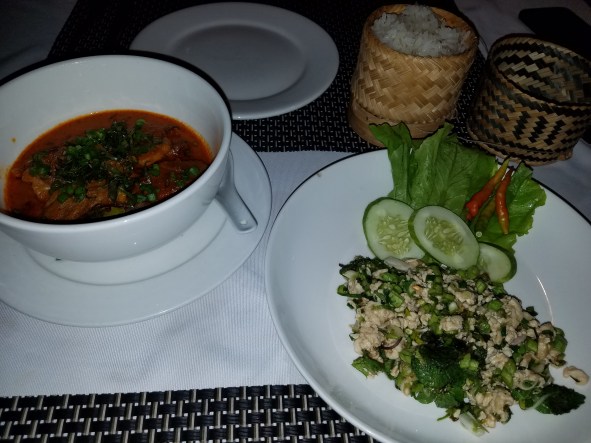


 Leaving Xieng Thong and following the map provided by My Dream, we biked on the in the sweltering heat, thinking to visit the Royal Palace Museum. It turned out to be closed for lunch and we took the hint, choosing a outdoor riverside café. Despite lots of cute shops and restaurants, air-conditioning didn’t seem to be an option anywhere nearby and we were a sweaty mess anyway. The proprietress welcomed us warmly and brought an electric fan. Lunch was delicious, cheap and relatively cool and we left refreshed.


 A small temple at the summit housed a few worshippers and a cat, the biggest crowd being outside taking in the nearly 360° view and the setting sun. It was worth the hike, but we headed down just ahead of the crowd, not wanting to be trapped on steep stairs in the dark with a group of sometimes-unsteady-on-their-feet tourists.


