Now totally enchanted by Singapore, we were determined to fit in as much as possible in our second, full day. First up, Little India. Our hotel, the beautiful Intercontinental Singapore, sits conveniently by the Bugis subway stop on the Downtown Line, which runs directly to Bayfront (the Marina Bay area) and Little India (in opposite directions). Two stops, and we hopped off in another world. A huge covered market teemed with vendors hawking every imaginable dry and wet good, women in saris, tourists, locals…all in a sweltering Mubai-like heat. The main street was decorated with peacock lights, ready for the upcoming Deepavali Festival which celebrates the victory of light/good over dark/evil.
We slipped off our shoes (and I wrapped up in a provided cloth to cover my knee-exposing shorts) to enter the Veeramakaliamman Temple, a beautiful Hindu Kali temple that bustled with worshippers and holy men offering ceremonies and blessings for the holiday.
Veeramakaliamman TempleInside Veeramakaliamman TemplePrayers at a Veeramakaliamman Temple shrine
In need of a break from the heat and approaching noon, we ducked into a local restaurant (Indian, of course) and found ourselves enjoying a delicious meal…while we waited for the a/c–which they’d just turned on–to fight off the heat. I won a pleased smile from the proprietress as I used my last bit of naan to wipe the final traces of delicious sauces from my Northern Indian set meal. At $6.90sgd ($4.95usd), it was a deal.
Lunch crowd building at Amaravati restaurant in Little IndiaNorthern Indian lunch
Riding the Downtown line back past Burgis, we hopped off at Bayfront, once again near the Marina Sands Hotel, but this time heading to the Gardens By the Bay comprised of two enormous greenhouses: the Flower Dome and the Cloud Forest dome. (We paid $3 sgd/pp for all day shuttle service between the subway station and the domes.) The Flower Dome mimics a cool desert environment so was a delightful break from the heat and humidity outside. It’s also a gorgeous, extensive display of flora and organic statuary.
The Flower Dome
The adjacent Cloud Forest dome is equally cool, but humid as the world’s largest indoor waterfall cascades dramatically from its soaring ceiling. Reached by elevator, floating walkways spiral high above the ground, letting you wander in and out of lush foliage, huge crystal displays and behind the waterfall as you make your way back to ground level. Tickets for entry to both domes are usually $28 sgd/adult ($20.10 US), but we were able to buy them online for $22 sgd ($15.79 US) using the smartphone and included app provided to us by the Intercontinental Singapore hotel.
The world’s largest indoor waterfall, inside the Cloud Forest domeView from the top of the waterfallFloating walkways inside the Cloud Forest dome
After the domes, it was time to check out the Supertree Grove, another Sinngapore landmark I was dying to see. The Supertrees are manmade, tree-like towers, covered in flowers, some of the largest of which are connected by a space-age floating walkway. We paid our $10 spd/pp to ride an elevator up to the walkway. Solar panels provide power to the Supertrees, which light up at night–we were definitely coming back after dark! The Supertrees are otherworldly, truly making you feel like you’ve landed on some beautiful, alien planet. The concept alone is fascinating. To see them made real is magical.
Supertree Grove
During a break back at our hotel, we tried a durian chocolate bar, we’d been unable to resist in a nearby market. I’d heard about durian for years–a fruit so foul-smelling it’s banned in hotels and other public places, but had never tried it. The fruit is large, and although durian is available in an Asian market back home, I hadn’t wanted to contend with such a big fruit, nor be stuck with figuring out how to get rid of it if it was as bad as billed (like “rotting meat” is a common description). Despite the smell, there are those who like the taste. I figured it might be akin to smelly cheeses, hard to get past the smell at first for some, but worth it. Durian mixed with a chocolate bar sounded like a pretty innocuous first try. My first bite was wretched, invoking something like chocolate mixed with dirty diaper. The second bite was no better and I gave it up. We wrapped the bar up and threw the bar away in an outside bin. Despite this precaution, our previously sweet-smelling room reeked when we returned and it took several blasts of our handy-dandy travel Febreze to restore things.
Don’t do it!In the subway: We could only speculate on the grave penalty for bringing a durian onboard.
A couple of hours of our day were spent at a brewpub, courtesy of David’s never-ending fascination with craft beer. We made the delightful acquaintance of a local doctor who also happened to be a real beer aficcianado. We had much fun sampling the beers and exchanging contact info. [I’m hoping to get David to write some beer reviews, so will skip details for now.] This detour left us with enough time for a quick dinner before heading back to admire the Supertrees after dark. We were surprised and pleased to find them less gaudy than we feared. They emit a gentle, softly changing glow, enhancing the feel of some alien plant life. Wonderful.
At the very last minute, we decided to do the ultimate tourist thing and get a Singapore Sling at the famed peanut-shells-on-the-floor Long Bar in the Raffles Hotel. The old hotel has open common areas, so the walk through the halls is a hot, sticky affair, although the white colonial architecture is lovely. The bar itself is super loud and full of tourists. We split a Singapore Sling, just to try it and were glad we did at $27 sgd, not including tax and mandatory tip. The drink is small, mostly ice and really sweet. Give it a pass and you’ll miss nothing, but I’m not sorry we tried it.
Singapore Sling and peanuts in the Long Bar at the Raffles Hotel
Helix Bridge, Marina Sands Hotel & Artscience Museum
I only allowed 2 nights in Singapore, mostly because 1) we arrived early by boat so really had a full first day, unlike usual travel days; 2) I had 2 free nights at the Intercontinental Singapore and didn’t really want to pay for another night or move; and 3) I was really more interested in a quick look and then getting on to later destinations that were higher on my list of things I really, really wanted to see. [I realize there are a lot of “reallys” in the above sentence, but they seem to belong, so I’m leaving them.] Anyway, it turned out that I really, really loved Singapore a lot more than I expected. So, it looks like there’s a return trip in our future.
Singapore is notorious for some pretty strict laws on seemingly minor things (gum chewing, toilet flushing) and the death penalty for things like drug smuggling. David and I had absolutely no interest in drug smuggling, but we were loathe to ditch the two packs of gum we’d brought from home and were sure to need over the next month of exotic, breath-endangering foods in Malaysia, Cambodia, Laos and Thailand. The ship told us not to bring gum, but an Internet search said gum was legal, just not selling gum. First hand reports also said the worst that would happen is they would throw away your gum. So, I stashed the packages in my suitcase and hoped for the best. Sure enough, we discovered a security scan as we exited the cruise terminal, but happily, gum did not seem to be an issue. (Our hotel handed out a brochure saying even gum chewing was legal, just not selling.)
[Cruise Port Info: After security, there’s a visitor center upstairs with free wi-fi, an ATM machine and helpful information people with maps. Taxis are plentiful. USE METERED TAXIS. Ignore the shouts for private cars, walk into the parking lot, past the limos with more shouts that they’re “ready now” for “only” some outrageous price, and follow the signs to the taxi queue. Our delightful driver, gave us a running commentary of the city and suggestions for destinations and charged us a bargain $13.50 spd (appx. $9.72 US) to drive us to the Intercontinental. He declined an offered tip, saying they don’t tip in Singapore.]
Debarkation security line in the Singapore cruise terminal, after baggage collection; long, but efficient
While living under such strict regulations might drive me nuts, it does make for a very clean and orderly society. Subways are spotless, people line up (queue) properly, etc. We also found everyone to be friendly, polite and helpful…and English-speaking, a welcome bonus.
After settling into the lovely Intercontinental Singapore and eating a quick Thai lunch in the attached indoor shopping center, we headed out for my first, dying-to-see destination, the Marina Sands Hotel with its crazy surfboard/boat structure on top which houses and incredible zero-horizon pool, viewing decks, bars and restaurants, and park. En route, we detoured past the Wealth Fountain, the largest fountain in the world (Singapore is big into that sort of thing), arriving during one of the periods where you can walk into the center of the fountain, stick your right hand into a burbling circle of geysers and walk three circles while making a wish.
Inside the Wealth Fountain, walking 3 times around with your right hand in the water while making a wish
Leaving the fountain and its surrounding shopping mall (also something Singapore is very big into), we followed Google Maps down hot streets and yet another huge, lux shopping mall to pop out onto a terrace with our first view of the Marina Sands, Helix Bridge and cracked-egg Artscience Museum. These space-age buildings captured my attention from the first time I’d seen them online and they didn’t disappoint. Wow. [See lead photo above.]
Making our way across the Helix Bridge, we came to another huge mall where we found the underground walkway to the Marina Sands Hotel. We bought $20pp tickets to the Skybar and rode the elevator to the top. Since the Marina Sands is a hotel, there are areas reserved only for guests. An outer observation terrace on this level as is the entire spectacular swimming pool. Still, there are two outdoor bars and an indoor restaurant space available to those with tickets. The $20 can be applied to drinks or food, too. Before you get too excited, the drinks are crazily priced: David had an $16 50ml Hoegaarten draft beer and a $23 mai tai. We shared a table with a newly-wed couple from Bulgaria, just passing through from their Bali honeymoon, each of comfy on our own cushioned rattan couch. David and I enjoyed the drinks, the view and the company immensely, and found the whole experience well worth the price.
The spectacular pool atop the Marina Sands HotelView from the Marina Sands Skybar
Dinner our first night was an adventure at Lau Pa Sat, the grande dame of Singapore’s street food venues. Located in a Victorian era pavilion now dwarfed by surrounding skyscrapers, Lau Pa Sat draws crowds of local workers at lunch and more crowds at night when satay stalls open on the periphery. We had fun looking at an array of foods and ordering satay to eat outside…but, boy, was it hot and humid! The satay was good, but not great to my way of thinking: not grilled enough and with a coarse peanut sauce that was a tad too sweet for me. Sauteed local greens were a bigger hit as were stir fried noodles.
Lau Pa Sat, dwarfed by its neighborsSatay vendors just outside Lau Pa Sat; hot work!
Naha, Okinawa: Naminoue Beach with Naminoue Shrine in the background to the right
We’re off the RCL Mariner of the Seas tomorrow and back on our own. I haven’t written travelogues about the cruise portion of our 2.5 month odyssey just because I don’t know that I’ve got much new or useful to offer. It’s been fun and we loved the itinerary–both for the ports and for its transportation value as part of our overall trip, but the ship’s service has been a let-down, not nearly as good as we experienced on our trans-Pacific crossing on the Celebrity Millennium. It was my first time on RCL, and I’d heard good things, so maybe this is just a function of changes as the ship has been fairly-recently based out of China. Definitely, cultural and language aspects were a challenge, but food, service, efficiency of on- and off-boarding left a lot to be desired. Oh well, hardly a hardship, just a little disappointing. Still, it’s been nice to have this 10-night break with someone else in charge of our itinerary before we begin our last month of travel through southeast Asia.
In the spirit of completeness, I hit on a few highlights below from our ports-of-call with Mariner that might be of interest to someone doing this cruise or making these stops:
First up was Naha, Okinawa. It was good to be back in Japan, but while we avoided the forecast rain, the sunny day brought some pretty serious heat and humidity. The highlight was definitely the hatagashira parade on Kokusai street, part of an annual festival and prelude to world’s largest tug-of-war set to take place the following day. Groups of costumed young men performed amazing balancing acts with decorated 10m poles called hatagashira to the chanting of crowds:
I couldn’t find much information about the Naha cruise port itself, so am happy to report that we docked at the Wakasa Berth, much closer in than I’d feared. (Apparently, it is possible for a ship to dock in the “spare cruise ship berth” on the far side of the container port that lies behind Wakasa Berth.) The small cruise terminal offers ATM machines, free wi-fi, helpful information staff, and plenty of taxis. There’s a nice little beach (see photo above) not 10 minutes’ walk from the the dock (walk to the right out of the port, cross the street, and take the path on the side of, not over, the bridge), or you can skip the beach and shrine and walk directly to the monorail (to Shuri Castle) and main shopping street, Kokusai Street, in about 20 minutes. Stopping at lovely Fukushuen Garden along the way will slow you down, but is worth the delay. Just beyond the beach, and accessible from the beach by a flight of stairs, is a pretty Buddhist Shrine. The surprise gem of our visit came when we cut through a park just to our left as we descended the main shrine stairs. We were just planning to cut back to the street leading from the port to Kokusai Dori Street. The park turned out to be a memorial park adjacent to the Tsushima-Maru Memorial Museum to the mostly-children who lost their lives when the ship on which they were being evacuated was torpedoed by an American ship. Like the Peace Museum in Hiroshima, this little museum is dedicated to providing rest to the souls of those who died, to memorializing their lives, and to displaying the consequences of war. It’s a sad, but welcoming little tribute with children’s belonging and a recreated classroom. Everything save a video with English subtitles and the transcript of messages from the American warship (targeting the destroyers and military personnel accompanying the evacuation, and apparently unaware of the children) is in Japanese…so the nice lady at the desk refused to accept our payment for tickets and allowed us in free. The video alone was worth the stop. (And the air conditioning is welcome, too.)
Naha, Okinawa, Japan: Hatagashira parade on Kokusai Dori Street
Our next port-of-call was Hong Kong. I’d long wanted to visit, and had been disappointed when a schedule change left us with only 10 hours in port, rather than the two days initially planned. Still, we made the most of our time. The new cruise port is at the old airport and, while the terminal is huge and modern, it’s an inconvenient location and the massive size just makes for a lot of walking through empty spaces. (I measured .4 miles on my Fitbit from the shuttle bus to the ship on our return, 90% of that simply walking back and forth through the maze-like terminal.) Despite my misgivings about the location, free shuttles provided by local malls turned out to be a really convenient launch to our day. We chose a shuttle that dropped off at Hollywood Plaza mall, and after snaking through a Marks & Spencer (weird), we ended up in a mall by multiple ATM’s, grabbed some cash, then descended an escalator to the Diamond Hill subway station. We bought tickets at machines (that require bills of 50HKD or less) and give change. For less than a couple of US dollars apiece, we rode all the way to Central station on Hong Kong Island (starting on the green line, then changing at Mong Kok so that we just had to step across the platform and onto the red line). From Central station, we took Exit J and followed signs to the Peak Tram, rode ding ding double-decker trams along Bank Street, then caught the Star Ferry back to Kowloon. We checked out the famous high tea at The Peninsula, but opted for a drink at the Intercontinental with its spectacular view of Victoria Harbor as evening fell and the lights came on.
Hong Kong: Beautiful Victoria Harbor
After Hong Kong, we had our first stop in Vietnam. The port at Chan May is a very industrial port, a long way from anything of interest to most travelers. The nearest tourist destinations: Danang, Hoi An and the former imperial city of Hue are all worth seeing, though. In fact, the hard part is choosing which to see since Hoi An and Hue are in opposite directions. There’s no cruise terminal. Knowing we needed to make plans (and not a fan of large cruise ship excursions), I’d signed us up for a private tour via Tommytours with people I’d met on Cruise Critic. [If you don’t know Cruise Critic and you cruise or plan to cruise, you need to get familiar with it. Join your ship’s “roll call,” sign up for the Meet & Greet on-board, read tips from your fellow cruisers, pool resources for tours. You’ll meet a lot of people who want to do nothing but cruise which may not be your thing, but they know the ropes of their chosen line and they’re good friends to have: We boarded with Diamond-Plus level friends, so were 5th and 6th on the ship, avoiding lines and getting to settle in early.] The Chan May port charged $25pp for a tour company to drive in to pick up, so we walked out of the port to meet our guide. I’d been leaning towards Hue, but David was taken with photos of Hoi An, a small group tour was available to Hoi An, so that’s what we did. Hoi An has the advantage of being a lovely city that was saved from destruction during the war. Heavily reliant on tourism, it’s still a beautiful glimpse at an older way of life and we really enjoyed our visit. Hue, site of the Tet Offensive, was destroyed and the former “forbidden city” is a reconstruction of the original. Our guide picked us up in a brand new, 16-seat van with great air conditioning and 2 fast wi-fi hotspots. Cold water and cold towels made the van a delightful refuge from the humidity and passing showers. On the way to Hoi An, we stopped at Danang Beach where some of our group bought live crabs to be cooked later for lunch. Our next stop en route was at the Marble Mountain area which actually consists of 5 holy mountains representing the 5 elements of local religion: metal, wood, fire, water and earth. We rode a free-standing elevator up to Water Mountain. A sudden downpour left only David and me with the guide to explore the pagoda, temple and cave shrines on the mountain. (We had rain gear while our companions did not. Although the guide handed out ponchos, the others were already wet and wearing shoes that couldn’t handle the sudden rushing water that cascaded down the steps and paths of the mountain. David and I wore made-for-fly-fishing Teva sandals–our faves for such travel–and just waded on until the cloudburst ended.) Hoi An turned out to be the kind of place where you just want to ramble. Our guide took us through a Buddhist Temple and classic long, narrow, two-story house with balcony overlooking the bustling street. We walked past river boats and through an ancient Japanese covered bridge before David and I ducked out for a little time on our own. Back with the group, we enjoyed at 7-course feast of Vietnamese food on an open-air veranda by the river. Back at the ship, our guide was able to drive into the port, bypass tour buses and drop us off right at the ship. This was a good thing, since a storm had rolled in. It was pouring raining and howling wind. David and I were fine in our rain gear, but a lot of people were drenched in the unsheltered line trying to get back on the boat.–The poor organization of Mariner striking again. [We used Tommy Tours for our Hoi An tour. You can find Tommy at: http://tommydaotours.com/. Ty (prounounced “Tee”) was our guide. They were very professional. The only slight negatives I’d point out are that lunch was very late in the day, 2pm, so we were hungry after our early start, and Ty’s accent sometimes left us guessing, but we’ve found that to be a very common problem in Asia. We paid $75 apiece and did tip.]
Hoi An, Vietnam
Our next port, Phuy My, Vietnam, was as industrial and remote as Chan May, also offering no cruise terminal, but at least a few vendors under tents. The place to see here is Ho Chi Minh City, Vietnam, the former Saigon. Knowing it was a nearly 2-hour drive, I debated whether we wanted to make the trip at all, but decided it made no sense not to. One again, we pooled with some Cruise Critic friends, walking out of the port to board another private van (booked through Tours By Locals). Another 16-seater, this van had great a/c, but only room temperature water and a non-functional wi-fi hotspot. Not as nice as the Hoi An set up, but our guide, Tam, turned out to be very interesting. The son and relative of many refugees (aunts and uncles escaping to Australia and his father imprisoned for 5 years after a failed attempt with the 6-year old Tam), his family suffered punishments in the past and job discrimination that continued. Still, he was upbeat and informative. Braced for the bustle of the big city, we were still blown away by the massive, chaotic crowds of scooters that swarmed the streets darting between trucks, buses and cars. Tam assured us traffic was actually light since it was a Saturday. Oh, good Lord, I could only imagine “rush hour!” We peered out the windows of the van, fascinated as we moved past the Saigon River from large roads to narrow, byzantine streets filled with shops offering nothing but scissors, others offered dragon costumes, medicinal herbs, and so much more. Stepping out of the van for the first time, I was hit by the smell of incense, but couldn’t tell where it was coming from. Tam let us down a narrow passage between buildings to arrive at the courtyard of a 300 year old Buddhist temple. The smell of incense definitely emanated from the building, growing to a cloud as we moved past a raging fire in a big free-standing “furnace” in the middle of a second courtyard. The temple bustled with activity, worshippers lighting 1 or 3 (never 2) sticks of incense and waving them before them before planting them before altars to bow and pray. Overhead, a myriad of spiral, cone-shaped incense burned, adding to the thick atmosphere. Ceramic statues crowded the roof of the temple, ornate and beautiful in a way completely unlike the temples we’d seen in Japan and Korea. After the temple, we visited the biggest, dirtiest market I’ve ever had the fascinating but dubious pleasure to visit. This place offered wholesale goods only and burst with hats, clothes, food, herbs, sugar and more, overflowing from an enormous covered area to sprawl into trash-strewn streets alive with pedestrians, porters with every imaginable bundle, and–of course–scooters. It was a relief to return to the sanctuary of the van for the drive to the War Remnants Museum. This museum, surrounded by captured American military vehicles, gives the (mostly-Northern) Vietnamese view of the Vietnam War. It’s uncomfortable to see, particularly the many photos of those injured by Agent Orange and the horrible birth defects suffered by multiple generations of those exposed. The famous “We hold these truths to be self-evident…” quote is displayed with jarring impact. The culpability of the North is glossed over (much like we saw in the Military Museum in Belgrade, Serbia, and unlike the more balanced approach of the Hiroshima Peace Museum), but it’s still worth seeing and acknowledging the horrible price of war. We moved from war to lunch, pushing away for a time thoughts of man’s inhumanity to man. We’d asked Tam for a local food lunch and he delivered with a noisy Vietnamese “pancake” restaurant. Crispy shrimp and pork “pancakes” cooked outside in iron skillets were served piping hot and folded over bean sprouts. We broke off pieces, rolled them in lettuce leaves and dipped in a special sauce. Delicious! Other courses included crab spring rolls and small beef rolls served with dry rice paper for rolling with various condiments and yet another sauce. We had pho and local beer and deep red watermelon, too. Messy, but fun, and lots of new things to try. We ended our day with visits to the French colonial-era Notre Dame cathedral, post office, opera house, city hall, and the classic Rex Hotel. It was a fascinating day and fun; I’m so glad we went…and I doubt I’ll need to do it again. [Tam a/k/a “Tony” can be reached at http://www.saigonmekongtours.com and sales@saigonmekongtours.com. Split 8 ways, we paid $75 apiece for all transportation, entries, and lunch and did tip afterwards. The tour lasted approximately 8 hours. Tony did a good job despite a few language/accent struggles for us, but again, we’ve found that to be the norm in Asia.]
Ho Chi Minh City, Vietnam
So, now I’ve caught this blog up to date. We know that when we get off the ship tomorrow, we’re probably in for more travel uncertainty than in more-developed Japan and South Korea, but we’re excited…Besides, we definitely won’t be roughing it our first couple of nights in Singapore. We’ve booked the Intercontinental, courtesy of easy points via an IHG promotion and David’s IHG credit card. (The promotion ended before I started blogging or I would have definitely shared. I got over 60,000 IHG points for sending in some postcards, enough for a night at the Intercontinental. David racked up points with postcards, too, then scooped up the rest with a credit card signing bonus.) After Singapore, we’re off to Kuala Lumpur, Malaysia, before heading to Cambodia and beyond. Here’s hoping the adventures that lie ahead are good ones!
China has recently expanded their visa waiver provision, allowing certain in-transit visitors to visit the country for 144-hours (6 days) without a visa. This is really a great opportunity to get in a not-insubstantial visit without the hassle and expense of obtaining a Chinese visa before you leave your home country, the only other option for travel to China. The requirements for this waiver are specific, though:
You must arrive in China from one country and depart to a third country, i.e., you CANNOT simply fly to China and back from your home (or another) country.
The visa waiver is available to those arriving and departing from certain entry points including airports and cruise ship ports in Shanghai, Baoshan, etc.
You may visit certain other nearby regions and cities. For more information see: http://www.sh-immigration.gov.cn/listPageEn.aspx?lx=40&id=4414. (The link to the left of this page entitled “Interpretation of 144-hour Visa-exemption Transit Policy” has useful answers to FAQ’s, too.)
You need to advise the carrier taking you to China of your plan to use the 144-hour visa waiver at the time you check-in. You have to show that carrier your actual departure tickets to a third country (and itinerary if needed to clarify that you will be leaving to a third country). They will enter this information in their computer and, presumably, thereby notify the Chinese authorities that a passenger intends to use this waiver upon arrival in China.
Once in China, at immigration, you go to a clearly-marked visa waiver line rather than the usual immigration line. At the Shanghai Airport, this line was to the far right as you look at the immigration lines. The line for visa waivers was much shorter than the regular lines. You need to again present actual tickets showing your onward travel plans to a third country. Since we were leaving on a cruise, rather than a flight, we had to show our itinerary as well as our tickets which showed that the next stop on our cruise was in Japan, not China or the country we had been in prior to China (which, for us, was South Korea). [The cruise itinerary was not on our tickets and the original itinerary I had with me showed a first cruise stop in Xiamen, China rather than Okinawa, Japan, which was substituted for Xiamen, so it was crucial that we printed an accurate itinerary before departing South Korea.] Once you’ve presented the required documents, you receive an appropriate sticker in your passport allowing you to remain in China until your departure. (Your Chinese hotel will request your passport and verify your authorization under the visa waiver program.)
View of Seoul Station and beyond from our well-located, but unauthorized AirBnB apartment
We had our first unpleasant AirBnB experience in Seoul and it had very little to do with the apartment itself. Two days before we were to arrive in Seoul (and just as we were about to begin our much-anticipated, Internet-free stay at Beomeosa Monastery, ie., with no time to make other plans), I received an email from the owner of the apartment we’d booked in Seoul, “Mr. S.” Mr. S wrote to touch base regarding handing off the keys, etc…and to tell me that “if any persons (police man) ask you regarding the you come to here through the airbnb, then pls DON’T SPEAK for airbnb will be appreciated…so you can say that this room is your friend’s room for you.”
Hmm. This was a first. I was, in essence, being asked to lie to foreign police to cover for an unauthorized rental apartment. No way was I comfortable with this and I would not have booked the apartment if I’d known. I really resented being put in this position, especially when I didn’t really have time to look for an alternative.
I researched AirBnB en route to Seoul via the KTX train’s wi-fi and discovered that a 2015 lawsuit had ruled that AirBnB rentals must be registered with the government. I now suspected that Mr. S might have avoided that registration.
When we arrived in Seoul, Mr. S met us as promised in the underground subway walkway which connects Seoul (train) Station to the building where the apartment is located. He handed off the keys, but when I expressed concern about his email regarding police and asked him to accompany us the short distance on to the building, he refused, leaving us to deal with any problems on our own. He apparently thought our odds of getting past “tourist police” better without him, but we had nothing to do with the situation and I thought it was pretty chicken of him to leave us to our own devices. Mr. S told us the riskiest part of this whole venture was when we went through the building with luggage (so he didn’t want any part of that). He dropped by the apartment 10 minutes after we were in to deliver the wi-fi hotspot he’d promised and extra blankets, so it wasn’t as if he had some pressing appointment that prohibited him from walking in with us.
On our 2nd night there, we went to explore the top floor gym and discovered a sign saying that all AirBnB rentals were banned in the building (apparently a building-specific internal rule) and could be subject to being reported to the police. “Great.” Even if Mr. S had registered his apartment with the government, it looked pretty clear that he was in violation of the building’s own rules. The next morning, we saw a similar sign on the front door. Unfortunately, we were past AirBnB’s 24-hour after check-in deadline for reporting problems that might void the whole deal and stop payment to Mr. S. From what I read, I believe it was he who was potentially in violation of laws and/or building rules, not us, but it was very awkward and uncomfortable nonetheless.
In the end, we decided to live with the situation and hope for the best, since we were already moved in and only had 2 nights to go after seeing the posted signs. Happily, we were not confronted by police or building staff. I did report the situation to AirBnB and explain the facts on the ground in my review of the apartment and Mr. S so that others would be advised. (I was surprised that no one else had mentioned the authorization problems in the many positive reviews for this apartment. Either people ignored the situation, or the signs–and Mr. S’s proposed dealing with police–were a new development.) There are other AirBnB hosts offering apartments in this same building, though, so I hope AirBnB takes some initiative here.
I intend to keep using AirBnB as apartments are often better suited to my travel needs than hotels, but I will more closely scrutinize local laws. I’d like to see AirBnB alert its users when there are potential legal problems in a city or country so that users can ask the right questions of owners. AirBnB must be aware of the legal challenges its faces in different cities and countries (as covered in numerous newspaper articles), and I’d appreciate a heads-up for those of us who use the service. A simple alert from AirBnB when I search a potentially-problematic location would be greatly appreciated.
The apartment itself was pretty much as shown in the AirBnB photos. I had some quibbles with supplies, but the location was excellent. (It shares a brand new high-rise building with a Sheraton Hotel, and is connected to covered shopping, subway and the huge, modern Seoul Station.) Had it been an authorized rental, I’d have given it and Mr. S fine marks.
Access to the airport train from Seoul Station is to the left of Entrance/Exit 3 in this photo
Korean Air offers a very convenient service (unavailable for code-share flights): You can check-in and check your luggage at Seoul Station before taking an express train to the airport. To do this, you need to arrive 3 hours before your flight. (This isn’t really a big deal since they ask you to arrive at the airport 2 hours early if you’re going to check luggage there, and the direct train from Seoul Station is about 45 minutes.)
The process at Seoul Station is as follows:
1. Arrive 3 hours early. (The location is by Entrance/Exit 3 of Seoul Station, down two floors via escalator and/or elevator.)
2. Buy a train ticket to the airport (either at a machine if you have cash or a local credit card, or at the office just by the machines–to your left as you face the machines–with a foreign credit/debit card). You MUST buy the train ticket first. You’ll need to show it at check-in. Choose a time at least 30 minutes in the future for your train ticket to allow time for check-in and immigration. If you should miss that train departure time, you can exchange your ticket for a later time at the office.
3. Check-in and check your luggage at the Korean Air check-in desk just as you would at the airport.
4. Go to immigration. This is located at a small office just beside the ticket office, at the entrance to the check-in desks. The process was very quick.
5. Take the elevator a short distance away to the train platform. The train is clean, comfortable, air conditioned and (like so many public places in Korea) offers free wi-fi.
At the airport, you take a special entrance, along with diplomats and crew, for those who have already passed through immigration. (There’s a convenient photo of this entrance taped to the Korean Air check-in desk.) Follow the signs to this “Designated Entrance” which was to our right just past a cell phone service shop as we exited airport security.
Photos of entry points at airport taped to Korean Air check-in desk at Seoul Station
The system worked like a charm for us and our luggage was first off the plane when we arrived in Shanghai.
I realized I failed to publish two travelogues from our time in Seoul, South Korea, in October 2016, so I’m adding them now, but back-dating them so they will be in chronological order on Wanderwiles. -Tamara, 12/5/2016:
Memorial and prayer ribbons tied to a fence in Imjingak Park
Visiting the Demilitarized Zone (“DMZ”) between North and South Korea was high on my list of things to do in Seoul. At this time, access to the DMZ requires booking an organized tour; you cannot visit on your own. After doing some research on tour providers, I chose Koridoor. Not only was their price competitive, but I liked that they worked with the USO and coordinated with the US Army so that there was an opportunity to hear from US soldiers stationed in South Korea. Koridoor offers two DMZ tours plus tours to other places in South Korea. I opted for the longer JSA/DMZ tour which includes the Joint Security Area. Knowing this tour is extremely popular, I booked a couple of months before we were to be in Seoul. The tour was scheduled to run from 10am-6:30pm and cost $92/civilian adult and $65 for US military personnel. Unfortunately, before we even left the States, I received an urgent email telling me there would be no JSA tours during the week we were to be in Seoul due to some “operational reason in” the United Nations Command Military Armistice Commission (UNCMAC). This situation effected all tours to the JSA, not just Koridoor. With no other options, I rebooked for the DMZ Half-Day Tour for $41pp. Our new itinerary was as follows:
08:00 : Departure from Camp Kim USO
08:50 : Unification Bridge
09:00 : Dora Observatory
10:15 : The 3rd infiltration Tunnel
10:50 : Dorasan Station – Free admission (Optional : Admission to platform – extra 1,000KRW in cash)
11:20 : Lunch at the Korean Restaurant (not included)
12:20 : Imjingak Park
14:00 : Arrive at Camp Kim USO
The morning of the tour, David and I caught the Seoul subway from Seoul station one stop to Sookmyung University station. From there, it’s an easy walk to the USO office which sits just in front of the US Army’s Camp Kim.
We arrived on time to find the waiting area full. This is a popular tour! I realized en route that I’d forgotten to bring our passports and was really worried that we’d be turned away. Thankfully, the photos of our passports we keep on our phones were good enough. Judging by the crowd there, I’m pretty sure rebooking for another day would have been impossible. I also doubt the photos would have been good enough if we’d still been booked on the JSA portion of the tour. Whew!
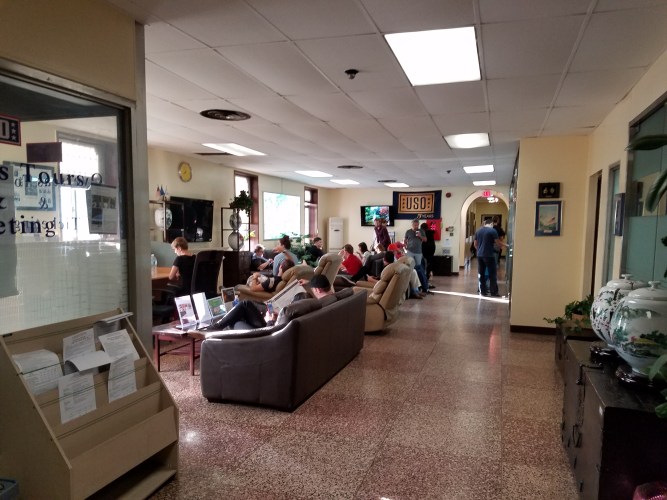
In the USO, waiting to board the tour buses
It turned out there were two buses in use for the day’s tour. We were assigned bus “B” when we checked in, and not long afterward we were invited to board the bus parked on the road out front.
Barbed wire and our first peek at North Korea from the bus en route to the DMZ
We passed over the Unification Bridge without incident, zigzagging through barriers set up to slow the speed of vehicles. Our tour guide gave the guards a list of our names, nationalities and passport numbers and that was it. After passing a South Korean military base, we arrived at the Dora Observatory, exiting the bus to walk past a group of South Korean soldiers apparently just taking in the view themselves.
We brought our own binoculars, but there were options: A long row of pay binoculars lined the observatory deck, allowing tourists to look across the DMZ to North Korean observation towers so we could watch them watching us watching them…
Our next stop was the 3rd Infiltration Tunnel and DMZ museum. The small museum has models of the DMZ and four North Korean-built tunnels into South Korea, videos, relics and life-size recreations of tunneling. Following tips from a North Korean defector, the 3rd Infiltration Tunnel, considered the most dangerous to South Korea, was discovered in 1978 when water injected into the ground erupted into a geyser. In keeping with the hostile relationship between the two Koreas, each side claims the other dug the tunnel(s), but it seems pretty obvious the 3rd tunnel as well as the other three are North Korean creations.
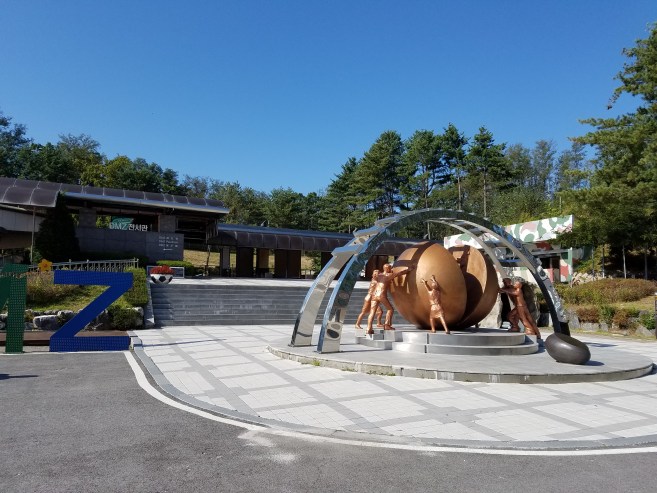
DMZ Museum and reunification monumentMuseum display showing how the tunnels were made, digging holes to insert dynamiteIn front of the building housing the entrance to the 3rd Infiltration Tunnel
The 3rd Infiltration Tunnel has a very steep descent followed by a low ceiling. You have to put your belongings in a locker and no cameras or photography of any kind is allowed. Hard hats are required and we soon discovered why: The thwocking sound of hats hitting the low rocks over head came regularly throughout our visit. There are lots of warnings for people with mobility, breathing or claustrophobia issues and they should be taken seriously. It’s a steep–but relatively wide and modern–hike down to the rough rock tunnel where there’s nowhere to step aside or straighten up once you’re at the bottom. It’s also cool down there, too, about 50°F/11°C. Info at the museum and from our guide claims that 30,000 troops could move through the tunnel/hour. We found that hard to believe.
Passing through security to enter the descent to the tunnel. (Yellow hard hats are on the wall inside.)
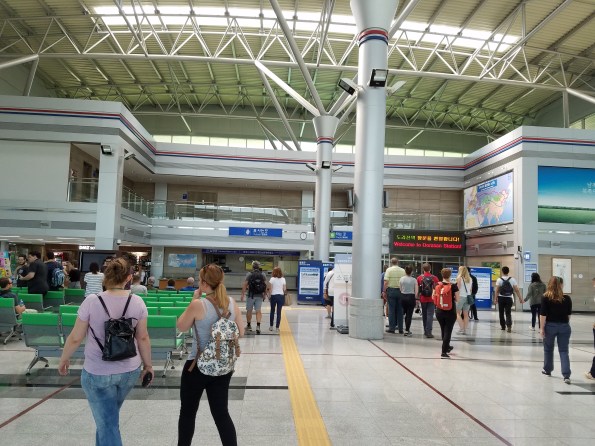
Our next stop was a weird one: the Dorasan train station. The station was built to facilitate trade and transportation between the two Koreas during a brief warming period. The big, modern station was the last stop in South Korea and was actually operational for a short period, but is now closed for all business save the kind we were there for.
A tour group in Dorasan station
You can buy a 1000 won ticket that lets you pass through a turnstile and walk along the track. At about 86 cents, we figured “Why not?,” but it’s an underwhelming experience.
Unused tracks quai at Dorasan station
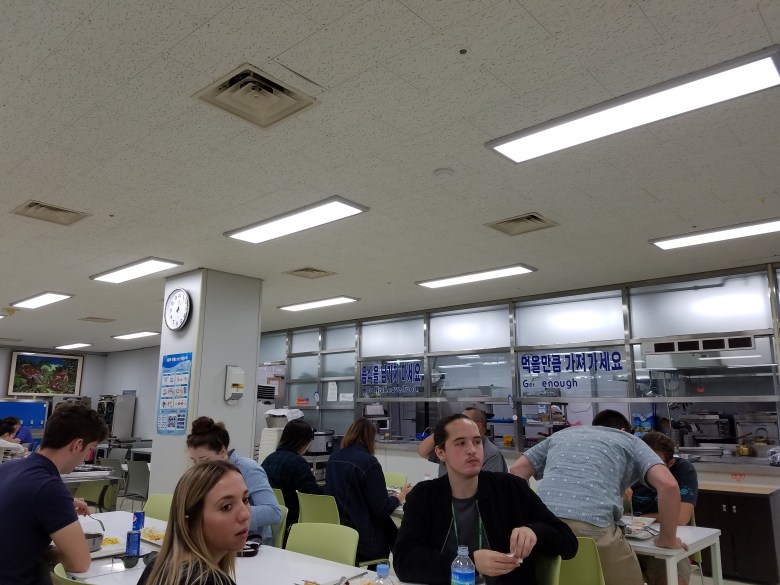
Lunch at a “Korean restaurant” turned out to be lunch at an institutional-type cafeteria located upstairs in a building housing the Inter Korean Transit Office.
The Dora Restaurant is upstairs to the right
We had two options for meals, and David and I both went for traditional bimimbap which is sort of the national dish of Korea. “Bimimbap” means “mixed rice” and we put our own bimimbap together from ingredients laid out buffet-style, topping a bowl of white rice with namul (seasoned vegetables), gochujang (a spicy chili sauce), soy sauce, etc. Sometimes you get a raw or fried egg and/or sliced meat. When we finished, we bused our own table, carrying our trays to the cafeteria ladies behind a counter in the back. It really was an uninspiring lunch. Maybe they were going for an authentic “military” experience?
The Dora Restaurant, an institutional-style cafeteria for lunch; bus your own plates to the counter in the backBimimbap
Our final stop was Imjingak Park. Bizarrely, an amusement park sits to one side of the more somber memorial areas of Imjingak Park. The park was built to console those who couldn’t return to their hometowns and families. It contains the wooden “Freedom Bridge” a former railroad bridge that was used to repatriate POWs returning from North Korea.
Freedom BridgeTributes and messages left at the end of the Freedom Bridge nearest North Korea
A dilapidated train is preserved in the park, badly damaged by artillery fire. Along one side of the old track, a barbed wire-topped fence is covered with ribbons representing prayers, memorials and wishes for peace. [See top photo.]
War-battered train at Imjingak ParkNow unused railroad bridge to North Korea as seen from Imjingak Park
Another unusual tribute interested David and me; it is in honor of a television show we’d seen depicted in the popular Korean movie, “Ode to My Father.” The television show, known as “Reuniting Korean Families” or “Search for Dispersed Families” in English, was created 30 years after the Korean War as a way for separated family members to find each other. People came to be filmed holding placards describing family members, places and/or details they could remember. Many were children at the time of the war, some who couldn’t even remember their parents’ names. More than 10,000 families were reunited via the show. There’s plenty out there on it for those interested, but here’s a link to get you started: https://www.koreabang.com/2013/pictures/photos-in-1983-all-of-korea-was-crying.html
Tribute to the “Search for Dispersed Families” television show with photos of the show around the perimeter
Leaving the park, we headed back to Seoul. It was an interesting day that I wouldn’t have missed so long as we were in Seoul, but I also can’t put it anywhere near the top of things South Korea or even Seoul itself has to offer. I would have liked to have done the JSA portion of the tour, but it’s a troubled area and interferences with these tours shouldn’t be too surprising. From what I saw, most of the tours looked very similar (and things can get crowded because of that). Koridoor offers one of the best deals and I like the idea of USO involvement although we didn’t get to hear from US military personnel due to the UNCMAC-induced change of plans. In sum, if you’re in Seoul and have the time, by all means go to the DMZ. If you don’t have the time, don’t worry about it.
From the first time I read about temple stay programs in Japan and South Korea, I was hooked on the idea of spending the night at a Buddhist temple. I wanted to learn more about Buddhism and what, exactly, Buddhist monks did on a daily basis. The stays I saw in Japan (“shukubo”) sounded more like simple lodging in a monastery; interesting, but not as much as I was looking for. When I found South Korea’s Templestay program, it seemed I’d found what I was looking for: a real cultural experience aimed at sharing and preserving an ancient way of life.
Beomeosa Temple just outside of Busan, South Korea, offered a temple stay and I wanted to visit the temple anyway; I had my destination! Beomeosa (pronounced “boh MOH sah”) offers temple stays most weeks, Sat. – Sun. You must reserve in advance and should do so as soon as possible. The temple asks for bank transfers, but kindly agrees to accept cash payment upon arrival for foreign guests. Their temple stays alternate between a “resting” and a hiking program. The day that worked with our travel schedule was the “resting” program which focuses on spiritual renewal and offered a 1-hour, as opposed to a 3-hour, mountain hike. We would have been happy with either, but decided we’d probably been lucky to get the shorter hike since the weather was just clearing from the previous day’s rain and still drizzly.
The “base temple” where we spent much of our time (& which served as the women’s “dorm”)
One of the reasons I’d chosen a hotel near Busan Station (rather than the elegant Park Hyatt for which we had free nights available) was that it made getting to our temple stay so easy. We stored our large luggage with our hotel, walked the short distance to Line 1 of the subway just in front of Busan Station. Line 1 runs directly to Nopo dong Station where we got off to catch the 90 Bus straight to the entrance to Beomeosa Station. [Note: The stop before Nopo dong is called “Beomeosa,” but do not get off there.] The subway ride costs 1000 won/pp, one-way = $.91. The whole process takes about 1 hour 15 minutes: 21 stops/40 minutes on the subway, 1 minute walk out the door of Nopo dong station to the 90 Bus, 6 stops/15 minutes on the bus, and about a 5 minute walk up the hill to the temple. When you exit the subway, turn left, away from the Central Bus Station (for long-haul, inter-city buses) and walk right, outside the station, where the local buses park. The sign for Bus 90 is the first one you come to. Pay on the bus (1300 won/pp, one-way = $1.18pp). There’s parking if you want to drive.
View of the 90 Bus stop on leaving Nopo dong train stationView upon exiting Bus 90 at Beomeosa Temple. The entrance steps are just ahead to the right.
Check-in for Templestay was between 1:30-2pm and we arrived right on time. When we explained why we were there, a friendly man at the ticket/info booth at the base of the hill gave us a map and directions and sent us on our way. We joined groups of visitors and hikers climbing the hill to the temple complex. (Beomeosa Mountain boasts several popular hiking trails through its forests where streams fan out through the trees, flowing between enormous boulders.) As we passed through colorful painted gates and large statues of fierce-faced guardians, we wondered what this experience would be like. We’d visited lots of Buddhist temples and shrines in Japan, read what we could, but still so much of it was a mystery to us.
The 2nd entrance gate to the temple complex
We passed through the last and largest gate into a wide courtyard dominated by a main temple just ahead and several surrounding temple and shrine buildings, all painted in bright shades of red, green, blue, yellow and white. (Although I’ll refer to “Beomeosa Temple,” it’s not one building. There are many temples and shrines of various sizes, as well as living quarters, a drum tower and more which make up the temple complex.) Mounting a last flight of stairs, we turned left as we’d been instructed passing temples on our right and living quarters on our left with signs forbidding entry and stating that meditation was in progress. Later, we’d learn this was where the monks lived. At the far end of a row of temples, we arrived at a gate marked Templestay and climbed one last small hill to a temple much like those we’d already passed.
One of the many temples at Beomeosa
A young Korean woman met us, quickly found our names on a list and handed us our clothes for the weekend, indicating where we could change. Although, the instructions I’d received upon booking said we could wear “light clothes” under our temple clothes, both David and I found it made no sense to wear anything other than underwear beneath the soft washed cotton of our new clothes. We were given identical outfits, different only in size: a purple front-buttoning tunic with 3/4 sleeves and loose-fitting gray pants with stretchy waist and ankles. Both top and bottom had pockets which came in handy since we stored away our other belongings and gave our valuables to be locked in an office. Once dressed, the same Korean lady gave us a brochure with a map of the temple and surrounding mountain and general instructions about temple etiquette and mindset.
Our “base” temple is #15 on the mapTips for temple life and mindset
Our fellow templestayers began to arrive and also don the uniform; they included a Russian, an Argentinian living in Busan, an Australian woman whose sick husband left before things began, two women friends from Seoul, two Chinese sister-in-laws, and ten Korean foster/orphanage kids–8 boys and 2 girls–ranging from middle school through high school and the sweet lady who chaperoned them. An exhausted German couple fresh from an overseas flight and a missed train from Seoul arrived just as we began dinner.
With the younger members of our group, just before things kicked off
Our first activity began with an instruction to grab a cushion from a stack in the corner and form a circle. A monk had joined us and took the lead at the point of the circle nearest a golden bas-relief altarpiece featuring a Buddha among a host of other companions. The young woman who checked us in stationed herself nearby with a clipboard where she jotted notes before translating things to English. A Korean, she’d lived many years in Vancouver and spoke excellent English. The monk introduced himself and the translator began by explaining that while in Catholicism or Protestant Christianity you might call a priest “father” or a minister “reverend,” in Korean Buddhism they referred to the monks as “sunim.” Sunim asked us to introduce ourselves and tell where we were from and why we’d come. He looked to me to start so I gave my name and home and said that I wanted to learn more about Buddhism and the culture around it as part of my trip to Korea. The translator translated my words for sunim and the Korean visitors and so it went around the circle. The younger members gave their grades in school and a few of the less shy ones added their goals and ambitions in life.
Introduction time
After introductions, we took a short break then formed our cushions into rows to listen to a younger sunim explain etiquette of the temple and what was expected of us. As we’d read in the brochure, he explained the proper way to greet monks we might encounter while around the temple, with palms pressed together at chest level and bowing at the waist, a “half-bow” or “hapsang.” We were told to walk with our hands clasped in front, right hand over left, left thumb resting over the right thumb in the “chasu” body posture. We shouldn’t swing our hands vigorously, etc. This was to encourage slower walking and contemplation. Silence was encouraged as a way of having a conversation with yourself. Also, we should not walk or stand with our hands behind our back as that was considered impolite. When in a temple, we should take a cushion from the ever-present stacks in the corner, then sit cross-legged with our hands resting clasped in front of us or with our fists closed, fingers down, resting on our knees. When finished, we should return cushions to where we’d found them. We were taught how to do a full bow; first dropping to the knees, then the elbows, then placing our foreheads on the floor, palms resting beside our head. Then, turning the palms upward, then back down, before rising. A half bow upon entering a temple, facing a Buddha or pagoda, was then followed by three full bows and a final half bow. We practiced the various bows, to the loud cracking noise of a split bamboo rod that sunim slapped against his palm to signal the time and pacing of bows and half-bows. All of this instruction was given in a friendly and welcoming manner and we were repeatedly assured that anything we couldn’t do or weren’t comfortable doing was fine. Our hosts were especially considerate and concerned that people with knee or back problems or stiffness from sitting cross-legged should feel free to extend a leg or two and move about as needed. We all knew that we were supposed to do 108 full bows during an evening ceremony following dinner and there was some apprehension; sunim and the translator both took pains to assure everyone that nothing was mandatory, only encouraged if physically doable.
A prayer for everything: This one in the ladies’ toilet area cracked me up!
Next up was a tour of the beautiful temple complex. We walked, hands clasped, when we remembered, and bowed our hapsang and received return hapsang from monks we passed, but our group was not great at keeping silent. There were too many comments to share, too much to ooh and aah over.
Sunim explaining the gatesSunim showing us around the main courtyard
After the tour, it was time for our vegan dinner served in the traditional and formal communal style known as “balu-gongyang.” A carefully prepared set of four nesting bowls, placemat/napkin, small towel, chopsticks and wooden spoon was set out for us in a private room off the temple cafeteria. Sitting in a large circle, sunim explained the strict guidelines for each step of the meal. First, we unpacked our set, placing each bowl in a specific spot on our placemat. Hot water was poured into the largest bowl, swirled, poured into the next smallest bowl, poured again, until the water remained in the smallest bowl where we’d also placed the eating ends of our chopsticks and spoon.
Pouring hot water for the dinner ritual
Next, food was served on a low rolling tray. Each dish was to be put in a particular bowl: rice in the largest, soup in the next largest, and side dishes (kimchi, cold greens, pickled vegetables, etc.) in the third largest bowl.
Our balu-gongyang dinner
We ate in silence, a sign posted at one end of the room proclaiming our prayer for the meal which proclaimed, “…I am ashamed to eat this food…” the idea being that eating was only to sustain life so that one could strive for enlightenment. Happily, the food was actually quite tasty and I really wasn’t at all ashamed to eat it.
After we finished, sunim taught us a ritual cleaning method whereby we cleaned our bowls in sequence as before with fresh hot water and using one slice of pickled yellow radish which we’d been instructed to hold back to “scrub,” adding the water at last to the water remaining in smallest bowl. Finally, we were encouraged to drink the final water and eat the radish as a way of humbly avoiding waste (and finally getting a drink). Our translator and sunim laughed at this and told us the final step, like everything in the program, was optional, but encouraged as an authentic experience. As she pointed out, there was nothing in the water we hadn’t already been eating in separate bowls. Fresh water was available just outside the dining area. And, we did a final cleaning in the cafeteria kitchen before returning the bowls to numbered cubby holes in the private dining room.
Final dinner clean up in the cafeteria
The highlight of the evening came just after dinner when we were led to watch the evening drum ceremony. David and I expected some ritual banging on the huge drum that hung from the second story of the drum house (which also housed dragon and cloud-shaped gongs and a huge bell for awakening the spirits). Instead, we witnessed an unbelievable display of talent that went on for quite some time as three monks tag-teamed each other to play pounding rhythms on the drum. They stood facing the drum skin, which was much taller than a man, and proceeded to beat a driving call using both the skin and the sides of the drum, arms extended over their heads, to the side, below, above, over and over. A video of this beautiful ceremony is posted on Wanderwiles’ Facebook page.
The evening drum ceremony (Video on Wanderwiles’ Facebook page)
As the monks finished their drumming, a line of other monks passed below to begin their evening prayer in an adjacent temple. We were led to a facing temple for our own evening prayers joined by locals. The temple was thick with incense and the chanting of the monks and the worshippers (including some of our young companions) was moving. We did our full- and half-bows to the cracking sound of the bamboo rod.
Back at our “base” temple, the time for our 108 full bows had come. A bag of wooden beads and a long cord awaited us before our prayer cushions. The young sumim who’d instructed us earlier explained that the 108 bows symbolized 108 impurities that we were to think on and try to free from ourselves. At the end of each bow, we were to string a wooden bead on the cord, rise, then begin the next bow at the sound of the bamboo rod. As always, anyone who couldn’t or didn’t want to do the full 108 bows was reassured that it was no problem, but we were encouraged to try “using the energy of the group.” David and I both managed our full complement of bows, but it was a different experience than I’d expected. The stringing of the beads was tricky and the whole thing got to be a little more frantic than meditative and I found myself laughing at myself and others as we scrambled to thread the elusive little beads, then get back up in time to throw ourselves back into the full bow at the crack of sunim’s bamboo rod. Still, it was fun and there was definitely a sense of accomplishment when we were done. We finished off our string of beads with a “4-cord braid” capped with a “mother” bead and 4 “baby” beads, scorching the final knots to make things permanent. Korean Buddhists use the beads somewhat like a rosary, running them through their fingers as they pray, or wrapping them around their hands in a figure-eight/google symbol of infinity.
Preparing for the 108 bows and the bead-stringing108 beads waiting to be strungFinished beads
Finally, it was time for bed. David went off to sleep in a separate building with the male members of our group while the women and girls prepared palettes on the floor of the temple where we’d just strung our beads. Toilets and communal showers were in a separate building just in front of the temple. Lights out was at 9:30pm; early, but no one had any complaints about that! Nearly everyone simply slept in their temple clothes. I found myself quickly lulled to sleep by the sound of stream water cascading down the mountainside and the light breeze drifting through the sliding door near where I’d made my bed.
Bedtime in the temple
A 5am wake-up had us scrambling to put away our palettes and clean up for the day. Then, it was morning prayers and meditation followed by a vegan breakfast served cafeteria-style in the main dining hall. Once again, the food was simple but tasty.
Sunim leading the breakfast lineVegan breakfast
The drizzle of the day before had given way to a beautiful morning. The air smelled of greenery, wood and water. After breakfast, the young sunim led us on an easy hike up Mt. Beomeosa to a hermitage.
Leading us on our hike to the hermitage
In Korea, a hermitage is more like a remote temple than a place where a hermit might live. Inside the hermitage, Sunim led us in meditation, facing the windows over the valley rather than the altar. The mountain afforded a great view of the temple complex and an absolutely magical view of Busan in the distance, rising like a fairytale city above the clearing mists.
View of the Beomeosa temple complex from the mountainView of Busan from Mt. Beomeosa
Back at our base temple, we had an hour break before our final activity: “conversation with a monk over tea.”
Break time at the temple
We formed a circle on our prayer cushions while the senior sunim prepared tea for us. We were each give an bar of unsweetened glutinous rice topped with dried berries, raisins and nuts. It was filling and just-right after our hike, but I noticed that sunim only drank tea. He then took questions from anyone who had them, expounding on such diverse topics as how one becomes a monk (monk “college”), are there women monks (yes, they shave their hair and wear the same robes so you might not recognize them), his/Buddhism’s views on war, how to treat illness, etc.
Tea with a monk: time for questions
After changing back into our street clothes and saying our final good-byes, David and I made a last visit through the main temple courtyard before heading down the hill through the three gates. We passed people just arriving, knowing that the temple would soon be crowded with visitors. What a privilege it had been to enjoy the peace and beauty of the temple in quieter hours while experiencing a bit of daily life there.
Korea’s Templestay program now has a dozen or so temples across Korea that offer stays with English translation, and many more that are Korean-only. (Beomeosa Temple has English and Chinese translators available; verify in advance. No other languages are currently offered at Beomeosa.) Day visits without an overnight are also available at some temples. You can find out more at http://eng.templestay.com/. Our temple stay cost 70,000 Korean won (approximately $63) per person which includes everything I described. Although photos are usually prohibited in temples, Beomeosa Templestay allowed us to photograph most everything we wanted. (Although, we of course tried not to be rude or intrusive so did not take photos during prayers.) They also took photos themselves and posted them online for us to view and download afterwards.
Unfortunately, we woke to driving rain our first full day in Busan. Hmm. When you travel, bad weather happens, so good to have a Plan B. In Busan, Plan B was the hop-on/hop-off bus. We were pretty sure that we weren’t going to do much hopping off unless we saw shelter nearby, but what the heck? At least we’d see some of the city and we were kind of ready for a slow day anyway. Busan offers several hop-on/hop-off buses and, happily, they all pick up by Busan Station very near our hotel.
After viewing a couple of brochures and comparing routes, we chose the BUTI Bus. Although it claimed to offer free onboard wi-fi, our bus had none. Strike one. The app I’d downloaded didn’t work either. Strike two. The tour was mostly in Korean. Probably should be Strike Three, but we were in for the long haul, so we stayed on. Given our experience, I’d try the other hop-on/hop-off called the Busan City Bus Tour. [This is really confusing as both the BUTI Bus and this other bus use the phrase “Busan City Bus Tour. There may be a third bus also using the same name. The price is the same for all of these buses, 15,000 Korean won (approximately $15).) We got off at the last stop which was the underground shopping area near Gwangbok (Exit 6).] We were only idly curious about the shopping, but we hoped to be able to use the sheltered areas to reach the Jagalchi Fish Market.
The underground shopping areas turned out to run for what seemed to be miles in both directions.
Sure enough, we could get to Jagalchi. Exiting the underground at a sign to the fish market, we walked straight ahead to the first intersection, then turned left to see the covered market just beyond. Hurrying through the rain, we found shelter in the huge two-story fish market. Tank after tank displayed fish, shellfish and other unidentifiable sea life.
Upstairs, many small restaurant stalls blend together, all hawking fresh to order seafood. We picked one with windows overlooking the water and settled onto cushions in front of a low table. Perplexed by some of the menu options, we finally settled on crab soup and grilled fish. We were surprised with several dishes arrived pre-main course, making it plain we’d ordered way too much. Oh well, it was still raining and we had time to kill so why not indulge in a lunchtime feast?
The crab soup was delicious, but frustratingly difficult to eat. The crab was hacked in to rough quarters and we had no tools but chopsticks and a spoon. The fish was tasty, but equally tricky given all the bones. The side dishes, especially the “seafood pancake,” were the sleeper hits.
Lunch lasted long enough that the rain had finally lightened a little and we had fun watching several chefs in a seafood competition set up under tents outside.
Back in the underground shopping area, we spent a little more time browsing the Lotte Department store before heading back to catch the BUTI bus back to Busan Station. Not an ideal first day in Busan, but not bad either.
The Busan City Tour bus I’d try next time. (Not the BUTI Bus)
Months prior to our trip, I’d bought our ferry tickets from Fukuoka/Hakata*, Japan, to Busan, South Korea, online at http://www.aferry.com/jr-kyushu-beetle-ferry.htm. This site makes buying international tickets easy for English-speakers and I found the fares to be actually cheaper than on the Japanese and Korean sites. Both Japan and Korea offer daily ferry routes between Hakata and Busan. The Korean fare is slightly cheaper, but the Japanese “JR Beetle” runs twice daily and offered a more convenient time for us, so I went with that.
[*Hakata is the former name of the city of Fukuoka and both the train station and a port are still called Hakata. This can be a bit confusing when you’re looking for trains as well as ferries since the natural inclination is to look for the name of the city as it is currently known.]
Instructions with our tickets informed us that we needed to be at the port at least 45 minutes prior to departure with printed ticket receipt in hand. Our hotel recommended we arrive an hour early. On a rainy morning, we caught a cab from the truly-lovely Grand Hyatt Fukuoka to the Hakata Port and found ourselves in a nearly-empty modern facility. Apparently, we had more than enough time.
At the service counter, we exchanged our printed receipt for a real ticket and we were charged an expected fuel surcharge of approximately $20pp then escorted to a nearby machine to pay an additional $5pp for a government tax.
Japanese government tax machine
We were directed to a 2nd floor waiting area where we eventually showed the receipt from the machine to emigration along with our passports before being allowed into a second waiting area with several duty-free shops. Downstairs from this waiting area was yet another waiting area by the entrance to the pier.
Escalator to 2nd floor waiting area of Hakata ferry port
I’d seen photos of the JR Beetle, but I was still a little surprised at how small the hydrofoil seemed for this 3-hour crossing of the Sea of Japan. With the weather increasingly inclement from yet another typhoon to the south, I had to wonder how smooth this crossing would be.
Inside the JR BeetleInterior of JR Beetle; tv screens showed an Asian movie once we got going
We were a little disappointed to find the so-called “food service” offered no more than a few snacks and a pack of sandwiches. Opting for the sandwiches and a beer, we settled into our lunch soon realizing that eating was a little tricky in the not-all-that-smooth ride. We hurried to finish our lunch before we got further out into open waters.
Within 15 minutes of departure, a couple across from us was visibly sick. They disappeared not to be seen again during the voyage. Moments after they left, a woman walking down the aisle fell into David’s tray, sweeping his beer to the floor. She refused to stay down, though, getting up to fall several more times before a ferry attendant got her back to her seat. But not for long. She was up and falling several times during the journey. Meanwhile a young couple ahead of us started making multiple trips to the bathroom, he gripping her upper arm firmly in support. David and I watched all this, hoping we wouldn’t be next. Fortunately, we were fine and even dozed off during the jostling ride.
Despite the rough trip, we arrived in Busan on time. The terminal in Busan is even larger and more impressive than the Hakata Port.
Busan ferry port
It’s an easy walk from the Busan ferry terminal to the huge Busan train station. Turn left out of the ferry terminal past the taxis and then cross the drive into the terminal before taking the crosswalk across the main street to the blue-windowed Busan Station. The first elevators you come to will go up to the north side of the station, but you’ll have to go around to the front to enter the station. A second column of elevators (further down the main road away from the ferry terminal) will take you to an entrance to Busan Station main hall (and a nice viewing platform offering photo ops of the new Harbor Bridge). Our hotel, Almond Busan Hotel, was just beyond Busan Station, so cutting through the station made for a quick, easy walk.