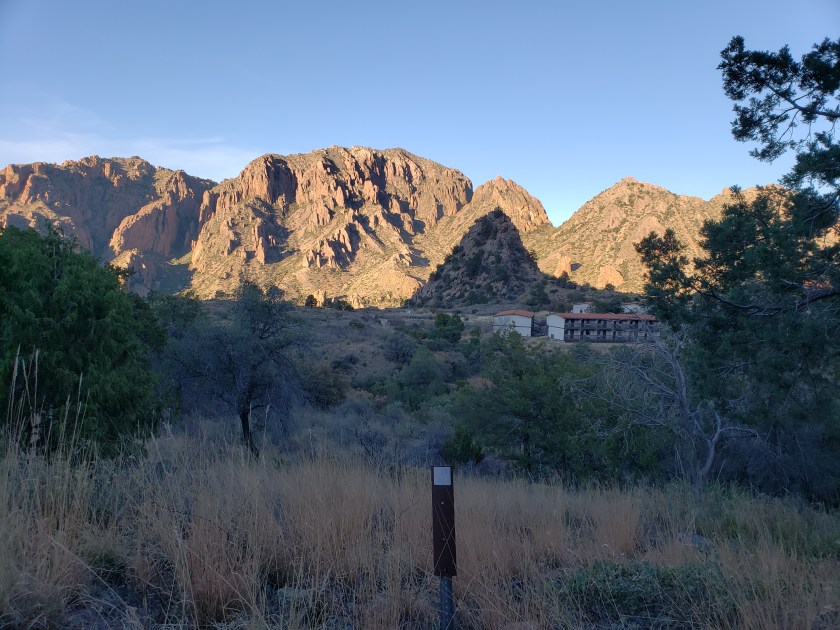
“Casa Grande” rock formation towering over Chisos Mountains Lodge, viewed from the Chisos Basin Loop Trail with Cottage 103 center
For my first ever and long-awaited visit to Big Bend National Park, I wanted to stay in one of the five “Roosevelt Stone Cottages” belonging to Chisos Mountains Lodge, the only (non-camping) lodging within the park. While the Lodge has hotel- and motel-style rooms, the Roosevelt Stone Cottages are the most popular and book up “almost a year in advance” per the Lodge web site. I found this to be the case. Although some of the cottages were booked when I did a search last January, I was able to get one of my top picks, #101 by booking last January 19, one year and a few days before our arrival. Still, even with that lengthy pre-booking, we weren’t guaranteed the cottage of our choice since the Lodge reserves the right to change (should there be a maintenance problem, etc.). Upon check-in, I was happy to find we would in fact have the cottage I’d booked.
The cottages come equipped with three double beds, a private bathroom with a shower only, a small desk and a modest dining table, way more than David and I needed for the two of us, but what the heck. We planned to do this stay right and that meant a cottage. The cottage turned out to be spacious and charming, if not fancy, with stone floors, beamed ceiling, and an effective electric heater where a fireplace used to be. Two double beds occupied the main room and the third sits off in a separate, open side area. The cottage is equipped with a small refrigerator, coffee maker and microwave. There’s also a closet that was so cold it made a great wine cellar. Old photos of the park added a charming touch.
Cottage 101
We were a little concerned when we first drove up to our cottage (clustered around a circular parking area with 2 of the other 3 individual cottages and 2 duplex-style cottages). Not only did our cottage not have a “private driveway” as I was told by the man who checked me in (probably in mistaken reference to cottage 100 which sits apart from the other cottages, closer to the motel area and actually isn’t offered for rent on the lodge web site), but there was only one parking space left. The space was thankfully right by our cottage, but on the opposite side from the stone sidewalk by which we would have normally approached. Oh well, we carried our luggage and ice chests the short distance and set them on our porch. No problem. Happily, it turned out that all the cars belonged to hikers who’d decided to enter the (7) trails from the spot near cottage 103 and they all cleared out shortly before dark. It was Sunday of a long weekend and we never saw that many cars again.
Speaking of cottage 103, that one is definitely the rock star/most-sought-after cottage at Chisos Mountains Lodge and it’s easy to see why. The cottage is identical inside to 101 (ours) and 102 but it faces the iconic “Window” and has a wide, covered porch (as does 102, which has a view of the Window from a yard area to the side of the cottage). See lead photo to this post. The only slight downside to 103 I could see was that a trailhead giving access to seven trails is just beside it and people like to start hikes there and to perch on a large boulder just by the porch of 103 to enjoy the view and take photos.
Our cottage 101 sits a bit apart from 102 and 103 and faces the far side of the canyon with a couple of the motel buildings in site. It has a smaller uncovered porch which actually turned out to be a bonus for us as we could set up our telescope on the porch and watch the full lunar eclipse over the “Casa Grande” rock formation that dominates Chisos Mountains Lodge.
Uncovered porch on Cottage 101
View from the “front yard” of Cottage 101 with motel portions of Chisos Mountains Lodge visible in the distance
Chisos Mountains Lodge has one restaurant just beyond the gift shop and registration area. The restaurant offers great views of the Window and opens onto a large terrace. Food turned out to be surprisingly good and not unreasonably priced considering the location. There’s an attached bar with television that played non-stop football while we were there. There’s also a convenience store not far away among the motel buildings.
View of “the Window” from our dining table at Chisos Mountains Lodge restaurant
Our cottage turned out to be just what we wanted: comfortable beds, lots of hot water (although the shower head is mounted laughably low), very quiet at night. The location, nestled into the Chisos Mountains Basin, is spectacular. There’s no wi-fi in the cottages or other rooms, although Comcast wireless worked for me as a domestic roaming option on my T-Mobile-serviced Samsung Galaxy S9+ Android phone. Service wasn’t very fast and couldn’t load some things, but it was good enough for email, texts, map searches, etc. David’s S7 (also on T-Mobile) could not connect. That may have be a function of the phone or settings (although roaming was on), but we didn’t care enough to worry about it. We weren’t in Big Bend National Park to stare at our phones. There is wi-fi in the lobby/gift shop/restaurant area, but it was iffy. Again, Internet access wasn’t a big deal for us and we had a great stay.
Heading to Big Bend National Park from Davis Mountains State Park, we made sure to make time for a stop-off in Terlingua, a former mining town known primarily for its eponymous chili cook-off (actually two cook-offs these days which take place on the first weekend in November). I’d heard about the Terlingua chili cook-off for decades and am the proud owner of a cookbook of championship recipes from the original event. The chili cook-offs draw upwards of 10,000 people to a tent- and camper-filled party in the desert. According to the town’s event calendar, Terlingua has also instituted a couple of lesser cook-offs including one for black-eyed peas and another for dutch ovens. Barring cook-offs, Terlingua is a desolate little town. I didn’t expect much, and a cook-off-less Terlingua turned out to be less than that. Oh well, all travel destinations are not created equal. If you’ve got the time, the turnoff to the Terlingua “Ghost Town” is about 5 miles west of Hwy 118 just north of a main entrance to Big Bend National Park. If you don’t have the time, no worries.
Terlingua has developed a sort of funky, artsy reputation, but it is mostly a motley collection of ramshackle buildings; an old cemetery full of broken crosses and beer bottles; mobile homes, cheesy teepees, and the like serving as tourist accommodations; and a few small businesses and eateries scattered across a rocky desert.
We made a quick swing through the one main store (not remotely tempted to buy souvenirs), peeked in the ramshackle old jail and walked across the parking lot to view ruins of early settler buildings that constitute the “ghost town,” all of which took 20 minutes or so. The Starlight Theater, a well-known spot recommended to us was closed at lunch time, so we headed to nearby guesthouse La Posada Milagro for lunch. We ate outside on their porch, enjoying the view of the mountains of Big Bend in the distance despite the unsightly clutter of Terlingua. My chicken quesadilla was actually very good and my husband liked his big chicken salad sandwich, too. The service was friendly and we were welcome to provide our own beer.
Post lunch, we made a short trip through the dirt roads of the town towards AirBnB teepees in search of clear inflatable domes that serve as rental rooms offering views of the starry skies abounding in this remote part of the world. (My cousin had sent me an article about these new additions to Terlingua, and we were mildly curious.) We found the turn-off to the domes which sit just over a small rise from the teepees with a sign asking us to go no further if we weren’t guests. Oh well, the search was nothing but a lark anyway.
Terlingua Cemetery
Our last stop in Terlingua was the cemetery, as ramshackle as the rest of the town, but interesting nonetheless. Most graves are marked by rough board crosses although some are more elaborate and the cemetery is still in use. Typical Mexican skeleton-themed candles and trinkets decorated many graves along with flowers, beads, beer bottles and other mementoes.
All in all, I’m glad we stopped off in Terlingua just so I could see it for myself since it was such a short detour on our way to Big Bend National Park, but I can’t think of a reason to go back.
Located in the Davis Mountains near Fort Davis, Texas, the McDonald Observatory is a research and education facility of the University of Texas. The observatory offers “Star Parties” to the public Tuesdays, Fridays and Saturdays throughout the year which are bookable online for a reasonable fee. While the observatory web site states that Star Parties often fill up months in advance, the permissible group size is large and I found 100+ spots still available several days before our Friday night reservation. Our January 17 date no doubt had something to do with the lighter crowd, but we chose the time of year deliberately to avoid crowds…and the sweltering peak-season temperatures in our ultimate destination, Big Bend National Park.
We were excited at weather forecasts predicting clear skies for the night of our Star Party, but that excitement turned to concern a couple days prior when we woke to find the forecast suddenly calling for high winds up to 45 mph. Yikes! Not what we had in mind, especially on a cold mountaintop at night. I immediately called the observatory and was able to change our reservations to Saturday night. It turned out to be a good thing that I called so quickly: Despite all those vacancies showing earlier, a sign on the door as we entered the visitor center Saturday night stated that the party was now fully booked. I talked to fellow Indian Lodge guests later who had been turned away.
With the restaurant at Indian Lodge closed, we decided to eat at the StarDate Café at the Observatory. As recommended in the email confirming our booking, we arrived an hour early since we wanted to eat before the Star Party. It’s a good thing we did, too. We snagged the last table and were able to get our dinner order in just before the line grew long and wait time jumped to 30, then 40 minutes. The café stays open for the first hour of the party, so guests arriving after us could come back to the café to eat during the party, but we were happy to eat and be done with it ahead of time. I slipped into the ladies’ room while we waited to pull on a pair of silk long underwear, an extra layer I was glad to have later as temperatures plunged outside. (I’d been worried it would be overheated in the cafe, but it was actually pretty chilly inside when we arrived.) The café opens to a large terrace with views of the observatory domes and quite a few tables that would probably be great in the summer or a mild winter day, but were out of the question for dining on a January night.
Right at 7pm, observatory staff announced the beginning of the Star Party and we were instructed to go outside to an open amphitheater for an orientation lecture.
Pre-viewing introduction at the outdoor amphitheater. Those stone benches are cold!
The initial lecture was brief after which we were invited to either go straight to the ten telescopes set up in the viewing park or remain for a more detailed lecture on constellations. We sat in the back to get ahead of the exiting mob and opted to go straight to the telescopes. We were glad we did. The speaker advised us that the domes which house the largest telescopes are particularly popular, so we headed to those first before more people arrived. We quickly made our way through all ten scopes, moving on if a line was long. There are telescopes of all sizes and shapes. We were there the night before a full moon, which reduced the visibility of the stars and constellations so more than one telescope was focused on the moon, the most powerful taking in just a portion of the moon and bringing its craters and peaks into sharp view. Another telescope that took in the entire moon was so bright that I had a dark after-image in one eye for at least ten minutes! Other telescopes were focused on the brightest stars since others were drowned out by the brilliant light of the moon. Still, it was cool to see things like the cloudy nebula in the sword of Orion and a pair of bi-colored twin stars. Overall star viewing was a little disappointing because of the extremely bright moon, but it was still fun and we had a full lunar eclipse to look forward to the next night in Big Bend National Park, so it was hard to complain. We were just finishing up at the last telescope when the lecture let out and a big crowd streamed into the viewing area and we realized we had had no idea what a long line was. I counted several lines that had quickly ballooned from 5 or so people to 22 or more.
Using one of the more unusual telescopes in the viewing park
The visitors center remains open during the Star Party so people can warm up, get refreshments, etc. A short film runs in a loop the entire time, there’s a gift shop, toilets and a child-friendly small museum.
________________________
Practical info:
Cold is a real issue at the McDonald Observatory as temperatures at the observatory elevations (6300-6800 ft) can be much colder than below and the approximately 2-hour Star Parties take place mostly outside. Wear layers, hats and gloves, and the observatory encourages viewers to bring blankets which can be left in cars and retrieved if needed. Blankets or long coats are extra nice for sitting on the cold stone benches in the amphitheater. The Star Parties take place at the Rebecca Gale Telescope Park at the observatory and do not use the research telescopes higher up the mountain. Those telescopes are available on “special viewing nights” scheduled periodically throughout the year.
Prices for Star Parties are $12/adult; $10/military, 65+, and UT staff and students ; $$8/child 6-12; and, free for children under 6. Make reservations online for Star Parties, Twilight Programs, Day passes, Solar Viewings and special events.
The StarDate Café is located on site and serves sandwiches, quesadillas, tacos, snacks and drinks. The observatory recommends Star Party guests arrive an hour early if planning to eating there since crowds can be large.
Indian Lodge in Davis Mountains State Park; the original adobe received a gleaming coat of white paint in last summer’s remodel.
Deciding where to stay during our much-anticipated McDonald Observatory “Star Party” came down to a historic hotel in downtown Fort Davis or Indian Lodge in Davis Mountains State Park. Highly recommended by friends, closer to the observatory, located within the state park where we wanted to hike, and newly refurbished as of summer 2018, we opted for Indian Lodge.
Built to look like a multi-level pueblo village, Indian Lodge opened to the public in 1939. The lodge boasts a big two-fireplace den/game room, a lovely pool and a restaurant with hit-and-miss opening hours. Our room on the upper level had windows on two sides and a now-blocked adobe fireplace in one corner. The ceiling consisted of large beams and twigs. Just what I had in mind!
Indian Lodge guests are welcome to build or stoke a fire in the “den” and make use of the games and tables.
Our first afternoon, we used the trailhead at the end of the parking area nearest our room to access the Indian Lodge Trail. The 1.5 hour hike along the ridge offers sweeping views back down to the valley where the lodge sits on one side and far beyond on the other side to where we could see the mountaintop observatory domes in the distance. High winds up to 45mph whipped across the unprotected ridge. We’d been scheduled for a “Star Party” at the observatory that night, but managed to change it to the following night to avoid the windy weather passing through. We returned to the road leading to the lodge via the Montezuma Quail Trail. The Texas Parks & Wildlife Department provides excellent trail maps with photos. The lodge restaurant was closed that night so we drove into nearby Fort Davis for Mexican food at Cueva de Leon, a casual spot that’s been in business for decades and was on a list provided by the lodge. The place is nothing fancy (in keeping with the rest of Fort Davis), but solid and traditional. It’s BYOB and we picked up a 6-pack of craft beer at the small shop across the street. The food brought back memories of similar restaurants of my childhood.
On the advice of the super-friendly lodge staff, we drove up to begin a hike on part of the Skyline Scenic Trail at the top rather than hike up along the switchback road. Views from vehicle-accessible lookouts are nice as was the hike, but it is very close to the road.
Indian Lodge boasts a nice pool…but it was way too cold in January for us to try it out.
Back at the lodge, we made use of iron tables and chairs on a terrace we shared with two other rooms for lunch-with-a-view before heading off to spend the afternoon in the town of Alpine (a 35 minute drive from Indian Lodge). We enjoyed leisurely following a brochure-guided walking tour of the historic town, stopping near the end for a spelt chocolate chip cookie break at a clearly-popular Taste and See Bakery.
Nighttime was reserved for the McDonald Observatory Star Party that I’ll write up in my next post.
____________________________
Practical info:
Reservations are available at Indian Lodge via the Texas Parks & Wildlife web site. Book well in advance, especially for holidays. Free wi-fi is available in the den and lobby area, but did not reach to our room (or any of the other rooms that we heard of). We did not have cell phone reception in the lodge (which sits in a valley) although staff cheerfully offered me use of their land line to follow up on a missing credit card. We did get enough signal for texts and some emails (and so probably calls as well, although we didn’t try) on high points of our hikes. There is a coffee maker in the room, but no fridge or microwave. Staff let us use the full-size fridge in the dining area for food we’d brought in ice chests. Our 1-queen bed room cost $259.60 for two nights ($230 + $29.90 tax). Camping sites are also available to reserve.
Trails in the park are well-marked and fun to hike although the ones within walking distance of the lodge and camp sites are not super extensive. There’s a 75-mile scenic loop for driving that has other trails along the way. A bear was spotted on one of these the week before we arrived. We saw small birds and hawks, but no large animals on our hikes, although there are bear, mountain lions, javelina and deer.
The elegant lobby of Hotel Settles in Big Spring, Texas
I’m super excited about our upcoming week-long Texas roadtrip. As a native Texan with roots going back to the days when Texas was an independent republic, it’s high time I got myself to one of the state’s most iconic, unique and remote treasures, Big Bend National Park. I reserved one of the park’s coveted Chisos Mountains Lodge cottages a year ago and crossed my fingers that the weather would cooperate when the allotted time rolled around. A government shutdown didn’t even cross my mind back then. Fortunately, although Big Bend is a national park, the park is open, if unstaffed, and the Lodge is run by a private concessionaire, so we’re still a go. On our journey, we’ll also take in other Texas classics including a “Star Party” at the McDonald Observatory in the Davis Mountains, a stay in the “James Dean” room at the Paisano Hotel in Marfa and lots more.
Driving straight to Big Bend would take us about nine hours from the Dallas-Fort Worth metroplex, and what fun is that? I wanted to break up the trip, but a first glance at the map showed the Midland-Odessa area to be a likely spot and those light-on-charm oil towns did not exactly inspire. When a little research showed outrageous prices for low-end chain hotel/motels in the area, I looked for alternatives and was thrilled to discover the historic Hotel Settles in nearby Big Spring. The photos looked charming and surprisingly posh and the price was great in comparison to the Midland-Odessa options. We had our first stop!
Big Spring boasts many remnants of the past, like these old gas pumps (with Hotel Settles in the background), in varying states of repair/decripitude.
The 15-story, 150-room Hotel Settles opened on October 1, 1930. The hotel was built by Will R. and Lillian Settles, following the discovery of oil on their ranch. At the time, it was the tallest building between El Paso and Ft. Worth. The Settles only owned the hotel for two years, being forced to sell it when the Great Depression hit and their oil profits fell.
The following years saw a succession of owners. The hotel’s restaurant, the Settles Grill, boasts of famous guests during that time including Elvis Presley, Lawrence Welk, and President Herbert Hoover, as well as Jerry Allison, a Big Spring native and drummer for Buddy Holly and The Crickets.
Although the Settles Grill looked good, the menu at nearby Lumbre appealed more to our personal tastes and we enjoyed a truly excellent meal there: seared tuna steak on lightly sauteed veggies for me and skewers of 8 big, bacon-wrapped shrimp and fish tacos for David.
Big Spring suffered heavy loss of businesses during the oil bust of the late 70’s and the hotel closed its doors in 1982. Over the next decades, the property fell into a derelict state until the local community began a preservation effort. A native of Big Spring bought the hotel in 2006 and invested $30 million in its historically-minded renovation. The original Grand Ballroom was fully refurbished and other rooms restored and given names honoring their regional history. Fascinating photographs throughout the hotel show pictures from Big Spring’s cattle ranching, railroad, and oil boom years as well document the amazing restoration of the hotel. The only negative to this comeback story we heard was from some locals we met at quirky Desert Flower Art Bar (a cool venue offering some of the only craft beer in town along with Texas basics like Shiner beer plus a selection of wine and liquor): Apparently, the Hotel Settles owner (a Fort Worth neighbor of Ross Perot) used no local labor in remodeling the hotel. Very disappointing to hear!
Buildings in Big Spring are a mixed bag
Wandering around town, we found an interesting mix of buildings from the early 1900’s (and a few from the late 1800’s) in various states, many clearly abandoned and in ill-repair, others renovated or in the process of being so. Money has obviously been spent recently in some restoration and Big Springs reminds me somewhat of a Fredricksburg wannabe, a town in decline trying to reinvent itself as a tourist destination. With charming old buildings, an infusion of new bars and restaurants, Big Spring State Park and nearby Midland-Odessa oil business, Big Spring has assets to work with.
Practical stuff:
I booked Hotel Settles seven weeks prior via an Expedia flash sale which got us a 1-queen bed room for $109.95 ($97.30 plus taxes & fees of $12.65). A quick check of Expedia a few days prior showed all 1-queen bed rooms sold out and the cheapest remaining room (a 2-queen bed room) offered at $254+$33.02 tax & fees=$287.02! A few moments after that Expedia search, the Hotel Settles web site showed only an “historic suite with parlor” available for $224.00 + $29.12 taxes & services= $253.12. When I checked in, the lady at the front desk was on the phone quoting similar prices to someone who understandably declined to book. It pays to plan ahead and keep an eye out for sales!
Our room is charmingly redone with excellent bedding and the old bathroom “chicken wire” and subway tile restored. The space is on the small side, typical of this era hotel, but well appointed with Keurig coffee maker, plenty of outlets, flat screen tv and a/c. My only quibble would be with the a/c rumbling to life and blowing on the bed during the night, but that’s a problem I find with lots of hotels. There was fairly loud music going on downstairs last night in the Pharmacy Bar, but we could hear nothing upstairs. Electronic keys are required for the elevators, and rooms feel very private and secure.
I recently sent the following to a family member. I can’t count how many times I’ve forwarded this to friends and family and it occurred to me (finally) that I ought to just post it on Wanderwiles. Et, voilà!:
Basilica of Sacré-Coeur
A MONTMARTRE WALK
I always tell people that Montmartre is worth a visit and makes a great walk. A lot of people skip Montmartre because it’s more down-scale and crowded and has some steep walks, but it does have some of the best views and most classically Parisian locales and can be done mostly downhill if you follow the route I’ll set out. It’s not unsafe (I have a friend who owned a jewelry store there and loved the area), picturesque (beyond a certain grunginess) and charming in its own way. There is a large immigrant population in Montmartre, it’s the bustling fabric district of Paris, and it’s full of tourists and a fair amount of party-minded types in addition to merchants and the like, so expect bustling activity, noise and a colorful international vibe going in. Here’s my favorite route:
Start at Métro Stop Anvers (line 2)and head uphill along rue Steinkerque (to your right as you’re exiting the Métro). [It’s usually crowded, so as always in crowds, be aware of your surroundings–purse across the shoulder, valuables in inside pockets, etc. I’ve never had a problem, but it’s always best to be city-smart.] You’ll pass lots of fabric and tourist shops and see the white basilica of Sacré-Coeur on the hill ahead. Enjoy the view of the church from the base of the hill. You can walk up or skip the steep hike and head to your left (as you’re facing Sacré-Coeur, as in the photo above) where you’ll come to the funiculaire de Montmartre. If you’ve got Métro tickets or passes, they work there, or buy a ticket at the stand. Ride to the top and take in the spectacular view of the city. (You can’t, however, see the Eiffel Tower from the steps. You’ll get to see it soon, though.) Take a look at the interior of the basilica with its beautiful mosaic of Christ with his sacred heart ablaze in gold on the ceiling. You can visit the crypt and climb the dome. When you come out of the basilica, head to your right along the sidewalk to the left of the road. About halfway down that road, you’ll see the Eiffel Tower in the distance.
View of Paris and the Eiffel Tower en route to place du Tetres from the Basilica of Sacré-Coeur
The road T’s in about a block. Go right a short distance uphill and you will come to the famous Place du Tertres on your left where artists are set up in a square surrounded by cafés.
Place du Tertres
After wandering the square, head downhill along the road you came into the square on (rue Norvins). (If you like Dalí, you can head left a very short way down rue Poulbot and then take another left. The Dalí Museum will be there on your left. Or take a detour to your right on rue des Saules and another right on rue Cortot to visit the small Musée de Montmartre and view Le Clos Montmartre, the last working vineyard in Paris.) From rue Norvins as you leave place du Tertres, head left downhill where rue Norvins branches and you’ll come to rue Lepic on your left. Wander downhill on rue Lepic where you’ll see a restaurant in a (modern recreation) windmill; further downhill to your right on a hill, you’ll see the last original windmill in Paris, the Moulin de la Gallette which was painted by Lautrec, Renoir, Picasso and Van Gogh (who lived with his brother on rue Lepic for a time). Just opposite this windmill, head downhill on steep, narrow rue Tholoze. At the bottom turn right, then immediately left. This will take you through the heart of the old rue Lepic street market. (Rue Lepic makes a big “U” which rue Tholoze bisects so you just pick back up on rue Lepic here.) The well-known Lux Bar is about halfway down on your left. At the bottom, you’ll come to blvd Clichy and Place Blanche. Métro Blanche (line 2 again) is in the center of the boulevard. Take time to look to your right where you’ll see the Moulin Rouge. If you cross to the Métro entrance and look back, you can snap a good picture of it or cross to the median for a straight-on shot.
Moulin Rouge viewed from the entrance to Métro Blanche
I usually just hop the Métro here, as I’m a big fan of Paris’ public transportation.
One of the many great opportunities afforded us while cat and housesitting in Edmonds, Washington, is the chance to observe the local marine life. Taking it a step further, Edmonds also hosts the only whale watching boat service in the Seattle area that runs through December, Puget Sound Express. Being whale enthusiasts, we made an outing with Puget Sound Express a top priority when we arrived for our 5-week housesit in Edmonds. With the luxury of being able to walk to the marina where PSE’s two whale watching boats moor, we watched the weather forecast and booked the first sunny, calm day. We chose a weekday hoping for a smaller crowd and had no problem booking a couple of days before, probably because mid-October is off-season.
Whale watching is always a matter of chance, but we really lucked out: Within 10 minutes of pulling out of the marina, we sighted the first humpbacks in the Sound between Whidbey Island and the Kitsap Peninsula. The highlight of the day, though, came when our captain pulled us up to wait facing a huge flock of seagulls feeding on the surface. We could see at least 2 humpbacks heading for the flock and the naturalist aboard told us the whales were coming to feed. The first that arrived, swam under our boat then swam upward into the flock to “lunge feed” just in front of us, its huge head out of the water, jaws closing on food. Seagulls scattered an swirled in every direction. Spectacular! I’ve gone whale watching before, but this was a nature documentary moment.
After that, we sped out to the Salish Sea, spotting sea lions on channel markers along the way and the occasional harbor seal. In the Salish, we spotted two pods of orcas hunting and socializing. We snapped photos of them with Mt. Baker providing a picture-perfect backdrop against a blue sky. What a day!
Orcas in the Salish Sea with Mt. Baker in the background
Although we could have ordered sandwiches, chips and a drink from Red Twig, a cute eatery a couple of blocks from our condo in Edmonds for $15 apiece, we packed our own sandwiches. (The strange and very handy hardware/grocery/deli hybrid Ace Hardware store on the corner of 5th Ave. and Walnut St. in Edmonds makes great sandwiches for half the price. They’re enormous, too. Half a sandwich is more than ample for me.) We were glad we brought our own when we saw the sandwiches provided: On generic sandwich bread, not what we’d expect from Red Twig. One lady we talked to was very disappointed. For $5.50, you can buy a ceramic “bottomless” mug offering refills from the galley of coffee, tea or hot chocolate. – Heavenly, after getting chilled standing outside watching whales. The ride in the speedy Chillkat (40mph+!) was surprisingly smooth and I was never in any danger of spilling a drop.
All in all, we were really impressed with Puget Sound Express, its boat, naturalist, captain, everything. The price is $135/adult and $85/child for a 4-hour whale watching excursion. The only glitch came pre-trip with some confusion over the meeting place as Puget Sound Express Whale Watching has two boats, the Puget Sound Express and the smaller (and faster?) Chillkat. We arrived early and waited by the Express behind Anthony’s where an email told us to go, but finally had to call when no one showed up. It turned out we were supposed to be further down at Dock D for the Chillkat. The lady on the phone was not clear on where we should be either and kept trying to send us in the opposite direction, but we finally found the right spot and boarded. (Someone told us the Chillkat is the boat they takeout on weekdays; no idea if that’s accurate.) We pulled out right at 9:32am and were back at 2pm. To book the tour we took on the Puget Sound Express website, click “Tours” in the drop-down menu at the top then “Guaranteed Whale Watching Tours,” then “Seattle Whale Watching Tours.” The guarantee is that you’ll get to go again if no whales are spotted, a good offer for visitors who can make use of it. PSE also offers tours out of Port Townsend on the Kitsap Peninsula as well as multi-day and bird watching tours.
Downtown Edmonds in the Bowl: corner of 5th Avenue and Main Street
As I mentioned in my last post, we’re spending five weeks cat and housesitting in Edmonds, Washington, a beautiful little town on Puget Sound just north of Seattle. Since our arrival in Seattle in late September, we’ve been blessed with one of the most spectacular autumns imaginable. The trees are on fire in shades ranging from bright yellow to deep burgundy and the skies have been unseasonably clear. We’ve been told Edmonds can get crowded in the summer–and no wonder, it’s got lots to offer in the way of charm, but it’s been delightfully crowd-free during our stay save for a blow-out, family-friendly Halloween street party.
The condo we’re in is in a lovely, well-secured building, although it’s hard to imagine needing security in this picture-perfect slice of Americana. The building opens onto one of the two main streets in “the Bowl” of Edmonds that dips down to the waterfront. Tree-lined, with a fountain in the middle of the intersection, pretty old-style buildings, this part of Edmonds reminds us of some idealized Mayberry. We’ve spent our days exploring the many boutiques, restaurants and coffee shops lining the blocks around us and walking to the water where we like to plant ourselves on a long, L-shaped concrete pier to watch the ubiquitous fishermen and people crabbing off the pier and the ferries shuttling between Edmonds and Kingston on the Kitsap Peninsula. We take binoculars to scan the water for harbor seals, waterfowl and a bald eagle that has staked out a perch atop the mast of a particular sailboat in the yacht club marina, sometimes with a fish fresh-plucked from the Sound. Yesterday, we joined a small group at the end of the pier watching orcas swimming across the Sound, some so close to the ferry leaving Kingston that it was stopped for a while to let the orcas pass. I saw these magnificent sea mammals breach four times, leaping out of the water to fall back with a huge splash. What an unexpected treat! (See why we’re never without binoculars around here?) The Olympic Mountains provide the purple-blue backdrop to the peninsula and Mt. Baker looms off to the right up the coast. Gorgeous!
Salmon wind vane art on the jetty by the main pier with Mt. Baker in the distance
Edmonds hosts all sorts of events throughout the year. There’s a free monthly art walk every third Thursday, 5-8pm with local artists displaying their works in various shops and cafes. We just missed an annual writers’ conference the first weekend in October that I would have loved to have attended. The Halloween bash I mentioned was tons of fun with over-the-top costumes on children and adults and music playing on the main circle. Nearly every establishment on the two closed-off streets handed out candy. The local theater had a free “haunted theater” and distributed bags of popcorn afterwards. The bakery handed out donut holes. A local church offered free coffee and hot chocolate. The local history museum hosted a for-pay haunted house. There’s a holiday market scheduled to open and more throughout the year. Find a calendar of events on the Visit Edmonds website.
In addition to all the above, the Edmonds beer scene is pretty impressive for such a small town. There are two local breweries, Salish Sea Brewing Company (downtown and offering food as well) and American Brewing Company (a taproom), Brigid’s a great bottle shop offering local craft beer, and Gallaghers’ Where-U-Brew, a spot where you can brew your own beer or sample the house brews. I’ll see if I can’t get David to do a post on those soon. A local husband and wife own a craft spirits distillery by Brigid’s called Scratch Distillery that offers tastings and workshops where you can blend and take home custom spirits. Gin is their thing, but they’ve branched into vodka and whiskey as well.
Sunset view from Anthony’s Homeport in Edmonds
We haven’t found a bad restaurant in town, but can particularly recommend classic Anthony’s Homeport which faces the yacht marina and gets a great view of sunset over Puget Sound. We hesitated to try Mexican restaurant Las Brisas because we get plenty of that in Texas…but we don’t get halibut ceviche or halibut fajitas. Awesome! For cocktails, it’s hard to beat tiny, Paris-inspired Daphne’s. A single bartender mixes classic drinks while maintaining a constant banter with patrons perched around the bar, the only seating save for two small tables. Daphne’s seems to host a never-ending party. We hear chatter and laughter from Daphne’s whenever we walk by, day or night. Although we’d stuck our heads in a couple of times, we didn’t give it a try until last night. I loved the sidecar, a 1918 Ritz Hotel in Paris concoction of brandy, Cointreau, lemon juice and a twist. David opted for a “corpse reviver” from the Savoy Cocktail Handbook circa 1930: Gin, Cointreau, Lillet Blanc, absinthe, lemon juice and a cherry. Delish!
There’s an extensive scuba diving park just off Bracket’s Landing Park beach by the ferry dock offering walk-in dives. There is also an excellent whale watching company, Puget Sound Express, that offers year-round boat excursions. We had an incredible day with them watching humpbacks (including a nature-documentary-worthy lunge feeding episode) just 10 minutes out into the Sound and orcas in the Salish Sea. I’ll post about that separately.
Oh yeah, travel guru Rick Steves calls Edmonds home, too. His headquarters is on 4th Avenue North where visitors can book tours, borrow travel books, view videos and do a little shopping for travel gear. He’s a popular native son, philanthropist and vocal proponent of legalizing marijuana.
Our sole criticism of Edmonds is the noise. Between trains, the ferries, seaplanes, trash and recycling pick-up, and amazingly frequent lawn care involving leaf blowers and hedge trimmers, this town needs to do something about the noise pollution. It’s really out-of-keeping with the clear care taken to keep the town immaculate and inviting. Nevertheless, Edmonds is more than worth a visit if you’re in the area and an easy drive from Seattle. It’s also a good base to visit the Kitsap Peninsula by ferry, take Boeing’s impressive Future of Flight tour in nearby Everett, take the ferry from Mukilteo to Whidbey Island, and many other local attractions. There’s only one hotel in the Bowl, the Best Western Edmonds Harbor Inn, and a few AirBnB apartments, but the Bowl is undoubtedly the charming heart of Edmonds.
It’s been a while since I posted about pet and housesitting, but we’ve done quite a few since then (many repeats to much-loved Antwerp, Belgium) and we’re back at it, in Washington State this time. After spending two weeks in the Leschi/Mt. Baker area of Seattle proper caring for a sweet old Australian shepherd mix, we’re now weeks into a five-week cat-sitting stay in Edmonds, a charming waterfront community about 30 minutes north of downtown Seattle. We’re still trying to decide on where to settle long-term and Seattle and environs is an area we wanted to check out. It’s been a great stay and, as always, housesitting provides so much more insight into what day-to-day life in a place is like than some short vacation in a hotel or AirBnB.
We chose the Edmonds cat- and housesit many months beforehand, then decided more last-minute to do the earlier two-week dog- and housesit in nearby Seattle when David came across the posting on Trustedhousesitters.com and realized that their stay ended on the day we were scheduled to start in Edmonds. We figured, “Why not do both?” The contrast in neighborhoods has been really interesting and worthwhile. Both homes are very nice, our current stay being in a lovely and spacious condo in the heart of Edmonds with balcony, views of Puget Sound, gas fireplace, and radiant floors. The pets are sweet and add that extra home-like feel we love.
On the down side, we faced our first pet health issue rising to the level of needing a veterinarian visit with the Australian shepherd mix, Rowan, in Seattle. Although old, deaf and on medication for congestive heart failure, she’d been spry, eager for her walks, and my constant shadow in the condo. Out of the blue one night, her jaw started spasming making her teeth clack uncontrollably and really giving us a scare. We sat on the floor with her, stroking her head until it stopped, afraid she was having a seizure. WhatsApp messaging with her owners in Portugal was reassuring; apparently she’d had the same symptom some years ago and it was related to pain from an infected tooth. She had a history of tooth problems and was scheduled for a cleaning and check up the next week when her owners returned. They asked us to just keep an eye on her and let them know if there was a recurrence. Unfortunately, Rowan’s jaw began to swell the next evening and was so much worse the following morning that one eye was nearly swollen shut, red and weeping. This sweet dog didn’t complain, just laid her head in my lap, showing total faith that we’d make things better. Messaging with the owners confirmed their agreement that we needed to get Rowan to the vet. We were up early and ready to go by 8am Saturday when the vet office opened. I was able to get Rowan an appointment on an emergency basis, but not until 11am. When Rowan began to drool blood, we headed out early, deciding we’d rather wait in the vet’s office should she have some sort of crisis. Thankfully, we’d just rented a car so we could transport her, since the Seattle neighborhood we were staying in was not particularly pedestrian friendly. This is when it can be hard being a pet-sitter. You just have to do what you’d want done for your own pet and hope all goes well. It helped that we were on the same page with the owners and they were just worried about Rowan and sympathetic to our position. Agreeing that it was probably a tooth/gum infection, the vet put Rowan on strong antibiotics and pain-killers urging me to call immediately if she had any diarrhea or vomiting… So, of course, as soon as we were back home, David was in the shower, and I took Rowan to the park, she had watery diarrhea. We had about 30 minutes before the vet closed for the weekend and the last thing we wanted was to have to put a sick dog back in our brand new rent car and haul her to some unknown–and unfamiliar with her– vet-in-a-box, so we left her home, dashed back to her vet, picked up more medicine…and all worked out in the end.
I relate this story just to remind everyone interested in pet-sitting that there is the potential for crises, big and small, and you need to be prepared. We love pet- and house-sitting and we’ve had wonderful experiences and met terrific people and animals, but the benefits come with real responsibilities. With older animals, there’s always that nagging feeling in the back of my mind that everyone has to go sometime, but please, please, sweet dog or cat, not while we’re taking care of you!
Speaking of older animals, the two cats we’re now tending in Edmonds are brothers, 17 years old. They’re loveable, arthritic old boys whose mom has them on an interesting Washington-state-sort of regimen of hemp oil “pot drops” and joint medicine masked by dollops of souffle-style cat food. They also have a steady cloud of pheromone “happy gas” emanating from a wall plug-in. It made us smile, but whatever the owner wants (and is legal, of course) is fine by us. The pets we tend are bound to miss their people, so we try to minimize the stress by giving them lots of affection and keeping them as close to their usual routine as possible.
Movie time with one of our cat charges in Edmonds
Edmonds has turned out to be a fantastic place to housesit. It sort of reminds me of a New Englandy, Pacific-Northwest Carmel. It’s quaint and picturesque with a beautiful seafront, a ferry landing, yacht club, lots of good restaurants, coffee shops and boutiques within steps of our housesit … and an old, one-screen theater that’s actually still in business! I’ll do a separate post on this charming town later.
I’m still very happy with Trustedhousesitters.com and arranged both of the above Washington stays through them. The site is well thought out, easy-to-use, security conscious and gets lots of traffic. If you use the above link, you’ll get a 20% discount and I’ll get a couple free months, so thanks to anyone who does. Learn more about the basics of pet and housesitting and other sites we’ve tried in my earlier post Pet and Housesitting: See the world like a local. While we intend to stay with Trustedhousesitters, I’ve come across a couple of other sites that are cheaper and may be worth a look. I haven’t tried them yet and can’t vouch for them personally, but for anyone who wants to economize a little more or just explore other options, you can check out MindMyHouse.com and Housesittersamerica.com.
A final note for owners looking for pet- and housesitters: While competition can be fierce for housesits in popular locations and nice homes, you do need to sell it a bit if you want to get the best responses. Photos of your pets are essential, but so are photos of where the sitter(s) will stay. Tidy up, if necessary, and at the very least post photos of the bedroom where your sitters will sleep, the bathroom they’ll use and your kitchen. Shots of the living area(s) and any view, yard, etc. are good, too. Without this basic information, we’ll assume the worst about the house and move on and so will most of the sitters you’d most want taking care of your home and pets.
We’re just back from a short 4-night cruise, the highlight and point of which for us was to finally visit Havana, Cuba. We actually booked the same Norwegian Cruise Line (NCL) cruise last summer, trying to beat the new Trump-imposed regulations on travel to Cuba, but were thwarted when Hurricane Irma canceled the cruise. This time, all went beautifully and we found our day in Havana to be fascinating and the travel easy and hassle-free. [Note: Find more practical info and links at the bottom of this post.]
I had lots of questions and some concerns about the new regulations, pre-trip, and learned a lot by researching online. Still, I had questions to which I could find no answers, so this post will have plenty of practical info and details that I wish I’d known in advance.
Choosing a Category of Travel Under New Restrictions: We settled on making our first visit to Cuba by cruise ship simply because it was easy and the most sure-fire way to travel there without worrying about U.S. restrictions on travel. These reasons seemed even more relevant after the new regulations went into effect, doing away with individual “People-to-People” travel which had previously been the main way for Americans to do a general visit to Cuba. “People-to-People” is just one of many so-called “licenses” that Americans much choose in order to travel legally to Cuba. This is a U.S. requirement and means nothing to Cuban authorities.
Group “People-to-People” is still allowed and that is the category under which most cruise-line-sponsored shore excursions fall. Given the ridiculously high prices and large-group/motor-coach nature of those ship-sponsored excursions, I wanted to book a private tour. Under the new regulations, the preferred license category for individual travel is now “Support for the Cuban People.” We checked that box on the form supplied by NCL used by them to obtain our visas, and in addition, checked “Journalism” as we both freelance from time to time in addition to writing this blog. Since we specifically wanted to visit and write about breweries and beer in addition to travel and that would comprise a part of our itinerary in addition to the basic “Support for the Cuban People,” we wanted to be sure we covered all our bases.
Private Tour with Havana Journeys: After doing my initial research, I chose Havana Journeys for our tour. At $120/100CUC for a 6-hour private tour (not including lunch which we paid for separately), it was one of the best prices I found, had solid reviews, included a vintage car for the driving portion of our tour, and offered to provide a written “Support for the Cuban People” itinerary. We paid a deposit of 20CUC online (which resulted in a modest extra processing fee) with the 80CUC balance due on arrival in Havana. Havana Journeys were very professional in the lead up to our trip, replying promptly to questions, sending a photo of our guide, Katiusca, and telling us where to meet her (“by the Chopin statue” in Plaza de San Franciso, just across the road from the pier). Our ship was scheduled to dock at 10am and we were concerned that formalities and money exchange (Cuba is a cash-only destination) would take time, so we agreed to meet Katiusca at 11am.
Tour Disaster Averted. The only issue that came up with Havana Journeys–and it could have been a huge one–was an unexplained change in the date of our tour. We were arriving on Wednesday the 12th. I initially requested that date and they confirmed the date, but somehow on the final itinerary document sent by Havana Journeys shortly before our departure, the date was changed to Tuesday the 11th. I totally missed the change, so bear some responsibility, but I simply never imagined such a change, this being a port stop set by the cruise line and fixed from the time we purchased the cruise months prior. We spent 11am-2pm Tuesday the 11th on NCL’s private island in the Bahamas, so had no Internet access although I’d bought ship wi-fi (something I had not intended to do) due to a last-minute situation at home that required my availability. Thank God I did! When we returned to the ship Tuesday, I found I’d missed several WhatsApp calls and messages. Havana Journeys was trying desperately to reach me: The guide was waiting for us. Where were we? Katiusca would wait 1h45m for us before giving up…and that time was passed by the time I got the WhatsApp messages. What to do?? I quickly tried to call back, but got no answer. I emailed every address I had for Havana Journeys, wondering what we’d do if I couldn’t reach them…and very thankful I at least had the notice I did. If we’d just showed up the next day, ignorant of the situation, we’d have waited in the heat, wasting our precious time in Havana, and eventually going off in search of some way to reach Havana Journeys. I had contact numbers for them in the U.S. and mobile and land line numbers for the contact in Cuba, but not a number for the guide since we would not have phone service in Cuba or on the ship. Internet is scarce in Cuba, so we’d have had some problem finding wi-fi before I could even begin to try to contact someone. Thankfully, I did finally reach Havana Journeys by WhatsApp call. While I waited on the line, they rescheduled Katiusca for the original, correct date and we were back on. Whew! Moral of this Story (which I knew and didn’t do): CHECK AND RE-CHECK DATES.
Docking in Havana. Although scheduled to dock at 10am, we actually docked earlier, sailing past iconic landmarks I’d only see in photographs and video: El Morro fortress, the Hotel Nacional…It was thrilling. The cruise terminal in Havana is wonderfully convenient. We pulled up to the pier, “parking” like some mammoth car, just across the street from lovely Plaza de San Francisco. We joined other passengers on the bow of our ship smiling and waving at the people just below and the vintage American cars gliding by. I could even spot the head of the bronze Chopin statue were we were to meet our guide. Cruise ports don’t get much more conveniently located.
Looking over the bow of our ship toward Plaza de San Francisco. The Chopin statue where we met our guide is circled in yellow just above the white pole on the bow of the ship. (In the distance and hard to see, I know.)
Group tickets assigning debarkation times were to be handed out starting at 8:30am, but they started early and David was only able to get us in Group 4. This turned out to be a non-issue as they started calling groups before 10am, called Group 2 about 10 minutes after Group 1, then called Groups 3 and 4 together. We stepped off the ship at 10:02am. Despite our concerns, we breezed through customs, security and money changing and were out on the street 20 minutes after we exited the ship. At the customs booth, the agent took the paper tourist visa we’d been given by the ship, snapped a photo, stamped our passports and we were off. Security is just a standard airport-style x-ray machine. Money exchange is at the far end of the rectangular terminal building. Many people were on duty there and there was virtually no wait. The man we dealt with was friendly and spoke good English, and was very patient as we exchanged both the last of our euros and U.S. dollars. (There’s a 10% penalty for changing dollars due to the chilly relations between our countries, so the exchange rate is better for euros.) Despite being warned repeatedly that foreigners must change money to the local closed tourist currency, the CUC, we found out later that many individuals and places apparently do take foreign money. I wish we had known. Havana Journeys did, however, require us to pay the balance of the tour (80CUC) to Katiusca in CUC.
With nearly 40 minutes before we were scheduled to meet our guide, we opted to visit the 16th century basilica and the monastery of San Francisco de Asis (Saint Francis of Assisi) on Plaza de San Francisco. The building is undergoing renovation, but much is still open including the sanctuary, and two floors of the monastery surrounding an open central courtyard; it’s a lovely spot. A small orchestra playing in the main sanctuary added to the experience and the guides scattered throughout were helpful and friendly, even encouraging me to climb up on the wall of an upper floor terrace to take photos and a video of the lovely square below where I could see the bronze Chopin statue where we were to meet our guide.
Our Tour Begins. Although our plan was to meet Katiusca by the Chopin statue, it was hot and humid and Chopin sits on his bench unprotected from the sun, so we waited on the steps of a nearby building in the shade along with other ship passengers looking for their guides. The photo Havana Journeys sent me showed a platinum blonde woman, so there was a little hesitation on my part when I first spotted a brunette that looked plausible. Sure enough, we’d made our connection and were off. She began by taking us to a free open-air art gallery just across from the basilica of San Francisco. The gallery boasts a beautiful and enormous wall sculpture composed of a number of 3-D clay tiles as well as other quirky works of art. Katiusca described the central role of art in Havana and the privileged life of some artists who are allowed to travel more than average citizens. She got side-tracked, though, when she realized that David and I are attorneys. She is an intellectual property attorney and we spent much time talking about Cuba’s legal system, the proposed new Cuban constitution and her hopes or lack thereof for any positive results. I finally suggested we walk while we talked, and we moved on to walk the remarkably clean streets of Old Havana from Plaza de San Francisco to Plaza Vieja.
Beer! Or not. “It’s Cuba.” One of the three small breweries we’d asked to visit, Cervecería Factoría Plaza Vieja, occupies one of many elegant colonial buildings on Plaza Vieja. We didn’t expect a lot from Cuban breweries based on what little we’d been able to find in our pre-trip research, but we were looking forward to trying the closest thing to local “craft” beer and talking with local brewers. This was something new for Katiusca, so she was intrigued, too.
David and Katiusca waiting for Cervecería Factoría Plaza Vieja to open
Although just opening, Katiusca was able to get brewer Nivaldo to talk with us and we got a private visit to the working area of the brewery. Nivaldo explained basic brewing with which we’re familiar, but was also able toa answer some of our questions about ingredients used in their three beers, uninspiringly labeled simply Clara, Oscura and Negra (light, medium and dark). Local yeast is provided by a Havana “Center of Research”and Cervecería Factoría Plaza Vieja uses local cane sugar, but that’s where any semblance of intriguing local ingredients ends. They use Austrian hops imported via Panama and there’s absolutely no attempt and innovation of flavors and techniques. Part of this is due to the sheer difficulty in obtaining supplies of all types given the U.S.-led embargo; part is due to government control and lack of vision. When we urged the use of rum barrels to age dark beer, local fruits for flavoring, brewery-collected wild yeast and the like, Nivaldo just shook his head. Katiusca, both translating for Nivaldo and adding her own input, tried to explain how completely stifled enterprise and innovation is in Cuba. We asked about maybe home brewing creative beers and they both said it would be impossible and illegal.
Nivaldo and David in a brewery with no beer of its own
So, while not expecting much, we were ready to try Cervecería Factoría Plaza Vieja’s beers. Not so fast. Nivaldo informed us that the equipment had been broken for seven days and they had none of their own beer. Maybe a local bar had some of their beer? No. And it would be 3 weeks before they could get the equipement fixed. Wow. We were disappointed, but Katiusca just shrugged, “It’s Cuba.” So, we’d have to visit one of the other breweries on our list that was nearby. Nivaldo informed us the equipment at that other brewery was broken, too, and that it broke at the same time and would be fixed around the same time. Maybe we misunderstood and it was the supply chain that was “broken.” No, it was the equipment. We were incredulous. How could that be? Another shrug. “It’s Cuba.” Hmm. This was turning into a beer story that wasn’t exactly about beer. We thanked Nivaldo for his time, slipped him a little compensation for his time and continued our explore of Old Havana.
Old Havana is beautiful, parts of it are derelict, most of it is very clean. Lots of restoration has happened since Old Havana was named a UNESCO World Heritage Site, and a whole lot more needs to be done. Some of the old colonial buildings look to be in great shape; others are literally falling down, and people live in both. The renovation is mandatory, so people are moved in and out as deemed necessary by the government. We passed or wandered briefly through hotels, art galleries, museums. There was so much more to see than we had time for and I was already thinking about coming back.
Old Havana street; no trash in sight here
We met our driver, Danni, around 1pm and climbed into our big, gorgeous warm-brown-and-white 1955 Ford Fairlane. Havana Journeys offered us a convertible for an extra fee not understanding that I would have paid extra for an enclosed car. I know all about hot and humid and I wanted air conditioning. Boy, were we happy with our choice! We enjoyed watching other people in convertibles, but they can have them. Everyone we met who opted for a convertible was hot and sunburned. No thanks!
After rolling along the famed Malecón seawall, past the Hotel Nacional and Mafia-spawned hotels from the 40’s and 50’s, we drove down “5th Avenue” viewing mansions in the exclusive Miramar neighborhood before arriving at Buenaventura, a paladar (privately-owned restaurant) in the residential neighborhood of Marianao. Eating at this sort of restaurant was part of our “Support for the Cuban People” itinerary and the family-owned outdoor restaurant turned out to be nicer than expected. Prices are geared towards foreigners and are undoubtedly much, much higher than the average Cuban could afford. We paid 59.40CUC ($68.30) for lunch. Not cheap, but then again, we ate and drank well: a shared ajiaco appetizer (a thick soup made of pork, pumpkin, sweet potato, malanga and plantain), rum-glazed lobster/langosta tail for David, pork ropa vieja for me, 2 mojitos and 2 piña coladas. At the end of the meal, we were comped 2 cigars and our choice of a small glass of coffee, chocolate or pineapple liqueur…while we enjoyed an impromptu music and dance performance by the owner and cooking staff. Good fun!
Santería. Our tour took an unexpected but fascinating turn after lunch when we made a stop at lush Parque Almendares on the Almendares River. Katiusca wanted us to see yet another side of Cuban culture; she told us some people hesitate to visit the park because of its popularity with practitioners of Santeria, a voodoo-like religion with roots in Africa and mingled with Catholicism. As she talked, two men on the waterfront held two for-the-moment-live chickens by their legs, moving back and forth between dipping the chickens towards bowls placed on the riverbank and wading into the flowing water. The squawking of the chickens was disturbing, and as we walked and Katiusca gestured, we realized the ground around us was literally covered with feathers and chicken bones. Grim. Katiusca said that Santería had bloomed after Russia pulled back from Cuba and, although the government had driven practitioners from the seafront, their numbers had grown. They met regularly at Parque Almendares and their children sported amulets and “protective” bracelets, despite laws prohibiting the wearing of religious iconography at schools.
Santería ritual in progress in Parque Almendares
Hot and sweaty for the moment, but a/c awaits in our beautifully preserved 1955 Ford Fairlane
Later in the afternoon, we visited Plaza de la Revolución a vast expanse of pavement bracketed by government buildings sporting giant metal portraits of Che Guevara and Camilo Cienfuegos and the immense memorial to José Martí, the revered Cuban poet, author, national hero and inspiration of Fidel Castro and so many others.
Jose Martí Memorial viewed from Plaza de la Revolución
Still No Beer. A stop at another small brewery at Antigua Almacén de la Madera y el Tabaco on our list confirmed that the equipment there was broken just as at Cervecería Factoría Plaza Vieja and none of their beer was available. “It’s Cuba.”
Katiusca encouraged us to buy tickets for a night of dancing at a “social club” claiming it was more authentic than elaborate shows at the Tropicana and the like. We swung by to look at the place, but decided against it not wanting to tie ourselves to one place on our only night in Havana. Located on the top floor of a 3-story building surrounding an open courtyard, the club shared the building with a girls’ school and an old theater. The middle floor was absolutely derelict, an unpleasant smell wafting up from the rubble and old theater chairs.
Third floor social club with view onto 2nd floor rubble; very Havana.
Life in Cuba. We discussed Cuban life with Katiusca and asked about the nearly empty shelves we’d seen through pharmacy windows. She explained the ramifications of the U.S.-led embargo and how many things were hard to get. I told her I wish I’d had a way to contact her before we came; we’d have been happy to bring hard-to-get items. Before our trip, I searched online regarding things to bring, having brought school supplies and the like on other trips to countries in need. I told Katiusca that some of what I read indicated that offering items might give offense, implying some sort of inferiority. Her response: “Cubans don’t take offense,” need trumping pride. At one point, I asked Katiusca if she thought things would get better for people in Cuba if relations with the U.S. normalized. “It would have to be better,” she answered. “It couldn’t be worse.”
Katiusca and Danni dropped us off back at the ship at 5pm, sweaty and tired. We opted to reboard to shower and eat before heading back out to wander Havana. Katiusca assured us Old Havana was safe to explore on our own and that the buildings looked beautiful lit up at night.
On Our Own: Havana at Night. With the general idea of heading toward’s Hemingway-favorite El Floridita Bar and walking the wide Prado boulevard, both of which we’d passed with Katiusca, we left the ship and walked to Plaza Vieja. As promised, the elegant buildings looked pretty at night and cafés with outdoor seating boasted bands and couples dancing to Latin rhythms.
Pausing to watch the dancers at a restaurant just down from Cervecería Factoría Plaza Vieja, we found ourselves in an extended conversation with Alejandro, a 28-year old who’d initially just been trying to lure us into the Italian-owned café. More than eager to talk, he vented his frustration at opportunities in Cuba. Despite his IT Engineering degree, he found the pay much better at the café. He confirmed what Nivaldo and Katiusca told us about the impossibility of starting a business like the craft brewing we’d imagined (then added that the beers at Cervecería Factoría Plaza Vieja were “very, very, very bad”). He expected no improvement whatsoever from the new Cuban constitution being developed and thought nothing would change for the better going forward. He said his mother had felt the same way when she was his age…and now here he was. Nothing changes. He wanted to emigrate to the U.S. (His brother was in Florida.), Canada, Europe, Australia, anywhere.
Finally bidding Alejandro goodnight, we decided to walk down Teniente Rey towards the Capitol. Katiusca had indicated that was the way to walk towards the social club, so we figured it would be a nice stroll. Teniente Rey between Plaza de San Francisco and Plaza Vieja was clean and beautifully restored; we expected the same continuing on the street on the other side of Plaza Vieja. Boy, were we wrong. With each block, the road got seedier and the lack of street lights made it more uninviting. People were scattered about, clumped in small groups; occasionally, children joined the mix. For blocks, there were no open restaurants, clubs or shops. At one intersection, we looked up to see the second floor of a building completely collapsed…and fresh laundry hanging on lines amongst the rubble. I’d have loved to have photographed the area, but felt it wiser to keep striding along. People called out to us from time to time, offering taxis, usually, but we just said “No, gracias,” and no one hassled us. Beyond a small, public wi-fi-equipped square crowded with people looking at their phones, we finally reached the Capitol and shortly thereafter a livelier area and Floridita.
El Floridita, self-proclaimed birthplace of the daquiri, exceeded expectations. It’s a pretty period bar with bartenders inverting two rum bottles at a time into perpetually busy blenders. Decorated in red, beige and black with a long dark wood bar, the place was full, but not unpleasantly packed, and a great little band by the front door added to the experience.
We staked out a spot at the bar and ordered a couple of the famous daquiris, striking up a conversation with another couple from the ship. We had to step aside every so often to let people pass who wanted to pose with the bronze statue of Hemingway propped against the far edge of the bar. When a woman singer began to belt out classic Spanish songs in a clear, strong voice, we ordered another round. Floridita may be a tourist staple, but the old lady has class and we had fun.
Leaving El Floridita, passed the Hotel Inglaterra and the ornate Gran Teatro de la Havana. Strolling down the wide, paved median of the boulevard Prado, I found myself pulled into an impromptu street dance with a man whose dark features blended with the night. Scattered along the median people sat and talked, danced and drank. A group of young people did tricks on skateboards.
The Prado
Neighbors chatting in a building on the Prado
People in once-elegant buildings in various stages of repair along the way looked out of windows and rooftops or chatted with neighbors across balconies. When the Prado reached the water of the Canal de Entrada, we turned right to stroll the seawall towards the port, passing a Spanish fortress and small fishing boats anchored and bobbing with the huge statue of Christ of Havana lit brightly and shining on the far bank. We reached the Cruise Terminal at midnight to find it well-lit and security and immigration waiting to pass us quickly back to the ship.
_________
More Practical Info:
Katiusca would like to book tours independently. She can be reached by email at katiusca77@nauta.cu and I’ve found her quick to reply. I can highly recommend her as a guide. In addition to being an attorney, she’s the mother of two teenage daughters and needs the guide work to support her family. Her English is excellent and she’s very knowledgeable about Cuban history and culture.
Despite the date mix-up, I’m happy with Havana Journeys and recommend them as well for those more comfortable with a go-between.
Click here for a fascinating and not-so-clear list of examples of what does and does not qualify as “Support for the Cuban People.”
Click here for a list Cuban government- and or military-owned entities and subentities with which Americans are forbidden to have direct financial transactions. Note: “Entities or subentities owned or controlled by another entity or subentity on this list are not treated as restricted unless also specified by name on the list.” Many bars, restaurants and shops are thus not covered by this restriction.
We did everything we could to qualify under the “Support for the Cuban People” category of “license,” and I feel comfortable we met the somewhat nebulous requirements. Still, I see very little chance of anyone questioning tour qualifications for the “Support for the Cuban People” category. Simply check that category on the cruise line affidavit that arrives well before departure, the cruise line will then obtain a tourist visa which says absolutely nothing about why you’re in Cuba. Local Cuban authorities only look to see that there is a visa. Upon returning to the U.S. (the only country that cares about the “Support for the Cuban People” and other “license” requirements), we were just one of hundreds getting off a cruise ship from Cuba. We went through passport control in Miami without question. We are, of course, keeping all our records for 5 years as required, but it seems like a pointless exercise. I’d like to return to Cuba for a longer stay someday and feel comfortable about doing so, even under the new regulations.