I had to share a quick post about the charmingly pipe-happy town of Saint-Claude, France, and the nearby Trou de l’Abîme, an enchanting hiking spot in the Jura region of France. With the June weather getting a little too hot for us in the village of Thoiry where were spending a couple of weeks house-and cat-sitting, we were off for a day in the low Jura mountains searching for somewhere cool. The pipe-happy town of Saint-Claude and the nearby Trou de l’Abîme riverside hike were the perfect finds.
The Saint-Claude Cathedral (with a pipe plant sculpture)Saint-Claude and the Musée Pipes et Diamants
Saint-Claude bills itself as the pipe-making capital of the world and sports a giant puffing pipe, pipe plant art and pipe-shaped trash cans throughout town to honor its claim. We were really planning on hiking, but of course, we had to check out Saint-Claude. The old town perches atop high walls looming above a valley river. We visited the cathedral (always a promising place for a little break from the heat) and then were lured in by the quirky Saint-Claude Pipe and Diamond Museum. I’m so glad we were! We loved the collection of elaborately carved pipes including “pipe portraits” of famous figures and the personal portrait pipes of members of the local Brotherhood of Master Pipers club. We learned about the town’s history of pipe making, read directions on how to properly smoke a pipe, and watched a video of the robed brotherhood doing their thing. Oh yes, and there is a smaller area with diamond exhibits, too, but we’ve seen lots of diamonds and passed through that area quickly after the pipes. After a short break for cold beers and lunch, we were ready to move on to the Trou de l’Abîme (hole of the abyss).
The easy hike starts just off the road beyond an old mill covered in bright green overgrowth and looking like something from a fairy tale. Soon, we were walking along a pathway in the cool shade of moss-covered trees along a small, rushing river. Metal and wood stairs and catwalks took the path upward along the side of a narrow gorge carved by the river. The river opened into three “marmites de géant” (giant’s cauldrons), deep holes carved in the river by swirling water carrying small stones and grit. The air around us carried a wonderful, fresh-smelling chill, Nature’s own air conditioning!
Les Marmites de Géant
The hike continued past the marmites and upwards through more moss-covered forest until we reached the Trou de l’Abîme, the entrance to a vast underwater river that reaches a depth of 45 meters and surfaces and retreats underground for a total of 667 meters, 345 of which are subterranean.
Trou de l’Abîme
So there you have it. No famous sights, but a quaint town and unique natural beauty made for a fun and interesting (and cool!) day.
Looking back at Chamonix, France, from the Aiguille du Midi cable car as it ascends
Decades ago, I was intrigued to learn it is possible to take a cable car over the Alps from Chamonix, France, to Italy. I’d wanted to make the trip ever since, but I learned that weather was a huge factor. The Aiguille du Midi (“Needle of the Midi”) is a 12,606ft mountain peak in the Mont Blanc massif. The Aiguille du Midi cable car is the highest cable car in France and the closest you can get to the summit of Mont Blanc without climbing. Weather can turn bad quickly at such high altitudes and the cable car can be halted without notice. Losing visibility is also a risk if clouds form on the mountain peaks. Even when living in Paris, a dash for the Chamonix cable car (a 6+ hour drive or multi-stage train trip) on a day forecast to be sunny just never made sense. With two summer weeks to spend house- and cat-sitting near Geneva, I realized we were only an hour and twenty minute drive away from Chamonix. My time might finally have come to visit the famous ski town and the Aiguille du Midi cable car!
Aiguille du Midi cable car rises from Chamonix
I realized I wouldn’t be going over the Alps to Italy this time. We needed to stay in Thoiry to take care of the house and our charming feline charge, Leo. The practicalities of traveling via cable car didn’t really make sense either the more I thought about it: What to do about cars? Luggage? Riding up the highest cable car in France to look Mont Blanc “in the eye,” so to speak was more than good enough for me. I scoped out the weather predictions for the Aiguille du Midi mountain peak, picked the sunniest near-term forecast, and bought our tickets for the Aiguille du Midi cable car online.
The day arrived bright and sunny in Thoiry and we headed off. I’d chosen at 12:05 time slot thinking we’d have a leisurely start, time to look around Chamonix, and hopefully let any clouds burn off. My plan mostly paid off, but my concerns about weather were well-founded. We arrived to a clear day in Chamonix, parked just across the street from the cable car base building at the Parking du Grépon, and walked around to find a crowd in the paved plaza in front of the building waiting for their time slot to be called. Touristy types like us mingled with mountaineers hauling gear. It was warm in the sun and we headed on into town to explore and to find the makings of lunch to take up the cable car with us.
Chamonix and the Arve River with the Alps and Mont Blanc in the distance
Chamonix is every bit the pretty Alpine ski town I expected it to be. We had fun wandering the streets and really lucked out with our picnic lunch choice: Le Refuge Payot, offering local foodstuffs, turned out to have a terrific deli in the back with baguette rustique and aged meats cut to order. I chatted with the young man making our sandwiches about the changes wrought by Covid and how Chamonix was starting to regain its mojo. We also discussed the jarring shortage of Dijon mustard in France. David and I had only just discovered the empty mustard shelves upon arriving in Thoiry. There’d been plenty of mustard –which we use copiously – in Antwerp, only a shortage of certain cooking oils due to the war in Ukraine. Our sandwich-maker informed me that Chamonix, too, had no mustard. It was a sad state of affairs in a mustard-loving country and we commiserated the shortage as we discussed the crazy state of the world in general. We talked about masking and anti-maskers, government restrictions and lack thereof, all the things that most of the planet has had to deal with in one way or another. It’s a strange, bonding experience in a way. In some form or fashion, we’ve all experienced the global pandemic. Despite huge progress, all was not back to normal in Chamonix and business was relatively slow, even for the summer season. I wished him luck as we paid and packed our sandwiches into backpacks full of the warm layers we’d brought for our cable card ride.
Passing another cable car on the way up. Mid-way, the mountain slope is pretty barren, but there’s a small bar and hiking paths.
Business wasn’t so slow at the Aiguille du Midi cable car when we returned following our walk. Buying tickets in advance was definitely the right move. I’d been happy with our 12:05pm time slot, but I’d been eyeing wispy clouds growing in the direction of Mont Blanc apprehensively as we walked around Chamonix. The skies were still cloudless in the other direction with more than a dozen hang-gliders flitting above the town. For all the good that would do us if clouds snagged on the higher peaks around the summit of the Aiguille du Midi. I wanted to get up the cable car as soon as possible while the skies were still reasonably clear in that direction. Once our time slot was called, we moved quickly through the line to be packed in a probably-not-pandemic-smart way into the cable car. We snagged good spots and had wonderful views as the car moved steeply upward. There’s a stop midway, but getting off there risks being unable to find space on a crowded summit-bound car, so we stayed on to the top. And what a top! The Aiguille du Midi and the mountaintop buildings at its highest reaches exceeded my lofty expectations. Wow! And, wow, was it cold after the warm day below!
Mont Blanc across from the Aiguille du Midi. Look closely to spot climbers.
Thankfully, we’d come prepared and I’d even managed to wiggle into some layers on the ride up. Icy air and bright sunshine greeted us as we stepped onto the first of many terraces in the sprawling complex of buildings at the summit of the cable car. I hadn’t realized just how extensive the structures on the summit are; they’re truly impressive, and the soaring Alps surrounding them are even more so.
Just some of the impressive construction atop Aiguille du Mid
We wandered from building to building, terrace to terrace, marveling at the sweeping views. In all directions, we could see lines of linked mountaineers and other mountain climbers in pairs and smaller groups. It was so strange to watch people engaged in strenuous activities out in high altitude as we watched from the ease and comfort of viewing decks and big plate glass windows. Binoculars are a must-bring for a trip up the Aiguille du Midi! We could zoom in on people climbing Mont Blanc itself, wondering if gathering clouds would make them turn back, idle-if-fascinating entertainment for us, potentially life-threatening for them. Equally incongruous were the climbers around the summit buildings: We were watching Mont Blanc climbers at one point when a woman climber appeared over a boulder just in front of us. More than once, a climber appeared beside or just above a viewing deck.
A climber summits a peak adjoining a viewing terrace
Facilities at the top of the Aiguille du Midi included museum-quality exhibits on the effects of altitude and the construction of the cable car and its buildings, Le Tube, a large passage suspended between two buildings, a café, a restaurant (still closed due to Covid on our visit, but due to open soon), a gift shop, toilets and more. There is also that connection to the cable car descending into Italy. I found the whole thing wonderful, the vision, skill and chutzpah required to conceive of and build such a place remarkable.
Pas Dans le Vide with buildings and terraces below and Chamonix beyond
It would be easy to spend hours at the summit buildings, and we did. One of those hours, though, was spent in line for the Pas Dans le Vide (“Step into the Void”), a clear box over a breathtaking drop into which visitors step for an extra-special view and photos. There’s no extra charge for the experience. At first, we thought the whole concept was a waste of time, but as we found ourselves mesmerized by the views and realized we still have a view as we waited, we gave in and joined the queue. Would it have been a great trip without the Pas Dan le Vide? Yes! Am I glad we did it? Oh heck, yes! I mean, who knows if we’ll ever go back and it was unique and fun.
Wanting to take full advantage of our time house- and cat-sitting in Thoiry, France, I avidly browsed local websites and scanned any tourist brochures I came across. I was excited when I discovered that Voltaire’s home-in-exile-from-Paris for 20+ years was in nearby Ferney-Voltaire, France, only 15 minutes away. I’m a fan of the famous, witty and irreverent French philospher and writer. We had to go!
Banished from Paris by Louix XV, Voltaire (né François-Marie Arouet) lived at Ferney (later Ferney-Voltaire) from 1758 to 1778. Among other well-known works, Voltaire wrote Candide at the château in Ferney in 1759.
The Château de Voltaire at Ferney-Voltaire sits on extensive gardens perched above Lake Geneva and only a few miles from the city of Geneva. The outside is much as it was in Voltaire’s time, but the interior was changed significantly over the years. The last private owner reassembled furniture and art belonging to Voltaire and the property now belongs to the French state. Displays of models and diagrams depict the changes and show how the château looked when Voltaire lived there with his niece, Mme Denis née Marie Louise Mignot, the daughter of Voltaire’s sister. Mme Denis served as hostess for the many guests who visited the château. Although they never married, Voltaire was reported enamoured of Mme Denis and she inherited his estate upon his death.
Statue of Voltaire just inside the front door of the château
The interior of the château is beautifully maintained with inlaid floors and period furniture. A life-size statue of the puckish Voltaire stands just inside the front door. We thoroughly enjoyed our visit of the château, which finishes with a room of books and comic books depicting Voltaire in some way. The variety of books and the way in which Voltaire remains relevant to so many is surprising and a tribute to the man.
Looking towards the Alps from the château gardens
The château offers views of the Alps from the formal gardens. A small orangerie at one end is apparently an event venue now. In addition to the main gardens, the château grounds include woods, a tree-lined bower, a field with sheep and plots used for farming.
Practical info: From April 1 – September 30, the château is open from 10am-6pm. From October 1 – March 31, the château is open from 10am-5pm. During both seasons, it is open every day with the last entry 45 minutes before closing. The château is closed on January 1, May 1 and December 25. Check here for more details and prices.
The Palais de l’Isle in the middle of the Thiou River dates to the 12th century.
I’ve known several people from Annecy, heard about it for years, but had never had the opportunity to visit. With Annecy just under an hour drive away from our house- and cat-sit in Thoiry, now was the perfect time.
The route took us over the Rhône River and through the Haute-Savoie region of France. We arrived on a warm, sunny June holiday (Lundi de Pentecôte) to find Annecy absolutely buzzing with people. Despite the hordes and lack of street parking, we found ample cheap parking in the château parking lot just a short walk up the hill from the city center. I was worried about the crowds at first, but the city absorbed them well and the atmosphere was festive rather than claustrophobic. For lunch, we surprisingly had no wait for an outdoor table in the shade at the café of our choice, Café Bichette. We enjoyed trying award-winning local beers – a blonde for me and a triple for David – from Brasseurs Savoyards.
Busy old town Annecy
Annecy is picture-perfect little city in an idyllic setting on Lac d’Annecy/ Lake Annecy, one of the five Alpine lakes. Only 40-45 min. down the A41 from Geneva, it’s well worth the drive. The old town dates back centuries with its iconic Palais de l’Isle in the middle of the Thiou River dating to the 12th century. (See lead photo and viewed from behind in the photo immediately above.) The Palais was a small castle near where the river and lake meet, then a prison and a courthouse, then a prison again during WWII. It houses a small history museum now and makes for a nice stop.
Boats abound on Lake Annecy on a sunny June day.
We explored the old town at leisure, enjoying the weather, walking along the lake and lakeside park, people- and boat- watching. Motor boats, tour boats and lots and lots of small pedal boats dotted the lake. At the end of our day, we wandered back up the hill to visit Château d’Annecy (Annecy Castle), the former home of the Counts of Geneva and the Dukes of Genevois-Nemours before before heading back to the parking garage and our car. The château is large and houses both historical items and art depicting the region as well as a display relating to the five alpine lakes, their marine life and the local fishing heritage. Château d’Annecy also offers a view over the old town rooftops, lake and mountains.
It had been awhile since David and I did a pet- and housesitting gig for someone new, but we had a couple of weeks to fill between our latest cat-sit in Antwerp and the time I’d set aside for a long-wished-for trip to Corsica. On whim, I searched Trustedhousesitters.com for something that might work. (See my earlier posts on pet- and housesitting here and here.) I was intrigued to find a two-week cat- and housesit in Thoiry, France, a small village nestled against the Jura Mountains just outside of Geneva, Switzerland. I wrote the owner, Lydia, right away; we had a great video chat and it was a done deal. Her tomcat, Leo, turned out to be the easiest cat-sit ever. He roamed at night and came home in the morning for breakfast and to socialize and nap. He never even used his litterbox during our stay. Lydia’s home was cute, comfortable and modern and a breeze to maintain with techy touches including a robot lawn mower and big, retractable awning over the patio.
A mere 7.5 miles (12 km) from the Geneva airport (GVA), Thoiry is an easy commute to the city, but still retains a charming “main street” with a terrific bakery (La Boulange), a grocery store, a wine shop, a few eateries, and a lively market filled with regional goods every Sunday. A modern mall sits amid a commercial center 2 km from the village center. Thoiry prides itself on its beekeepers and honey and wooden bee statues are scattered throughout the town.
One of two bee statues flanking the approach to the Thoiry town hall
I hadn’t been in the region in many years, since the first year I’d lived with my boys in Paris. Back then, we’d trained to Geneva to stay with family friends at their chalet in the Haute Savoie on the other (still French) side of Geneva from Thoiry. I was looking forward to revisiting beautiful villages along Lake Geneva/Lac Leman and discovering others yet unknown to me. Then, there were interesting places to explore in the Jura and daytrips to be had in Alpine towns.
There’s been plenty written about Geneva and the gorgeous towns along Lake Geneva, so although we loved Vevey, Montreux, Ivoire and more, I won’t go into much detail here save to share a few photos and say that the castle at Montreux (Château de Chillon) is worth a visit, especially on a pretty day. Just remember to have your paper “parking clock” to put under the windshield if you’re driving and want to park on the street. We picked one up for free at the castle, but it turned out the car rental company had provided one in the glove box, if only I’d thought to look.
View from the Château de Chillon in Montreux with the Dents du Midi (in the Chablais Alps) in the distance
[Note: France now requires an international driving permit or that a foreign-language license be translated into French by government-approved translators (a near impossibility for short-term tourists). One-year international driving permits are easy to get and cheap at AAA, but need to be gotten before leaving the U.S. unless you’ve got lots of time abroad to mail your application and for the permit to be mailed before you need to drive.]
Driving was easy on great French and Swiss roads. Like everyone in the region, we made frequent border-crossings, always passing right through with no passport check; even though Switzerland is not an EU member it is in the Schengen Area. The biggest driving hassle was Geneva traffic which seemed never-ending and made the city an annoying-if-lovely bottleneck. I’ll touch on a few of our favorite daytrips in the posts that follow: Annecy, Voltaire’s château, Chamonix, and the Jura, with quirky little St-Claude and its pipes and lush hiking trails being an unexpected treat.
Enchanted Princess docked in Ponta Delgada, Azores, en route from Fort Lauderdale, Florida, to Copenhagen, Denmark
I haven’t blogged since last fall’s Belgium/Paris/Kenya/South Africa travels, but that’s not to say we haven’t traveled. David and I spent three months doing a transAtlantic cruise from Fort Lauderdale to Copenhagen, 5 weeks in Antwerp, 2 weeks near Geneva and a final stay in Corsica in the spring before heading home to Texas for a 4th of July family reunion and some summer pool time in the sun. Our spring travels were great, but I wasn’t sure I had much to add to the ever-swelling ocean of travel reviewers and bloggers. A dear friend disagrees, so I’m back at Wanderwiles just for you, Phyllis. I won’t detail it all (I’ve written a fair amount about our much-loved Antwerp already.), but there were some fun discoveries I’m happy to share.
First up, I guess a quick recap of the cruise is in order. We always love a repositioning cruise, but in 2022 it made more sense than ever given the travel frenzy as the world emerged from the Covid-19 pandemic. We needed to be in Antwerp in early April and flights were ridiculously expensive (in dollars or miles/points) and inconveniently routed, too. So, I went to Vacationstogo.com (“VTG”) to see if any repositioning cruises would get us there. We’re not brand loyal when it comes to cruises, choosing them for destination, usually as a one-way trip to start or end longer travels. I found a really intriguing Princess repositioning cruise from Florida to Copenhagen and a less interesting and more expensive option on Norwegian. We had a little bonus credit which Princess cruise line gifted to us in addition to a refund for a transPacific cruise to New Zealand that was canceled as the pandemic took hold. I confirmed lots of cheap direct (1 hour) flights from Copenhagen to Brussels Airport (the main airport for Antwerp), and the choice to go with the Princess cruise was a no-brainer. After deducting our credits, we paid a mere $1478 for both of us for 14 nights in a balcony cabin. (Without our credits, the total cost with taxes and fees would have still been only $2102.) With all lodging, meals, transportation and entertainment included, this was cheaper than the economy flights I’d seen, forget about business class! (There are gratuities to be factored in, although this cruise remained a great bargain.) The stops were appealing, too: Ponta Delgada in the Azores, Brest and Cherbourg in France, and Skagen and Copenhagen in Denmark. We’d been to Ponta Delgada before, but really liked it. Despite all my years in France, I’d not been to Brest or Cherbourg. It had been ages since I was in Copenhagen and David had never been. Fun!
In the spirit of keeping reviews of this cruise brief, I’ll hit only a few highlights and tips:
Ponta Delgada is a great cruise port, allowing an easy walk into the charming town. For those with the time and inclination to explore the island, there’s a car rental agency ANC Rent-a-Car (azoresholidays.pt) at the end of the main pier to the right as you head ashore near the swimming area. We rented a car last time we were in port for an overnight and made a full circuit of the island, eating lunch cooked by volcanic heat and admiring the gorgeous views and prolific wild hydrangeas. A favorite Ponta Delgada restaurant that demanded a return is A Tasca which offers tasty local food and reasonable prices. It’s a popular place and fills up quickly with a line forming outside. We were there and waiting at the lunch opening along with a few others in-the-know. A food tour stopped in on our last visit so I guess that’s a possibility, but we much prefer to skip the cost and restrictions and eat when and what we please for as long as we please. (A Tasca’s tuna steak is my personal favorite.) Another, quirkier, recommendation are the mojitos in the bowling alley on the pier just before the cruise ship boarding area. When we returned to the ship and discovered multiple excursions had just arrived creating a huge line, we decided we had time to grab a drink to go. Atlantic Bowling was the closest spot, and the bartender quickly produced as good a mojito as this Texan has ever had, poured it in a go-cup, charged us an extremely reasonable €4, and we were off.
Bayeux Museum courtyard. Photos of the famous tapestry are not allowed.
We also really enjoyed Cherbourg (another walking-distance port, boasting a seafaring history and flair), but only after we hopped a train to picturesque Bayeux to see the famous Bayeux Tapestry. [We walked to the train station and bought tickets from a machine. The machine is only in French and I helped two other English-speaking couples purchase their tickets. Senior rates mentioned online weren’t available on the machines. There was plenty of available seating on the trains to and from Bayeux.] Despite living in France for years and wanting to see the tapestry since my parents read to me about it as a child, I’d never made the trip. It was well worth it and an easy train ride from Cherbourg. Bayeux is a charming town of half-timbered buildings and a lovely cathedral. The tapestry is actually a 70m x 50cm (230ft. x 20in.) embroidery which wraps around several walls of the viewing room. It’s an amazingly intricate work of medieval art which tells the story of the conquest of England by William, Duke of Normandy in 1066.
Nyhavn in Copenhagen
I was disappointed when rough seas canceled the scheduled stop in Skagen, the northernmost town in Denmark. Such changes are part of traveling by ship, though, and it hardly ruined our cruise, we just ended up with an extra night in Copenhagen. Construction is underway to extend the local metro out to the end of the cruise port which will be great, but for now, it’s a distance into town and too far to walk to the closest station. Princess offered complimentary buses in and out the first day, but we were on our own on debarkation day. We caught a cab to Orientkaj metro station and took the modern M4 metro into Copenhagen Central Station. The metro exit opened onto Stampesgade where we could see the sign for Hotel Tiffany, my choice for our stay. With its reasonable price, nice rooms and fantastically convenient location, Hotel Tiffany was perfect for us. The close proximity to the main train station made a daytrip to Malmö, Sweden, (over the Øresund Bridge, the longest combined rail and road bridge in Europe) and our departure to the airport very easy.
That’s all I’m going to write about the cruise except to say it was smooth, sunny sailing the entire time, fun and relaxing, and it’s always good to arrive overseas sans jetlag. As I mentioned at the start, I’m skipping our five weeks in Belgium as I think I’ve written enough about some of our favorite things there over the years. We did explore a few out-of-the-way places while staying in a village just outside of Geneva that I think are worth a mention, so in coming posts I hope to share a little about daytrips around the Jura Mountains and alpine lakes followed by highlights of Corsica. In September, we took a transPacific cruise to New Zealand where we spent three weeks and 2000 miles of driving exploring both islands.
The last hurrah of my big birthday trip was a two-flight return journey from Cape Town to Dallas via Doha on Qatar Airways Qsuites. I’d been wanting try Qsuites for awhile, but it just never worked into our plans. With American Airlines offering this pair of flights on partner Qatar Airways for a super-reasonable 70,000 miles, now was the time!
While the route might see ridiculously out-of-the-way on first glance, it was actually perfect and I’d do it again in a heartbeat. The first flight was overnight, Cape Town to Doha, so I chose two interior seats (Qsuites are in a 1-2-1 configuration) so that David and I could merge our seat cubicles. We shared dinner, then had our seats reconfigured to have a private double bed in the sky. We loved it!
After a restful overnight, we landed early in Doha with enough time to check out Qatar Airways impressive Al Mourjan business class lounge. (It’s hard to believe Qsuites are only business class as they outstrip many a first class seat for comfort, excellent dining and pure luxury.) The lounge is immense with a huge reflecting pool running through a central, two-story space, touch pads at every seat, private rooms and cubicles and an upstairs dining room (do reserve). Signs advised that the number of persons allowed in the lounge was limited, but we were allowed in immediately and it’s hard to imagine how many people would make that vast space and seating capacity overcrowded.
Inside the Al Mourjan Business Class Lounge in Doha
The second leg of our journey was a 16-hour flight non-stop from Doha to Dallas, one of the longest flights in the world. After our first flight, we couldn’t wait to get back on a plane to check out the window seats I’d chosen for this leg of the journey. Would that I was always so eager to get back on a plane! Once again, we were offered White Company pajamas for the flight. When I told our attendant that we already had a pair from the previous flight, he urged us to take another so we got a couple of sets for my sons. They’re delightfully comfortable and we’ve all enjoyed wearing them back at home on tv nights.
Windows seats were ideal for this flight and we felt like we got a free tour of the planet from the sky. The weather was clear for the entire flight back and we got surprisingly clear views of Iraq and Euphrates, Romania, Turkey, Greenland and its melting glaciers… I took pictures out the window, comparing them to the flight map on my seat screen and adding labels. I’m a sucker for a little nerdy fun!
Qsuites dining really deserves a shout-out. It exceeded my (high) expectations. The lobster Thermador, in particular, rivaled any I’ve had in a restaurant. (See lead photo.) Wines and champagne were good, a final “lobster salad sandwich” boasted big lobster chunks and a full, shelled claw. Delicious!
Although the room we stayed in listed online at over $700/night, our stay at The Cellars-Hohenort was completely free thanks to Hyatt credit card “annual” certificates which David had accumulated over the pandemic as Hyatt and other hotel chains extended the validity of such certificates during the worldwide shut-down. (We used my three certificates for our stay at The Marine Hermanus.) The Cellars-Hohenort is part of the Liz McGrath collection of three 5-star hotels which, along with The Marine Hermanus, had just come under the Hyatt umbrella. We couldn’t have been happier with this use of the certificates!
Magnificent camphor trees and other idyllic spots on the grounds of The Cellars-Hohenort
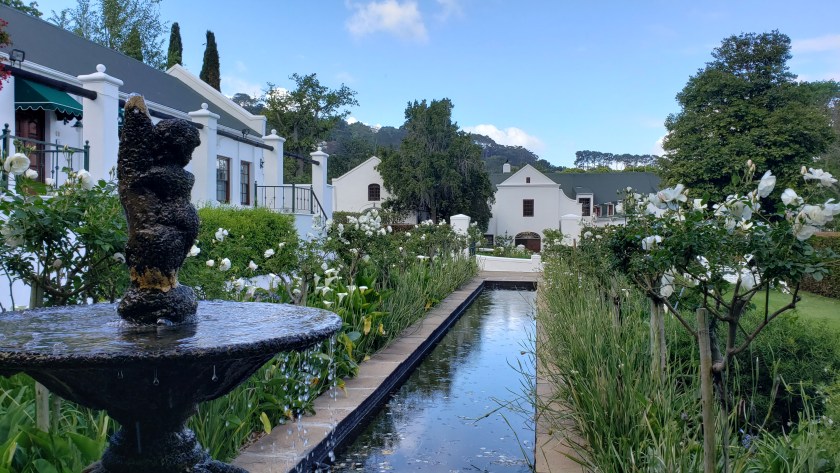
The Cellars-Hohenort is housed in several gleaming white, traditional-style buildings of a former winery. The hotel sits on grounds that could rival any botanical garden with flower beds, fountains, ponds, a small vineyard and a stand of immense 272-year old Camphor trees (planted in 1760). We loved exploring the grounds and ate every breakfast enjoying the view of Table Mountain.
View from our indoor breakfast table. The weather was so nice we moved outside for our last two mornings
Due to our Hyatt status, the Cellars-Hohenort comped us our “continental breakfast,” an ample spread that went beyond the usual. This is a perk they probably weren’t obliged to offer during a free stay and really added to the value of our certificates. We ate dinner twice in their excellent restaurant, too. We charged to the room then paid at check-out with a Hyatt credit card so that we earned 9x the points for those expenses. (The bonus points did not automatically show on my statement, probably because of the affiliate-status of the Liz MacGrath hotels, but a call to Hyatt had those extra points quickly added to my account.)
More of The Cellars-Hohenort
The Cellars-Hohenort could not be more conveniently located for wine tasting in the Constantia region. We made stops at Klein Constantia, Eagles’ Nest and Constantia Glen, the furthest from our hotel being a 12-minute drive away. The wines were all good and we really loved the views from the pretty terrace dining area at Constantia Glen. Eagle’s Nest was particularly family-friendly with children playing around picnic tables scattered around a back lawn.
We spent our last full day wandering the spectacular Kirstenbosch National Botanical Garden, a mere 6-minute drive from The Cellars-Hohenort. The Kirstenbosch website justly boasts “Kirstenbosch National Botanical Garden is acclaimed as one of the great botanic gardens of the world. Few gardens can match the sheer grandeur of the setting of Kirstenbosch, against the eastern slopes of Cape Town’s Table Mountain.” I could do a post just on the garden, but enough for now. Suffice it to say, we loved it, it’s more than worth the trip, and the on-site restaurant moyo Kirstenbosch is delightful, too, especially if you can snag a table outside on a gorgeous day.
Kirstenbosch National Botanical Garden, founded in 1913
Although we felt far from the bustle of Cape Town proper, it’s only an easy <25-minute drive from The Cellars-Hohenort to the Cape Town airport. We did leave a little earlier than necessary to avoid rush hour, though, on the advice of the hotel.
Skeiding ostriches were as curious about us as we were about them.
I’m behind on blogging having been distracted by the holidays and then the heartbreaking last weeks with my beloved, nearly 18-year old dog, so am finishing up the end of our South Africa trip while on a transAtlantic cruise from Florida back to Europe. I’ll keep it brief, but I hated to let two favorite South African stays (and a pair of awesome Qatar Airways Qsuites flights home) go unreported.
Looking for something different after our time driving South Africa’s Garden Route, I was intrigued to find Skeiding Guest Farm, billed as a working ostrich farm. How fun!) Turning inland from the Garden Route, the drive to Skeiding took us through dramatic mountain passes into the Little Karoo, a rugged high plains area. We stopped for lunch at a funky little roadside café and gift shop called Bella de Karoo and descended back through the mountains to the ostrich farm at the end of some miles of unpaved road. (Bella de Karoo apparently has guest rooms elsewhere, but we didn’t check those out.)
The main house at Skeiding Guest Farm where meals are served.
Skeiding Guest Farm is run by a married couple, Neels and Anné-Lize, who both trace their ancestry back to the earliest Afrikaner settlers. Skeiding is a working farm on 1200 hectares (appx. 2965 acres). We were met at the main house by Neels who checked us in and showed us to our charming cottage with its big covered patio overlooking a sweeping vista. After settling on a dinner time, David and I headed out to hike the farm (a working ranch as well as a farm), accompanied by Clara, the friendly doberman.
Skeiding farm (clockwise from top): views of the Langeberg Mountains, a curious ostrich, view from the living room of our cottage, and hiking with Clara the doberman
On this first ramble, we saw lots of sheep, but no ostriches. We also marveled at the local birds, particularly the brilliant yellow and red weaver birds who flitted back and forth among their woven nests that dangle like straw Christmas ornaments from so many African trees.
Brilliantly colored weaver birds
We found the farm’s flock of ostriches on a later hike, laughing as the big-eyed creatures at first ran from us, then approached, looking for treats. Neels told us he’d greatly reduced the flock as selling meat became a money-losing business due to international restrictions following an outbreak of bird disease in Africa. He now mostly keeps the ostriches for guests and to sell their eggs to race horse breeders who use them for feed to enhance the horses’ coats and general health.
Neels at the braai and an excellent dinner
Food at Skeiding Guest Farm deserves a special mention as it was abundant and outstanding. Anné-Lize is the main cook while Neels is in charge of the indoor braai (barbecue). We opted for ostrich steaks, of course, which Neels barbecued to perfection in front of us. The rest of the meal, accompanied by local wine, was equally delicious. The next morning revealed an extensive spread of a dozen cheeses(!), picture-perfect fruit plates, and cooked-to-order scrambled ostrich eggs. More food that we needed, but we enjoyed every bit of it!
The Indian Ocean at The Heads, Knysna, South Africa
The famed Garden Route along the southern coast of the Western Cape of South Africa stretches from Mossel Bay to Storms River. I’d planned our first two nights officially on the Garden Route at an AirBnB apartment in Mossel Bay. The drive from Hermanus was just under 3 ½ hours along an inland stretch of the N2 highway. It wasn’t the gorgeous coastline we’d enjoyed en route from Cape Town to Hermanus via the Cape Peninsula, but it had had its own rugged vastness with mountains looming beyond plains off to our left. We loved a lunch stop at Ou Meul Bakkery in Riviersonderend where kudu venison meat pies and sweet pastries were delicious and cheap.
Our AirBnB apartment in Mossel Bay was on an upper floor of an oceanfront complex with a wall of glass overlooking the water from the enclosed balcony where we ate breakfast. Our hostess had said whales and dolphins could be sighted from the window, but we didn’t see any, which was a bit of a let-down after non-stop whales in Hermanus. We took long strolls along the wide, nearly deserted beach both days we stayed in Mossel Bay. It seems there’s not a lot to do in the town in the off-season.
View from our Mossel Bay AirBnB apartment
A casual waterfront restaurant (Delfino’s) recommended by our hostess served uninspired food in a nothing-special atmosphere. It wasn’t horrible, but not a stellar start. A sea of small campers and tents parked next to the restaurant parking lot; I guessed them to be the local version of the “snow birds” that frequent my home state of Texas in the winter. We found a better dinner option on our own at pretty Café Gannet the second night, and really enjoyed it. I just wish we’d found it sooner and worked in time to try the picturesque make-your-own-gin micro distillery on their premises. Still, we were left looking for much to do in the cool spring weather. We watched waves crashing near a zip line that dropped to the shore from a peak where a lighthouse overlooked the waterfront, but no one braved dipping through the icy spray. We tried Big Joe’s, a local franchise meat pie shop whose gravy-filled meat pies couldn’t hold a candle to the meat-packed kudu venison pies at Ou Meul. We wandered a bit on the local main street. Hmm. After all the build-up for the Garden Route, our first stop wasn’t stacking up to charming Hermanus nor the spectacular views around the Cape Peninsula. We were looking forward to moving into the heart of the Garden Route. Hopefully, we’d see what all the fuss was about.
The beach is wide and beautiful at Mossel Bay, but this pic is a reminder that security is always an issue in South Africa. We enjoyed the freedom of driving ourselves and exploring, but we remained extra vigilant and barbed wire, warnings of “armed response,” guards, etc. are the norm.
I’d booked a guest house in Knysna (“nize-nuh”), but the drive was less than 1 ½ hours, so we decided to drive on past another 50 min, to the Bloukrans Bridge before coming back to check in. This would put us near to the far east side of the Garden Route so we’d see most of it before we settled in at centrally-located Knysna. The drive did give us some lovely views of the coast, as promised. Was it prettier than the Cape Peninsula? Not really.
The Bloukrans Bridge boasts the “highest commercial bungee jumping site in the world,” and it’s pretty spectacular, whatever its current ranking. Neither David or I had any interest in jumping, but it was fun to see. (If you are interested in jumping, learn more here.) We enjoyed lunch at a picnic table overlooking the bridge, feeling a little bad about the empty main building and vendors with wares set out for no one but us (and we weren’t interested). Tourism was clearly taking a big hit due to the pandemic. One other couple arrived while we were there, also Americans, but that was it. Entrance to the Tsitsikamma viewing area is free; we were just stopped at an entrance booth where we gave our names for some unknown reason. No one stopped us on the way out and the booth seemed deserted.
Bloukrans Bridge
After navigating a steep road and a dicey uphill turn-in through a quick-closing electric gate, we found our Knysna guest house to be all we’d hoped for. Perched on a slope overlooking the Knysna “Lagoon” (an estuary) and The Heads (headlands opening onto the Indian Ocean), the house was beautiful and clean, our hostess welcoming and very chatty. We loved our room with two walls of windows and a nice balcony offering that gorgeous view.
Our Knysna guest house balcony with view of the Lagoon and The Heads
We soon learned that the estuary fills and drains each day and it was fascinating to watch shallow islands emerge and retreat. Birds flocked to the islands to feed. We rented a canoe one day and paddled out to one of the islands. The Steenbok Nature Reserve on Leisure Island provided more (free) bird watching and a nice walk along the water with lots of local dog owners. A short drive to The Heads offered spectacular views from the East Head overlooks, some jutting over the cliff edges facing the Indian Ocean. East Head Café is a real treat with outdoor seating overlooking the pass between The Heads. We enjoyed local craft beer at Red Bridge Brewing Co. and toasted our last night in Knysna with champagne and local oysters waterside at Drydock.
Summing up the Garden Route for us: We enjoyed our four nights on the Garden Route, but in hindsight, we would have skipped Mossel Bay altogether and gone straight to Knysna. (We’d spend those two nights in the Stellenbosch wine region instead.) If you’re looking for beach time and the weather is warm, I’m sure Mossel Bay is fun, especially for families with kids, but we’ve got lots of warm beaches at home and we weren’t in South Africa for that, even if we’d been there in summer. Also, I’d debated between Knysna and Plettenberg Bay, and am glad I chose Knysna. It’s bigger (appx. 70,000 pop. vs. PB’s 19,000) and just had more to offer us.
Tip: I found canoe and kayak rentals in a tourist brochure and debated booking via the website listed there, but decided to just drive to the physical site first. (Located at Kalaideskoop on Thesen Island, across from the Gastropub, despite the brochure putting it at restaurant Sirocco) The price was substantially less on-site than what I saw in the tourist brochure at a purported “discount”. This may have been partially due to the depressed tourism due to Covid-19, but just FYI.