Our first full day truly off the boat with luggage in tow, we made our first travel error by hopping on a train going in the wrong direction. So much for my travel wiles! It’s not something I do often, but I’ve definitely done it before. Usually, I catch it sooner, though: It took me 30 minutes before I noticed we were getting more rural instead of the expected Tokyo skyline. A personal “best.” Aaargh. Oh well, easy enough to get on a train going the other direction; just an annoying waste of time and some extra schlepping of luggage. But, this was when I discovered a really great trick for navigating Tokyo trains, metro and bus: Google Maps combined with Google Translate. [Both require Internet connection (although there’s an offline option for Google Translate where you download a specific language; see below), so get a SIM card if you can. See my earlier post about NTT Docomo card. It’s been great for us.]
Google Maps will actually tell you the next train going to your destination, give you the platform number (a vital bit of info when nearly everything at hand is in Japanese), and count down until departure. If you miss that train, you can re-search for the next fastest departure and it will find other routes as well.
Unfortunately, we discovered in Kyoto that while much info provided by Google is in English, Google often gives you bus, bus stop names and other info in Japanese characters:
This is where Google Translate comes in handy: Take a screen shot. Open Google Translate [choose Japanese to English, of course] and tap on the camera icon. Instead of taking a photo now, select the little box with a mountain scene in the bottom. This will take you to your recent photos where you can choose the screenshot. Let Google Translate scan and find the Japanese writing. When it’s finished scanning, you’ll see the Japanese writing (and sometimes other words) in boxes:
Then, just scribble over the Japanese writing with your finger and Google Translate will translate the words you’ve chosen into something you can read:
You can use the same method with screen shots of locations on Google Maps.
We use Google Translate all the time when we travel. It’s not perfect, but it’s pretty amazing (and sometimes funny). Using the eye symbol feature (where available), you can translate live time. It’s like peering through a magic window into an English-language world wherever you are. It even preserves fonts in live-time. In Belgium, we’ve been able to look at a hand-written chalkboard menu in Dutch and see the translations, as if written in chalk in English. Wow. On our current Asia trip, we use the simple photo translate option for information plaques and the like. It was a huge help when I needed prescription eye drops in Kyoto and the pharmacist spoke no English. I could translate my needs by typing a couple of words in Google Translate on my phone (and pointing to my eye), then read the dosage information of the package by taking a photo in Google Translate.
You need an Internet connection to use Google Translate, unless you choose “offline translate” and download the language of your choice–a great feature.
I arranged a private guide in Hakodate through the Hakodate Goodwill Association. http://www.hakodategoodwill.com/indexeng.html The Association offers tours for up to 6 people on a pre-arranged basis for an unbelievable 3000 yen total ($29.41) plus any expenses of the guide which was explained to be a day-pass for the tram (600 yen or $5.88) and maybe some entrance fees, although those might be free for the guide. How could I resist?
A few weeks before our departure, I posted on our Cruise Critic roll call and 4 shipmates quickly jumped on this deal. In about a week, I got an email response to my online application to the Hakodate Goodwill Association from a local named Kensuke (“Ken”) who agreed to be our guide. He responded promptly to my few email questions about payment and again the day before we arrived in Hakodate to give me a weather forecast and assure me he would meet our shuttle bus from the ship.
When I’d asked him by email how we’d recognize him, he wrote back to say he was “a 5’7″ Japanese man with black hair and brown eyes” and would be holding a sign. (I’d been really grateful for that last, since the physical description did little to set him apart from the vast majority of his countrymen.) Anyway, I’d created a mental image of a slender man, dressed in typical Japanese business black-and-white. His emails indicated a pretty good command of English, but I knew Google Translate could have something to do with that.
As promised, Ken was front and center, holding up a sign with my name as soon as we stepped off the shuttle bus from the port just after 11am. In contrast to my imagined guide, he was round-faced and a bit rumpled, wearing a black t-shirt with a large graphic design, and army green pants with a thick chain hanging from the wallet he kept in his pocket. It was also immediately apparent that his English was limited. Oh well, he was there and he knew where to take us, so all in all, things were OK. Ken walked us briskly into the nearby train station to buy day-passes for the tram saying we needed to hurry so that we could experience the morning fish market before it closed at noon. We pitched in 200 yen for his ticket, a whopping $1.96 per couple.
We walked the few blocks to the market where we found a teeming mass of activity. Hakodate is famous for squid. In the center of a big covered market, we watched people fishing for live squid in a tank to be summarily turned into sashimi. At Ken’s urging, David prepared to join the queue, but when 9 school kids piled in ahead of him, he changed his mind…and one squid got a temporary reprieve.
Fishing-for-squid tank in the Hakodate Morning MarketInspecting the goods
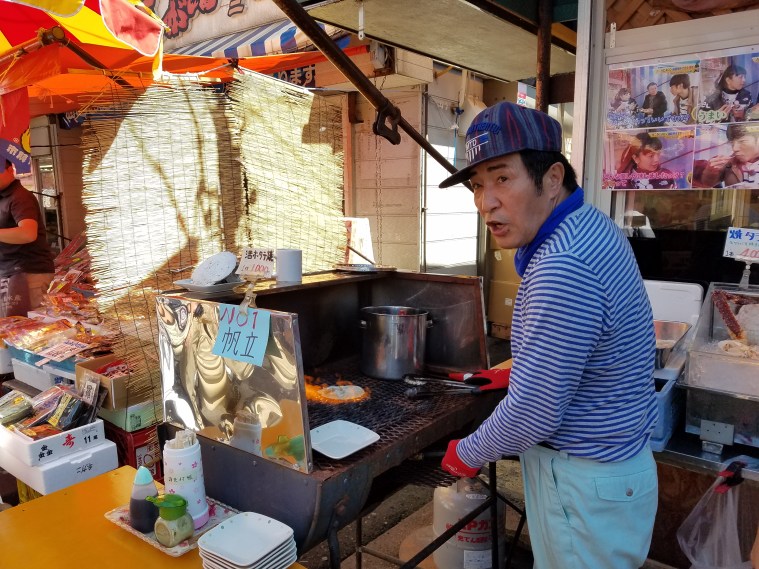
Ken’s English was limited, but it was great to have him identify some of the mysterious things for sale: whale bacon, smoked scallops (I’d thought they were caramel candies!), herring roe (the only item we didn’t like on our sushi lunch in Otaru–a strange, solid rubbery mass of tiny yellow beads) and so much more.
The covered market opened onto a busy, sunny street filled with vendors and tiny restaurants of all types. David bought a luscious slice of canteloupe, eating it perched on a bench beside his fellow customers. We bought “barbequed” scallops piled high on a shell and cooked on an open pit fired by a handheld propane torch until the broth around them boiled. Delicious! A little further on, I couldn’t resist squid ink soft serve ice cream that turned out to be surprisingly good…probably because there was little of the squid ink to be found other than the odd gray color.
“Barbequeing” scallopsDavid finishes off the last of the broth while the chef and his wife wait for the final thumbs-upSquid ink ice cream!
Leaving the market, we headed towards restored brick warehouses which Ken explained were now shopping malls. Their brick construction and the brick pavers we saw on roads belied the strong European influences in Hakodate. None of our group was interested in shopping, so we breezed past more music boxes and souvenirs, stopping only for cold local beers and a melon drink at a grocery store/deli.
Our path took us up an increasing slope to Higashi Honganji Temple, a beautiful Buddhist temple. After repeated destruction by fires, the current building was erected in 1915 and was the first reinforced concrete temple in Japan. Apparently, the construction caused some concern, both as to whether the material was strong enough to hold the massive roof…and as to the purity or lack thereof of a material that people had walked on and therefore made impure. Geishas were hired to dance on the floor and somehow that resolved all. The temple shows some western influence, one main depiction looking as much like a Catholic saint as anything. Nearby Catholic, Protestant and Russian Orthodox churches emphasize that influence.
Continuing our uphill climb, we boarded the gondola up to the Mt. Hakodate Observatory House for a sweeping view of the city and the surrounding waters of the Tsugaru Straits. The Hakodate Ropeway (gondola) tickets turned out to be the biggest expense of the day at 1280 yen pp, roundtrip ($12.55). Sure enough, after a little negotiation between Ken and a lady at the ropeway office, Ken was free so long as we paid for the group of six at once. No problem. We were a cooperative group and we settled up quickly.
We finally used our tram tickets for a long ride to Goryokaku Fort, a star-shaped fort of European design. The grounds of the fort are now a park and people rowed small rental boats on the moat waters. At the center of the fort the former magistrate’s office has been rebuilt and provides an interesting glimpse of classic Japanese architecture. Tatami mats felt delightfully cool under my bare feet, giving off a fresh scent of straw. The large wooden sliding doors to the building were thrown open as well as the paper interior doors allowing in both sunshine and a light breeze from the beautiful day outside.
Pleasantly tired and happy after our long day and nearly 6 miles walking, I thought it a perfect end to our tour. The rest of the group agreed and we followed Ken to the tram for our ride back to the train station and the ship shuttle bus.
It was 4:45pm by the time we reached the station and Ken had had nothing to eat and only a few canned soft drinks despite our offers. We felt guilty that he was to receive only 3000 yen for nearly 6 hours of time with us. Conferring among ourselves and worried about the Japanese aversion to tips, we offered him an extra 3000 for his dinner which he very happily accepted. We parted with positive feelings all around.
I’d recommend the Hakodate Goodwill Association to anyone looking for an unbeatable deal, willing to try an amateur guide with unknown language skills, and physically able to handle a good deal of walking, often uphill. (We walked about 6 miles with Ken.)
______________________________________
Cruise port details:
It’s about a 15-minute shuttle bus ride from the port to the train station. There’s no realistic way to walk. Celebrity and/or the city provided the shuttle at no charge.
Free wi-fi was offered just beyond the gangway in the passenger welcome area.
I was totally charmed by Otaru. The old buildings of Sakaimachihondori Street, the main shopping area, are almost achingly picturesque…reminding me, in some ways, of a Japanese Carmel. We began our explore of the area at the Otaru Music Box Museum in a 3-story wooden building across from the towered post office. The “museum” is really more of a large souvenir shop selling every kind of music box imaginable. A tall clock outside the music box museum surprised us when it blew the half-hour on a train-like whistle, emitting a gray puff of smoke.
Otaru Music Box Museum
It’s an easy stroll from the music box museum down Sakaimachihondori Street toward Otaru Canal. Vendors on both sides of the street offer free samples: chocolate, sweet cakes and cookies, sake and other more exotic spirits like kelp “wine.” I found the seafood shops especially intriguing with all sorts of live and dead offerings, many of which I couldn’t identify. “Hairy crab” is a local specialty.
Sakaimachihondori Street
Kimono for sale just off Sakaimachihondori Street
At the end of Sakaimachihondori Street, we crossed a small canal and–after procuring some yen at the post office ATM–headed toward the main Otaru Canal and the sushi restaurant I’d booked for my birthday celebration. Otaru is famous for sushi and I wanted to be sure to get a seat at Mazasushi as it got great reviews, but I’d read that there were often long lines and that little English was spoken there. I booked through Savor Japan, the only service I could find that made booking in English in Otaru doable. https://savorjapan.com/ Although the maitre d’ had a little trouble finding the reservation, he did eventually locate it and we were seated at a window overlooking the canal across the street, just as I’d requested. Yay for Savor Japan! [There wasn’t a line, though, so we might have been alright without.]
Sushi lunch at Masazushi Zenan
The sushi was excellent and we had fun trying a new dish of squid, sea urchin and raw egg. To eat, we mixed the uni (sea urchin) into the raw egg, then dipped the squid in that. The “noodles” were cold and crunchy and made a really good accompaniment. I found the uni surprisingly mild, not at all fishy. This dish made me a convert.
We took a post-lunch stroll along the canal which is lined down one side with restored old warehouses. Otaru’s fortunes were built on the herring fishing industry before the fish left for different waters.
Otaru Canal
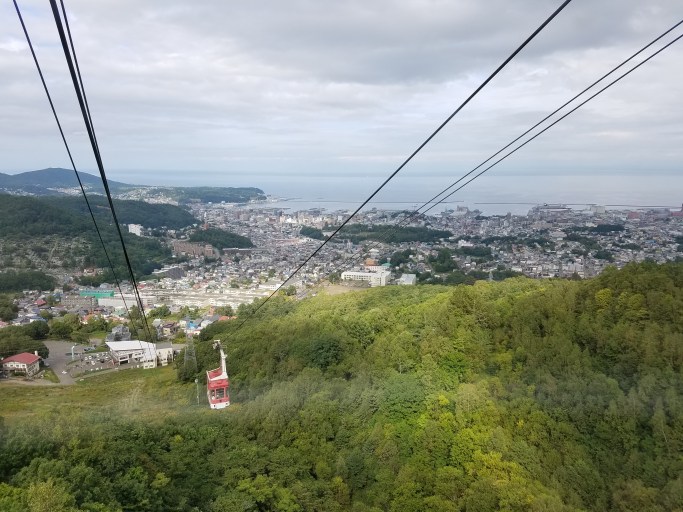
Leaving the canal, we walked a few blocks to the Otaru Train station to catch the #9 bus (220 yen pp one-way, about $2.15) to Mt. Tengu (Tenguyama) where we rode a gondola to the summit for a sweeping view of the city and harbor. A beautiful little meditation path leads past Shinto shrines through the woods to another overlook.
Mt. Tengu gondola
Mt. Tengu meditation path and Shinto shrine
The city bus picks up and drops off in the parking lot across from the base gondola station. There’s a glass shop across the parking lot with windows where we watched glass blowing going on in a downstairs workroom before catching the bus back to Canal Station. (You pay the driver via a machine when you exit the bus.)
On the bus from Mt. Tengu. I love the white gloves!
Because David always wants to try local beer, we made a quick stop at the Otaru “Brewery” and Restaurant which is really a German-style beer hall (kind of weird) with big brass beer tanks in the center of communal tables. The beer was nothing special, but we enjoyed sitting outside at a small table on the canal (which had the added benefit of letting us escape the pervading odor of smoked sausage inside–not exactly unpleasant, but we didn’t want to end up smelling the same way).
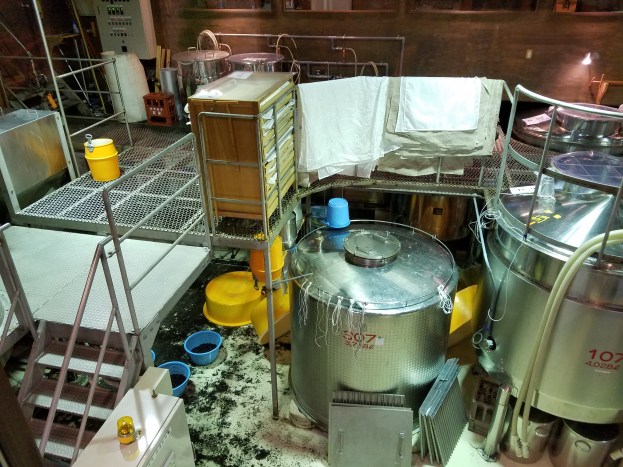
With David’s beer stop out of the way, it was time for my sake stop. The Tanaka Sake Brewery Kikkogura sits just north of the cruise port terminal so it made a convenient stop on our way back to the ship. A very friendly, giggling young woman poured 4 sakes and 3 fruit wines (blueberry, plum, and peach) for us to taste. Instructing us in the Japanese version of “Cheers!” she wrote out “KANPAI” to be sure we got it right. After purchasing a bottle of the really delicious plum wine, we toured the working brewery with the aid of an English self-tour handout. It was all very interesting and fun. Both the tasting and the tour are free.
Many little cups laterOverlooking the working part of Tanaka Sake Brewery Kikkogura
____________________________________
Cruise port details:
The city of Otaru set up information tables with maps and staff perfectly fluent in English.
Stalls selling food an souvenirs were also set up just off the ship.
A stall with free wi-fi was also provided.
It’s about a 20-minute walk from the ship to the Music Box Museum. It’s an easy walk with no hills, but several intersections. It’s not particularly scenic, but seemed perfectly safe. The guest information people were happy to mark the route on our map and point out ATM machines, points of interest, etc.
I’m posting onboard ship in the port of Otaru using a Japanese data SIM card I bought on eBay before leaving the U.S. I bought 2 of these cards which are by the Japanese company, Docomo, which my research showed to have the best coverage in Japan. The cards are for 8 days each, so we plan to use them back-to-back during our stay in Japan, using my Galaxy S7 phone as a hotspot for David’s Galaxy S7s and our laptop. Each card is described as “4G LTE, 3GB/8 days, unlimited.” The cards cannot be used with HTC, Blackberry, dual SIM phones or any smartphones made in China.
Approaching Otaru, Japan, this morning
The card starting working in the wee hours this morning, while we were at sea off the Japanese coast, but still some hours from the port of Otaru. The signal is strong and fast and both David’s Galaxy S7 Android phone and the laptop are connecting well with my phone’s hotspot.
I paid $26.98 for both cards, including shipping from Hong Kong. It took about 20 days for the cards to arrive, which was within the vendor’s estimated shipping time. He was very responsive to my questions and had good reviews, so I felt reasonably comfortable making the purchase. We might could have bought the cards in Japan and I read that visitor SIM cards are sold at Narita Airport. But, we are arriving by ship in Otaru where I could find no information about such SIMs and, even if we did find them, I had concerns about language issues. I also didn’t want to spend my limited time ashore looking for and waiting in a shop anyway if I didn’t have to. Given the reasonable price on eBay, it seemed a no-brainer to me.
I chose data-only SIM cards because we don’t really care about making calls–and should we need to, we can usually call for free using Google. The Internet, i.e., data, is what we really want and need for Google Maps, researching local sites, texting with home via WhatsApp, email, etc. Anyway, so far, so good!
UPDATE: I’ve been using the Docomo card for four days now and am generally happy. Sometimes, the connection is a little slow, but for the most part it’s been really good. Also, some of the sluggishness may be due to being offshore and to having other devices using my phone as a hotspot. Most impressive of all, not only did I retain connection when we were on a ship 15 miles off the Japanese coast, but I was even able to make a 30+ minute call to my son in the U.S. on WhatsApp with excellent quality…and for free!
So we leave tomorrow on the trip that inspired me to start this blog: a 77-night ramble through Asia. This trip runs the gamut of lodging, transportation methods, and weather. It’s been a challenge to plan (and a challenge to pack for). We’re excited!
In a (large) nutshell, this trip includes:
Our first trans-Pacific cruise [the Aleutians, northern Japan, Yokohama/Tokyo]
2 weeks in Japan [Tokyo, Kyoto, Hiroshima, Miyajima island (where we’ll stay in a ryokan, a traditional Japanese inn), Fukuoka]
a ferry to South Korea [Busan, a Buddhist temple stay, Seoul, the DMZ]
a cruise from Shanghai to Singapore [Okinawa, Hong Kong, Chan May/Hoi An and Phu My/Ho Chin Mihn City, Vietnam]
Singapore and Kuala Lumpur
Siem Reap, Cambodia, to see Angkor Wat
Luang Prabang, Laos
a 2-day open-boat trip up the Mekong with a stop at some to-be-determined-when-we-get-there guesthouse in tiny Pakbeng, Laos
2.5 weeks in Thailand: Chiang Khong, Chiang Rai, Chiang Mai (a day with elephants and a Thai cooking school), Krabi (scuba diving the Phi Phi islands), the Bridge on the River Kwai at Kanchanaburi, Bangkok
a 1st class mega-flight on Korean Air from Bangkok to Seoul to Dallas (courtesy of airline miles and credit card points, a favorite game of ours)
I’ve tried to anticipate the trickier bits and done an incredible amount of research, but I know there will be things I overlooked or had no way of knowing. There are liable to be things that don’t pan out as we’d hoped (or maybe don’t even pan out at all). It’s the nature of travel, and also part of what makes it exciting and interesting. And besides, I don’t want to plan every moment anyway. I intend to focus on experiencing the trip rather than documenting it, but I’ll blog about it when I can. Hopefully, there will be fun as well as useful info to share…and, no doubt, our portion of clueless-fools-in-a-strange-land moments. Wish us luck!
[We’ll be incommunicado for most of the 16-day Pacific crossing, so other than a possible post in the Aleutians 5 days out, we’ll be in Japan before I do any posting. I know going off-grid is a weird way to start a blog, but that’s the plan.]

 Unfortunately, we discovered in Kyoto that while much info provided by Google is in English, Google often gives you bus, bus stop names and other info in Japanese characters: