The last hurrah of my big birthday trip was a two-flight return journey from Cape Town to Dallas via Doha on Qatar Airways Qsuites. I’d been wanting try Qsuites for awhile, but it just never worked into our plans. With American Airlines offering this pair of flights on partner Qatar Airways for a super-reasonable 70,000 miles, now was the time!
While the route might see ridiculously out-of-the-way on first glance, it was actually perfect and I’d do it again in a heartbeat. The first flight was overnight, Cape Town to Doha, so I chose two interior seats (Qsuites are in a 1-2-1 configuration) so that David and I could merge our seat cubicles. We shared dinner, then had our seats reconfigured to have a private double bed in the sky. We loved it!
After a restful overnight, we landed early in Doha with enough time to check out Qatar Airways impressive Al Mourjan business class lounge. (It’s hard to believe Qsuites are only business class as they outstrip many a first class seat for comfort, excellent dining and pure luxury.) The lounge is immense with a huge reflecting pool running through a central, two-story space, touch pads at every seat, private rooms and cubicles and an upstairs dining room (do reserve). Signs advised that the number of persons allowed in the lounge was limited, but we were allowed in immediately and it’s hard to imagine how many people would make that vast space and seating capacity overcrowded.
Inside the Al Mourjan Business Class Lounge in Doha
The second leg of our journey was a 16-hour flight non-stop from Doha to Dallas, one of the longest flights in the world. After our first flight, we couldn’t wait to get back on a plane to check out the window seats I’d chosen for this leg of the journey. Would that I was always so eager to get back on a plane! Once again, we were offered White Company pajamas for the flight. When I told our attendant that we already had a pair from the previous flight, he urged us to take another so we got a couple of sets for my sons. They’re delightfully comfortable and we’ve all enjoyed wearing them back at home on tv nights.
Windows seats were ideal for this flight and we felt like we got a free tour of the planet from the sky. The weather was clear for the entire flight back and we got surprisingly clear views of Iraq and Euphrates, Romania, Turkey, Greenland and its melting glaciers… I took pictures out the window, comparing them to the flight map on my seat screen and adding labels. I’m a sucker for a little nerdy fun!
Qsuites dining really deserves a shout-out. It exceeded my (high) expectations. The lobster Thermador, in particular, rivaled any I’ve had in a restaurant. (See lead photo.) Wines and champagne were good, a final “lobster salad sandwich” boasted big lobster chunks and a full, shelled claw. Delicious!
Although the room we stayed in listed online at over $700/night, our stay at The Cellars-Hohenort was completely free thanks to Hyatt credit card “annual” certificates which David had accumulated over the pandemic as Hyatt and other hotel chains extended the validity of such certificates during the worldwide shut-down. (We used my three certificates for our stay at The Marine Hermanus.) The Cellars-Hohenort is part of the Liz McGrath collection of three 5-star hotels which, along with The Marine Hermanus, had just come under the Hyatt umbrella. We couldn’t have been happier with this use of the certificates!
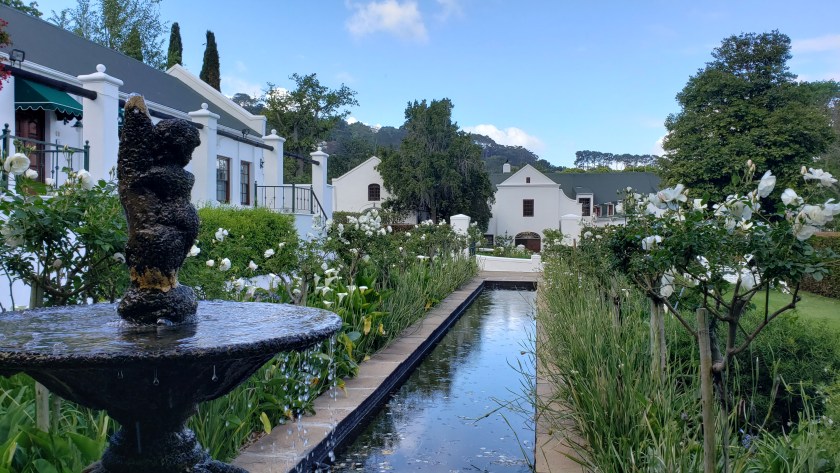
Magnificent camphor trees and other idyllic spots on the grounds of The Cellars-Hohenort
The Cellars-Hohenort is housed in several gleaming white, traditional-style buildings of a former winery. The hotel sits on grounds that could rival any botanical garden with flower beds, fountains, ponds, a small vineyard and a stand of immense 272-year old Camphor trees (planted in 1760). We loved exploring the grounds and ate every breakfast enjoying the view of Table Mountain.
View from our indoor breakfast table. The weather was so nice we moved outside for our last two mornings
Due to our Hyatt status, the Cellars-Hohenort comped us our “continental breakfast,” an ample spread that went beyond the usual. This is a perk they probably weren’t obliged to offer during a free stay and really added to the value of our certificates. We ate dinner twice in their excellent restaurant, too. We charged to the room then paid at check-out with a Hyatt credit card so that we earned 9x the points for those expenses. (The bonus points did not automatically show on my statement, probably because of the affiliate-status of the Liz MacGrath hotels, but a call to Hyatt had those extra points quickly added to my account.)
More of The Cellars-Hohenort
The Cellars-Hohenort could not be more conveniently located for wine tasting in the Constantia region. We made stops at Klein Constantia, Eagles’ Nest and Constantia Glen, the furthest from our hotel being a 12-minute drive away. The wines were all good and we really loved the views from the pretty terrace dining area at Constantia Glen. Eagle’s Nest was particularly family-friendly with children playing around picnic tables scattered around a back lawn.
We spent our last full day wandering the spectacular Kirstenbosch National Botanical Garden, a mere 6-minute drive from The Cellars-Hohenort. The Kirstenbosch website justly boasts “Kirstenbosch National Botanical Garden is acclaimed as one of the great botanic gardens of the world. Few gardens can match the sheer grandeur of the setting of Kirstenbosch, against the eastern slopes of Cape Town’s Table Mountain.” I could do a post just on the garden, but enough for now. Suffice it to say, we loved it, it’s more than worth the trip, and the on-site restaurant moyo Kirstenbosch is delightful, too, especially if you can snag a table outside on a gorgeous day.
Kirstenbosch National Botanical Garden, founded in 1913
Although we felt far from the bustle of Cape Town proper, it’s only an easy <25-minute drive from The Cellars-Hohenort to the Cape Town airport. We did leave a little earlier than necessary to avoid rush hour, though, on the advice of the hotel.
Skeiding ostriches were as curious about us as we were about them.
I’m behind on blogging having been distracted by the holidays and then the heartbreaking last weeks with my beloved, nearly 18-year old dog, so am finishing up the end of our South Africa trip while on a transAtlantic cruise from Florida back to Europe. I’ll keep it brief, but I hated to let two favorite South African stays (and a pair of awesome Qatar Airways Qsuites flights home) go unreported.
Looking for something different after our time driving South Africa’s Garden Route, I was intrigued to find Skeiding Guest Farm, billed as a working ostrich farm. How fun!) Turning inland from the Garden Route, the drive to Skeiding took us through dramatic mountain passes into the Little Karoo, a rugged high plains area. We stopped for lunch at a funky little roadside café and gift shop called Bella de Karoo and descended back through the mountains to the ostrich farm at the end of some miles of unpaved road. (Bella de Karoo apparently has guest rooms elsewhere, but we didn’t check those out.)
The main house at Skeiding Guest Farm where meals are served.
Skeiding Guest Farm is run by a married couple, Neels and Anné-Lize, who both trace their ancestry back to the earliest Afrikaner settlers. Skeiding is a working farm on 1200 hectares (appx. 2965 acres). We were met at the main house by Neels who checked us in and showed us to our charming cottage with its big covered patio overlooking a sweeping vista. After settling on a dinner time, David and I headed out to hike the farm (a working ranch as well as a farm), accompanied by Clara, the friendly doberman.
Skeiding farm (clockwise from top): views of the Langeberg Mountains, a curious ostrich, view from the living room of our cottage, and hiking with Clara the doberman
On this first ramble, we saw lots of sheep, but no ostriches. We also marveled at the local birds, particularly the brilliant yellow and red weaver birds who flitted back and forth among their woven nests that dangle like straw Christmas ornaments from so many African trees.
Brilliantly colored weaver birds
We found the farm’s flock of ostriches on a later hike, laughing as the big-eyed creatures at first ran from us, then approached, looking for treats. Neels told us he’d greatly reduced the flock as selling meat became a money-losing business due to international restrictions following an outbreak of bird disease in Africa. He now mostly keeps the ostriches for guests and to sell their eggs to race horse breeders who use them for feed to enhance the horses’ coats and general health.
Neels at the braai and an excellent dinner
Food at Skeiding Guest Farm deserves a special mention as it was abundant and outstanding. Anné-Lize is the main cook while Neels is in charge of the indoor braai (barbecue). We opted for ostrich steaks, of course, which Neels barbecued to perfection in front of us. The rest of the meal, accompanied by local wine, was equally delicious. The next morning revealed an extensive spread of a dozen cheeses(!), picture-perfect fruit plates, and cooked-to-order scrambled ostrich eggs. More food that we needed, but we enjoyed every bit of it!
The Indian Ocean at The Heads, Knysna, South Africa
The famed Garden Route along the southern coast of the Western Cape of South Africa stretches from Mossel Bay to Storms River. I’d planned our first two nights officially on the Garden Route at an AirBnB apartment in Mossel Bay. The drive from Hermanus was just under 3 ½ hours along an inland stretch of the N2 highway. It wasn’t the gorgeous coastline we’d enjoyed en route from Cape Town to Hermanus via the Cape Peninsula, but it had had its own rugged vastness with mountains looming beyond plains off to our left. We loved a lunch stop at Ou Meul Bakkery in Riviersonderend where kudu venison meat pies and sweet pastries were delicious and cheap.
Our AirBnB apartment in Mossel Bay was on an upper floor of an oceanfront complex with a wall of glass overlooking the water from the enclosed balcony where we ate breakfast. Our hostess had said whales and dolphins could be sighted from the window, but we didn’t see any, which was a bit of a let-down after non-stop whales in Hermanus. We took long strolls along the wide, nearly deserted beach both days we stayed in Mossel Bay. It seems there’s not a lot to do in the town in the off-season.
View from our Mossel Bay AirBnB apartment
A casual waterfront restaurant (Delfino’s) recommended by our hostess served uninspired food in a nothing-special atmosphere. It wasn’t horrible, but not a stellar start. A sea of small campers and tents parked next to the restaurant parking lot; I guessed them to be the local version of the “snow birds” that frequent my home state of Texas in the winter. We found a better dinner option on our own at pretty Café Gannet the second night, and really enjoyed it. I just wish we’d found it sooner and worked in time to try the picturesque make-your-own-gin micro distillery on their premises. Still, we were left looking for much to do in the cool spring weather. We watched waves crashing near a zip line that dropped to the shore from a peak where a lighthouse overlooked the waterfront, but no one braved dipping through the icy spray. We tried Big Joe’s, a local franchise meat pie shop whose gravy-filled meat pies couldn’t hold a candle to the meat-packed kudu venison pies at Ou Meul. We wandered a bit on the local main street. Hmm. After all the build-up for the Garden Route, our first stop wasn’t stacking up to charming Hermanus nor the spectacular views around the Cape Peninsula. We were looking forward to moving into the heart of the Garden Route. Hopefully, we’d see what all the fuss was about.
The beach is wide and beautiful at Mossel Bay, but this pic is a reminder that security is always an issue in South Africa. We enjoyed the freedom of driving ourselves and exploring, but we remained extra vigilant and barbed wire, warnings of “armed response,” guards, etc. are the norm.
I’d booked a guest house in Knysna (“nize-nuh”), but the drive was less than 1 ½ hours, so we decided to drive on past another 50 min, to the Bloukrans Bridge before coming back to check in. This would put us near to the far east side of the Garden Route so we’d see most of it before we settled in at centrally-located Knysna. The drive did give us some lovely views of the coast, as promised. Was it prettier than the Cape Peninsula? Not really.
The Bloukrans Bridge boasts the “highest commercial bungee jumping site in the world,” and it’s pretty spectacular, whatever its current ranking. Neither David or I had any interest in jumping, but it was fun to see. (If you are interested in jumping, learn more here.) We enjoyed lunch at a picnic table overlooking the bridge, feeling a little bad about the empty main building and vendors with wares set out for no one but us (and we weren’t interested). Tourism was clearly taking a big hit due to the pandemic. One other couple arrived while we were there, also Americans, but that was it. Entrance to the Tsitsikamma viewing area is free; we were just stopped at an entrance booth where we gave our names for some unknown reason. No one stopped us on the way out and the booth seemed deserted.
Bloukrans Bridge
After navigating a steep road and a dicey uphill turn-in through a quick-closing electric gate, we found our Knysna guest house to be all we’d hoped for. Perched on a slope overlooking the Knysna “Lagoon” (an estuary) and The Heads (headlands opening onto the Indian Ocean), the house was beautiful and clean, our hostess welcoming and very chatty. We loved our room with two walls of windows and a nice balcony offering that gorgeous view.
Our Knysna guest house balcony with view of the Lagoon and The Heads
We soon learned that the estuary fills and drains each day and it was fascinating to watch shallow islands emerge and retreat. Birds flocked to the islands to feed. We rented a canoe one day and paddled out to one of the islands. The Steenbok Nature Reserve on Leisure Island provided more (free) bird watching and a nice walk along the water with lots of local dog owners. A short drive to The Heads offered spectacular views from the East Head overlooks, some jutting over the cliff edges facing the Indian Ocean. East Head Café is a real treat with outdoor seating overlooking the pass between The Heads. We enjoyed local craft beer at Red Bridge Brewing Co. and toasted our last night in Knysna with champagne and local oysters waterside at Drydock.
Summing up the Garden Route for us: We enjoyed our four nights on the Garden Route, but in hindsight, we would have skipped Mossel Bay altogether and gone straight to Knysna. (We’d spend those two nights in the Stellenbosch wine region instead.) If you’re looking for beach time and the weather is warm, I’m sure Mossel Bay is fun, especially for families with kids, but we’ve got lots of warm beaches at home and we weren’t in South Africa for that, even if we’d been there in summer. Also, I’d debated between Knysna and Plettenberg Bay, and am glad I chose Knysna. It’s bigger (appx. 70,000 pop. vs. PB’s 19,000) and just had more to offer us.
Tip: I found canoe and kayak rentals in a tourist brochure and debated booking via the website listed there, but decided to just drive to the physical site first. (Located at Kalaideskoop on Thesen Island, across from the Gastropub, despite the brochure putting it at restaurant Sirocco) The price was substantially less on-site than what I saw in the tourist brochure at a purported “discount”. This may have been partially due to the depressed tourism due to Covid-19, but just FYI.
Six free-annual-night Hyatt certificates first put Hermanus, South Africa, on my radar screen. David and I each had accumulated lots of hotel certificates over the pandemic and we each had three Hyatt nights that we needed to use. We get one certificate/year with certain credit cards and, although they usually expire within a year, Hyatt had extended the expiration due to the pandemic. This created a great opportunity to use those certificates for an extended stay. We often use these certificates for a 2-night stay, using each of our 1-night certificates, then calling the hotel to make sure we can stay in the same room, rather than checking out and then in again as the booking switches from one of our names to the other. So, we could have lumped our nights together for a 6-night free stay somewhere, but that really didn’t suit our plans on this trip.
With travel so restricted due to the pandemic, a lot of the usual best-use locations (like Asia) were closed to us. When the idea of a trip to Africa started to come together, I searched Kenya and South Africa for interesting-looking Hyatts. As luck would have it, Hyatt had just added three new Small Luxury Hotels (SLH) to its lineup in South Africa and two of them fell under the eligibility requirements for our certificates. (The certificates are good for hotels in Hyatt Categories 1-4. The idea is to use the certificate for the poshest Category 4 available in order to maximize the value of the certificate.) I decided to use my three certificates at The Marine Hermanus. What a great find that turned out to be!
We arrived just after dark at The Marine after our day exploring the Cape Peninsula. After a quick stop at the guard post, we were let into the gated parking lot and shown to the registration desk. The welcome was very friendly and, after confirming we were hungry, we were promised a table would be waiting in the dining room as soon as we settled into our room. I had reserved a standard king room and it was charming. On the side of the building facing away from the town of Hermanus, we had a very oblique view of the water, I think. It was dark and morning would tell. Or so I thought. After a quick wash-up, I went to put our valuables into the safe and discovered it to be old and not functioning. Oh well, I wasn’t overly concerned, but did want to lock things up so mentioned it to the man at Reception on our way to dinner. Midway through an excellent meal, he arrived, apologizing again and saying he was moving us to a suite and would escort us there with our luggage as soon as we were finished with dinner. Well, that called for a toast!
The Marine Hermanus
The suite turned out to be enormous, easily three times the size of our original, comfortably-sized room. Our new digs had a king-sized bed, sofa and coffee table, small dining table and two chairs, a minifridge stocked with free beer, soft drinks and snacks under the tv, a vanity, and enough open space for a rousing game of ping-pong. The bathroom sported a huge shower, a massive tub, a toilet, and three(!) sinks. To top it all off, we had one of the few balconies in the vintage hotel, and the biggest one at that. Our balcony sat atop the covered entrance to the hotel so, straight ahead, we looked down the street towards downtown Hermanus. The bay was just to the left, but since our balcony was so big we had a table and chairs and lots of room. Once the sun was up (and rain showers cleared), we could sit outside and watch whales any time of the day! [An internet search showed this suite was running about $560/night at the time, making this stay an excellent use of my Hyatt certificates.]
It’s always fun to survey your new surroundings after arriving in the dark. Morning revealed to us a picture-perfect waterside town with a paved walk meandering along the cliffs. The weather proved to be fickle, changing quickly from sunny with scattered clouds to squalls that moved through quickly. We nevertheless set out for a walk along the cliffs to the main town pier. We spied our first whales in no time and had fun watching them until the weather drove us to shelter. We explored semi-sheltered booths of local items for sale then moved on to indoor shops as rain came down in earnest. Our first day in Hermanus continued like that with us moving in and out-of-doors as the weather dictated. Fortunately, the town is small and The Marine was in easy walking distance. Our spacious suite wasn’t a shabby retreat either!
Whale breaching just off shore by The Marine
In addition to a view of the bay and of the town, we had a view of the modestly-sized parking in front of The Marine. We were impressed to see men washing every car in the lot… and repeating the wash after every frequent shower. Unemployment is high in South Africa and perhaps as a result there seem to be many such service jobs, making us feel very pampered, if a bit uncomfortably so.
Over the three nights we spent in Hermanus, we explored the cliff walk for long stretches in both directions. The cliffs along the town front invariably offered excellent whale watching, with several whales to be seen at almost any time, some very near the land. We saw mother whales with calves, whales breaching, spyhopping and fin waving. It was magical! Wandering past the main town pier we found lots of “dassies” (large brown-furred rodents also known as rock hyraxes) grazing among whimsical sculptures. Rounding a curve in the coastline, the water became less sheltered with big waves breaking on huge rock slabs. Wildflowers and birds, including a pheasant-like Cape Francolin mama with chicks, wandered the wildflower-laden greenery that decorated the upper portion of the rugged coast.
The rugged coast of Hermanus
In addition to two excellent meals at The Marine, we had seafood with a view of the water at Lemonicious and wood-fired pizza at Embers Wood Fired Oven which also offers a surprisingly good selection of Belgian beers, thanks to input from a Belgian couple who retired from their own restaurant in Hermanus a couple of years back. They were in Embers the night we ate there, visiting with the owner, and we were delighted to find they were Antwerpers by origin with a daughter still in school there. On a sunny weekend afternoon, we ate a tasty lunch outside at Pear Tree Bistro with a view of the bay while a talented local musician played with the aid of an amplifier set up beside his van.
The Hemel-en-Aarde Valley (“Heaven and Earth”), a popular and scenic wine region, is located a short drive from Hermanus and we drove one day to a wine tasting at Ataraxia, a pretty winery with a tasting room designed to look like a chapel. We were surprised to find our choice of wineries really limited on a weekend. For some bizarre reason, many of the wineries were either closed entirely on the weekend or only open from 9 or 10am to noon. Who wants wine for breakfast?! It seemed really crazy since it would seem their main source of steady businessduring the on-and-off travel bans due to Covid-19 would be daytrippers from Cape Town, most of whom would be presumably working during the week and free on weekends. In fact, we shared a table at Ataraxia with a group of women doing a girls’ weekend away from husbands and kids. (These ladies were tons of fun and apparently had no problem with breakfast-time drinking.) They told us they thought the weird winery hours were due to the pandemic. I’m not sure how that makes sense, but there you have it.
Ataraxia Winery in the Hemel-en-Aarde Valley
All in all, we loved Hermanus. It’s not a big-event place, but a charming town to pass some days whale-and-wave watching and enjoying the local food and wine. I can’t say enough good things about The Marine or its parent group, The Liz McGrath Collection. We had to call them twice, once to ask to move our reservation at The Marine up a day and another time to advise them of a late arrival. Both times, the phone line was answered immediately by someone eager and able to help. Would that all customer service lines were like that!
A final view of Mt. Kilimajaro as we leave Kenya, the Zambezi River just above Victoria Falls on a refueling stop in Zambia… and Cape Town, South Africa, here we come!
After our Kenya safari, it was time for 15 days/14 nights in South Africa. I wanted to spend the entire time in the Western Cape, exploring Cape Town, driving the famous Garden Route at leisure and doing a little wine tasting. We also wanted to make use of Hyatt anniversary night certificates that had been piling up during the pandemic but that would be expiring before too long. With Hyatt and Small Luxury Hotels having recently added the 3-hotel Liz McGrath boutique hotel chain in South Africa to its lineup, we had a great opportunity to get max value from those certificates.
I booked some hotels well before we left the States: I booked our first few nights in the Hyatt Regency Cape Town. I chose this hotel primarily because it was a very nice and convenient hotel at a ridiculously cheap price (especially with a buy-2-get-1-free member promo Hyatt was offering) and because I was braced for travel uncertainty from Kenya and didn’t really care if we missed a night or two at this hotel. (Uncertainty arose both from Covid issues and Kenya Airways’ reputation for canceling flights.) Then, I booked 3 nights using my Hyatt certificates at The Marine in Hermanus, a gorgeous Liz McGrath hotel on the cliffs of a picturesque coastal town known for great whale watching. Next, I booked our last 3 nights in South Africa at the Cellars-Hohenort (another Liz McGrath hotel) with David’s Hyatt certificates. The Cellars-Hohenort is a former winery located on spectacular grounds in the Constantia wine region and suburb of Cape Town, an easy drive to the airport for our departure flight home.
With these 9 nights booked, we were left with 5 free nights that I decided to leave open until we got to South Africa and could get the lay of the land. I rented a car for the 12 days after our first 3 nights in Cape Town so we were free to roam. I originally had in mind spending all 5 of our unbooked nights on the Garden Route, maybe breaking them up as 2 nights/2 nights/1 night, in some combination thereof. This turned out to be a fine choice as tourism was still way down due to the pandemic and room availability was not an issue.
We ended up staying 2 nights in Mossel Bay at a 2-bedroom/2-bath AirBnB apartment on the beach, 2 nights at a guest house in Knyzna with a balcony overlooking the “lagoon”and “The Heads” (an estuary and headlands opening to the Indian Ocean), and 1 night at a 4000-acre Afrikaaner ostrich farm inland. We really enjoyed our time in South Africa. With hindsight, the only thing I’d change is to skip staying in Mossel Bay and spend those 2 nights in the Stellenboch wine region. I’ll explain why in a later post since I’m going to break up our time in South Africa into several posts.
Cape Town the first time:
We landed at Cape Town Airport early afternoon, bought cheap MTN SIM cards at the airport, and hopped a taxi to the Hyatt Regency Cape Town. (We don’t usually buy SIM cards anymore since switching to T-Mobile, but decided that we wanted to get the best possible coverage because we’d had connectivity issues in Kenya and we planned to be driving long distances on our own in a country with a bit of a history of crime and violence.) I’d made no plans, anticipating a slow first day in Cape Town as we’d been up since 4:30am. So we enjoyed a little downtime before indulging in 2-for-1 local wine and happy hour small plates at nearby Iron Steak Bar. Our friendly young waiter reinforced hotel staff’s recommendation that we not walk around the area after dark, so we headed back to the hotel to later grab an uninspiring dinner and call it an early night.
The Hyatt Regency Cape Town is a very nice hotel with some drawbacks worth noting. First off, it’s located on the edge of the Bo-Kaap District, a neighborhood of colorful Malay-style buildings that makes every list of places-to-visit-in-Cape-Town I’ve seen. The area is definitely distinctive and lends itself to photos, but (on repeated advice) I never stepped out the door with a purse and staff warned us against displaying anything of value or walking after dark. To be fair, I don’t mean to imply that Bo-Kaap is a special case regarding security, our hotel’s warnings applied to strolls in the non-Bo-Kaap direction as well. For that matter, we were warned about walking after dark pretty much everywhere in Cape Town we went save for the V & A Waterfront.
Colorful Malay-style houses in the Bo-Kaap neighborhood
I’d hoped (and kind of expected) the locals would tell me the warnings about crime I’d read before arriving were overblown, but they did the opposite. Without fail, everyone we talked to in Cape Town advised us against walking even a couple of blocks and suggested we take Uber everywhere, which we did. We did walk around some during the day and we saw more than a few questionable characters, but we had only minimal hassles from panhandlers. Still, it wasn’t a great feeling to be so on guard and we missed the miles-long city rambles we love in Europe. Another issue we discovered in Cape Town was the unreliable electricity. Without warning, the power went off one morning and, after waiting thirty minutes for it to come back on, David called the front desk. “It’s load-shedding. Do you know what that is?” No we didn’t, but we do now. Apparently, South Africa has suffered an energy crisis with periodic rolling blackouts since 2007. There’s a handy app called EksomSePush that warns of impending blackouts, but how’s a foreign visitor to know if not told? The Hyatt Regency didn’t bother to tell us when we checked in or to post a notice anywhere of impending 2-hour blackouts. (Blackouts can run up to 8 hours at a stretch depending on the level deemed necessary.) At the Hyatt Regency, power goes off in all the rooms, only staying on via generator in the common areas. Thankfully, I didn’t have soaking wet hair when the power went off, but I can imagine some pretty inconvenient situations. We learned to ask when the next outage was and eventually, I discovered and downloaded that nifty app. More specifically to the Hyatt Regency, its restaurant is rather institutional and does not have a liquor license. It was a good thing we’d already had wine the first night, and with so much on offer in Cape Town, we never considered eating there again.
The Victoria & Alfred (“V & A”) Waterfront is a upscale leisure center of Cape Town. We hopped an Uber there our first full day and enjoyed exploring the shops, food stalls, bars and views of Table Mountain beyond the cluster of docked boats. Tour boats leave from here to Robben Island where Nelson Mandela was imprisoned for 27 years and the Zeitz Museum of Contemporary African Art is housed in an intriguing old silo. We liked the V & A so much, we returned for a second a visit to enjoy an outdoor waterside lunch at the Victoria & Alfred Hotel and a second visit to the African Trading Port. I could spend hours in this huge, multi-story store which offers everything from cheap souvenirs by the bushel to really spectacular (and spectacularly-priced) one-of-a-kind African works of art, ceremonial clothing, religious items, colonial-era goods and big game trophies. There’s a definite museum-quality to many of the items in the jam-packed rooms. [Note: South Africa is taking the pandemic seriously. Masks are required even on the open sidewalks and we saw police at the Waterfront reminding people to put on their masks or pull them up over their nose.]
The V & A Waterfront in Cape Town
A surprise favorite in Cape Town was the old fort known as the Castle of Good Hope. The fort houses so much more than we expected and we ended up spending hours exploring not just the old fortification, but the multiple museums explaining the history of Cape Town with maps and art showing the location of the original waterfront (now moved), reconstructed rooms from the 17- and 1800’s, and memorabilia and photos from pre-Apartheid multi-ethnic neighborhoods Bo-Kaap and District 6 where residents were forcibly evicted and sent to “township” slums. I’d listened to an excellent audiobook on the history of South Africa (“A Rainbow in the Night”) in preparation for this trip and the Castle offered so many images that served as perfect illustrations to the book.
The Castle of Good Hope, a fortress dating back to 1666 and the oldest colonial building in South Africa, houses multiple museums and displays
We really found the city itself to be more of a bar-and-eatery destination, albeit in a spectacular natural location. The ethnic diversity of the city does make the eating and drinking varied and interesting. We enjoyed wine tasting and small plates at Openwine a half block from the Hyatt Regency. Ostrich steaks for dinner at Kloof Street House were delicious and the eclectic Victorian atmosphere date-night-worthy. I’d heard so much about Cape Town and its beautiful setting that I was a little surprised at how few things felt like true must-sees to me. (Of course, this is just my humble opinion. With age and a lot of travel under my belt, I find I’m less inclined to feel pressure to visit a place just because it’s on someone else’s list if I’m just not feeling motivated for whatever reason.) All those lists end up including the Cape Peninsula and daytrips to wine country as part of Cape Town. Tabling the Table Mountain cable car despite the short drive from our hotel and giving Robben Island a pass due to unpredictable weather, we were ready to get out of the city and start our road trip. First up was the Cape Peninsula. I was excited!
The Cape Peninsula: Beautiful beaches, the end of the world, and penguins!
After doing a little research, I’d booked a Budget rental car at a downtown location a 10-minute walk from our hotel. We had the car for 12 days and we’d drop it off at the Cape Town Airport when it was time to fly out. Budget shares the downtown location with Avis and the same people staff the shared counter in a parking garage under a commercial building. Shortly after 10am, we drove our brand new 4-door Toyota Corolla back to the hotel to pick up our luggage and we were off.
We wanted to drive to the Cape of Good Hope at the very tip on the Cape Peninsula. There’s so much to see en route including swanky Camps Bay Beach and Chapman’s Peak Drive, often cited as one of the most beautiful coastal drives in the world. Honestly, all of the driving on the peninsula is pretty spectacular, but the stretch known as Chapman’s Peak Drive clings to some particularly steep mountain walls overlooking the water. This stretch is a toll road and offers plenty of pull-offs to admire the view. This doesn’t particularly discourage local vendors, and we saw several of those set up at the overlooks offering beaded statuettes and other souvenirs.
Starting off on the Cape Peninsula: Camps Bay Beach, Hout Bay, Chapman’s Peak Drive, and Noordhoek Beach
From Chapman’s Peak we drove past the vast stretch of Nordhoek Beach then turned inland and crossed the peninsula to stop for lunch in Simon’s Town on the east coast. From there, we headed straight for the tip of the peninsula and Cape Point National Park, officially the Cape of Good Hope section of Table Mountain National Park. This meant we passed up one of the things I most wanted to see, the penguin colony at Boulders Beach, but we’d visit the penguins on the return trip north.
The main park road branches with the Cape of Good Hope to the right (west) as you head south. We opted to go there first just because the name was so familiar from childhood history and geography lessons. Clouds scudded by in the stiff breeze, seeming to change the weather from minute to minute. We passed ostriches grazing before parking to clamber over the rocks at the point. When we returned to our car, I found a large mama baboon waiting on my side. Signs warn about baboons everywhere we’ve been in Africa. (We were even told to keep our sliding glass doors in Kenya locked because they would open them and come in.) So when I saw that baboon waiting, I told David I’d get in on his side and climb over (right-side driver car). Just as I settle in, David says the baboon is charging a woman who had her hatchback open. The baboon jumped past her into the car. A family member helped her finally chase it out, but it made off with stolen loot:
Beware the baboons!
At the farthest reaches of the park is the Flying Dutchman Funicular which carries visitors to the new Cape of Good Hope Lighthouse. As with so much on this October trip in the time of Covid-19, we found few cars in the large parking lot and no wait to ride up. The view of this rugged spot where ships have braved the merging of two oceans for centuries really feels like the end of the world.
Cape Point
We timed our arrival at Boulders Beach near to its 6:30pm closing time. (Park hours in South Africa are seasonal, so check before you go.) After leaving the car in a nearly empty lot, we walked across a long and meandering boardwalk to the main entrance to the beach and penguin colony. First alerted by the smell, we found nesting penguins in the sheltering undergrowth all along the boardwalk. After paying the entry fee, the walk widened as it faced the open water and led to a viewing platform on the beach where many dozens of penguins milled about in the sand or swam in the surf. Wonderful! Only a few other people and a family we’d met back at the funicular joined us and we lingered until they left and we had the spot to ourselves. Baby penguins flapped and called for parental attention. A rainbow arched into the ocean. It was magical.
Boulders Penguin Colony
Having shut down Boulders Beach, we headed northward along the eastern coast of the Cape Peninsula then along the southern coast of the mainland towards our next destination, the whale-watching town of Hermanus. As one of our very favorite stays in South Africa, Hermanus and historic clifftop hotel The Marine deserve their own post, so that will be up next.
Lioness and cubs in Masai Mara National Reserve, Kenya
Traveling from an apartment in Paris to Kenya for a safari was truly a “now for something completely different” move. Just what I had in mind to really make this 2-month trip a birthday celebration. I’d been wanting to make a trip to sub-Saharan Africa from Europe to avoid the really long flight(s) and jetlag that attend travel there from the US. After five weeks in Belgium and France, now was the perfect time.
In addition to the obvious appeals, I loved the idea of Kenya because it made sense as a waypoint on our way to South Africa and we could get there from Paris without an overnight flight. This meant we were fine with flying economy (with a exit row or bulkhead seat for David’s long legs). I transferred Chase Ultimate Rewards points to Air France/Flying Blue to book an 8-hour flight on Air France from Paris to Nairobi, Kenya, for 48,000 points (24,000 points apiece) plus €214.40.
Flying to Kenya before South Africa also meant I could fly directly from Nairobi to Cape Town and avoid Johannesburg, something I definitely wanted to do. It also meant another daytime flight so we’d be fine flying economy again. Once more, I transferred Chase Ultimate Rewards points to Air France/Flying Blue to book on Air France partner Kenya Airways from Nairobi to Cape Town. This cost 40,000 points (20,000 points apiece) plus €173.70. We paid extra for bulkhead seats.
Our original flight from Nairobi to Cape Town was supposed to be only 5h45m, but that flight was canceled a couple of weeks before we were to fly. Kenya Airways rebooked us 3 days later, a change that would not work. I called Flying Blue and was able to change to a day before our original flight. This flight was longer (7.5 hours) because of a fuel stop in Zambia, but it was still a day flight. I called Noah Kuti, owner of Wildebeest Safaris, and he had no problem moving our planned safari up a day. This actually worked out better for us as I’d allowed an extra day in Nairobi just in case our Paris to Nairobi flight was delayed from its original late night arrival. The flight was delayed, but only until 11pm, and we were fine starting early the next morning on our safari.
We spent the night at the Crowne Plaza Nairobi Airport. I had booked a Kenyan hotel near the airport, but tales of nightmarish traffic caused by extensive road construction (including one horror story claiming it took 3 hours to go 5 miles) made me opt for the more expensive Crowne Plaza. It’s one of two hotels on airport grounds and it took about 3 minutes to get from the terminal to the hotel via a free shuttle sent by the hotel. At $150US, it’s very pricey by Kenyan standards, but well worth it IMHO. A security guard stopped our shuttle van, searching underneath with a mirror on a pole for explosives, I assume. Once cleared, a boom was raised and we were in. The hotel lobby is elegant, the staff eager to help, and our upgraded room (as IHG members) was sleek and modern with a large balcony. (The hotel also offered a surprisingly good exchange rate, much better than at the airport so we were set with cash for tips.) We didn’t have much time to enjoy the room, but the bed was comfortable and the shower hot and powerful. All we needed.
Our guide and driver, Dennis, met us in the lobby early the next morning. Cheerful, friendly, knowledgeable (with a college degree in local biology) and genuinely interested in making sure we got what we wanted out of our safari, Dennis was a great companion. I’d booked a private safari so it was just David and me and Dennis in the 8-seat vehicle. Driving from the hotel towards Ambesoli National Park, we quickly encountered the road construction and traffic we’d read about. Dennis assured us our hotel choice minimized the traffic exposure. Still, we marveled at the traffic free-for-all that kept our pace slow for the first part of our journey.
Dennis and our safari land cruiser, both great!
The safari land cruiser we were in was in good shape, very clean, and much nicer than some of the roll-side and open air vehicles we saw on game drives (not to mention the packed tour minivans). Moreover, many of the safaris I considered before choosing Wildebeest wanted ridiculously high extra charges for vehicles identical to ours. An electric ice chest in the back kept drinks cold and we had lots of room to stretch out and to move around should we want to move into or out of the sun. The only negatives were a tied-together seatbelt on the seat I spent most of the time in and an a/c that was either not functioning or not used. When we first slowed in Nairobi traffic, I asked Dennis, “No air conditioning?” He just replied “No,” with a smile, and I left it at that. Fortunately, the weather was pretty delightful the entire time and we were comfortable. On the other hand, his windows-down policy meant meant we and our luggage were ludicrously dusty at the end of some drives, especially Ambesoli. At each lodge, porters would beat the dust from our suitcases and carry-ons then wipe them down. Oh well, when in Kenya…
We arrived at Ambesoli National Park in time for lunch at Ambesoli Serena Safari Lodge inside the park. We were thrilled as the first wildebeests and zebras appeared at some distance across a vast dry lakebed. Dennis assured us we’d see more much closer soon, but we had him stop anyway to scope the animals through our binoculars and snap a few pics. We laughed later when Dennis proved to be oh-so-right about the many up-close encounters we’d have on this safari. Our room at Ambesoli Serena Safari Lodge was comfortable, interesting and very local with painted clay walls, a bed draped in mosquito netting and a back patio shaded by giant cactus trees and populated by monkeys. The common areas overlooked a picturesque bit of the park where elephants, waterbucks and zebras grazed. We arrived in time for lunch and a little time to settle in before our first real game drive. Lunch was an ample buffet spread as would be dinner and breakfast. Three main tables offered self-serve salads, main courses and desserts. A chef manned another table and one table that offered made-to-order pasta, Asian noodles or omelets depending on the meal.
Spectacular Amboseli National Park
Our first real game drive was magical. (I say “real” because we saw lots of animals just driving to the lodge.) Dennis drove us all over Ambesoli, stopping often to let us take in the animals closer often than we’d even seen them in zoos: zebras, wildebeests, antelopes of all sorts, lots of elephants of all ages, giraffes, hippos and water birds and even a pair of lions mating. Being in dry season, a large portion of the lake was dry making a vast tan plain across which the animals roamed in profusion. We’d driven all the way from Nairobi with the windows down in our large safari land cruiser; now we had the roof top lifted as well and we were soon even dustier than ever, but thrilled and happy.
The things that block the road in Kenya are a bit different from what we’re used to at home!
The next morning proved spectacular as well as we watched one elephant pluck branches from a roadside acacia and another walk toward us down the road, passing so close we could have touched it. Dennis slowed the cruiser to a crawl to ease a Cape buffalo off the road, and we came upon a wading hippo so close we could hear him munch the water grass. Giraffes ran ahead of us down the road and we stopped to let a line of elephants cross just ahead of us. In the distance, Mt. Kilimajaro towered above it all. Beautiful!
Leaving Ambesoli began a long day of driving to our next stop, Lake Nakuru National Park. Geography necessitates driving back past Nairobi to get from Ambesoli to Lake Nakuru. This is a common route taken by safari tours and we knew what we were in for, but still it was a really long day: 7 hours of driving without a stop. Once again, traffic was a mess around Kenya and an overturned truck in the slopes leading to the Great Rift caused another traffic holdup. There are small private planes that fly between Kenya’s national parks and we considered going that route. In the end, we decided we were glad we drove on this our first Kenyan safari, but we’d definitely consider flying next time. We genuinely enjoyed the ever-changing and entertaining views of Kenyan life that streamed past our windows. Lunch at Lake Naivasha was a pleasant break from the drive, too.
Ever-changing glimpses of Kenyan life on the drives between parks
The wildlife stars of Lake Nakuru National Park are rhinos and water birds. We got great views of both and of the beautiful lake. The greener and more forested nature of this park provided a pretty contrast to the vast and often tan openness of Ambesoli. Lake Nakuru National Park is much smaller than Ambesoli, though, and we were stuck in a “traffic jam” of safari vehicles watching two lionesses in a roadside motte before we could get to our lodge… or even get far from the main gate.
Lake Nakuru National Park
The highlight for us at Nakuru was Sarova Lion Hill Game Lodge. This lodge was an upgrade that we chose due to wanting a lodge inside the park. We were put in the endmost “Faru” (rhino) suite which turned out to be elegant and enormous (including mahogany floors, a living area with a dining table, two sofas, a large chair and a fireplace and a huge front porch overlooking Lake Nakuru in the distance). With no neighbor on one side, we had views on 3 sides. A plate of fruit awaited us on the coffee table in our living room. A porter warned us to keep our sliding glass doors locked –not just closed– because the baboons knew how to open the door and would come inside to get the fruit. Even though my hair was so dusty I couldn’t run my fingers through it, I’d debated waiting to wash it until after the safari, figuring it would just get dustier. The enormous bathroom with it’s big shower and huge tub were too much of a temptation, though and I happily soaked the dust away. Fortunately, we never again encountered dust like we had in Ambesoli so my hair stayed blissfully brushable.
I wanted to visit a Masai village en route to the Masai Mara National Reserve but was braced for a cheesy touristy experience. The Masai did have a tourist-ready presentation, but the stop proved to be more than we expected. David and I were the only tourists there as things are still slow due to the pandemic. A group of men lined up to great us with a dance as we exited our land cruiser. They got me to dance a bit, but then focused on David because, after all, it was a men’s dance. David was a good sport and the guys took to him. At the common area inside the circle of clay and dung huts, I was drawn into a song and dance with the women before the chief of the village took us to visit a home. The interior was much more complicated than the outside suggested with two sleeping areas and a kitchen. We were soon smoky from the fire so headed outside where David’s new buddies showed him how to build fire their way before challenging him to a jumping contest in true Masai style. David’s a tall guy and managed to hit a high target branch to much cheering and laughter. Later, we enjoyed one-on-one time with the chief, visiting about Masai life and walking outside the village where sheep and goats grazed. He explained that our $30 entry fees go towards the local school perched on the hill above this village of seventy-five inhabitants. They really do need the income and were grateful for our visit. Hoping we’d contribute more, we were then led past table after table of handmade goods for sale by village women. The chief urged us to buy, saying sales proceeds would support families in the village instead of going to the community school. A small contingent of men followed us as we admired the wares, picking up anything they thought we liked. There was friendly sales pressure, but nothing too pushy. We ended up buying a few things, and they were happy with that. Despite the final (not unexpected) sales pitch, it was a fun experience and well worth the stop.
Visiting a Masai village
Our final safari destination was Masai Mara National Reserve. Noah texted me a day or two before we left Paris for Kenya offering an “upgrade” to Azure Mara Haven at Masai Mara from Mara Leisure Camp which he said was due to client complaints. When I asked questions, he assumed I agreed and I didn’t argue. This turned out to be a bit of a disappointment because Azure is not actually in the park and we were in an upgraded cottage rather than a true tent, which I had wanted to experience. Azure is close, but being out of the park meant no lions roaring at night and a 20 minute or so drive on either end of game drives. Still, the Masai who work at Azure were excellent hosts and we had a pleasant stay in our riverfront cottage. The common areas were pretty, too, decorated in Masai style. Meals were buffet-style and the Masai employees treated us to a dance one night, pulling me up to join them then decking me out in the blanket-like shuka and a beaded necklace. I was getting good at this! As with many Masai Mara lodges, power goes out in the rooms early every night at Azure. Water in the shower came and went, too, and there was no ice at the bar. As our Masai server pointed out, we were in the bush. There is a Sarova lodge inside the park and, if I’d known how much we would like Lion Hill at Lake Nakuru, I would have looked into that. Still, we had a good stay at Azure overall.
Masai Mara itself was awesome… and enormous! Contiguous with the Serengeti in Tanzania, the vistas go on forever. A wonderful surprise was that the Great Migration of wildebeests was not entirely over. While we didn’t see them crossing the Mara River, we did see astonishingly vast herds, spreading out to the horizon. What an experience!
A smaller herd of wildebeests crossing the road in Masai Mara
The main downside to Masai Mara is simply its popularity. There are a lot of vehicles in the park, spread out in the huge space for the most part, but then coming together in clumps as the guides radioed each other when they spotted one of the Big Five or something else of interest. When Dennis would hear one of these advisories, we’d go barreling across the plain to join a cluster of vehicles. All the jostling fooled our Fitbits and we laughed when they read that we’d taken 20-30,000 steps when we’d done nothing more than sit in the land cruiser. We saw so many full-bellied, sleeping lions, I finally told Dennis lions were “boring” and that we should move on. It made him laugh–and seek out more active lions.
Masai Mara National Reserve
Dennis didn’t flinch we when decided to do one last, very early morning game drive in Masai Mara instead of making a more leisurely departure back to Nairobi. We’d seen the “big five” (lion, leopard, Cape buffalo, rhino and elephant), but our leopard sightings had be obscured by brush. I told David I kept imagining my ideal leopard-in-a-tree sighting. Our decision to do one last game drive really paid off: There she was, a beautiful leopard lounging in a tree, gazing off into the distance.
After giving us a perfect, leisurely view, she stretched and hopped down to give us a lot more great photos. Often in Masai Mara, safari vehicles race to a sighting as the guides talk to each other on the radio. It was the biggest downside to the park; unlike Ambesoli, we were often joined by as many as ten other vehicles. With this leopard, though, there only one other truck near us. Perfection! Dennis seemed as excited as we were.
More Masai Mara, including later pics of that beautiful leopard
Some practical info to wrap things up:
An added concern in these pandemic times was the need for a PCR test to fly from Kenya to South Africa. We would not be allowed to board our Cape Town-bound plane without negative test results done within 72 hours of the flight. I found The Pumba Collection, a company offering Covid PCR tests at Masai Mara and Noah agreed to be sure we got to the testing site. In the end, he actually arranged for the doctor to come to us at the price of an on-site test ($110pp vs. $140pp). This was all good until the expected results didn’t come in within the 24 hours agreed. I started to worry as we neared 48 hours with a very early flight imminent. Noah never complained about my frequent texts and always responded quickly and reassuringly. He promised he’d get the results for me from the lab since I was having connectivity issues, and he did.
David and I had a great experience with Wildebeest Safaris. I was a little wary of booking online with a Kenya company, especially with Covid making so much about travel uncertain. I dealt directly with Noah from the beginning and he was super about staying in touch and always responded very quickly to my WhatsApp texts. In addition to accommodating our flight change, he never pressured us at all for the final payment, and in fact, I had to ask for final instructions a couple of days before we were to start our safari. His prices were extremely competitive and with all that was included, I felt we got great value for our money, always a top priority. I have read reviews regarding people who have not received refunds for safaris canceled in 2020 due to the pandemic. I have no personal knowledge of this and can only go by my own experience. Prior to booking and paying a 30% deposit, I did ask Noah what would happen if Covid interfered with our safari and he said we could rebook any time if that should happen.
We returned to the Crowne Plaza Nairobi Airport for our last night. We had an early flight to Cape Town the following day. Again, the hotel provided us with a free shuttle for the short drive to the terminal. We were through check-in and security and sitting in the Turkish Airways Star Alliance Lounge (via Priority Pass) enjoying excellent cappuccino 42 minutes after leaving the hotel.
Note: Yellow fever vaccine is recommended for Kenya and required for our entry to South Africa from Kenya. (We would not have been allowed to board the plane in Nairobi for Cape Town without showing our yellow fever booklets proving our vaccinated status.) We got our vaccines at the Institute of Tropical Medicine in Antwerp, Belgium where we spent 3 weeks prior to our stay in Paris. The Institute also advised us on other precautions and gave us prescriptions for malaria medicine and antibiotic ointments. It’s important to research what is needed in the way of vaccines before traveling and allow time as some vaccines require multiple doses and/or time for the vaccine to take effect. We needed to allow at least 10 days between getting the yellow fever vaccine and travel to the Kenyan yellow fever zone. See my previous post for detailed info regarding all the Covid tests and documents required for this 2-month trip.
This post is not as fun as some, but I wanted to share practical travel-during-Covid info that took me awhile to pull together for our recent travels to Belgium (via the UK), France, Kenya and South Africa.
This year was a big birthday for me, so I was hoping we’d be able to do something special after last year’s pandemic isolation. We were thrilled when Europe opened up to (non-essential) American travelers again after we’d been banned for so long during the pandemic. When Antwerp friends asked us back for a favorite house- and cat-sit in September, we decided to launch my birthday trip there. I came up with a 2-month/4-trips-in-1 birthday trip that included Belgium, Paris, Kenya and South Africa. I made plans with the understanding that any portion of our travels could be canceled at any time given the vagaries of ever-changing Covid restrictions. I researched travel requirements throughout the summer, thinking early on that South Africa might be out when that country raised its Covid Level from 2 to 3 to 4. A ban on all alcohol sales and the closing of many venues would make our planned Garden Route exploration and wine tasting impossible. Fortunately, South Africa was back to Level 2 by the time we traveled there. When –just prior to our September 2 departure– the EU recommended member nations consider banning Americans as our Covid numbers spiked, we started to wonder if we’d even make it to our first stop in Belgium. I decided each and every step of the trip would be a gift. As each portion of our trip materialized, we counted ourselves lucky and crossed our fingers for the next. In the end, all four portions of our trip worked out and we had a wonderful time: We spent three weeks in Antwerp, two weeks in an apartment in my beloved Paris, a week on safari in Kenya, and 15 days in the Western Cape of South Africa.
Traveling to these four countries required the usual check of entry requirements, visas, etc. plus country-specific Covid requirements. A useful, but not perfect, starting place for determining Covid travel requirements is the site Sherpa. Happily, Belgium had dropped all entry restrictions for vaccinated Americans like us. Unfortunately, flying American Airlines meant we were once again funneled through Heathrow which meant we needed a PCR test for the dubious “pleasure” of connecting through Heathrow to Brussels. A suddenly-filled CVS schedule meant an expensive trip ($139pp) to a Denton, Texas, testing clinic. Aggravating, but necessary. (Surprisingly, our health insurance did cover $51.31pp of these tests, so even if you need a totally discretionary Covid test for travel, it’s worth filing a claim.) The UK also requires a passenger locator form submitted within 48 hours of departure. Belgium, too, required us to fill out a passenger locator form prior to arrival and we had to show it at Belgium customs.
Entering France (via Thalys train) from Belgium was no problem. We did fill out the “required” French Covid Statement of Honor just in case we needed it to board the train, but no one asked us for it. I applied online at the French government website prior to our trip for an EU Digital Covid Certificate giving me a QR code establishing that I was vaccinated with an approved vaccine (Pfizer, in my case). This arrived prior to our trip and I was then able to upload that to the French TousAntiCovid app. In the app, I was able to mark this certificate as my “favorite” which then let me create a widget on a home screen so I always had the QR code easily to hand. This is important in France as nearly every restaurant, museum and venue requires a quick scan of that “passe sanitaire.” The French government has recently done away with the online application, and tourists can get the QR code establishing their vaccination status at local pharmacies, potentially at a cost. In a pinch, showing your American vaccination cards should work most or some of the time, but the passe sanitaire is the norm and definitely preferred. Alternatively, visitors can test at the many tents around Paris and provide a negative Covid test for entry.
To fly from Paris to Nairobi, Kenya, we again needed a PCR test. I found several sites offering the tests online and some by simply walking around. We opted for a Biogroup lab at 134bis, rue de Vaugirard, in the 15th arrondissement which did not require an appointment, was fast, and reasonably-priced at €45 (appx. $52pp). Once again, it was necessary to research entry requirements. Kenya specified the test must be 96 hours before our flight and we needed a special health surveillance form with QR code. Officials were waiting to check that form (digital or printed) as we deplaned in Nairobi. It was possible to look up the form by phone number, too, if the actual form was lost. Kenya also requires an eVisa that must be printed. Our flight was delayed an hour as Air France staff sorted through many passengers who thought a digital copy was sufficient, as apparently it had been in the past. [Note: The Kenyan eVisa is easy to apply for and relatively cheap at $51 including a $1 credit card fee. Use the official link above and don’t be fooled by much more expensive online “facilitators.” Also, although the Kenyan government said they’d email the eVisa, they didn’t, but it was online very quickly. We just had to check back to the accounts we created.]
To fly from Kenya (Nairobi) to South Africa (Cape Town), we needed yet another PCR test within 72 hours of our flight and a health screening form completed within 48 hours of travel. The PCR test was problematic as we would be in remote Masai Mara on safari during the window we needed the test since PCR results can take up to 24 hours and the labs are back in Nairobi. Searching online, I found a group offering tests at Masai Mara (on site for $110pp or at our lodge for $140). I arranged with our safari company to go to this testing site. In the end, they arranged for the doctor to come to us for no extra charge. There was a delay and some confusion in getting the results, but all worked out in the end.
[In addition to Covid tests, South Africa requires proof of yellow fever vaccine for travelers arriving from Kenya (and other yellow fever zones). The lifetime vaccine must be gotten at least 10 days prior to arrival in a yellow fever zone. We got ours at the Institute of Tropical Medicine in Antwerp; easy, extremely knowledgeable, and much cheaper than in the United States. We booked an appointment by phone before leaving the United States. Prior to boarding in Nairobi, Kenya Airways staff checked that we had our yellow booklets proving our yellow fever vaccination status. We also got prescriptions for anti-malarial medicine at the Institute, not required to travel to Kenya, but highly recommended.]
Finally, we needed an antigen test to return to the U.S. from South Africa. The test had to be done 3 days (not 72 hours, which potentially allows a little more time) prior to our departure flight. In another online search, I found a testing center at a Cape Town rugby club less than a 10 minute drive from our final hotel. I booked an appointment and paid 450 rand ($30pp) for the tests online via EasyTesting while we were in Paris. This worked like a charm and we had results emailed to us within 30 minutes.
All of this extra Covid testing and documentation is expensive and a hassle, but it’s doable. (Our total out-of-pocket costs for Covid tests for this trip was $559.) Travel now requires both expense and research, planning and constant checking for changes. In normal times, I usually keep a folder with all the documents David and I need for travel, stacked in chronological order, this includes any visas, tickets (many countries require printed proof of departure tickets), etc. These days I’ve separated documents in the folder into a manila folder for each of us to accommodate the increased number of documents: our proofs of vaccines, Covid tests results, contract tracing forms, etc. Note: Printing can be tricky, depending on where you’re staying, so planning and attention to detail is essential.
Isla Bartolomé with the volcanoes of Isla Santiago in the distance
We wanted to celebrate a big anniversary somewhere memorable, but as always in these strange times, Covid played a major factor in determining what was open to us (and with not too many related hoops to jump through) and what felt reasonably safe. That first “bulletproof” feeling after getting our vaccines was waning as breakthrough cases started popping up everywhere (including among family). Focusing on outdoorsy destinations seemed like a good idea… and, after a little research, the Galápagos Islands moved to the top of my list.
Dramatic red sand beaches, flamingoes and sea lions on Isla Rábida, first stop on our Galápagos cruise
While its possible to visit the Galápagos and remain on one island and take daytrips or take ferries from inhabited island to inhabited island, I wanted to do a yacht/small boat cruise to maximize the islands we could visit and the wildlife we hoped to see. These cruises are notoriously expensive, so it was going to cost, but (as always) I wanted value for our dollars. I spotted a 15-passenger yacht I liked through a German travel agency, did a little research to determine the owner of the boat and ended up booking directly through Galagents. It was a great choice. We got excellent service and lots more included items, including the final Covid test required for reentry into the United States. My helpful and quick-to-respond Galagents contact, Johana Cobos, even arranged for someone to come to our hotel on the mainland and do the Covid test there. So easy!
Early on our first snorkel off of Isla Rábida I was met by these two curious sea lions. Exciting and fun! We found ourselves swimming often with sea lions.
Getting to the Galápagos from the U.S. means flying to either Quito or Guayaquil on mainland Ecuador and then on to the Galápagos Islands. (Flights from Quito stop over in Guayaquil before continuing on to the Galápagos.) There are two airports serving the Galápagos: one on Isla Baltra (just off Isla Santa Cruz) and one on Isla San Cristobál. We flew into Baltra and out of San Cristobál, spending a night on each island on either end of our cruise to do a little exploring. This was especially important for me since our only chance to see giant Galápagos tortoises was at the Charles Darwin Research Station on Santa Cruz, a short walk from our hotel in Puerto Ayora.
At the Charles Darwin Research Station
Our cruise turned out to exceed expectations. We had a wonderful time on what felt sort of like a grown-up summer camp. We visited two islands a day for dry or wet landings followed by hikes. We also often snorkeled twice a day for nearly an hour each time. The snorkeling was amazing. I swam multiple times with penguins and sea lions, enjoyed massive swarms of colorful fish, huge sea turtles, rays and more.
A favorite shot: Huge sea turtle with white tip shark in the background
We saw lots of sharks, both from zodiacs and some in the water. A highlight was spotting a big hammerhead while snorkeling off of Isla Genovesa.–Awesome and a little unnerving as it resolved into view below us in the murkiest water we’d been in. On land, we saw large numbers of blue- and red- footed boobies, nazca boobies, and frigate birds, all often with chicks. We saw black marine iguanas, and land iguanas, penguins perched ocean-side, lots of sea lions with suckling pups of varying ages. Wonderful!
This penguin swam up while I was watching the big sea turtle above feeding. Amazing to swim with these wonderful birds! They also let us approach within 2-3 feet as they perched on rocks along the water. The wildlife of the Galápagos is wonderfully unafraid of humans.
Getting closer to the 6′ white tip shark that I spotted behind the sea turtle
I was able to book my first choice cabin on the yacht of my choice, the Galaxy I, so we had a king-sized bed on an upper deck with big widows running the length of one wall. Given the season and a stop at remote Isla Genovesa on our itinerary, we knew we were in for potentially rough seas and the higher deck meant even more rocking. Scopolamine patches worked their magic, though, and neither one of us felt even a twinge of seasickness.
Galaxy 1 Yacht
The sheer number of birds on some islands, especially North Seymour and Genovesa was impressive. Their lack of fear of humans was something I’d never experienced and it was amazing to walk right up to mothers and chicks, mating rituals, and more: boobies, frigate birds, short-eared owls and more.
Our naturalist, Wilo, provided insight into what we were seeing. For example, we nearly missed a smaller second chick beside the older chick and mother in the top pic above. In a sad example of the cruelty of nature, the boobies have two chicks as insurance should the first not survive. The poor second chick is shoved aside by its older sibling when it comes feeding time and often starves to death. We saw them often laying, weak and dying beside their parent and strapping sibling.
Birdlife in the Galápagos extends far beyond boobies and frigate birds
Another fun aspect of the timing of our trip were the sea lion pups. We found suckling pups of varying sizes on many of the islands we visited. Adorable and fun to watch!
Sea lions are a common sight in the Galápagos: curious, playful and assertive.
Our cruise ended on Isla San Cristobál and it was only a short walk from the pier to our harbor-side hotel. We visited the island’s Interpretation Center with the boat’s naturalist, but weren’t given enough time to hike the trails that begin there. After depositing luggage at our hotel, we went back to explore the trails, finding beaches and great overlooks with views of Kicker Rock a/k/a Sleeping Lion in the distance. We could see sea lions and sea turtles swimming far below us in the clear water.
View while hiking the trails beyond the Interpretive Center with Kicker Rock in the distance
Details and practical info:
I decided to concentrate this trip on the Galápagos, choosing to fly directly to Guayaquil. I wasn’t interested in visiting Quito on this trip for several reasons: the very late arrival time of flights, altitude (especially when I’d first been planning to scuba dive), Covid and crime. Guayaquil, unfortunately, has the highest crime rate of any city in high-crime Ecuador. Timing meant we had to spend a night there on either end of our trip, arriving at nearly 10pm from Miami. I booked us in the nearby TRYP by Wyndham (visible from my plane window on the runway), and we were very happy. Our rooms both nights at the TRYP were very nice, the included breakfast buffet was vast and stylish, and–especially given the armed guard outside our hotel and in front of every neighboring business–we really enjoyed the enormous, attached Mall del Sol. We had lots more time to explore on our end-of-trip stay, and the mall offers a huge variety of restaurants and stores in a secured environment. The TRYP also provides free taxis to and from the airport, a ride that takes about three minutes. Covid protocols were strictly observed on both our stays.
Ecuador ended Covid test requirements for entry earlier this year, but maintained the requirement for visitors to the Galápagos Islands. We were fortunate that Ecuador dropped the Covid test requirements to enter the Galápagos not long before our trip. This made things even easier, but we still had to get our $20pp entry tag and pay the $100pp Galápagos Park fee. Like I said, the Galápagos are notoriously pricey. We just looked at these fees as donations to one of the planet’s most unique and fragile natural wonders.
Choosing to stay pre-cruise in Puerto Ayora meant we had to get ourselves all the way back to the airport on Baltra to meet up with other guests arriving by plane the day of the cruise. This is about 1 ½ hour process given you need a taxi across Isla Santa Cruz, a short ferry to Isla Baltra, and then a bus ride to the airport. Oh well, it is what it is. When arriving by plane buy a bus ticket for $5US at the booth to the right as you exit the airport. When the bus drops you off at the ferry location, leave your large luggage at a drop-off spot at roof-level to the boat. Someone will off-load the incoming luggage from the ferry roof and replace it with the outgoing. Walk yourself down to water level to get on the ferry and pay $1USpp onboard to someone who will come around before the short ride is over. On the other side, a bus(es) and taxis will be waiting. The bus is slower but cheap. We opted for a taxi that took us directly to our hotel in Puerto Ayora for $30 we paid to our hotel. The going rate is more often $25, which I knew, but I was happy to pay the extra $5 to eliminate any worries about finding our brand new hotel.
Our hotel in Puerto Ayora on Isla Santa Cruz, pre-cruise, was the stylish Hotel La Isla. The hotel sits a short block back from the main street providing welcome calm plus a large, deck with a great sea view. I’d definitely recommend this one. I chose La Zayapa Hotel in Puerto Baquerizo Moreno on Isla San Cristobál for location and a room with a large window facing the harbor. The view was nice, but the hotel didn’t particularly impress.
I chose a 5-night/6-day cruise for a number of reasons and we were very happy with that timeframe. We had a fabulous time, saw all we hoped to, and really felt like we’d be starting to repeat ourselves if we stayed much longer. This is a very personal decision, though. We met people who planned to cruise the islands for two weeks and were thrilled about it. Some were returning. We both felt we’d be restless and tired with more. Mornings were early as were nights, and while the “hikes” were easy rambles (on admittedly rough terrain), snorkeling in cool water twice a day left us pleasantly tired (and hungry!). We visited 8 islands, in total, (9, I suppose, if you count little Baltra where the airport is), only two of them inhabited. I could envision going back only to do the far northwest islands of Darwin and Wolf for the large numbers of big sharks and whales, but it’s low on my personal list, at least any time soon.
It really was worth it to book directly with Galagents, too. We got great value for our money and much more included than some of the other passengers on our boat. Other agents tacked on charges for things like daily snorkeling equipment that would have been galling to pay. We brought our own masks and snorkels by choice, but used the boats full-length 3mm wetsuits. Some people wore optional shorties instead, but that wouldn’t have been enough for me. I tend to get cold, so also brought 5mm diving gloves which I was happy to have while using my GoPro. I also brought a dive hood, but didn’t wear it.
Speaking of GoPros: I was very glad we opted to upgrade to the latest model GoPro. Although our old 3+ still worked, the new one is lightyears beyond and I was able to pull some really phenomenal still captures from my videos.
I first thought we’d do a scuba trip since I’ve been diving for 37 years, am fascinated by marine life, and we were going at the start of the cooler season when the Humbolt Current brings colder water and lots of nutrients which makes for great opportunities to spot sealife. When one of the first scuba yachts I contacted sent me a list of dive spots, I did research on those locations and quickly scratched diving off our list. I found too many stories from experienced divers of unsafe dives with newby divers, some leading to deaths. [Click here for one sobering example.] While I swam competitively when young and I’ve been diving for a lot of years, I’m strictly a pleasure diver and know my limits and David’s. Sure enough, on the short ferry ride over from Baltra Island to Isla Santa Cruz, where most planes from the mainland land, I sat next to a trio of young divers, one of whom proudly proclaimed she’d done three dives. I leaned over to David, whispering “She’s exactly who I didn’t want to dive with.” No doubt most people manage their Galápagos dives without death or injury, but strong currents and downdrafts, cold water, challenging rock formations and budget dive outfits were enough to make us opt out. Happily, the snorkeling we did–often twice a day–was spectacular, and we saw all we hoped for in the way of marine life.
We did make one fun find on our perpetual search for interesting local beers: Galápagos Republic Brewing Company. Our first attempt to visit after their 4pm opening found the place closed, with only a couple of friendly dogs to greet us at the low gate to the main courtyard. We headed back after dinner and this time they were followed by the brewer himself. He gave us a tour of his immaculate and modern brewing equipment, then returned with us to the cute courtyard sitting area where he offered us a tasting of the three handcrafted beers on tap that weekday night: Chatham Blond Ale (5.6% ALC, 20 IBU, 5 SRM), Norfolk Red IPA (6.7% ALC, 52 IBU, 16 SRM, Ablemarle Stout (7.2% ALC, 31 IBU, 37 SRM). We enjoyed the samples then ordered our pints. We had a great time visiting with him about his beers and his plans to expand and use more local ingredients. I’ll blog more out this intriguing microbrewery later.
Gorgeous Bávaro Beach, Dominican Republic, in front of our condo home-for-a-month
We spent 2020 and then some sheltering in place with my high-risk parents. It was a beautiful place to stay and a privilege to be useful until we could all be vaccinated. But, after a year+ of being in one place with a lot of togetherness (plus doing all the shopping and 98% of the cooking), we were getting restless and everyone needed some space. First up were a number of visits to family and friends, then it was time to find somewhere new to light for a while. A search of places we could just live for a month (May 2021) with minimal hassles and no quarantine led me to the Dominican Republic. I’d only been once before to Samaná and that was ages ago. I found a beautiful 2-bedroom/2-bath condo at a great price on Bávaro Beach near Punta Cana. We were a go!
Covid issues top my usual travel research these days, and I knew the DR has mask requirements, social distancing and curfews in place because of the pandemic. In practice, this means very little to us. We wear masks when shopping and in restaurants until we’re seated and eating or drinking. Otherwise, we never wear masks since the majority of our time is spent outside or in our condo. The curfew is not at all unreasonable (M-F 10pm-5am, Sa and Su 9pm-5am) and a grace period for travel from work to home makes it even more so. Since daylight arrives here at 5:30am and it gets dark around 7pm, we’re finding ourselves leading a pretty early-to-bed/ early-to-rise lifestyle regardless of the curfew. For safety reasons, we’d planned not to be walking around the beach after dark or staying “in town” too late anyway.
I read about crime issues in the DR before coming here. Because of warnings about violent crime in certain cities and on the roads, we knew we wouldn’t be renting a car and driving around the island like we would elsewhere. This area of Punta Cana, though, feels very safe, and we are totally comfortable walking into the nearby commercial area where there lots of restaurants and shops and both local and tourist pedestrians out and about. We have walked back from restaurants after dark without concern, although never very late at night. Our condo complex is gated with guards walking the grounds 24/7. [Our two favorite restaurants–both less than a 5-minute walk away–are Dolce Italia with its authentic pizza oven and great piña coladas and Citrus with its eclectic menu and stylish interior.]
Just because this collage makes me happy. All but one of these pics is on the grounds of Stanza Mare. The yellow-and-red hedge is on our walk into our favorite restaurant area.
Another point to be aware of in the DR is that there isn’t potable tap water. This is a common situation on Caribbean islands (places like our beloved Barbados being rare exceptions). Our condo came with a 5-gallon water bottle in an office style “bubbler” that chills it before dispensing. A new bottle is delivered promptly upon request for $2.
We’ve been here 26 days now and agree this has been a great stay. Bávaro Beach is gorgeous with powdery white sand that stays surprisingly cool even in the heat of the day. It’s also very wide in places, wonderfully so in the area just in front of our condo complex where chairs are set up every day and watched over by an ever-present guard. We’ve spent the majority of our days sunbathing or just sitting in the shade of a palm leaf palapa-style umbrella, watching the water and scattered passers-by, reading and chatting. We’ve made friends with a fruit vendor, Daniel, who walks the beach daily and supplies us with fresh fruit and vegetables. We’ve enjoyed blending fruity concoctions and cooking just for us. It’s a long stretch of beach in either direction and despite walking for an hour or more, we’ve never run out of beach in either direction. We usually wrap up all that activity with a dip in the immaculate pool. Like I said, we planned this trip from the start as a low-key, just-live-somewhere-else month.
These are the joys of Bávaro Beach and the reason it’s a tourist favorite. There are downsides, though, and anyone thinking of coming here should be aware. First off, I guess the beach vendors are worth a brief nod as I’ve read complaints about them. Sure, you’ll be approached regularly by men offering tours or inviting you to “visit my shop” and women offering on-the-spot massages and hair braiding. This happens on the beach, in town, and pretty much everywhere. Such vendors are a staple of much of the world and we’ve found the Dominicans to be friendly and polite, and they do generally take no for an answer if you just say, “No, gracias,” and treat them like fellow human beings trying to earn a living. If they persist, David has taken to fibbing that we’ve already shopped and bought a lot or I just explain that we’re too lazy (“perezosos”) for an excursion which usually gets a smile. In short, they’re really not a problem, and we understand that times are very hard here now with tourism at a fraction of normal due to the pandemic.
There are a lot of empty beach chairs and some entirely closed resorts (like Paradisus Palma Real) on Bávaro Beach now because of the pandemic. It’s a good time to visit if you want a peaceful experience, an uncrowded beach and an appreciation for your presence. (The tire tracks are from police four-wheelers that patrol the beach.)
More of an issue than the beach vendors is the invasion of the beach by mats of floating sargassum seaweed. We’ve seen it get progressively worse over our month here and we sadly think our upcoming departure is well-timed because of it. I’ve done some research and found staggering numbers about the proliferation of sargassum (“sargazo” in Spanish). According to the University of South Florida’s Optical Oceanography Laboratory, since 2011 the scratchy, floating Atlantic seaweed has exploded 20x from the historical mean. [“…the amount of Sargassum increased during the month of April 2021, showing a total Sargassum coverage of 1036 km2 as compared with a historical mean of 50 km2 between 2011 and 2017…”] It’s a problem in Florida, Mexico and across the Caribbean, varying from beach to beach with location, currents and winds. I’ve read that peak season is from April to October or from May to August. Whatever it is, it seems the warmer months are worse. A Dominican newspaper wrote of a $15.6 million public/private fund to clean the stinking stuff off the beaches. Recently, we’ve seen bulldozers and dump trucks hauling large loads of sargassum away only to have it begin to accumulate again the next day. I’m told it’s not compostable, so can only imagine a fetid mountain of the stuff somewhere inland. It would be hard to burn until it dries and then there’d be the smoke. It’s a huge problem and another blow to the already suffering economy here and elsewhere in this part of the world.
Three consecutive days (May 17, 18, 19, top to bottom) showing the biggest influx of sargassum seaweed during our stay and then the clearing by a combination of nature and human effort
For us, sargassum is not a huge issue as the slope of the beach means we don’t usually even see the seaweed across our pristine expanse of white sand. But, it does make swimming in the ocean unappealing despite the warm water. On other, narrower stretches of the beach, though, it is a real problem with beach chairs right up against piles of the smelly brown weed. It’s worth some serious research before choosing a resort or condo here now, especially if you’re envisioning perfect wedding photos, etc. We’ve seen two weddings on the beach and imagine the couples never even thought about seaweed.
Big mounds of seaweed almost blocking the beach during clean-up near the Playa Turquesas resort and Zoho restaurant
The only activity we wanted to do while here was scuba diving and we did spend a day diving off of Isla Catalina in the Caribbean near La Romana. The diving itself was fun. We dove both the Wall and the Aquarium and found them to be pretty, typical Caribbean sites. Visibility ranged from good to fair and we saw lots of the usual marine life. The biggest issue with diving the Caribbean from Punta Cana, which is on the Atlantic coast, is the transportation.
Vendors on the beach and in town are all selling the same line-up of excursions, including diving. There are dive sites just off of Punta Cana, but I wouldn’t recommend them. By all accounts, visibility is poor and sea life minimal; it is the Atlantic after all. I wanted to dive the Caribbean where we were sure to find clearer water and the kind of colorful coral and varied animals we expect in the Caribbean. We bought our dive trip from Amaury, a friendly guy operating from a “Mega Caribbean and Sweet Land” office by the Huracán Café near us. We booked a 2-tank dive day with transportation to and from La Romana, a dive boat out to Isla Catalina, all equipment, and lunch with beer and rum on the island. We got the transportation, dives and lunch, but much was not as billed by Amaury with regards to transportation and the island lunch. We changed minibuses twice and ended up with 12 people crammed in a “12-seater” minibus each time despite being assured we be in a 15-person bus with only 8 passengers total. The transportation process is chaotic with minibuses from all over Punta Cana arriving at a large souvenir shop on the highway where we milled about as men with clipboards sent people to various buses and minibuses according to their destinations. Quite a few people’s names seemed to be missing from the clipboards, but those people (us included) were sent to minibuses anyway. It was kind of crazy, but apparently the way they do things in the DR and we did eventually make it to La Romana.
At La Romana, we were sent to a dive/snorkel boat where we found we were diving with a dive company (Passion Paradise) we’d never heard of. We’d been assured we would be with Happy Diving, whose owner, Debbie, we did see between the first two minibuses and who indicated what size wetsuits she’d have for us. We waited about 45 minutes before the boat left while they waited on other expected passengers. No one had our names, but they were expecting someone named “Chris Henderson” with three divers and two snorkelers. We were three divers (my cousin joined us in the DR for 5 nights), and they seemed to just decide that we would do. I have to wonder what happened to the Henderson party. Did they get those wetsuits Debbie supposedly had waiting for us? I also wonder how money gets distributed down the chaotic chain from Amaury to the diving company. Oh well, some things must remain mysteries.
We got a briefing on the dive sites, then learned that wasn’t our dive master. Hmm. No one ever checked our PADI and NAUI cards or asked about our experience. On the bright side, our dive master, Joel, took just the three of us and one other diver while the dive master who did our briefing took a larger group. On the not-so-bright side, the fourth diver with us was very inexperienced, flailing around as he swam and burning through his oxygen quickly. Fortunately, the dive master took him up then returned to let us continue diving. The dive master was also very attentive to my cousin who hadn’t dived in 20 years. Finally, we had only 45 min. on Isla Catalina, a made-for-tourists island stop where we had a lackluster buffet lunch and no beer or rum. The DR had passed a law a few weeks ago banning alcohol on such trips, something Amaury should have known and probably did. Not a big deal, but not what he sold us. Finally, the boat ride back to La Romana from Isla Catalina was really rough, a condition I gather is pretty common. I enjoyed it, but two young women were clearly seasick and rushed often to the two heads. We paid $150pp cash, less than several other operators we saw and on-par with others. We met at 7:30am and were dropped off at our condo around 5pm.
The dual-hulled dive boat was very nice, but small boats are required to serve as tenders from the dive boat to Isla Catalina.
I highly recommend this condo complex, Stanza Mare (see the top link above with pics on AirBnB); it’s immaculate, extremely well-tended and secured. It’s blessedly quiet, too, with no poolside “entertainment” blaring as in some resorts. Loud music is actually banned at the pool. My idea of heaven! (If you’re looking for a party scene, go elsewhere.) The management company servicing our condo, Volalto, has been exceptionally responsive to any requests. The U.S. requires a negative Covid test prior to our return flight. Volalto arranges Covid-19 antigen tests to be done in our condo for $40pp plus $10 for the house call. When my cousin had hers done, she was told the negative result within minutes then received the document result by text and WhatsApp some hours later. Our awesome Volalto agent, Kerstin, printed it and brought it prior to the ride she’d arranged for my cousin to the airport. So easy!