Stone Town and the Park Hyatt Zanzibar

I booked our last two nights in Zanzibar at the Park Hyatt Zanzibar, a beautiful and historic former mansion set on the water and in the middle of Stone Town (also known as “Mji Mkongwe” which means “old town” in Swahili). Stone Town is the old part of Zanzibar City, the main city of Zanzibar, which sits on the west coast of the island facing the direction of mainland Tanzania.

The architecture and layout of Stone Town reflects the island’s historic ties to Oman as well as a complex fusion of the many cultures that have influenced it over the centuries. Stone Town was the seat of the Sultans of Oman and Zanzibar. Zanzibar became a part of the holdings of the Sultan of Oman in 1698. Around 1840, a later sultan moved his capital from Muscat to Stone Town. In 1856, a struggle over succession divided territories into the Sultanate of Oman and Muscat and a separate Sultanate of Zanzibar which existed until 1964 when the sultan was overthrown in the Zanzibar Revolution.

Throughout its early history, Zanzibar was influenced by the slave trade and the spice trade. Europeans from the United Kingdom and Germany, in particular, as well as Arabs and East Africans from the mainland and South Asian traders left their mark on the island. These influences can be found in the island’s food and language as well as architecture.

As our Zanzitaxi driver navigated the winding streets of Stone Town, we admired the buildings and made note of places to visit. The Freddie Mercury Museum and his adjacent former home (now a hotel) caught our eye and we made sure to walk the three minutes back from the Park Hyatt to check it out.

The Park Hyatt Zanzibar itself is a building to explore and enjoy. It’s lovely but un-air-conditioned lobby reminded me of the Raffles Hotel in Singapore. This old part of the hotel is beautiful and still houses some of the hotel’s best suites (all air-conditioned unlike the common areas), but we were staying in the newer adjoining air-conditioned building.

Older portions of the Park Hyatt Zanzibar

The new building apparently caused some concern, pre-construction, that it would risk Stone Town’s status as a UNESCO Heritage Site. Happily, the architecture blends wonderfully with its surroundings and any controversy seems to have disappeared. My Hyatt points put us in a large street-facing king room. The room was large and stylish, but when I mentioned a relatively minor issue with the room to Reception and asked for it to be dealt with, we were quickly moved to a waterfront room with balcony. Later, the manager sought us out in the dining room to apologize and to make sure we were happy. We were!

Our upgraded waterfront king room with balcony in the Park Hyatt Zanzibar
[Our original city-view room actually had a larger seating area, but the balcony
and waterfront view made the new room truly special.]

Staying at the Park Hyatt Zanzibar allowed us to experience Stone Town in a unique and immersive way. Located in the heart of Stone Town, we were an easy walk away from major sights, a short walk to: the Old Fort (free, but not a lot to see), Forodhani Gardens, the House of Wonders (closed and under repair after a major collapse in December 2020), the Freddie Mercury house and museum, and more.

Around Stone Town (from top left, row by row): Forodhani Gardens, Old Fort walls and passage into old town, “Painters’ Coridoor,” old town street with Freddie Mercury House and Museum to the left, the Old Dispensary, Cape Town Fish Market

We enjoyed a brief, lazy time in and near the Park Hyatt and I don’t claim to be an authority on Stone Town. I did my research, but had no real must-sees there. Boat rides out to Prison Island did not appeal. We’d seen tortoises in the Galápagos, prison ruins didn’t intrigue me, and I really didn’t want to find myself stuck on a small touristy island in the heat and at the mercy of someone else (and marine conditions) to get back to the main island and away from omnipresent beach vendors. With our time in Stone Town limited, I preferred to take advantage of the Park Hyatt, explore the old town surrounding the hotel, and relax. Given the high heat and humidity, we limited our walks around Stone Town in both time and time of day, saw all we cared to, and enjoyed ourselves.

But just exploring the Park Hyatt Zanzibar offered a glimpse of old and new Stone Town. Aside from the lovely building and its courtyards (including one with an artist working on the latest in a collection of canvases near a towering 200-year-old Muyuni mango tree), the Park Hyatt Zanzibar sits on a strip of beach frequented by locals and overlooking clusters of tour boats and the passing of ferries between Zanzibar and mainland Tanzania. We found people- and boat-watching from the hotel terrace and balconies or its pretty little zero-horizon pool endlessly entertaining.

Practical info:

I deliberately chose to end our stay in Zanzibar in Stone Town so that we would be near the airport. I read too many stories of random traffic problems causing hours-long delays when people drove to the airport from other parts of the island. I can’t verify that and we had no issues the day we drove from Nungwi to Stone Town, but I was happy not to have that worry nagging in the back of my mind.

We used Hyatt credit card annual free night certificates plus a point top-up to book a king bed room at the Park Hyatt Zanzibar. This included an impressive breakfast buffet that featured sparkling wine on our last morning (due perhaps to a temporary move that morning due to renovations from the usual dining area).

A short walk from the Park Hyatt, we enjoyed a casual sunset dinner one night at 6° South Zanzibar Grill & Wine Bar.

Nungwi, Zanzibar: resort time on a prime beach

Lone Masai on Nungwi Beach

Nungwi Beach on the northern coast of Zanzibar ranks among the prettiest on the island and is home to many popular resorts, hotels and restaurants. I definitely wanted to spend some of our time in Zanzibar there. Scanning our available hotel points and certificates and local resorts I was happy to find very reasonable award availability at Marriott’s Nungwi Beach Resort by Turaco. Reviews sounded good, the location was great, so I quickly locked in four nights.

Although roads are generally good in Zanzibar, the last half mile or so through the town of Nungwi approaching the resort is a narrow dirt road. Our SUV slowed to a crawl as our Zanzibar driver, Ally, dodged impressive potholes and wove among small shops. We stopped in front of tall gates, checking in with a security guard before proceeding to a large open-air lobby.

Reception provided us with two welcome drinks apiece, a tasty something in a glass and fresh coconuts with straws. There was no way to finish both (and we’d just come from Jambo Spice Farm where we’d eaten plenty and drunk our fill of coconut water) before the bellman was ready to escort us to our room. My award points got us a third floor standard king room with a balcony overlooking the pool and a view of the beach and ocean to our right. The room was spacious and housekeeping had covered not just the bed with hibiscus flowers and leaves, but also the bathroom counter and a low shelving unit under the flat screen tv (a charming process repeated all but one of our four days).

Our standard king room

We loved the room and soon decided the location was ideal as well. Although we faced the pool with its swim-up bar and party music, the pool and bar closed at 7pm, leaving our room blessedly quiet and with a nice view over the lush resort grounds and the ocean. On the other hand, rooms facing the beach are close to dining and entertainment and subject to noise much later than we’d be happy with.

The beach set-up is interesting. Without the natural rise atop which our Uroa hotel sat, this Marriott resort relied on a high retaining wall to protect it from the big tides of Zanzibar. (Get a glimpse of it in the video below.) This set-up meant we spent our beach time in loungers on the sandy “beach” on the resort side of the wall so that when sitting we saw just the heads of passers-by below on the public beach. The wall also provides a security barrier and there was always a guard walking the top of the wall. He wasn’t armed, but he would occasionally intervene to tell vendors peering over the wall to move on which they did without argument.

To get to the warm ocean water, we descended stone steps to the lower beach. A group of young Masai men waited there most hours of the day, offering tours, promoting shops, posing for photos and just visiting. Despite reviews I read complaining about these “beach boys,” we found them to be friendly and not overly persistent. We couldn’t blame them at all for trying to earn a living, especially with the slow rainy season soon approaching. They took “no” for an answer–sometimes after a few attempts at altering their pitch–then were often happy to visit, asking us where we were from, where we’d been in Zanzibar and elsewhere in Africa and what we thought of their homeland. They entertained themselves and us with jumping contests and an occasional song. Accepting tips from passers by, but not asking for anything that I saw. A few local women also offered massages or tours, but again, they accepted a “no” and moved on.

Masai on Nungwi Beach and the retaining wall of the Marriott resort

The big tides I’d been expecting didn’t materialize until our third day in Nungwi. That day the tide was so far out that many boats were left high and dry. Groups of locals harvested the pale green seaweed exposed by the receding water. We were told the seaweed is dried, powdered and used as a seasoning. We walked far out among the tidal pools finding many small crabs and fish and beautiful African red knob sea stars. I love this kind of tidal pool ecosystem and had been looking forward to it. It reminded me of the wonderful tidal pools in Nusa Dua, Bali… but minus the deadly sea critters. [Note: As with most beaches in Zanzibar, water shoes are a good idea. Spiny sea urchins are common, although they weren’t as plentiful in Nungwi as the were in Uroa.]

African red knob sea star in Nungwi shallows
Looking back at Nungwi Beach Resort by Turaco with the tide going out

I couldn’t pass up the chance to see more of the local sea life and arranged a day of scuba diving before we arrived in Nungwi with Dive Point Zanzibar which was recommended by the resort and charged identical prices to every other Zanzibar dive outfit I researched. Dive Point Zanzibar has a small office on the premises of Nungwi Beach Resort by Turaco, but their equipment is at another location nearby in Nungwi. They also have a main office in Matemwe, closer to popular diving and snorkeling off Mnemba Island. Dive Point Zanzibar offered dives at either Mnemba Island (known for larger fish and diving with dolphins, but reported to have mostly dead coral) and off Tumbatu Island (known for its colorful coral and tropical fish). I was inclined to Tumbatu from the start, but learning that it was nearly an hour drive to Matemwe (and an extra $30pp for that drive) to dive Mnemba cemented my thoughts. Being among a flock of boats chasing dolphins in Lovina, Bali, made me leery of seemingly similar descriptions of the diving and snorkeling crowds off Mnemba. And I love a good coral reef!

A driver with a van arrived promptly to pick us up from the lobby of our Marriott resort for the 5-minute ride to the Dive Point Zanzibar Nungwi office. After selecting fins and donning shortie wetsuits, our dive master led us on foot to the beach where our dive boat (a wooden motorized dhow) awaited us. We were joined by two other couples, a young Norwegian couple and a middle-aged Russian couple. We had our dive master to ourselves, though, as the others were either learning to dive or just snorkeling. [Note: Kudos to Dive Point Zanzibar for really nice equipment. New wetsuits (front zipping, too; not the all-too-common boarding shorties with the back zips not meant for divers wearing tanks) and BCD’s, quality masks and well-maintained regs were a pleasure to use.]

It was a 45+-minute ride to the first dive site off of Tumbatu island. Waters in the area can be rough during some periods, but we had the benefit of smooth seas and a gentle breeze. The dive was fairly shallow, around 40 feet. Almost immediately upon descending, we came across two octopuses in full view before darting to hide beneath a coral stand. The rest of the dive treated us to pretty coral and swarms of smaller tropical fish as well as some colorful nudibranches and another octopus, nothing remarkably different from a lot of other dives but enjoyable as diving always is. Visibility was only average, with a lot of bio material suspended in the water. After a snack break provided by Dive Point Zanzibar, we moved to our second dive off the little island just north of Tumbatu. This island is called Mwana Wa Mwana, which means “son of son” (or as our dive master translated it “baby of baby”). Our dive master explained that Tumbatu is known as the child of Zanzibar and this little island is the baby of that bigger island baby. The second dive was similar to the first and ended with enormous schools of colorful fish circling large stands of coral. The diving wasn’t exceptional, but it was good and a great way to spend the day.

Fishing ladies on Nungwi Beach near where we boarded our diving dhow

Prior to booking our trip to Zanzibar, I did a little research–as I always do before our trips–on safety which includes both potential health and crime issues. I’d read that crime, including violent crime, could be a problem in Zanzibar as in much of Africa. It was one of the reasons I opted for drivers rather than renting a car. Although the roads were good, I was particularly happy with this choice after we twice had drivers stopped by police requesting a bribe. Our drivers told us this was normal saying with a laugh that “This is Africa!”, but it could have been intimidating if we’d been on our own and dealing with language issues. I read particular warnings about crime along the beaches stretching from Nungwi to Kendwa stating that there had been violent muggings there. Warnings said not to walk the beach at night. Despite this, we saw quite a few tourists walking along the beach to the many restaurants and hotels near Nungwi Beach Resort by Turaco. We walked along the beach a fair ways ourselves during the day and I don’t think I’d have too many concerns about it in the early evening when lots of people are out. That said, we ended up being lazy and eating at our hotel as we’d done in Uroa. The food was good and the beachfront location of the Fisherman’s Grill restaurant was beautiful and especially spectacular at sunset. We learned to come early to grab one of those waterfront tables. Our room included a large buffet breakfast (even though when I booked with Marriott points the site said breakfast wasn’t included) and we opted to just pay à la carte for lunches and dinners. We just don’t eat or drink enough to justify the all-inclusive price and we found our total bill for lunches and dinners to be reasonably priced.

Sunset view from Fisherman’s Grill with one of the nightly soccer games that spring up along Zanzibar beaches as the sun and temperature drop.

The only issue we had during our stay at Marriott’s Nungwi Beach Resort by Turaco was an air conditioner that dripped water onto the floor between our entry area and the bedroom. Maintenance took a day to get it fixed, but it wasn’t a big deal. Nevertheless, the receptionist when we checked out apologized profusely and offered to buy us drinks to make up for it. We’d just had drinks and a light lunch at the bar and our Zanzitaxi ride was arriving so I half-jokingly suggested she could comp the drinks we’d just had. She jumped on the idea and comped us not only the drinks, but also our lunch then took off a discount from one of our earlier meals. More than generous. We left the Nungwi Beach Resort by Marriott extremely happy customers!

Uroa, Zanzibar

View from our porch at F-Zeen Boutique Hotel in Uroa, Zanzibar

After some weeks of gray and cold Paris, I was ready for sunshine and warmth. Unfortunately, the Mediterranean is still too cold for me this time of year so I started looking further afield. I eyed Cape Verde (Cap Vert) but found flights less-than-convient. A couple of stunning photos of Zanzibar beaches caught my eye, further research piqued my easily-piqued curiosity, and when I discovered I could book us reasonably-priced award flights in Qatar Airways business class with an overnight layover in Doha, I was all in.

Zanzibar is the name for both a multi-island “state” of Tanzania and a name for the main island of that state. Stone Town, Zanzibar, is about an hour ferry ride to Dar es Salaam on the mainland of Tanzania. Although Tanzania is primarily Christian, Zanzibar is Muslim and was the former home of the Sultans of Oman and Zanzibar. The Omani influence on architecture can be seen throughout historic Stone Town. Zanzibar is known for spices and was a former hub of the slave trade. Its Swahili culture reflects the influences of Africa, Europe and the Middle East. Swahili is the main language, but at least some English is widely spoken.

After reading that driving across Zanzibar is subject to the vagaries of weather and traffic, I decided to break up a 10-night stay into 4 nights on the east coast (beautiful beaches and smaller hotels), 4 nights on the north coast (more beautiful beaches and bigger resorts) and 2 nights in Stone Town (historic and closest to the airport).

A quick search through our available points and free-night certificates yielded happy results: in addition to flying on miles and using a free night certificate at the Intercontinental West Bay in Doha, we could book a well-rated Marriott resort in northern Nungwi with points and two nights at the premier and historic Park Hyatt Zanzibar with certificates and points. This left us with only the 4 nights on the east coast to pay for in cash. This trip was clearly meant to happen!

I settled on the F-Zeen Boutique Hotel (formerly Tamarind Beach Hotel) in Uroa for our first four nights on the east coast of the main island of Zanzibar. F-Zeen consists of a number of oceanfront traditional-style, thatched-roofed, air-conditioned cottages (both one-story duplexes and two story quads) and a number of un-air-conditioned (but still pretty) cottages further back from the water behind a swimming pool. Air-conditioning is essential for us and I chose one of their best waterfront cottages.

Our Zanzitaxi driver was waiting as promised at the airport near Stone Town. When he started driving south instead of straight east towards Uroa (per Google Maps on my phone), he explained that the usual route was blocked due to the funeral procession of a former president of Tanzania who’d been a native of Zanzibar. Fortunately, the detour took us along nice roads and we arrived at F-Zeen Boutique Hotel after about an hour.

Side view from our porch of F-Zeen pool, grounds, and beach

We were greeted by a friendly hostess, a welcome drink, and two sleeping cats on the small sofas in an outdoor area that serves as a small lobby. We were led to the cottage the farthest to our left along the oceanfront. Although pretty enough, I wasn’t thrilled with the location just beside a neighboring small bar where dogs barked and music played. Happily, our hostess found us a short time later on the beach, to offer us a choice between two other rooms and we quickly settled on an upstairs unit (Room 22) with big windows on two sides and a large porch facing the beach a few steps away. The bedroom was lovely and spacious, only lacking much in the way of storage space. Mosquito netting could close off the sleeping area from the front door and a small vanity area and bathroom although we saw no mosquitoes while there.* The bathroom was basic with a curved rebar creating a shower curtain. We lost power a few times, but never for more than ten minutes. It is Africa and Zanzibar is a poor island, so this wasn’t unexpected and not a problem.

Our four nights at F-Zeen passed quickly although we spent most of our time lounging on the beach, swimming in the wonderfully warm water of the ocean and the pool, and walking along the beach. I’d chosen Uroa Beach after reading that it was more laid back than Nungwi and that we wouldn’t be plagued by beach peddlers. This turned out to be accurate, although occasional Masai passed by offering sandals for sale and a few women offered massages. They did not press when we declined and left us in peace. More often, we saw locals going about their business, women passing with bundles of sticks on their heads, children playing, men wade fishing with seine nets.

We brought masks and snorkels, but there wasn’t much to see near the shore and the water is very shallow. Fine sand makes the beach a pleasure despite scattered seaweed, but there are spiny urchins further out and we were glad we brought water shoes. Zanzibar is known for big tides and the water recedes a fair amount for periods of the day. F-Zeen Boutique Hotel sits atop a sandy rise that forms a natural barrier to the sea although the water never came all the way to this slope while we were there. It made for a nicer beach than some of the hotels we walked to that either sat much further back from the ocean, narrow strips of beach or had rocky barriers between them and the water.

Our room included breakfast which was served buffet-style in an open-air dining room. We absolutely loved the selection of fresh tropical fruits, and I became a passion fruit junkie. We planned to try some of the little independent and hotel restaurants we saw on our beach walks, but ended up taking all our meals at F-Zeen. The food was good local fare if not gourmet and it was just too easy to walk the short distance to the dining room. Friendly and cheerful staff sealed the deal.

We wanted to visit Jozani Forest before we moved to our second hotel on the north shore, much farther away from the forest. F-Zeen was happy to arrange a driver and guide. The drive was just under an hour and well worth our time. We loved wandering under the trees as Zanzibar red colobos monkeys (only native to Zanzibar) and blue (Sykes’) monkeys moved in the trees above us, groomed babies, fed on ripe guava that littered the forest floor, and generally went about their lives totally unconcerned about the humans among them.

https://youtube.com/shorts/1SFb2JZk-GI?feature=share

All-in-all, we really enjoyed our laid-back start to Zanzibar at Uroa Beach and F-Zeen Boutique Hotel.

______________

*Although we saw no mosquitoes, Zanzibar is still a known malaria zone so we got prescriptions pre-travel and were taking anti-malarial medicine before, during and for a week after our trip. We probably saw no mosquitoes because we were in Zanzibar just before the main rainy season (which usually begins late March). However, many people mentioned how bad the mosquitoes can get after the rainy season and anyone planning to travel there should educate themselves and take appropriate precautions.

South Africa finale: A gorgeous hotel in a former Constantia vineyard

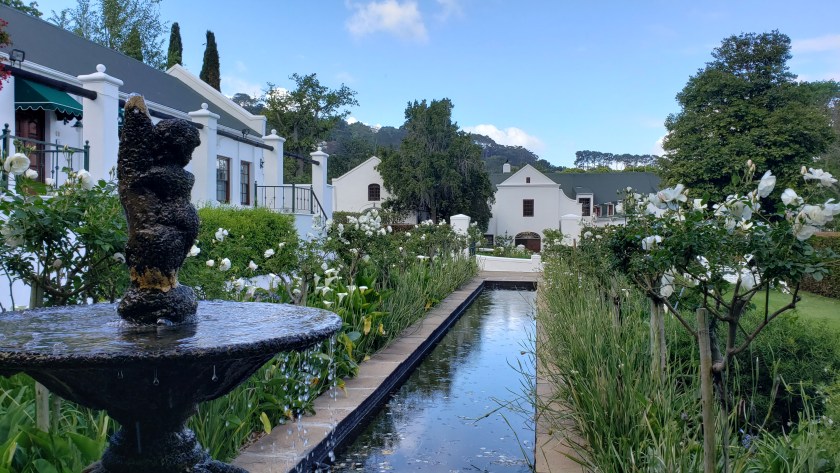
Although the room we stayed in listed online at over $700/night, our stay at The Cellars-Hohenort was completely free thanks to Hyatt credit card “annual” certificates which David had accumulated over the pandemic as Hyatt and other hotel chains extended the validity of such certificates during the worldwide shut-down. (We used my three certificates for our stay at The Marine Hermanus.) The Cellars-Hohenort is part of the Liz McGrath collection of three 5-star hotels which, along with The Marine Hermanus, had just come under the Hyatt umbrella. We couldn’t have been happier with this use of the certificates!

Magnificent camphor trees and other idyllic spots on the grounds of The Cellars-Hohenort

The Cellars-Hohenort is housed in several gleaming white, traditional-style buildings of a former winery. The hotel sits on grounds that could rival any botanical garden with flower beds, fountains, ponds, a small vineyard and a stand of immense 272-year old Camphor trees (planted in 1760). We loved exploring the grounds and ate every breakfast enjoying the view of Table Mountain.

View from our indoor breakfast table. The weather was so nice
we moved outside for our last two mornings

Due to our Hyatt status, the Cellars-Hohenort comped us our “continental breakfast,” an ample spread that went beyond the usual. This is a perk they probably weren’t obliged to offer during a free stay and really added to the value of our certificates. We ate dinner twice in their excellent restaurant, too. We charged to the room then paid at check-out with a Hyatt credit card so that we earned 9x the points for those expenses. (The bonus points did not automatically show on my statement, probably because of the affiliate-status of the Liz MacGrath hotels, but a call to Hyatt had those extra points quickly added to my account.)

More of The Cellars-Hohenort

The Cellars-Hohenort could not be more conveniently located for wine tasting in the Constantia region. We made stops at Klein Constantia, Eagles’ Nest and Constantia Glen, the furthest from our hotel being a 12-minute drive away. The wines were all good and we really loved the views from the pretty terrace dining area at Constantia Glen. Eagle’s Nest was particularly family-friendly with children playing around picnic tables scattered around a back lawn.

We spent our last full day wandering the spectacular Kirstenbosch National Botanical Garden, a mere 6-minute drive from The Cellars-Hohenort. The Kirstenbosch website justly boasts “Kirstenbosch National Botanical Garden is acclaimed as one of the great botanic gardens of the world. Few gardens can match the sheer grandeur of the setting of Kirstenbosch, against the eastern slopes of Cape Town’s Table Mountain.” I could do a post just on the garden, but enough for now. Suffice it to say, we loved it, it’s more than worth the trip, and the on-site restaurant moyo Kirstenbosch is delightful, too, especially if you can snag a table outside on a gorgeous day.

Kirstenbosch National Botanical Garden, founded in 1913

Although we felt far from the bustle of Cape Town proper, it’s only an easy <25-minute drive from The Cellars-Hohenort to the Cape Town airport. We did leave a little earlier than necessary to avoid rush hour, though, on the advice of the hotel.

An Afrikaner ostrich farm

Skeiding ostriches were as curious about us as we were about them.

I’m behind on blogging having been distracted by the holidays and then the heartbreaking last weeks with my beloved, nearly 18-year old dog, so am finishing up the end of our South Africa trip while on a transAtlantic cruise from Florida back to Europe. I’ll keep it brief, but I hated to let two favorite South African stays (and a pair of awesome Qatar Airways Qsuites flights home) go unreported.

Looking for something different after our time driving South Africa’s Garden Route, I was intrigued to find Skeiding Guest Farm, billed as a working ostrich farm. How fun!) Turning inland from the Garden Route, the drive to Skeiding took us through dramatic mountain passes into the Little Karoo, a rugged high plains area. We stopped for lunch at a funky little roadside café and gift shop called Bella de Karoo and descended back through the mountains to the ostrich farm at the end of some miles of unpaved road. (Bella de Karoo apparently has guest rooms elsewhere, but we didn’t check those out.)

The main house at Skeiding Guest Farm where meals are served.

Skeiding Guest Farm is run by a married couple, Neels and Anné-Lize, who both trace their ancestry back to the earliest Afrikaner settlers. Skeiding is a working farm on 1200 hectares (appx. 2965 acres). We were met at the main house by Neels who checked us in and showed us to our charming cottage with its big covered patio overlooking a sweeping vista. After settling on a dinner time, David and I headed out to hike the farm (a working ranch as well as a farm), accompanied by Clara, the friendly doberman.

Skeiding farm (clockwise from top): views of the Langeberg Mountains, a curious ostrich, view from the living room of our cottage, and hiking with Clara the doberman

On this first ramble, we saw lots of sheep, but no ostriches. We also marveled at the local birds, particularly the brilliant yellow and red weaver birds who flitted back and forth among their woven nests that dangle like straw Christmas ornaments from so many African trees.

Brilliantly colored weaver birds

We found the farm’s flock of ostriches on a later hike, laughing as the big-eyed creatures at first ran from us, then approached, looking for treats. Neels told us he’d greatly reduced the flock as selling meat became a money-losing business due to international restrictions following an outbreak of bird disease in Africa. He now mostly keeps the ostriches for guests and to sell their eggs to race horse breeders who use them for feed to enhance the horses’ coats and general health.

Neels at the braai and an excellent dinner

Food at Skeiding Guest Farm deserves a special mention as it was abundant and outstanding. Anné-Lize is the main cook while Neels is in charge of the indoor braai (barbecue). We opted for ostrich steaks, of course, which Neels barbecued to perfection in front of us. The rest of the meal, accompanied by local wine, was equally delicious. The next morning revealed an extensive spread of a dozen cheeses(!), picture-perfect fruit plates, and cooked-to-order scrambled ostrich eggs. More food that we needed, but we enjoyed every bit of it!

A breakfast feast

Hermanus, South Africa: coastal charm, whales and wine

Hermanus, South Africa

Six free-annual-night Hyatt certificates first put Hermanus, South Africa, on my radar screen. David and I each had accumulated lots of hotel certificates over the pandemic and we each had three Hyatt nights that we needed to use. We get one certificate/year with certain credit cards and, although they usually expire within a year, Hyatt had extended the expiration due to the pandemic. This created a great opportunity to use those certificates for an extended stay. We often use these certificates for a 2-night stay, using each of our 1-night certificates, then calling the hotel to make sure we can stay in the same room, rather than checking out and then in again as the booking switches from one of our names to the other. So, we could have lumped our nights together for a 6-night free stay somewhere, but that really didn’t suit our plans on this trip.

With travel so restricted due to the pandemic, a lot of the usual best-use locations (like Asia) were closed to us. When the idea of a trip to Africa started to come together, I searched Kenya and South Africa for interesting-looking Hyatts. As luck would have it, Hyatt had just added three new Small Luxury Hotels (SLH) to its lineup in South Africa and two of them fell under the eligibility requirements for our certificates. (The certificates are good for hotels in Hyatt Categories 1-4. The idea is to use the certificate for the poshest Category 4 available in order to maximize the value of the certificate.) I decided to use my three certificates at The Marine Hermanus. What a great find that turned out to be!

We arrived just after dark at The Marine after our day exploring the Cape Peninsula. After a quick stop at the guard post, we were let into the gated parking lot and shown to the registration desk. The welcome was very friendly and, after confirming we were hungry, we were promised a table would be waiting in the dining room as soon as we settled into our room. I had reserved a standard king room and it was charming. On the side of the building facing away from the town of Hermanus, we had a very oblique view of the water, I think. It was dark and morning would tell. Or so I thought. After a quick wash-up, I went to put our valuables into the safe and discovered it to be old and not functioning. Oh well, I wasn’t overly concerned, but did want to lock things up so mentioned it to the man at Reception on our way to dinner. Midway through an excellent meal, he arrived, apologizing again and saying he was moving us to a suite and would escort us there with our luggage as soon as we were finished with dinner. Well, that called for a toast!

The Marine Hermanus

The suite turned out to be enormous, easily three times the size of our original, comfortably-sized room. Our new digs had a king-sized bed, sofa and coffee table, small dining table and two chairs, a minifridge stocked with free beer, soft drinks and snacks under the tv, a vanity, and enough open space for a rousing game of ping-pong. The bathroom sported a huge shower, a massive tub, a toilet, and three(!) sinks. To top it all off, we had one of the few balconies in the vintage hotel, and the biggest one at that. Our balcony sat atop the covered entrance to the hotel so, straight ahead, we looked down the street towards downtown Hermanus. The bay was just to the left, but since our balcony was so big we had a table and chairs and lots of room. Once the sun was up (and rain showers cleared), we could sit outside and watch whales any time of the day! [An internet search showed this suite was running about $560/night at the time, making this stay an excellent use of my Hyatt certificates.]

It’s always fun to survey your new surroundings after arriving in the dark. Morning revealed to us a picture-perfect waterside town with a paved walk meandering along the cliffs. The weather proved to be fickle, changing quickly from sunny with scattered clouds to squalls that moved through quickly. We nevertheless set out for a walk along the cliffs to the main town pier. We spied our first whales in no time and had fun watching them until the weather drove us to shelter. We explored semi-sheltered booths of local items for sale then moved on to indoor shops as rain came down in earnest. Our first day in Hermanus continued like that with us moving in and out-of-doors as the weather dictated. Fortunately, the town is small and The Marine was in easy walking distance. Our spacious suite wasn’t a shabby retreat either!

Whale breaching just off shore by The Marine

In addition to a view of the bay and of the town, we had a view of the modestly-sized parking in front of The Marine. We were impressed to see men washing every car in the lot… and repeating the wash after every frequent shower. Unemployment is high in South Africa and perhaps as a result there seem to be many such service jobs, making us feel very pampered, if a bit uncomfortably so.

Over the three nights we spent in Hermanus, we explored the cliff walk for long stretches in both directions. The cliffs along the town front invariably offered excellent whale watching, with several whales to be seen at almost any time, some very near the land. We saw mother whales with calves, whales breaching, spyhopping and fin waving. It was magical! Wandering past the main town pier we found lots of “dassies” (large brown-furred rodents also known as rock hyraxes) grazing among whimsical sculptures. Rounding a curve in the coastline, the water became less sheltered with big waves breaking on huge rock slabs. Wildflowers and birds, including a pheasant-like Cape Francolin mama with chicks, wandered the wildflower-laden greenery that decorated the upper portion of the rugged coast.

The rugged coast of Hermanus

In addition to two excellent meals at The Marine, we had seafood with a view of the water at Lemonicious and wood-fired pizza at Embers Wood Fired Oven which also offers a surprisingly good selection of Belgian beers, thanks to input from a Belgian couple who retired from their own restaurant in Hermanus a couple of years back. They were in Embers the night we ate there, visiting with the owner, and we were delighted to find they were Antwerpers by origin with a daughter still in school there. On a sunny weekend afternoon, we ate a tasty lunch outside at Pear Tree Bistro with a view of the bay while a talented local musician played with the aid of an amplifier set up beside his van.

The Hemel-en-Aarde Valley (“Heaven and Earth”), a popular and scenic wine region, is located a short drive from Hermanus and we drove one day to a wine tasting at Ataraxia, a pretty winery with a tasting room designed to look like a chapel. We were surprised to find our choice of wineries really limited on a weekend. For some bizarre reason, many of the wineries were either closed entirely on the weekend or only open from 9 or 10am to noon. Who wants wine for breakfast?! It seemed really crazy since it would seem their main source of steady businessduring the on-and-off travel bans due to Covid-19 would be daytrippers from Cape Town, most of whom would be presumably working during the week and free on weekends. In fact, we shared a table at Ataraxia with a group of women doing a girls’ weekend away from husbands and kids. (These ladies were tons of fun and apparently had no problem with breakfast-time drinking.) They told us they thought the weird winery hours were due to the pandemic. I’m not sure how that makes sense, but there you have it.

Ataraxia Winery in the Hemel-en-Aarde Valley

All in all, we loved Hermanus. It’s not a big-event place, but a charming town to pass some days whale-and-wave watching and enjoying the local food and wine. I can’t say enough good things about The Marine or its parent group, The Liz McGrath Collection. We had to call them twice, once to ask to move our reservation at The Marine up a day and another time to advise them of a late arrival. Both times, the phone line was answered immediately by someone eager and able to help. Would that all customer service lines were like that!

Sofia, Bulgaria

Viewed from Vitosha pedestrian street: A streetcar passes in front of the Sofia Courthouse. Sofia has one of the longest tram systems in Europe, some of the cars dating back 50 years.

I added Sofia, Bulgaria, on whim to the 8-night side trip I’d planned for us before our latest house- and cat-sit in Antwerp, Belgium. It was really a matter of “as long as we’re in the area (Bucharest, Romania), why not?” I didn’t know much about either Sofia or Bulgaria before then. Pre-travel research confirmed my general impression of a less-than-wealthy Eastern European capital, still recovering from Communism and still relatively new to the EU. As of the latest census I could find, Sofia has a population of 1.2 million people as compared to Bucharest’s 1.8 million. Bulgaria is both the poorest country in the EU and the fastest shrinking population in the world.

We flew Romanian Tarom Air from Bucharest to Sofia. Arriving at 5:30am at the Bucharest airport, we found a long (albeit fast-moving) check-in line and a bustlingly busy airport. When we arrived in Sofia at around 9:40am, passengers on our flight were the only people in the baggage claim. Following online advice, we used an airport-sanctioned OK Supertrans taxi from the queue and had a friendly (non-English-speaking) driver with a working meter. It was a bargain 10 lev + 2 lev tip ($6.80 total) for the ride along a wide, straight boulevard into the center of Sofia and our AirBnB apartment.

First impressions were generally good. The wide, smooth boulevard turned to yellow glazed brick roads (Yes, the yellow brick road is real! :D) as we entered the older center of town. Boring residential architecture further out gave way to elegant and imposing public buildings with grand columns, arches, fountains and statuary. Less than a block from our apartment, a wide pedestrian street, named Vitosha after the mountain that rises above the city, bustled with people enjoying the many cafes and shops that lined it.

Facing the pretty open courtyard of a Spanish restaurant, our apartment boasted a much more appealing entrance than our lodging in Bucharest. Self check-in was a breeze using an electronic fob and keys left for us in a small safe locked to an adjacent shop gate. The one-bedroom apartment itself was spacious and modern with a remote that opened electric privacy shutters on windows and doors on two walls that opened to a patio and narrow side path. Nice!

We settled in and were back out the door by 10am our first day. Early flights have their benefits. After a quick run by the local grocery store to stock breakfast supplies, we headed back out to explore. Turning left at Vitosha, away from the pedestrian street, and putting the imposing Sofia Courthouse on our left, we walked toward the large Sofia statue, a personification of the city. Using the metro entrance to cross under the big intersection there, we popped up at the Serdika ruins which date back to ancient Roman settlers. The ruins are open-air and free and worth a look. David, more hungry than impressed with history, pushed for a lunch break so we left the ruins to settle into shady seats at upscale Largo Bar and Dinner under the high-arched portico of the adjacent Constitutional Court of Bulgaria building. An elegant lunch of grilled shrimp appetizer and a chicken pasta main course for David and seared sesame-crusted tuna salad for me along with local beers was tasty and reasonably-priced at 52.10 lev ($29.45 US).

The awnings of Largo on the left on the Constitutional Court building, plaza Nezavisimost on the right and the Sofia Concert Hall in the distance.

Happily fed, we continued on to the number one site in Sofia, the Alexander Nevsky Cathedral. The cathedral, in classic Eastern Orthodox style, was a tribute/thank-you from Bulgaria to Russia and is named after a Russian national hero. The elaborate painted interior of the cathedral with its huge dome is impressive. Entrance to the cathedral is free, but there’s a charge for photography. Two smock-clad guardians busily tut-tutted anyone snapping photos (even those waving their receipts) and scolded anyone who looked like they might even be considering wrong-doing of any sort. Since kissing and touching icons is a big part of religion in this part of the world, I had to wonder what was going on when these guards seemed to complain about people getting too close to certain items.

Alexander Nevsky Cathedral
Interior of the Alexander Nevsky Cathedral

After the cathedral, we meandered our way down boulevards and through parks on our way back to the apartment. I wanted to scope out the park meeting place for the free food tour I’d booked for the following day.

The free food tour turned out to be big fun and way more than I expected from a free tour. We ate lunch (at another health food stop for a salad to counter all that hearty Balkan food) beforehand, and I really should have skipped it. The two-hour food tour stopped at five locally-owned restaurants and shops, each of which offered us hearty tastings. The tour was so well attended that we were split into two groups. The guide for our 16-person tour was an eloquent 23-year old student named Ioan. At Supa Star, an all-soup diner, we were given cups of tarator, a traditional cold yogurt soup made with cucumbers, dill and garlic. Bulgarians are very proud of their unique and healthful yogurt and eat it and cheese in a myriad of dishes. We were surprised to descend into a pedestrian underpass on blvd Vasil Nevsky in front of the Ministry of Youth and Sports for our next stop at a shop selling national-favorite banitsa, a coiled savory pastry. The lady baker cut us generous portions of the fresh-from-the-oven pastry, filled with fresh farm cheese.

The least picturesque of our stops, but we had really tasty cheese-filled banitsa at this little shop.

We had a non-traditional bonus stop at Skaptoburger, a hamburger joint (one of a small locally-owned chain and very popular) where we each got a quarter of a hamburger. After that, it was off to Sun Moon, a well-known vegetarian restaurant and bakery where we sampled toasts spread with two classic toppings, one predominantly tomato and one eggplant. Sun Moon grows and grinds their own grains for their breads. Our final stop was at the impossibly-named Hadjidraganovite izbi, a Bulgarian tavern restaurant set in a wine cellar with traditional decor. There we were treated to a shot of a pelin, a celebratory wine-based absinthe drink, along with three types of bread-with-topping appetizers. As a final send-off, we joined hands to form a cramped ring as Ioan taught us a traditional dance.

As we walked from restaurant to restaurant, Ioan explained life in Sofia. When we came across this post-wedding gathering, he explained that the crowd was shouting “Bitter! Bitter! Bitter!” until the couple kissed to make things sweet.

I’ll save the rest of our Sofia stay, including a day trip to Rila Monastery and a cooking class in the apartment of a charming local hostess, for separate posts.

Practical info:

Find the free food tour (and other for-pay tours) on the Balkan Bites web site. Reservations aren’t necessary, but they will guarantee you a spot. This is a popular tour, so book if you know you want to go. Two late-comers were almost sent away the day we took the tour. Meet for the tour every day at 2pm by the large head statue in Crystal Garden (a/k/a Crystal Park). Although the tour is free, do tip. These guides put a lot into a full 2-hour tour.

The Alexander Nevsky Cathedral is open 7 days/week, from 7am-7pm. Entry is free. There’s a10 lev ($5.66 US) charge for photos. Find photos and a virtual tour on the cathedral web site.

For fresh salads in a casual small lunch spot, we liked Greens near Vitosha Boulevard.

Agra: Agra Fort and a homestay

Viewing the Taj Mahal from the Agra Fort

We arrived in bustling Agra in the afternoon after spending the first part of the day touring our way from Jaipur via Chand Baori and Fatehpur Sikri. Our driver threaded his way through the jumble of vehicles, pedestrians, cows and trash as we headed straight to Agra Fort. Hurrying to meet a waiting guide, we didn’t even have time to drop off our luggage.

Agra street scene

A UNESCO World Heritage site, Agra Fort was the main residence of the emperors of the Mughal Dynasty until 1638, when the capital moved to Delhi. The semi-circular fort occupies 94 acres and sits behind 70′ walls on the Yamuna River. Part of the fort is occupied by active military so tourists only see a small portion of the huge complex. From the main tourist courtyard, we could see soldiers atop the wall separating us from the military area.

Agra fort is impressive with multiple royal residences, courtyards, massive gateways and public buildings, but for us, the highlight was our surprise first glimspe of the Taj Mahal 2.5km away. What a moment! (The ladies in the top photo above are enjoying the same view.)

Agra Fort courtyard

Probably the most beautiful portion of Agra Fort is the Musamman Burj, the elaborate marble apartments of Shah Jahan, builder of the Taj Mahal. Shah Jahan spent the last years of his life under house arrest here, held prisoner by his son, Aurangzeb. The story goes that his son imprisoned him to prevent him from bankrupting the country by building a proposed black marble twin to the Taj Mahal as a burial place for himself. According to legend, Shah Jahan envisioned his black tomb sitting across from the white tomb of his beloved wife, Mumtaz Mahal. Shah Jahan lay on his death bed in the Musamman Burj gazing at the Taj Mahal.

After leaving Agra Fort, our driver drove us the short distance to Coral Court Homestay, our lodging for the next two nights. I’d read great things about this homestay, liked the idea of a family-owned homestay, and the location was ideal, within walking distance to the Taj Mahal.

The first turn onto the Coral Court’s street was less than encouraging: a dirt road, free roaming livestock. Our guide and driver seemed a little concerned when we pulled up to the locked gate. This turned out to be “Coral House Homestay,” belonging to a relative of our host, but not affiliated. The owner sent us a few doors down to Coral Court Homestay. Our guide went in and came back, much more satisfied, with someone to help with our luggage.

Despite the dirt road and cow, the Coral Court Homestay street and neighborhood turned out to be fine. (And it’s a short walk to the paved road and wide sidewalks leading to the Taj Mahal entrance.)

We were shown to a cheerful, turquoise-walled waiting area and offered refreshment while we filled out the necessary paperwork. Then, we were led through the dining room and upstairs to our room. We ended up really enjoying Coral Court Homestay. The delicious vegetarian food was made in the kitchen adjoining the dining room and served at communal tables. We made friends at dinner with two Frenchwomen from Asnières-sur-Seine and laughed when we found out we’d all stayed at the same wonderful hotel in Jaipur. (I blogged about Pearl Palace Heritage Hotel earlier and really recommend it for both amazing design and great value.) The rooms (we tried two due to availability issues when I booked) were comfortable and spotless. The walk from Coral Court Homestay to the Taj Mahal was easy and down a wide, limited-access road that kept the usual throngs of hangers-on blissfully at bay. There are several restaurants and shops along the way, too. We enjoyed good, reasonably-priced Thali lunches at two of them.

The rooftop area at Coral Court Homestay really made it for us, and we even ended up skipping a final wander before catching our evening train to Delhi, preferring to lounge on the roof and watch nearby neighborhood life. One evening, David hammed it up with kids playing in a courtyard below, one boy flexing his muscles and waiting for David to copy him before laughing and striking a new pose for David to mimic. Another group of older boys and young men were occupied shoeing large flocks of pigeons attempting to roost inside open buildings. The white domes of the Taj Mahal gleamed in the golden sunset.

Rooftop view from Coral Court Homestay in Agra

It’s funny, I’d expected to like Jaipur more than Agra, to find the former more elegant and the latter more rough-and-tumble, but I came away really liking Agra and actually preferring our time there. I’m sure a lot had to do with Coral Court Homestay and its neighborhood.

Practical info:

Agra Fort is open sunrise to sunset. The entry fee is 550INR/adult ($7.67). We found our guide to be informative and useful, but a guide isn’t necessary, especially with a guidebook, info on cell phone, etc.

At Coral Court Homestay, we paid 4718.82INR ($65.83 US) for a “King Suite” and 2799.10INR ($39.05 US)for a “Deluxe Double Room.” Both prices include goods and services tax. I booked using Booking.com through Topcashback for a rebate. (I get extra cashback if you use this link and you can get $10. As of today, I’ve gotten $833.40 from Topcashback on hotels and purchases I would have made anyway. I’ve got more ready to claim and more beyond that pending confirmation. It’s an easy and fun way to save a little cash.)

Pearl Palace Heritage Hotel in Jaipur, India

Breakfast area in Pearl Palace Heritage Hotel

I don’t often do straight-up lodging reviews and then only when there’s something really worth mentioning. Pearl Palace Heritage Hotel in Jaipur is one of those places that deserves a separate write-up. Located in a neighborhood that’s gated at night, Pearl Palace Heritage Hotel is safe, convenient, clean, comfortable and reasonably priced, but above all, it’s gorgeous. Housed in an elegant historic building, the decor is over-the-top in places, but fun and displaying impressive craftsmanship and artistry. The hotel has been named #1 Romantic Indian Hotel on Tripadvisor and a portion of The Best Exotic Marigold Hotel 2 was shot there in 2014. Photos are necessary to do this place justice, so here you go:

Our luxury king room in Pearl Palace Heritage Hotel

The walls in our bedroom were covered-to-ceiling with brightly colored paintings reflecting Hindu deities. A framed card informed us that our room was named “Patachitra” and explained that “patta” means cloth and “chitra” means picture. Patachitra is a form of Bengali narrative art dating back to 1AD and used with songs to tell Hindu stories. The art is hand-done and depicts the large-eyed style of Jamini Roy, an Indian artist of the 1930’s. The hotel owner also provided his own booklet filled with fascinating information about Jaipur, Indian culture, history and religions, etc. The bed and monogrammed linens were by far the most comfortable and luxurious we experienced in India. Air conditioning worked as expected, the room was quiet at night. The bathroom continued in the highly-adorned manner of the bedroom, but in monochromatic hand-painted tiles.

Lobby sitting area

The hallways of Pearl Palace Heritage Hotel sport graceful arches, bas-relief carvings, colorful wall paintings, carved wooden doors and decorative tile floors. Stairways are lined with historic photos.

Hallway outside our room. The floor tiles are different on each floor of the hotel.
The photos along the stairs are fascinating. (There is an elevator as well.)

Staff is friendly and helpful, too. The only negative to staying at Pearl Palace Heritage Hotel was the lack of a restaurant, but a rooftop restaurant is being built. Meanwhile, breakfast is delivered from nearby sister hotel, Pearl Palace, where we twice enjoyed a rooftop dinner. It’s a short tuk tuk ride away or a ten minute walk. The only minor downside there is the lack of a liquor license, so no wine or beer with dinner.

Front of the Pearl Palace Heritage Hotel. Scaffolding is related to building of the rooftop restaurant. The small round balconies are attached to some top-tier rooms.

Practical info:

I booked Pearl Palace Heritage Hotel on Hotels.com using the Topcashback portal for a rebate. The room I wanted was a “luxury king room” per the hotel website and cost $146.13 for three nights ($43.49/night plus $15.66 “tax recovery charges and service fees”), including breakfast, which we could choose to take in our room or in the breakfast area. More expensive rooms have small balconies and are more monochrome with carved stone predominating in the decor. They are lovely, too, but I couldn’t resist the fantastic painting that covered our room.

NOTE: Be careful not to confuse Pearl Palace Heritage Hotel with its sister hotel, Pearl Palace Hotel. The similarity in names is confusing. The other hotel is nice as well and its rooftop restaurant charming, but the decor cannot compete.

We arrived after midnight on our flight from Yangon via Bangkok and, at my request, the hotel sent a car to pick us up for 450 INR ($6.34 US). I definitely recommend this if arriving late. We ended up using the same driver, Ali, and his brother, Abès, in a tuk tuk and were very happy with the service. We used Ali’s tuk tuk once for a ride to the Pink City and once for a full day tour with Abès. Uber worked well in Jaipur (using our T-mobile included international Internet again) and we were able to use Uber to get back from the Pink City for a ridiculously cheap 35 cents or so. Simply acting like we were using our phones to call an Uber usually had tuk tuk drivers negotiating.

1910 State Hotel in Sterling City, Texas

1910 State Hotel in Sterling City, Texas

While not exactly a tourist destination, Sterling City does boast a historic little hotel and that was enough to get it on my radar screen as a half-way stop on our drive from Big Bend National Park back to the Dallas-Fort Worth area. I was looking for a hotel with character and–as nice as Hotel Settles was on the drive down–I wanted to take a different route home just to vary things up a little. When I found a list of historic Texas hotels online, I pulled up Google Maps and eyed the location of those I wasn’t familiar with. 1910 State Hotel in Sterling City seemed exactly what I was looking for.

While not as posh nor near so big as Hotel Settles, 1910 State Hotel was nonetheless intriguing. When I called for help booking (the hotel website couldn’t book as far in advance as I was looking), I found the lady, Nikki, on the other end to be super friendly and helpful. She promised to make note and book me as soon as their system would allow. I wasn’t really all that worried about it booking up, but as long as I was making plans, I didn’t want to let the final night of our trip slip my mind…and us end up in some boring chain hotel in nowhere Texas.

Nikki was good as her word and we booked a room for the end of our trip. When we arrived, we found Nikki as nice in person as she was on the phone and in email. She showed me all around the former bank/restaurant/doctor’s office. There’s a big commercial kitchen, a game-room area with fireplace, bar (not in use at the time), and game tables. Nikki showed me where to get free coffee in the morning, invited me to help myself to snacks and drinks in the kitchen (just leave payment for things in the fridge). She showed me how we could get in a keypad-equipped back door if she had to step away and lock the front door.

Our room at the 1910 State Hotel

Our room turned out to be downright huge with one large bed and two twin beds. The bathroom was large as well. I was a little worried that street noise might be a problem, but it wasn’t as traffic slowed to almost nothing at night and we slept well. The hotel is popular with people working in the surrounding oilfields and solar- and wind-farms. There’s not a whole lot in the way of restaurants, though, and we drove back to Big Spring for dinner at favorite Lumbre (a trip necessary anyway as I’d left my credit card there on the way down to Big Bend).

Everything at the 1910 State Hotel was friendly, informal and thoughtful. Nikki was a wealth of information about the area, telling me her family had ranched there for 150 years. Her 80+ year old mother still ranched and was the one who decided to buy and renovate the hotel. She gave us a final tip as we left, sending us a few minutes out of town to check out an old bridge over a low water crossing.

Wrapping up our Big Bend road trip at the State 1910 Hotel provided just the right touch of genuine, small town Texas. And a few days after we returned, I got a nice note from Nikki, thanking me for our stay. Now that’s Texan hospitality!

error: Content is protected !!